
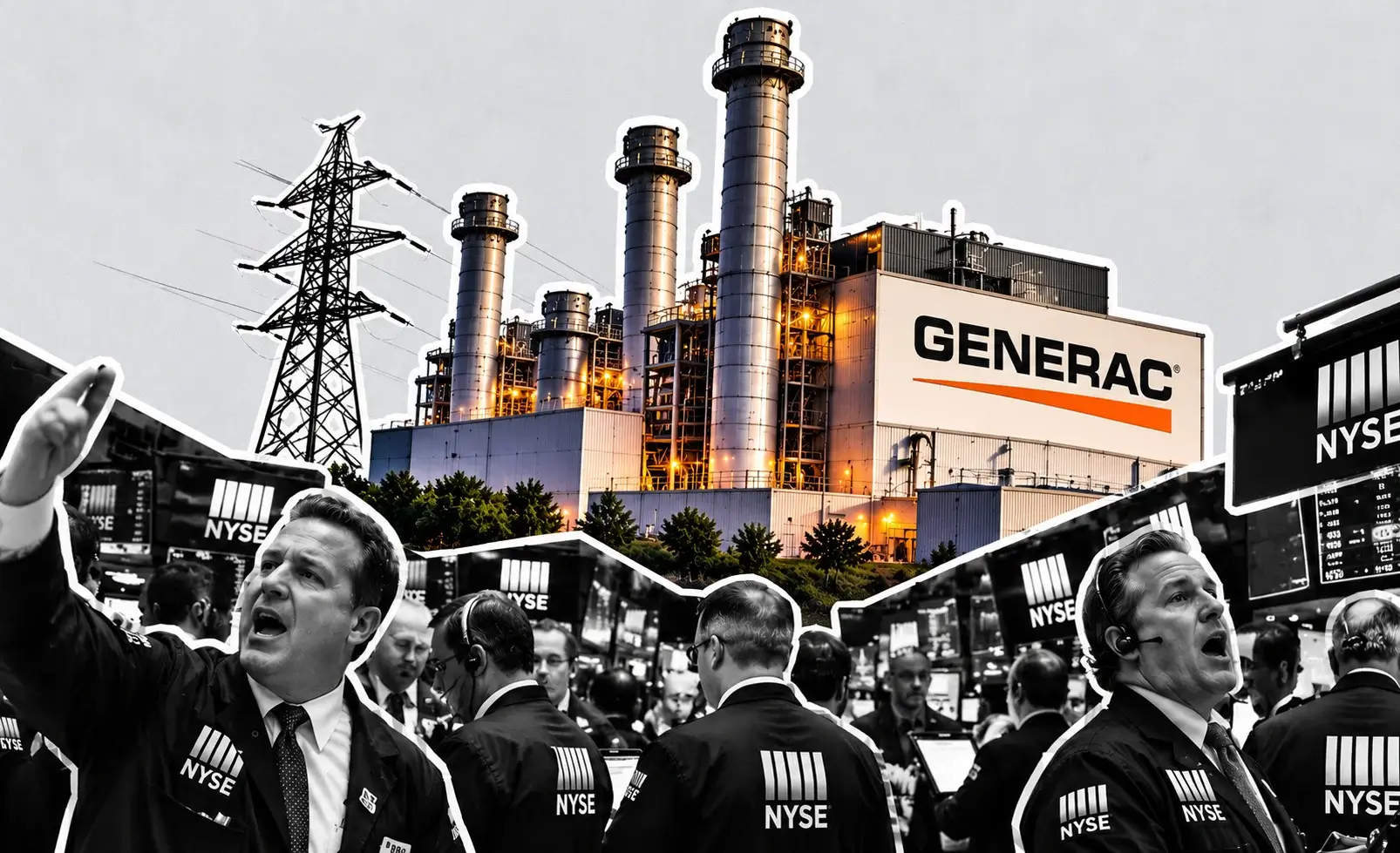
Genrac ($206) Fades 12% From $235 High as Amazon Deal Lifts Data Center Book to $4.0B — Upside Toward $296
Amazon's supply pact adds $2.4 billion of 2027–2028 deliveries and warrants on 1,693,745 shares at $200.93 | That's TradingNEWS
Key Points
- Generac trades at $206.44, up 17.9%, after hitting a $235.75 intraday high on the Amazon deal.
- Amazon's initial $2.4 billion order lifts Generac's data center order book to $4.0 billion.
- Amazon's warrants cover 1,693,745 shares at $200.93, 2.87% of the share count.
Generac Holdings (NYSE:GNRC) is trading at $206.44, up $31.33, or 17.9%, from Wednesday's close of $175.11. The session range tells the real story. Shares opened the day in a $234 to $235 indication after the Amazon announcement, printed an intraday high of $235.75, and have since sold down to a low of $205.49. The stock now sits 12.4% below its high and 0.5% above its low. A 35% gap has been cut in half within hours.
The gap itself was historic. Generac surged as much as 45% in after-hours trading Wednesday after disclosing a long-term supply agreement with Amazon for data center backup generators. By 9:48 a.m. ET on Thursday, the stock was up 27.3% at $223.23 and pacing for the best single-session gain in its history. That pace has not held. From $235.75 to $206.44, sellers have taken $29.31 per share off the top in the same session buyers delivered the record gap.
The setup before the news was ugly. On Wednesday, Generac traded at its lowest level since February 6, with a relative strength index of 28. The stock had violated support at $178.33 and was on track toward $167.56 before the announcement. Short interest had increased by nearly 30% in the most recent reporting period, with 2.66 million shares sold short, equal to 4.5% of the float. Shorts were positioned for a breakdown. They got a hyperscaler contract instead.
Market value moved with the price. Before the announcement, Generac carried a market capitalization of $10.33 billion. At $206.44, the company is worth $12.18 billion. At the $235.75 intraday high, it touched $13.91 billion. Wednesday's announcement added $3.58 billion in value at the peak, and the afternoon fade has already given back $1.73 billion of that.
The thesis for this forecast is simple. The Amazon agreement fundamentally changes Generac's revenue base, and the stock deserves a higher range than $175. The fade from $235.75 is not a rejection of the deal. It is a debate over price. The line that settles that debate is $200.93, the exercise price on Amazon's warrant. Amazon agreed to buy Generac stock at $200.93. If the market holds price above the level Amazon itself committed to, the gap holds and the path back to $235.75 stays open. A daily close below $200.93 signals the market is pricing execution risk above the contract value, and the gap starts to fill toward $178.33.
The broader tape is helping, not hurting. The S&P 500 is up 1% and the Nasdaq Composite is up 1.7%, with Amazon itself up 2%. Generac's fade is happening inside a risk-on session. That makes the $205.49 low a stock-specific test, driven by profit-taking and gap-trader exits rather than macro pressure.
The Amazon Agreement: $2.4 Billion Initial, $8 Billion Ceiling
The contract terms are concrete. Generac will supply industrial backup generators for Amazon's global data center infrastructure. Initial deliveries under the agreement are expected to total $2.4 billion across 2027 and 2028, with a total purchase target that could reach $8 billion over the life of the deal. The company identified Amazon as its second hyperscale customer.
Two details remain undisclosed, and both matter for valuation. Generac has not given the split of the $2.4 billion between 2027 and 2028, and it has not disclosed the margin profile of the Amazon agreement. A generator contract at a hyperscaler scale typically carries lower margins than Generac's residential business, because the customer has purchasing power and the product is built to specification. Without margin disclosure, the market is pricing revenue visibility, not confirmed profit.
The hyperscaler relationship did not appear overnight. During its second-quarter results on July 29, management said Generac had secured a global supply agreement with a second hyperscale customer during the quarter, and that its data center backlog of $1.6 billion did not include any committed volumes from that customer. Wednesday's announcement put a name and a number on that second customer. The market knew a deal existed. It did not know it would be Amazon and it did not know the size.
The sequencing gives the backlog a new shape. At the end of the second quarter, Generac had $1.35 billion of data center backlog scheduled for 2027, excluding the Amazon agreement. The broader data center backlog stood at $1.6 billion, including $1 billion of new orders received over the prior 90 days from new and existing customers. Adding the $2.4 billion Amazon tranche lifts the visible data center order book to $4.0 billion before any further orders.
The relationship with the first hyperscaler still stands. Management said in a recent fireside chat that its customer base is broadening beyond its first hyperscale customer. Generac now has two hyperscalers, a pipeline of non-hyperscale data center customers, and quoting activity from colocation and telecom operators. That diversification reduces concentration risk from any single buyer.
The $8 billion ceiling is the long-dated upside. Amazon's commitment to that full amount is not binding in the way a firm order is. It is a purchase target that triggers full vesting of the warrant. For the forecast, $2.4 billion is the number to model. The remaining $5.6 billion is an option on Amazon's data center buildout continuing at its current pace through the life of the contract.
The Warrant Math: 1,693,745 Shares at $200.93
The equity component ties Amazon directly to Generac's share price. Generac issued warrants to purchase up to 1,693,745 shares of common stock at $200.93 per share. The warrants, which could be worth up to $340 million at the exercise price, are held by Amazon.com NV Investment Holdings LLC, a wholly owned Amazon subsidiary. The math checks: 1,693,745 shares at $200.93 equals $340.3 million.
The vesting schedule links equity to purchases. Warrants covering 308,000 shares became exercisable on signing, 18.2% of the total. The remaining 1,385,745 shares unlock in stages tied to Amazon's generator purchase payments, with full vesting when cumulative payments reach $8 billion. The warrants run through September 16, 2033. That structure means Amazon's full equity upside depends on buying the full $8 billion of generators.
The dilution is modest. The full warrant represents nearly 3% of Generac's shares outstanding. Based on the pre-announcement market capitalization of $10.33 billion at $175.11, Generac has 59.0 million shares, so 1.69 million warrant shares equal 2.87% dilution if fully exercised. For a contract that can deliver $8 billion of revenue, 2.87% dilution is a small price. It also aligns Amazon's incentive with Generac's performance.
The strike price is the most important level on the chart. At $200.93, Amazon's warrants were priced 14.7% above Wednesday's $175.11 close. At today's $206.44, the warrants are 2.7% in the money. At the $235.75 high, they were 17.3% in the money, worth $59 million of intrinsic value on the full 1.69 million shares. At today's price, the full warrant carries $9.3 million of intrinsic value.
That strike creates a natural floor. Amazon negotiated a price at which it is willing to own Generac equity. A strike set above the pre-deal price signals that Amazon views $200.93 as reasonable value after the contract is priced in. When the stock trades above that level, the market agrees with Amazon's valuation. When it trades below, the market is saying the contract is worth less than Amazon implied. The intraday low of $205.49 is 2.3% above that line.
The warrant also explains part of the fade. Some buyers treated the $234 to $235 premarket print as the fair value of the deal. That price implied a 17% premium to Amazon's own entry point. Traders who bought the gap near $235 are now sitting on 12.4% losses, and their selling has pushed the stock toward the strike. A stabilization between $200.93 and $209.54 would show the market has found the level where contract value and execution risk balance.
Sizing the Deal Against Generac's Revenue Base
The contract is large relative to Generac. In 2025, Generac generated $4.21 billion of revenue, down 2.02% from $4.30 billion in 2024. Earnings fell 50.95% to $159.55 million. The Amazon tranche of $2.4 billion across 2027 and 2028 equals $1.2 billion per year on an even split. That is 28.5% of 2025 revenue, every year, from one customer.
The data center business is still small today. Generac recognized more than $100 million in data center revenue in the second quarter and expects nearly $450 million for the full year 2026. The Amazon deal averages $1.2 billion per year starting in 2027. That is 2.7 times the entire 2026 data center revenue base, from a single contract, before any growth from the existing $1.6 billion backlog or the first hyperscaler.
The full $8 billion ceiling reframes the company. Eight billion dollars equals 1.9 times Generac's entire 2025 revenue. If Amazon reaches that purchase target, the data center business would outgrow the residential business that made Generac a household name. The company would complete a shift from a home standby generator maker to a power infrastructure supplier for artificial intelligence.
Revenue growth forecasts already reflected some of this. Generac's revenue growth is forecast to accelerate to 17% in fiscal 2026, a significant jump from 0.61% growth over the trailing twelve months. Management maintained full-year 2026 consolidated net sales growth guidance in the mid-to-high teens percentage range. On the $4.21 billion 2025 base, 15% to 19% growth implies 2026 revenue of $4.84 billion to $5.01 billion, with 17% landing at $4.93 billion.
The 2027 math is where the deal matters most. The $1.35 billion of 2027 data center backlog, before Amazon, plus half of the Amazon tranche at $1.2 billion, gives Generac $2.55 billion of visible data center revenue for 2027 alone. That figure is 5.7 times the $450 million expected for 2026. Even if the Amazon split skews toward 2028, 2027 data center revenue would more than triple on backlog already in hand.
The residential business sets the floor. Residential external net sales were $617 million in the second quarter. Annualized, that is a $2.5 billion business, and it has been contracting slightly. The data center business is on track to match it within two years. The key forecast question is not whether Generac's revenue grows. It is how much margin that growth carries.
Q2 2026: Commercial and Industrial Carries the Quarter
The second quarter showed the shift already underway. Generac reported net sales up 11% to $1.17 billion, from $1.06 billion in the prior-year quarter, according to its second quarter 2026 results. Acquisitions, divestitures and foreign currency added a net 2 points to growth, so organic growth ran at 9%. Net income came in at $143.24 million.
The segment split is the story. Commercial and Industrial external net sales increased 29% to $556 million, from $431 million a year earlier. Residential external net sales decreased 2% to $617 million, from $631 million. The C&I segment added $125 million of revenue year over year, while residential lost $14 million. All of the company's growth came from the commercial side.
Management raised the C&I outlook. Generac lifted its 2026 C&I sales growth guidance to the low 30s percentage range, from the mid-to-high 20s. C&I growth of 30% for the full year would push that segment above $2.2 billion of annual sales on the current run rate. Chief Executive Aaron Jagdfeld said results reflected continued momentum driven by strong data center revenue as the company ramps production for large megawatt backup generators.
Earnings crushed expectations. Adjusted earnings per share came in at $2.91, against a consensus estimate of $2.00. That is a 45.5% beat. Adjusted EPS rose 76% from $1.65 in the prior-year quarter. Adjusted EBITDA reached $290.7 million, a 24.8% margin, beating estimates of $216.6 million by 34.2%.
Revenue missed slightly. Sales of $1.17 billion fell short of the $1.18 billion estimate, a miss of less than 1%. The market reaction on July 29 reflected that mix. Shares rose 1.09% to $197.74 in premarket trading, $2.14 above the prior close of $195.60. The move was restrained, as investors weighed the profit beat against the revenue shortfall and a one-time boost.
That one-time item matters. Part of the earnings beat came from a $71 million tariff refund. Without it, adjusted EPS and EBITDA would have been lower. The underlying margin expansion is still real, as the operating margin data shows, but the headline beat overstated the recurring earnings power. From July 29 to Wednesday's $175.11 close, Generac lost 10.5% from $195.60, as the market discounted the refund and worried about residential weakness.
The quarter set up Wednesday's move. Generac told investors a second hyperscaler existed, raised C&I guidance and showed data center revenue crossing $100 million per quarter. The stock still fell to its lowest level since February by September 16. The Amazon name and the $2.4 billion figure forced the market to reprice information it had partially received seven weeks earlier.
Margins, the Tariff Refund and Full-Year Guidance
Margin expansion is the most bullish data point in the quarter. Gross profit margin reached 44.5%, compared with 39.3% a year earlier, an expansion of 520 basis points. Operating margin rose to 17.9%, from 10.5%, an expansion of 740 basis points. Adjusted EBITDA margin expanded by 710 basis points to 24.8%. Those moves reflect pricing, product mix and cost discipline, not only the tariff refund.
Management cited specific drivers. Favorable price-cost dynamics and operational efficiencies, particularly in the residential segment, supported margins. Home standby generator sales returned to growth even as overall residential sales declined, helped by increased in-home consultations and adoption of next-generation products. The residential business is shrinking at the top line but improving its profitability.
Full-year EBITDA guidance moved higher. Generac now expects adjusted EBITDA margin of 20.0% to 21.0% for 2026, including a 1.5-point impact from tariff refunds, up from the prior range of 18.5% to 19.5%. Stripping out the refund, underlying guidance is 18.5% to 19.5%, the same as before. The raise was entirely the refund. That is the detail bears have used to argue the quarter was less impressive than headlines suggested.
The Amazon deal changes the margin question. Data center generators are large-megawatt units built for hyperscale buyers. Those customers negotiate hard on price, and the product competes with established industrial engine makers. If the Amazon contract carries margins below the 24.8% Q2 EBITDA level, a larger data center mix could pull consolidated margins down even as revenue surges. Generac has not disclosed the margin profile, which is the largest open variable in any 2027 earnings model.
Cash generation supports the balance sheet. Generac expects free cash flow of $350 million for 2026. On the 2026 revenue midpoint of $4.93 billion, that is a 7.1% free cash flow margin. The company can fund capacity expansion from internal cash rather than equity, which reinforces why the Amazon warrant, not a share sale, is the only dilution on the table.
The earnings base for valuation is uneven. Earnings of $159.55 million in 2025 were depressed, down 50.95% from 2024. Second-quarter net income of $143.24 million nearly matched all of 2025's earnings in a single quarter, helped by the $71 million refund. Annualizing a refund-adjusted quarter overstates earnings. Using 2025 earnings understates them. The honest earnings base for Generac sits between those two numbers, which is why free cash flow is the cleaner valuation anchor.
Residential Business: The Legacy Engine Under Pressure
Residential remains Generac's largest segment. External net sales of $617 million in the second quarter made up 52.6% of total sales. Home standby generators, portable generators, energy storage and smart home products make up the segment, sold through big-box retailers, dealers and direct channels. Generac's residential generators are fixtures in home improvement stores across the United States, and the brand built its $10 billion valuation on that business.
The segment is contracting. Residential sales fell 2% year over year, from $631 million to $617 million. Home standby generator sales returned to growth, so the drag came from other products, including clean energy lines. Investors have long worried about how dependent Generac remains on major outage activity and evolving clean energy economics. A quiet hurricane season or a mild winter cuts home standby demand.
Higher interest rates add pressure. The Federal Reserve raised rates 25 basis points to 3.75% to 4.00% on Wednesday and signaled another hike this year. A home standby generator is a large discretionary purchase, often financed. Rising borrowing costs and a housing sector under strain weigh on demand. August housing starts fell 2.6% to a 1.275 million annual rate, below the 1.309 million forecast, and builder sentiment dropped to a 12-month low of 32 in September.
The consumer is still spending. August retail sales rose 1.2%, beating the 0.7% forecast, and control-group sales jumped 1.4%, the fastest pace since September 2024. That supports residential demand even as housing weakens. The segment's problem is less about consumer health and more about a lack of weather-driven outage catalysts and slower clean energy adoption.
Diesel costs cut both ways. The national average diesel price hit a record $6.3103 per gallon on Wednesday, up 70.5% from $3.7008 a year ago. Generac sells both natural gas and diesel generators, and many large-megawatt data center units run on diesel. High fuel prices raise operating costs for generator owners. They can also increase interest in natural gas residential units and in backup systems as grid reliability concerns grow. Investors have flagged the company's diesel exposure as a risk factor.
The segment's role in the forecast is stability, not growth. Residential provides cash flow to fund data center capacity expansion. If it holds flat at $2.5 billion annualized while C&I grows 30%, the business mix shifts toward C&I in 2027. A sharp residential decline would slow that funding and strain the capacity plan. For the stock, the residential segment sets the downside floor and the data center segment sets the upside.
Capacity, Capex and Execution Risk
Generac's biggest challenge is building enough generators. Management said it is investing aggressively in incremental production and packaging capacity for large megawatt generators and plans to add further capacity as its pipeline of opportunities materializes. The company has a path to triple production capacity from its prior year-end 2026 target of $1.25 billion, focused on generator assembly and packaging.
Tripling the $1.25 billion target puts annual data center capacity at $3.75 billion. That number matters for the Amazon contract. With $2.55 billion of data center revenue visible for 2027 from existing backlog plus half the Amazon tranche, Generac would need 68% of that tripled capacity running in 2027 alone. Any further hyperscaler orders would push utilization toward the limit.
Capital spending is rising to match. Generac lifted capex guidance to 4.5% of sales, $50 million more than its prior plan. On the $4.93 billion revenue midpoint, 4.5% equals $222 million of capital spending in 2026. With $350 million of expected free cash flow after that spend, the company is funding expansion internally. Further capacity additions for the Amazon ramp could push 2027 capex higher.
Execution risk is the market's main concern, and the fade reflects it. The key swing factor for Generac is whether it can turn its data center backlog into profitable, on-time deliveries without overbuilding. Large-megawatt generator production involves engines, alternators, enclosures and switchgear. Supply chain delays at any stage push deliveries into later quarters. Thursday's market provided a live example: battery storage company Fluence Energy fell 17% to 22% after cutting guidance because of delays ramping capacity at a Houston contract manufacturing facility.
Overbuilding is the second risk. If Generac triples capacity and AI data center spending slows, fixed costs would weigh on margins. Concerns about AI pacing hit the sector hard on Monday, when Vertiv fell 7.8% intraday on fears that artificial intelligence had advanced too far, too fast. Hyperscaler capex can change quickly, and Generac is committing capital against a multi-year contract with a purchase target, not a firm $8 billion order.
The mitigating factor is visibility. A $2.4 billion initial tranche with defined delivery years reduces the risk that capacity sits idle in 2027 and 2028. The warrant structure gives Amazon a financial incentive to keep buying toward $8 billion. Execution risk is real, but Generac is now building against a named customer with an equity stake, not speculative demand.
Valuation After the Gap
At $206.44, Generac trades at a $12.18 billion market capitalization. Against 2026 revenue guidance of $4.84 billion to $5.01 billion, that is 2.4 to 2.5 times sales. Against $350 million of expected free cash flow, it is 34.8 times free cash flow, a 2.9% free cash flow yield. Against 2025 earnings of $159.55 million, the multiple is 76 times, but that earnings base was depressed and does not reflect the current margin structure.
The price-to-sales multiple is the most useful anchor for a company in transition. At 2.5 times 2026 sales, the market is paying a modest premium to a traditional industrial manufacturer, not an AI infrastructure multiple. If 2027 revenue reaches $6.0 billion on the back of $2.55 billion of visible data center revenue plus a stable residential base, today's market capitalization is 2.0 times 2027 sales. That multiple compression is the bull case for the stock.
The 52-week range shows how far the stock has fallen. As of late July, Generac carried a 52-week low of $134.80 and a high of $296.44. Today's $206.44 price sits 30.4% below that high and 53.1% above the low. The stock once traded 43.6% higher than today, before the Amazon deal existed. The market has valued Generac far above current levels with less data center visibility than it has now.
Year-to-date performance remains strong. At $223.23, Generac was up 63.4% for the year. At $206.44, the year-to-date gain is 51.1%. Even after the fade, the stock is one of the stronger industrial performers of 2026. The question is whether it reclaims its July levels, when it traded at $195.60 before earnings, and moves back toward $296.44.
The warrant sets the valuation floor. Amazon's $200.93 strike, negotiated alongside the contract, puts Generac at an $11.86 billion market capitalization. That is 2.4 times the midpoint of 2026 revenue guidance. A hyperscaler agreed to buy equity at that valuation with full knowledge of the contract economics. The market should be reluctant to price the stock below the level at which its largest new customer committed capital.
The valuation risk is margin. If the Amazon contract carries EBITDA margins in the mid-teens instead of the 24.8% Q2 level, 2027 earnings growth will lag revenue growth. At 34.8 times free cash flow, the stock already prices meaningful growth. The gap to $235.75 priced a high-margin outcome. The fade to $206.44 prices a more cautious one. Disclosure of contract margins, likely with third-quarter results, will move the multiple.
Competition: The Data Center Power Arms Race
Generac is entering a crowded market. Large-megawatt backup generators for data centers have long been supplied by established industrial engine makers, including Cummins and Caterpillar, alongside specialized power equipment suppliers. Generac's residential dominance does not translate automatically into hyperscale share. The Amazon contract is validation that it can compete at the high end.
Scale is the competitive gap. Vertiv, the data center power and cooling supplier, entered its July 29 earnings report with a $15 billion backlog. Generac's data center backlog of $1.6 billion before Amazon was 10.7% of Vertiv's. With the Amazon tranche, Generac's $4.0 billion visible data center order book reaches 26.7% of Vertiv's July backlog. Generac is still a smaller player, but it closed a large part of the gap in one announcement.
The broader power trade shows where investor money is flowing. GE Vernova rose 4.79% to $925.09 on Wednesday, extending the market's bet on turbines and grid equipment for AI data centers. Vicor jumped 12% on Thursday after granting a non-exclusive Vertical Power Delivery license to a new equipment manufacturer. Nebius rose more than 9% in premarket trading after raising GPU cloud prices by 17% to 21%, a sign that compute demand still outpaces supply.
Backup power is a distinct slice of that trade. Turbines and grid equipment deliver primary power. Generac's generators provide redundancy when the grid fails. Hyperscalers cannot run AI clusters without that redundancy, and every megawatt of new compute capacity requires backup capacity alongside it. That makes Generac's addressable market scale directly with data center construction, independent of whether power comes from utilities, turbines or on-site generation.
The competitive threat is pricing. When hyperscalers diversify suppliers, they gain negotiating leverage. Amazon adding Generac as a supplier increases competition among established generator makers for Amazon's volume. That dynamic helps Amazon's cost structure and pressures supplier margins. The equity warrant may have been part of the price Generac paid to win the contract against more established rivals.
Generac's advantage is capacity willingness. Established engine makers balance data center demand against mining, marine, rail and power generation customers. Generac is committing capital specifically to large-megawatt data center generators and plans to triple capacity. A supplier willing to dedicate capacity to a hyperscaler's timeline can win share even without the longest track record. The Amazon deal suggests that strategy is working.
Macro Backdrop: Fed Hike, Yields and the AI Capex Cycle
The macro environment shifted this week. The Federal Reserve raised its benchmark rate by 25 basis points to 3.75% to 4.00% on Wednesday, its first hike since July 2023. Sixteen of 18 officials projected at least one more increase this year, and markets price 75 basis points of additional tightening by next June. Higher rates raise the discount rate on long-dated earnings, which pressures growth multiples.
Generac's fade coincided with a mixed rate signal. The 10-year Treasury yield hit 5.04% earlier this week, its highest since 2007, before falling to 4.94% on Thursday as oil prices dropped. Lower yields support industrial and technology stocks, and the Nasdaq is up 1.7% today. Generac's decline from $235.75 to $206.44 is happening against that supportive backdrop, which points to position-driven selling rather than macro pressure.
AI capital spending is the dominant equity theme. OpenAI is in talks with investors on a funding round that would value it above $1.2 trillion, up from $852 billion in March. Hyperscalers continue to expand data center infrastructure, and the supply chain for power equipment is tight. Generac's contract with Amazon is a direct beneficiary of that capex cycle. Any sign of slowing AI investment would hit the stock harder now than before the deal, because more of its valuation depends on data center growth.
Energy prices are a direct input. Record diesel prices of $6.3103 per gallon pressure the operating economics of diesel generators, while Saudi Arabia's efforts to restore its East-West pipeline pushed WTI crude down to $95.50 on Thursday. Lower oil helps Generac's customers and eases input costs for manufacturing. A reversal in energy prices would raise both costs and inflation, which could force further Fed tightening.
The industrial sector is splitting on fuel costs. J.B. Hunt fell 13.3% on Wednesday after warning that record diesel prices would drive a 5% to 10% sequential earnings decline. Generac sits on the other side of that split. Energy scarcity and grid reliability concerns make backup power more valuable to data center operators, even as the same energy costs crush freight margins.
Friday's calendar can move the stock. The Bank of Japan decision arrives overnight, then Fed Governor Michelle Bowman at 9:30 a.m. ET and Kansas City Fed President Jeffrey Schmid at 11:45 a.m. ET. Hawkish Fed commentary would push yields higher and weigh on growth stocks. For Generac, the bigger near-term driver is whether gap traders finish selling and longer-term holders step in near $200.93.
Read More
-
Yen Stalls at 160 Despite a 3% JGB and Tokyo Core CPI at 2.0% — Intervention Sits at 164, Friday's Payrolls Decide
02.09.2026 · TradingNEWS ArchiveEnergy
-
OKLO ($37) Trades at 2.35x Cash After $1B Share Sale Hit — Upside Toward $43.99 September High
17.09.2026 · TradingNEWS ArchiveStocks
-
XRP-USD ($1.2983) Defends $1.256 100-Day EMA as ETFs Hold 1.07B XRP — Upside Toward $1.40 Range Top
17.09.2026 · TradingNEWS ArchiveCrypto
-
WTI ($100) Drops 5% From $105 High as Hormuz Transfers Hit 2.7M bpd — Downside Toward Brent $95.63
17.09.2026 · TradingNEWS ArchiveCommodities
-
Nasdaq Rips 1.7%, S&P 500 Adds 1%, Dow Climbs 268 After Fed Hike; Fluence FLNC Plunges 22%
17.09.2026 · TradingNEWS ArchiveMarkets
-
GBP/USD (1.3381) Loses Rate Edge as Fed Hike Puts Bank Rate 12.5 bps Below — Downside Toward 1.33
17.09.2026 · TradingNEWS ArchiveForex
Technical Map: Gap Support, Resistance and the Short Squeeze
The gap created a new chart. Before Wednesday, Generac had broken support at $178.33 and was heading toward $167.56. That bearish setup is invalidated by the announcement. The prior resistance zone at $205.71 to $209.54 was cleared in the post-news move and now forms part of the gap-support region. Today's low of $205.49 sits 22 cents below the bottom of that zone.
The support stack is tight. The first level is $205.49, today's intraday low. The second is the $205.71 to $209.54 former resistance band, which the stock is testing now. The third is $200.93, Amazon's warrant strike and the psychological $200 line. From today's $206.44, $200.93 is a 2.7% decline. A daily close below $200.93 would signal that the gap is failing.
Below $200.93, the gap begins to fill. The next support is $195.60, the pre-earnings close on July 28, a 5.3% decline from today. Below that sits $178.33, the prior support that broke before the announcement, a 13.6% decline. A full gap fill to Wednesday's $175.11 close would erase the entire deal-driven move and would be a 15.2% decline from today's price.
Resistance begins at the session high. The first level is $223.23, the price at 9:48 a.m. ET when the stock was pacing for its best day on record, an 8.1% gain from today. The second is $235.75, the intraday high, a 14.2% gain. Clearing $235.75 would confirm that the fade was a shakeout and would open a move toward the prior 52-week high of $296.44, a 43.6% gain.
Short interest adds fuel to any rebound. The 2.66 million shares sold short equal 4.5% of the float, and short interest rose nearly 30% in the most recent period. Shorts who sold near $175 are now down 17.9% at today's price. If the stock stabilizes above $200.93 and resumes higher, covering by those shorts could accelerate a move back toward $223.23.
Momentum reset sharply. On Wednesday, Generac traded with an RSI of 28, deeply oversold. A 35% gap in one session pushed momentum from oversold to overbought. The afternoon fade is working off that condition. A stock that moves from an RSI of 28 to a $235.75 high and then consolidates above its warrant strike builds a stronger base than one that holds the highs without a pullback. The consolidation zone to watch is $200.93 to $223.23.
Generac Stock Price Forecast Verdict: Bullish Above $200.93, $235.75 Target
Generac enters the close at $206.44, up 17.9% from $175.11, after gapping to an intraday high of $235.75 and fading to a low of $205.49. The Amazon agreement delivers $2.4 billion of initial deliveries across 2027 and 2028 and a purchase target of up to $8 billion. Amazon holds warrants on 1,693,745 shares at $200.93, 2.87% of the share count, with 308,000 exercisable immediately. The contract lifts Generac's visible data center order book from $1.6 billion to $4.0 billion.
The fundamental case is strong. Second-quarter sales rose 11% to $1.17 billion, C&I sales jumped 29% to $556 million, gross margin expanded 520 basis points to 44.5%, and adjusted EPS of $2.91 beat estimates by 45.5%. Management raised C&I growth guidance to the low 30s, expects $450 million of data center revenue in 2026, and plans to triple capacity from its $1.25 billion target. Visible 2027 data center revenue reaches $2.55 billion on backlog plus half the Amazon tranche, 5.7 times the 2026 figure.
The risks are real. The Amazon contract's margins and delivery split are undisclosed. Part of the Q2 earnings beat came from a $71 million tariff refund, and underlying EBITDA margin guidance was unchanged at 18.5% to 19.5% excluding the refund. Residential sales fell 2%. Capacity expansion carries execution risk, and at 34.8 times free cash flow, the stock prices meaningful growth. The fade from $235.75 shows the market will not pay any price for the deal.
The forecast is bullish with a defined line. The stock holds the $205.71 to $209.54 gap-support zone and trades 2.7% above Amazon's $200.93 warrant strike. First resistance is $223.23, then the $235.75 intraday high, with the $296.44 52-week high as the extended target. Support sits at $205.49, $200.93, $195.60 and $178.33. A daily close below $200.93 invalidates the bullish bias and opens a gap fill toward $178.33 and $175.11.
The trigger for the upside is margin disclosure and hold of the strike. A daily close above $209.54 confirms the gap holds and puts $235.75 back in play. A third-quarter update showing data center margins near consolidated EBITDA levels would support a move toward $296.44.
Verdict: bullish bias above $200.93, targeting $223.23 near term and $235.75 on a confirmed hold of gap support, with the forecast invalidated on a daily close below $200.93.