Gold Price Forecast: XAU/USD Slides From $5,600 to $4,700 After Fed and Inflation Shock
Record gold rally snaps as hot PPI, Warsh’s Fed pick and a stronger USD spark a violent crash from all-time highs, even as central banks keep buying and XAU/USD stabilizes around the $5,000 zone | That's TradingNEWS
Gold Price Forecast – XAU/USD After A Historic Spike And Crash
Gold Price – XAU/USD From Relentless Rally To Violent Repricing
Gold in XAU/USD terms has just moved through a classic blow-off and crash at record levels. After roughly doubling in 2025, spot gold pushed past $5,000 per ounce for the first time and briefly traded in the $5,400–$5,600 area. Futures then reversed brutally, with the most active contract collapsing to about $4,700 intraday and closing near $4,745, a daily loss of roughly 11–12% or about $600 per ounce. Spot has since oscillated around the $5,000–$5,050 band.
Silver behaved as leveraged beta on the move. After trading well above $110–$120 per ounce, it fell into the $74–$100 zone, posting one-day drawdowns in the 28–36% range – the largest recorded in modern data. Palladium slid around 15% toward $1,700, and platinum dropped roughly 17% toward $2,180.
Even after this reset, XAU/USD remains dramatically above levels seen barely a year ago, when prices were still south of $3,000. The message is clear: this is not a normal correction inside a calm range; it’s a repricing of an overheated move at historically elevated territory.
Macro Shock: Warsh, Hot PPI And A Stronger Dollar Hit Gold
The turning point for XAU/USD was a cluster of macro shocks that simultaneously lifted real yields and the dollar. December Producer Price Index data came in materially hotter than consensus: headline PPI rose about 0.5% month-on-month (roughly 3.0% year-on-year), while core PPI climbed to around 3.3% from 2.9%, the highest since mid-2025. The stickiest subset of PPI – services ex-volatile components – advanced roughly 0.4% again, the eighth straight month at that pace, taking the annual rate to about 3.5%.
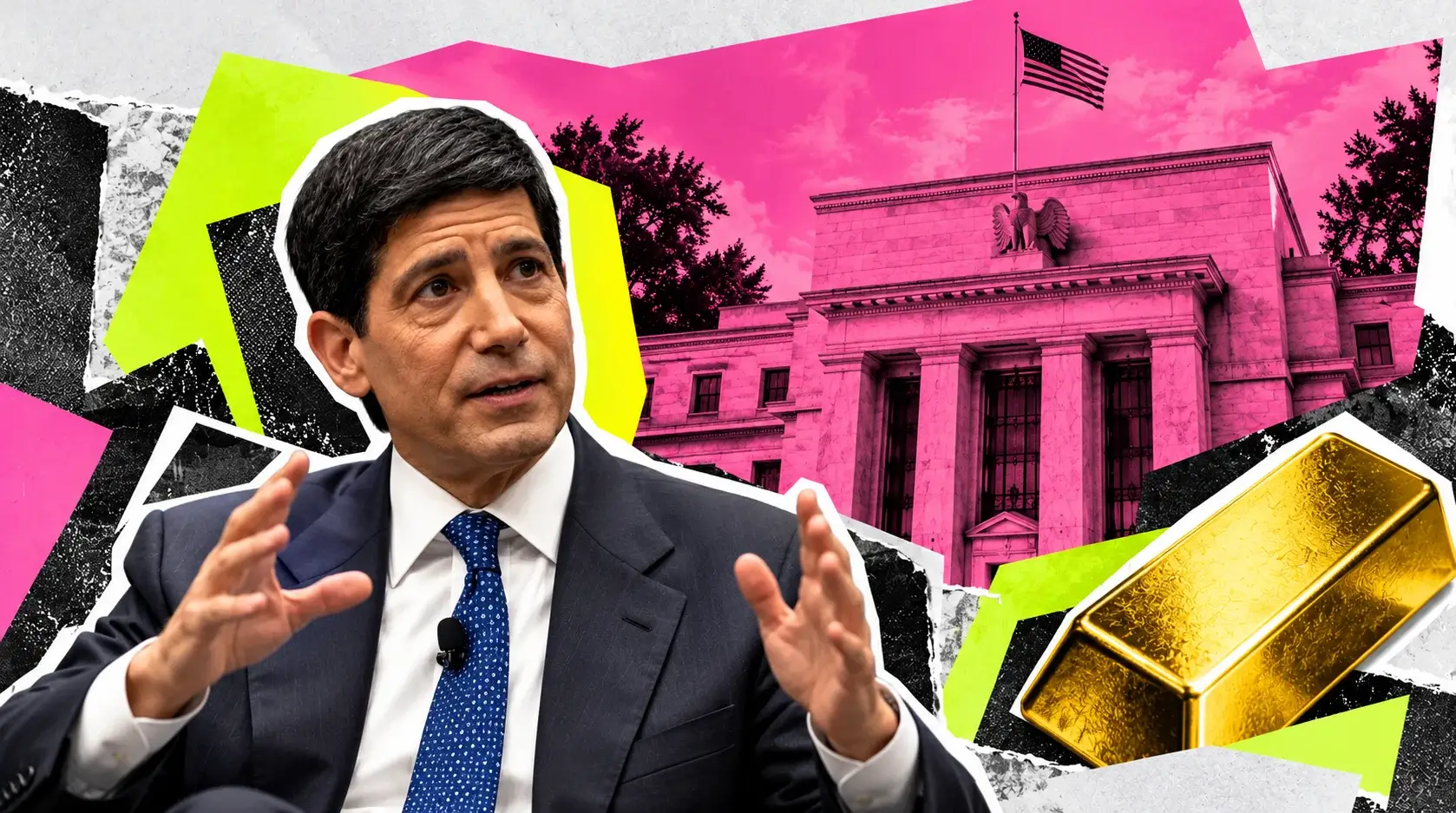
At the same time, markets digested the nomination of Kevin Warsh as the next Federal Reserve Chair. Warsh has consistently argued against prolonged ultra-easy policy and large balance-sheet expansions. That profile forced traders to rethink the entire 2026 rate path: Fed funds futures now price roughly 50–55 basis points of total cuts for the year, starting around June, instead of the earlier narrative of multiple early and aggressive cuts.
Real yields on 10-year inflation-linked Treasuries sit close to 1.9%, far above the sub-1% regime that supported prior gold bull runs. The US Dollar Index has pushed into the mid-90s, recovering roughly 0.7–0.8 points in a single day around the PPI release and hovering around 96–97. For gold, this combination is toxic in the short term: the non-yielding asset suddenly competes against higher real returns in dollars, and global buyers face a stronger base currency.
Gold Price – XAU/USD As A Gauge Of Monetary Credibility, Not Just Inflation
The current gold cycle is not just a direct reaction to short-term inflation spikes or one-off shocks. Over the last three decades, periods of high confidence in monetary frameworks – steady growth, moderate inflation, predictable policy in the early 1990s and 2000s – coincided with long stretches of flat or subdued gold prices.
What has changed is confidence in long-term monetary discipline. Markets now question whether major governments and central banks can sustainably control inflation, public debt and currency value over the coming decade while absorbing repeated fiscal and geopolitical shocks. That doubt pushes XAU/USD higher even as headline inflation in several large economies has cooled from recent peaks.
This is why gold has stayed elevated despite some easing in consumer price measures. The metal is discounting a regime where the “rules of money” – debt dynamics, balance-sheet size, political pressure on central banks – are less trusted, even if the next quarterly inflation print looks tame.
Structural Demand For Gold – XAU/USD Underpinned By Central Banks And ETFs
Beneath the crash, XAU/USD still rests on powerful structural flows. Total global gold demand in 2025 exceeded 5,000 metric tons for the first time once over-the-counter activity is included. Investment demand was the primary driver:
ETF holdings added roughly 801 tons, while bar-and-coin purchases climbed to around 1,375 tons, the highest level in about 12 years. Central banks bought on the order of 860–950 tons, below the immediate post-pandemic peaks but still extremely elevated versus historical norms.
Policy makers are sending a clear signal. One European country has lifted its gold reserve target from about 550 tons to 700 tons, explicitly prioritizing bullion over marginal dollars at the margin. In China, physical demand has remained resilient despite record prices, supported by seasonal flows and retail confidence.
At the private-sector level, even large digital-asset players have started to accumulate gold as a reserve, with individual corporate holdings now comparable to those of smaller nation states. That means XAU/USD is no longer driven purely by Western ETF flows; it is anchored by a broad base of official and institutional demand that is less sensitive to short-term price swings.
Gold Price – XAU/USD As The Anti-Dollar Hedge In A Politicized World
The political backdrop has reinforced gold’s role as the clean anti-dollar hedge. Repeated tariff rounds from Washington, including aggressive levies on multiple European economies and trade friction tied to strategic territories, have strained global trust in the stability of US-centric trade architecture.
The seizure of foreign leaders and the escalation of sanctions regimes have highlighted the risk of reserve confiscation for countries and blocs that may fall out of political favor. Wars in Eastern Europe and the Middle East, periodic shutdown episodes in the US government, and deteriorating fiscal arithmetic all feed into one trade: reduce exposure to unilateral dollar risk and increase allocation to gold.
The price performance reflects this rebalancing. Over the past year, gold has gained roughly 80%, while silver is more than 200% higher at recent peaks. Over the same horizon the dollar index is around 10% lower than a year earlier at points, showing how the metal has served as a mirror trade against perceived currency and policy risk rather than just a simple inflation hedge.
Read More
-
Yen Stalls at 160 Despite a 3% JGB and Tokyo Core CPI at 2.0% — Intervention Sits at 164, Friday's Payrolls Decide
02.09.2026 · TradingNEWS ArchiveEnergy
-
AMD ($560.68) Rebounds 10% From Its October Low on the Meta Helios Win — November 3 Report Holds the Key to $649
27.10.2026 · TradingNEWS ArchiveStocks
-
Ethereum ($2,312) Lags Bitcoin and AI Stocks as BitMine Nears Its 5% Cap — Break of $2,295 Opens $2,200
27.10.2026 · TradingNEWS ArchiveCrypto
-
Brent ($113.88) Trades a $2.35 Range as Houthi Strikes Meet Saudi-Iran Diplomacy — Break of $117 Unlocks $120
27.10.2026 · TradingNEWS ArchiveCommodities
-
Nasdaq Rips 1.3%, S&P 500 Hits 7,728, Dow Stalls as BA Drops to $171
27.10.2026 · TradingNEWS ArchiveMarkets
-
GBP/USD (1.3310) Can’t Cash In on 5.43% Gilt Yields as Budget Risk Meets a Firm Dollar — Break of 1.3274 Opens 1.3200
27.10.2026 · TradingNEWS ArchiveForex
Positioning, Leverage And Volatility: Why Gold Crashed So Hard
The magnitude of the XAU/USD crash is best explained by how crowded and leveraged the trade had become. Technical indicators had been flashing bright red: the relative-strength index on key gold contracts pushed toward 90, an extreme overbought reading rarely seen outside of late-1970s-style manias. The silver/gold ratio had climbed almost as far as in that historical blow-off, suggesting speculative excess in the high-beta metal.
Options markets amplified the move. A record wave of upside call buying effectively forced market-makers to chase prices higher, reinforcing a reflexive “parabolic” structure on the way up. Once the Warsh nomination and hot PPI print hit, that reflex flipped.
Volatility gauges exploded. A key gold ETF volatility index surged toward the high-40s, levels last seen during the 2020 pandemic shock, while silver-linked volatility measures spiked above 120, their highest readings since inception. As prices rolled over, leveraged futures and options positions were liquidated en masse, forcing traders to dump gold into a falling market.
In that context, an 11–12% drop in XAU/USD and a 30-plus percent fall in silver in a single session are the mechanical outcome of one fact: positioning had moved too far, too fast relative to the underlying macro trend.
UBS Gold Price Targets – XAU/USD Scenario Grid For 2026
Institutional forecasts have adjusted upward even after the crash. One major investment bank now projects gold at about $6,200 per ounce for March, June and September 2026, up from a previous $5,000 target, with a modest pullback toward around $5,900 by year-end after the US midterm elections.
Their scenario bands for XAU/USD are wide:
An upside case pushes gold toward roughly $7,200 if geopolitical stress escalates or confidence in long-term monetary discipline erodes further. A downside case assumes a meaningfully more hawkish Fed and stronger real yields, dragging gold toward about $4,600 if markets fully reprice to a higher-for-longer regime.
With spot stabilizing around $5,000–$5,050, upside to the base case sits near +20–25%, while downside to the stress floor is closer to −8–10%. The skew is still favorable, but not as asymmetrically bullish as when XAU/USD traded near $2,000–$2,500.
Official Buying As The Closest Thing To “Insider Flow” In Gold – XAU/USD
There is no traditional insider trading in gold, but official sector behavior is the closest proxy for informed structural positioning. Central banks see the system from the inside: they understand sovereign risk, debt dynamics, sanction tools and the political constraints on monetary policy.
The fact that central banks collectively added around 860–950 tons of gold in a single year, even as prices broke to new highs, is crucial. These institutions are not momentum-chasing hedge funds; they are re-engineering their reserve mix. When a country raises its gold objective from 550 to 700 tons, it is signaling that even at $4,500–$5,000+, XAU/USD is an acceptable entry level for long-term insurance against currency and policy risk.
For private investors and institutions, that official-sector accumulation is the functional equivalent of insiders buying, not selling, into strength. It strengthens the floor under the market, even if speculative positions wash out.
Rates, Real Yields And Three Macro Paths For XAU/USD
The next leg for gold depends on how the rate path evolves from here. A useful framework is three macro paths and what they imply for XAU/USD:
In a base case, the hot PPI print feeds into personal consumption inflation but not in a runaway fashion. Core inflation tracks around 0.3–0.4% month-on-month in coming data, with annual rates near 3%. The Fed delivers roughly 50 basis points of cuts starting mid-year, keeping real yields elevated but not rising sharply. In that environment, gold likely trades choppily in a wide $4,600–$5,800 band, with rallies capped by real-yield headwinds but supported by ongoing political and structural demand.
In a hawkish case, services inflation proves stickier than expected, core prints stay at the upper end of the range or higher, and the Fed can justify only 0–25 basis points of total cuts, or potentially none. Real yields push higher, the dollar index moves above current levels, and the opportunity cost of holding XAU/USD rises. Under that path, tests of the $4,600–$4,800 downside zone are plausible, and volatility spikes could drive brief undershoots toward the lower $4,000s.
In a dovish case, disinflation resumes and growth momentum cracks. Core inflation slips back toward roughly 0.2% month-on-month, labor data softens, and the Fed can move 3–5 times (around 75–125 basis points) over the next year. Real yields fall, the dollar weakens, and risk appetite broadens. That environment would justify a fresh leg higher in XAU/USD, with sustained trades above $6,200 and optionality toward the $7,000+ zone if geopolitical or fiscal shocks are layered on top.
Gold Price Forecast – XAU/USD Range, Bias And Price Target
Taking all of this together – the structural central-bank and ETF demand, the political anti-dollar bid, the recent parabolic overshoot, and the repricing of rates – the risk-reward profile for XAU/USD is no longer extreme in either direction but still leans positive over a 12-month horizon.
A reasonable working range for the next year is $4,600–$6,500 per ounce, with the most probable trading cluster between roughly $4,800 and $5,800 as markets digest the Warsh nomination, incoming inflation data and the pace of Fed cuts.
On balance, the structural drivers – reserve diversification, doubts about long-term monetary discipline, geopolitical fragmentation – argue that gold remains in a secular bull phase, but the recent vertical move and violent crash mean that much of the easy upside has already been captured at current levels around $5,000.
Verdict for XAU/USD over the coming 12 months: Hold with a bullish bias. Dips into the $4,600–$4,800 zone look like accumulation opportunities for investors who are underweight, while sharp spikes toward or above $6,200 should be treated as points to reduce leverage and rebalance rather than chase.