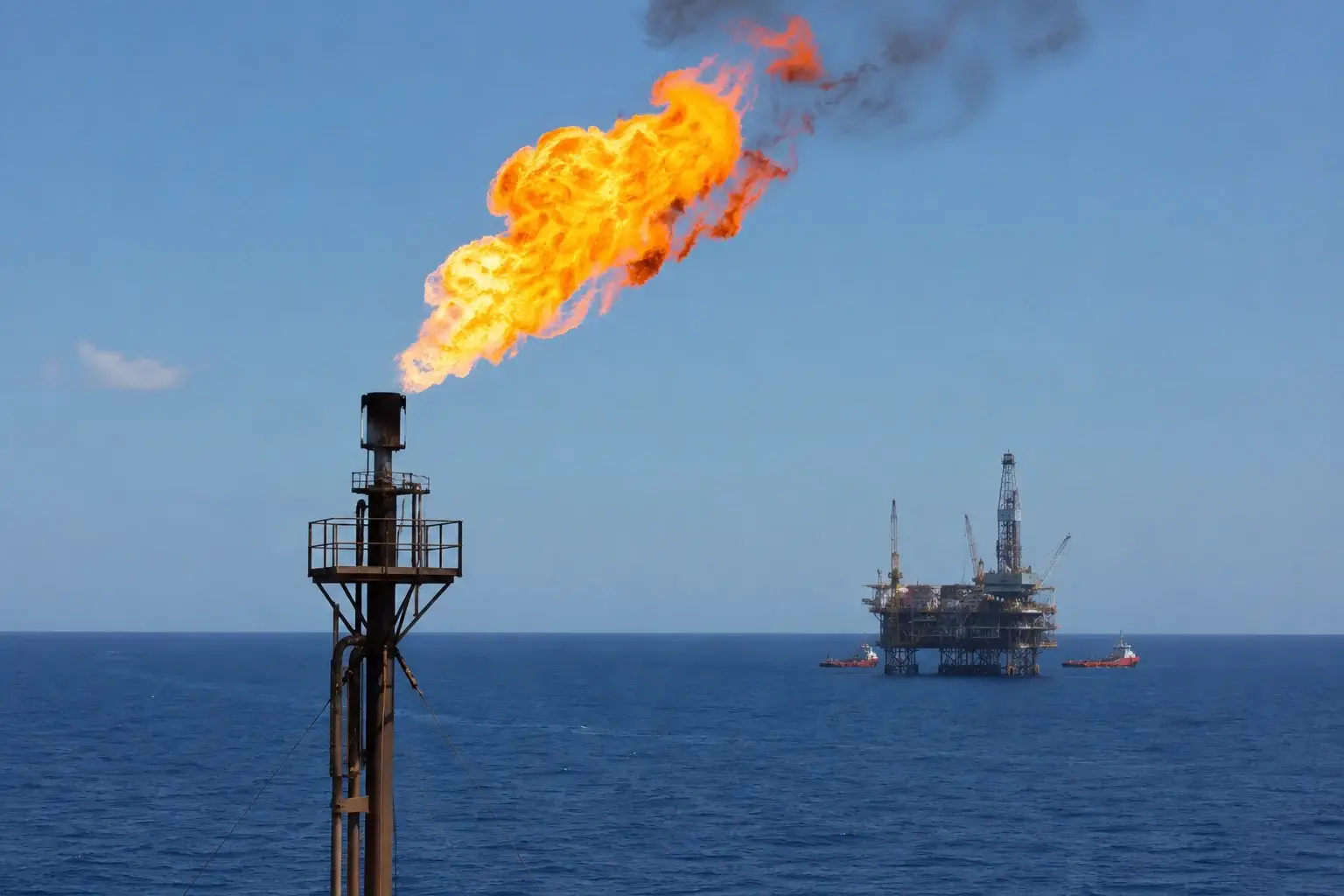
Natural Gas Price Futures Forecast: NG=F Rockets 5.88% to $2.92 as Iran Rejection Reopens Global LNG Supply Risk
Front-month June contract breaks descending channel; Hormuz disruption keeps Qatar offline, US production flat at 109.6 bcfd, storage surplus compresses to 6% | That's TradingNEWS
Key Points
- give me 3 key points 100 charecters each
- Trump rejects Iran offer; Qatar LNG at 17% offline; TTF at $19/MMBtu pulls demand toward US exports.
- EIA storage at 63 Bcf vs 77 Bcf 5-yr avg; US output flat 109.6 bcfd; Waha negative 66 days straight.
Natural gas screens lit up sharply Monday, with Natural Gas Futures (NG=F) advancing 5.88% to $2.92 per MMBtu after Trump's flat rejection of Iran's peace framework sent every energy contract on the NYMEX board higher in sympathy with crude. The front-month June contract was tracking gains of 8.4 cents to $2.841 per MMBtu earlier in the session — putting the contract on track for its highest close since May 4 — before the broader Iran-driven bid lifted the entire energy complex by mid-afternoon. The settlement print at $2.91 per million British thermal units capped a session that saw natural gas reclaim the $2.80 psychological level decisively after weeks of grinding consolidation between $2.676 at the floor and $2.883 at the ceiling. The cleanest single-day catalyst was Trump's Truth Social post calling Tehran's revised counteroffer "TOTALLY UNACCEPTABLE" — a verdict that landed Sunday evening and reopened the entire geopolitical risk premium that had been quietly bleeding out of the curve over the past month. NG=F at $2.92 represents the highest print in roughly four weeks and confirms that the consolidation regime that had defined natural gas since late April has now resolved decisively to the upside, with the descending channel from the April highs broken on a closing basis and the momentum profile flipping from neutral-bearish to constructive. Gasoline futures climbed 2.34% to $3.5998 per gallon, heating oil added 1.56% to $3.9686 per gallon, WTI June crude (CL=F) closed up $2.65 or 2.78% at $98.07 per barrel, and the entire energy complex traded as a single risk-on bid driven by the Iran headline that finally cracked the consolidation regime.
Why the Iran Rejection Matters More for Natural Gas Than the Headlines Suggest
The transmission mechanism from Trump's Iran rejection into the Natural Gas Futures (NG=F) tape runs through three discrete channels that have been quietly building over the past 70 days, and the magnitude of each channel deserves more attention than the daily price moves capture. The first channel is the Strait of Hormuz throughput collapse — only two LNG carriers transited the Strait in April compared to roughly 70 vessels per day before the war started on February 28, with Qatar's Ras Laffan facility still running at reduced capacity and 17% of its export operations offline pending repairs that will take years rather than months. The second channel is the QatarEnergy production cuts that halted LNG production after Iran attacked Qatari facilities, sending Dutch TTF gas prices to a three-year high near $19 per MMBtu and Japan-Korea Marker prices to an eight-month high near $13. The third channel is the structural demand pull from European and Asian buyers who depended on Qatari supply and now have to find replacement molecules every single month — US LNG export terminals sit directly in that path, and the weekly feedgas numbers have not yet fully reflected the structural demand build that is loading underneath the market. Trump's rejection of Iran's terms removes any near-term diplomatic offramp from the supply disruption, which mechanically forces the global LNG market to operate without Qatari volumes for longer than the truce-optimist camp had been pricing. The implication for NG=F is that the seasonal storage-versus-production debate that has dominated the domestic narrative gets overwhelmed by the global supply pull, with US LNG becoming progressively more strategically valuable every week the Strait stays restricted.
The Production Tape and Why Output Decline Sets Up an Asymmetric Trade
The supply side of the Natural Gas Futures (NG=F) equation has been quietly reshaping over the past several weeks, and the magnitude of the production decline matters more than the absolute level. Lower-48 dry gas production held near record highs around 109.6 billion cubic feet per day in May, essentially flat with April's print and modestly below the all-time monthly record of 110.6 bcfd set in December 2025. The cleaner read sits underneath the headline number — output has declined incrementally over recent weeks as low spot prices forced energy firms to reduce activity rather than continue feeding the storage surplus. EQT, the second-largest US gas producer, has explicitly cut production while waiting for prices to recover, telegraphing the kind of producer discipline that historically tightens the supply-demand balance just as seasonal demand begins ramping. The Waha Hub picture tells the parallel story of regional oversupply — average prices at the West Texas hub stayed in negative territory for a record 66 consecutive days, with Waha averaging negative $2.29 per MMBtu so far in 2026 compared to positive $1.15 in 2025 and positive $2.88 across the prior five-year average. The Waha negative-pricing record run reflects the pipeline constraints trapping associated gas in the Permian Basin rather than fundamental Henry Hub weakness — meaning the headline price weakness obscures meaningful tightening underneath the surface. The 2026 Waha pricing has gone negative on 75 separate days through May, surpassing the 49-day record set in 2024 and dwarfing the six negative-pricing days in 2020 and the single negative-pricing day in 2023. Daily Waha prices first averaged below zero in 2019 and registered 17 negative-price days that year — meaning the structural Permian oversupply has been a multi-year fixture rather than a recent phenomenon.
The Storage Number That Forced Shorts to Cover
The Energy Information Administration reported a 63 Bcf injection for the week ending May 1 — a print well below the consensus expectation of 72 Bcf and dramatically lighter than the five-year average for that week of 77 Bcf. The triple-bearish-expectation miss forced short-positioned traders to cover aggressively, with Natural Gas Futures (NG=F) bouncing off the lows immediately as the storage tape came across. Last year's comparable week saw an injection of 104 Bcf, meaning the year-over-year delta runs 41 Bcf lighter at a critical seasonal transition point. Two consecutive lighter-than-expected injections is not yet a trend, but it is a data point worth weighting heavily because the seasonal builds typically accelerate as cooling demand begins ramping. Working gas inventories sit roughly 6% above normal as of the week ended May 7, down from 7% above normal during the week ended May 1 — and that 100-basis-point compression in the surplus represents the cleanest single tell on the structural tightening underway. The implication for the rest of the injection season is that if production continues at the current decelerating pace and weather forecasts deliver any meaningful warming beyond May 26, the surplus could compress further and force a re-pricing of the curve. Mild weather earlier this spring allowed energy firms to inject more gas into storage than usual, but the tailwind from that mild stretch is now exhausted and the market needs new constructive variables to sustain rallies above $2.90.
The Demand Picture and the LNG Feedgas Variable
The demand side of the Natural Gas Futures (NG=F) balance has been the principal structural support that prevented prices from collapsing further during the negative-Waha period. Average gas flows to the nine large US LNG export plants fell to 17.2 bcfd in May from a record-high 18.8 bcfd in April, with feedgas flows dipping toward 17.7 bcfd during the prior week because of seasonal maintenance at Gulf Coast export terminals. Every cubic foot of gas that stayed in the domestic market instead of leaving the country added to the oversupply pressure that has been compressing front-month pricing, and the maintenance window timing has been the cleanest negative variable for the bull thesis through early May. The maintenance window is not permanent — Gulf Coast facilities including Sabine Pass, Corpus Christi, Cameron, and Plaquemines are scheduled to return to normal capacity over the coming weeks, which would mechanically push feedgas flows back toward the April record-high of 18.8 bcfd. LSEG projected average gas demand in the Lower 48 states, including exports, would hold around 98.7 bcfd this week and next, with the next-week forecast revised lower from Friday's projection — telegraphing that the demand softness has extended slightly longer than expected. The deeper read is that LNG export demand has been one of the strongest structural pillars under US natural gas over the past several years, and even temporary feedgas slowdowns expose the market's vulnerability to domestic oversupply when the export valve narrows. The Qatari production cuts mean that once Gulf Coast maintenance completes, the redirected demand pull from Europe and Asia toward US LNG should be materially stronger than would otherwise be expected — with TTF at $19 per MMBtu and JKM at $13 making US export economics structurally attractive even at elevated Henry Hub prices.
The Technical Architecture and the Descending Channel That Just Broke
The chart for Natural Gas Futures (NG=F) has been printing a textbook descending channel from the April highs, with the upper boundary at roughly $2.85-$2.90 capping every recovery attempt and the lower boundary near $2.68 providing the floor on each pullback. Monday's 5.88% rally to $2.92 broke the upper channel boundary on a closing basis, invalidating the bearish channel structure and unlocking the next leg of upside if the breakout sustains. The 4-hour chart shows price moving above the red 50-period moving average at $2.81 — a level that had been acting as dynamic resistance throughout April and early May — and the move above that pivot represents the kind of technical confirmation that systematic strategies require to flip from short to long bias. The Fibonacci extensions from the prior swing range pointed to $2.768 and $2.676 as downside targets when price was trading inside the channel, and the failure to reach $2.676 followed by the breakout above $2.81 telegraphs that the consolidation has resolved bullishly rather than continuing the bearish trajectory. The RSI was sitting below 50 in bearish territory during the consolidation phase, but the Monday move likely lifted RSI above the 50-line for the first time in several weeks, confirming the momentum shift. Volume profile analysis had identified the $2.80 area as a zone of supply dominance, and the break above that volume node converts what had been resistance into supply that needs to be absorbed before the next leg can develop. The weekly chart frames the larger picture — June NG=F settled at $2.750 last week between $2.883 and $2.676, with the nearest swing top at $3.622 and the major range stretching from $3.622 down to $2.592. The 50% retracement of that major range sits at $3.107 as the nearest upside target, with the broader range from $4.246 down to $2.592 carrying a 50% target at $3.419 as the secondary stretch objective.
The Weather Picture and the Seasonal Transition Risk
Meteorologists forecast weather across the country will remain mostly near normal through May 26 — a forecast that historically supports stable injection-season activity without triggering the kind of cooling-demand surge that would mechanically drain storage. The cooler temperatures across parts of the Midwest and East added late-season heating demand early in the prior week and triggered some short covering, but the bullish weather tailwind exhausted by midweek. This is the dead zone between heating demand and cooling demand — the seasonal transition that historically delivers the lowest volatility and weakest directional conviction across the natural gas calendar. The structural read is that natural gas does not have a clean weather-driven catalyst until summer cooling demand begins materializing in earnest, which typically arrives in late May and accelerates through June and July as the first significant heat domes develop across the Lower 48. The 6%-above-normal storage surplus heading into the cooling season provides a meaningful supply cushion that limits the magnitude of weather-driven rallies, but the cushion gets thinner with every week that production decelerates and exports return to capacity. The asymmetric weather risk skews bullish for the back half of May and into June — if forecasts shift toward an above-normal-heat summer, the storage surplus could compress rapidly and force the kind of curve repricing that takes Natural Gas Futures (NG=F) through $3.107 toward the $3.419 broader retracement target.
The Global LNG Pull and the Strait of Hormuz Reality
The global LNG market backdrop sits at the center of the structural bull thesis for Natural Gas Futures (NG=F) through the second half of 2026, and the magnitude of the supply disruption has not been fully absorbed by the domestic-storage-focused commentary. Qatari LNG production at Ras Laffan continues operating at reduced capacity with 17% of export operations offline, and repairs to the damaged facilities will take years rather than months to complete. The first Qatari LNG tanker cleared the Strait of Hormuz after Pakistan-Iran talks, and a second Qatari tanker headed through Hormuz to Pakistan as the war continued — incremental shipments that demonstrate partial supply restoration without coming close to pre-war throughput. India declined Russian LNG cargoes under sanctions while talks continued on permitted shipments, telegraphing the kind of supply-routing complications that compress the global market structurally rather than tactically. Pakistan rejected LNG bids as its energy crisis deepened, demonstrating that the global LNG market is operating at a price level where some marginal buyers cannot afford to bid for cargoes. European and Asian buyers continue to scramble for replacement supply, with Germany seeking Israeli jet fuel and South Korean airlines cutting flights amid soaring fuel costs — each headline confirming the magnitude of the energy crunch propagating through downstream industries. The implication for US LNG export economics is that every week the Strait stays restricted creates additional structural pull toward US export terminals, and the seasonal Gulf Coast maintenance that has been compressing feedgas flows will eventually complete and unlock the back-half capacity that the global market desperately needs.
The Trump-Xi Summit and the Wildcard Catalyst for Gas
The Trump-Xi summit in Beijing on May 14-15 sits on the calendar as the single most consequential near-term geopolitical event that could reshape the Natural Gas Futures (NG=F) trajectory through the back half of May. Iran sanctions, trade frameworks, semiconductor export controls, and the broader Hormuz reopening question will all sit on the bilateral agenda, with any one of those threads carrying the potential to materially shift global energy flows. The base case across major sell-side desks is that the summit produces incremental progress on Chinese influence over the Iran situation without delivering a clean Hormuz reopening commitment — an outcome that would keep the Qatari supply disruption in place and continue supporting US LNG demand. The bull case is that Trump emerges from the summit with explicit Chinese commitments to pressure Iran into reopening the Strait — an outcome that would compress the global LNG premium and likely pull NG=F back toward the $2.75-$2.80 zone as the structural demand pull weakens. The bear case for natural gas is that the summit fails entirely, the Iran situation escalates kinetically, and Qatari supply remains offline through the back half of 2026 — an outcome that would accelerate the global LNG repricing and lift Henry Hub through $3.107 toward $3.419 as the structural pull overwhelms domestic supply. The asymmetry favors the bullish setup because the magnitude of the upside scenarios materially exceeds the downside on natural gas specifically — the storage surplus provides a meaningful floor, while the global demand pull provides an open-ended ceiling tied to TTF and JKM pricing in the upper teens.
The Producer Discipline and the EQT Decision Matrix
The producer behavior that has anchored the recent Natural Gas Futures (NG=F) support deserves closer attention because it represents the cleanest counter-narrative to the bearish supply commentary. EQT explicitly cut production while waiting for higher prices, telegraphing the kind of capital discipline that has been notably absent from the US shale gas complex through prior cycles. The 109.6 bcfd May output flat with April's print represents the production response to negative Waha pricing — producers in the Permian Basin have meaningfully scaled back drilling activity, and Permian rig counts have been compressing through the past four months. The structural read is that US shale gas production has moved past the era of growth-at-any-price and into the era of capital discipline tied to free cash flow generation rather than volume optimization. The implication for forward supply is that the production response to higher prices will be slower and more measured than prior cycles, which means a sustained move above $3.00 would not immediately trigger the kind of supply surge that has historically capped natural gas rallies. The Strategic Petroleum Reserve drawdown on the oil side has parallel implications for gas markets — when US energy buffers run low, the export economics tighten and the structural supply available for global markets compresses, lifting domestic Henry Hub pricing as a second-order effect of crude-side dynamics. The reduced rig counts compared to a year ago combined with the explicit producer commentary about waiting for higher prices creates a supply backdrop that should support sustained rallies once the demand catalyst arrives.
The Pivot Levels and the Trade-Trigger Architecture
The pivot structure for Natural Gas Futures (NG=F) is unusually well-defined heading into the late-May seasonal transition. The weekly $2.749 pivot was the level that defined directional bias last week, with the Monday breakout above $2.81 confirming the bullish resolution. Holding above $2.81 keeps buyers in control with a potential breakout over $2.905 putting $3.107 back on the radar — the 50% retracement of the major weekly range that has acted as the next overhead target for several months. A sustained move through $3.107 unlocks the path toward $3.419 — the 50% retracement of the broader range — with the prior swing top at $3.622 as the longer-term ceiling. The downside scenario requires losing the $2.749 weekly pivot, which would put $2.592 in play as the multi-month support, with $2.564 and $2.442 sitting beneath that as the disaster-scenario targets. The minor trend was already down with the minor range running $2.905 to $2.592, but the Monday breakout above $2.905 mechanically flipped the minor trend to up and shifted momentum to the bullish side. The major trend remains technically down given the nearest swing top sits at $3.622 — meaning a complete trend reversal requires breaking that level on a closing basis, which would unlock significantly more upside but remains an aggressive scenario from current levels. The trade-trigger discipline for active execution: long bias above $2.81 with stops below $2.749 and staged targets at $2.905, $3.107, and $3.419; short bias only on confirmed rejection at $3.107 or a daily close back below $2.749 with stops above the rejection candle and downside targets at $2.676 and $2.592. Risk management on natural gas requires tighter stops than crude or equity index futures because of the structurally higher volatility profile — daily range expansion of 5-8% is common during seasonal transition windows and binary news catalysts.
Read More
-
Yen Stalls at 160 Despite a 3% JGB and Tokyo Core CPI at 2.0% — Intervention Sits at 164, Friday's Payrolls Decide
02.09.2026 · TradingNEWS ArchiveEnergy
-
BBUL Fund Surges 14% as QNX’s Record Quarter Lifts BB, but Volatility Decay Limits the Hold
20.10.2026 · TradingNEWS ArchiveStocks
-
XRPI and XRPR Bounce With XRP, but $10.25M in October Inflows and a 1B Token Unlock Cap the Upside
20.10.2026 · TradingNEWS ArchiveCrypto
-
November NG Slips to $2.975 as Mild Weather Masks 45 Bcf Storage Surplus and First-Ever 20 Bcf/d LNG Demand
20.10.2026 · TradingNEWS ArchiveCommodities
-
Yen Firms to 158.08 as Katayama’s Warning and Ueda’s 2% Inflation Signal Cap Dollar Below 160
20.10.2026 · TradingNEWS ArchiveForex
The Indicator Stack and the Momentum Confirmation
The technical indicator profile for Natural Gas Futures (NG=F) flipped meaningfully constructive on Monday's breakout, with multiple confirmation signals stacking simultaneously. The RSI had been sitting below 50 in bearish territory throughout the descending channel period, and the move above $2.81 likely pushed RSI back above the 50-line as the cleanest momentum shift signal. The 50-period moving average at $2.81 had been acting as dynamic resistance, and the break above that level converts the MA from resistance to support — a structural change that systematic strategies use as a trigger to flip directional bias. The Fibonacci extensions that had targeted $2.768 and $2.676 on the downside got invalidated by the breakout, and the new Fibonacci framework projects upside targets at $2.905, $3.107, and $3.419 derived from the broader weekly range. The blue trendline that had provided minor support around $2.78 during the consolidation phase now sits underneath the new uptrend structure as the first layer of demand on any pullback. The volume profile that had identified $2.80 as a supply-dominance zone needs to be reassessed given the breakout — the absorbed selling at that level becomes the new accumulation zone, and a successful retest of $2.80 from above on declining volume would provide the cleanest entry signal for tactical longs. The composite technical read across timeframes — daily breakout above $2.81, weekly straddle of the $2.749 pivot resolved upward, minor trend flipped up on the $2.905 break — points toward continued upside with $3.107 as the immediate target and $3.419 available if the global LNG pull accelerates.
Where the Trade Sits Heading Into the Cooling Season
Natural Gas Futures (NG=F) at $2.92 on Monday's settle represents the cleanest single-day breakout of 2026 to date, with the technical structure flipping from descending channel to confirmed upside breakout and the fundamental backdrop transitioning from storage-surplus pressure to global-LNG-pull support. The constructive setup runs through the 5.88% Monday rally invalidating the bearish channel structure, the 6%-above-normal storage surplus down from 7% above normal a week earlier, the producer discipline reflected in EQT's explicit production cuts and the flat 109.6 bcfd Lower-48 output, the structural global LNG pull from Qatar's reduced operations at Ras Laffan and the offline 17% of export capacity, the European TTF at $19 per MMBtu and Asian JKM at $13 making US export economics highly attractive, the seasonal transition from heating to cooling demand that historically resolves into summer rallies, the 100-basis-point compression in the storage surplus, the 63 Bcf injection well below the 77 Bcf five-year average, and the Trump rejection of Iran's framework that reopens the Hormuz risk premium across the entire energy complex. The defensive setup runs through the still-record-65-day-streak of negative Waha pricing reflecting pipeline constraints in the Permian, the 17.2 bcfd LNG feedgas flow that sits below the April record of 18.8 bcfd due to Gulf Coast maintenance, the 6%-above-normal storage surplus that remains a structural cap on aggressive rallies, the major weekly trend that remains technically down until a break above the $3.622 swing top, and the LSEG projection of $98.7 bcfd demand this week and next that does not reflect any meaningful cooling-season ramp yet. The near-term bias leans constructive toward a continuation above $2.905 with the $3.107 target reachable within two to three weeks if the breakout sustains. The medium-term bias leans materially bullish given the global LNG pull, the producer discipline, the Hormuz disruption that Aramco's Nasser warned could push recovery into 2027, and the eventual seasonal cooling demand that will mechanically tighten the storage balance. The verdict for active trading desks is BUY/HOLD on natural gas with explicit acknowledgment of the higher volatility profile relative to crude — targets staged at $2.905, $3.107, $3.419, and ultimately $3.622 as the stretch objective, with risk management anchored at $2.749 as the structural invalidation level and tighter intraday stops sized against the daily range expansion that natural gas typically delivers during seasonal transition windows. The Trump-Xi summit on May 14-15, the next EIA storage release on Thursday, the Gulf Coast maintenance completion timeline, the Tuesday US CPI print that will calibrate broader macro flows, and any escalation in the Iran kinetic situation will sequentially determine whether the $2.92 breakout extends toward the $3.107 retracement target or fails back into the prior consolidation range. The bias decision is BUY at $2.92 with confirmed entry on any successful retest of $2.81 as new support, position-sizing matched to the structural conviction rather than the daily volatility, and a willingness to scale the position higher as the global LNG pull progressively dominates the storage-surplus narrative through the cooling season.