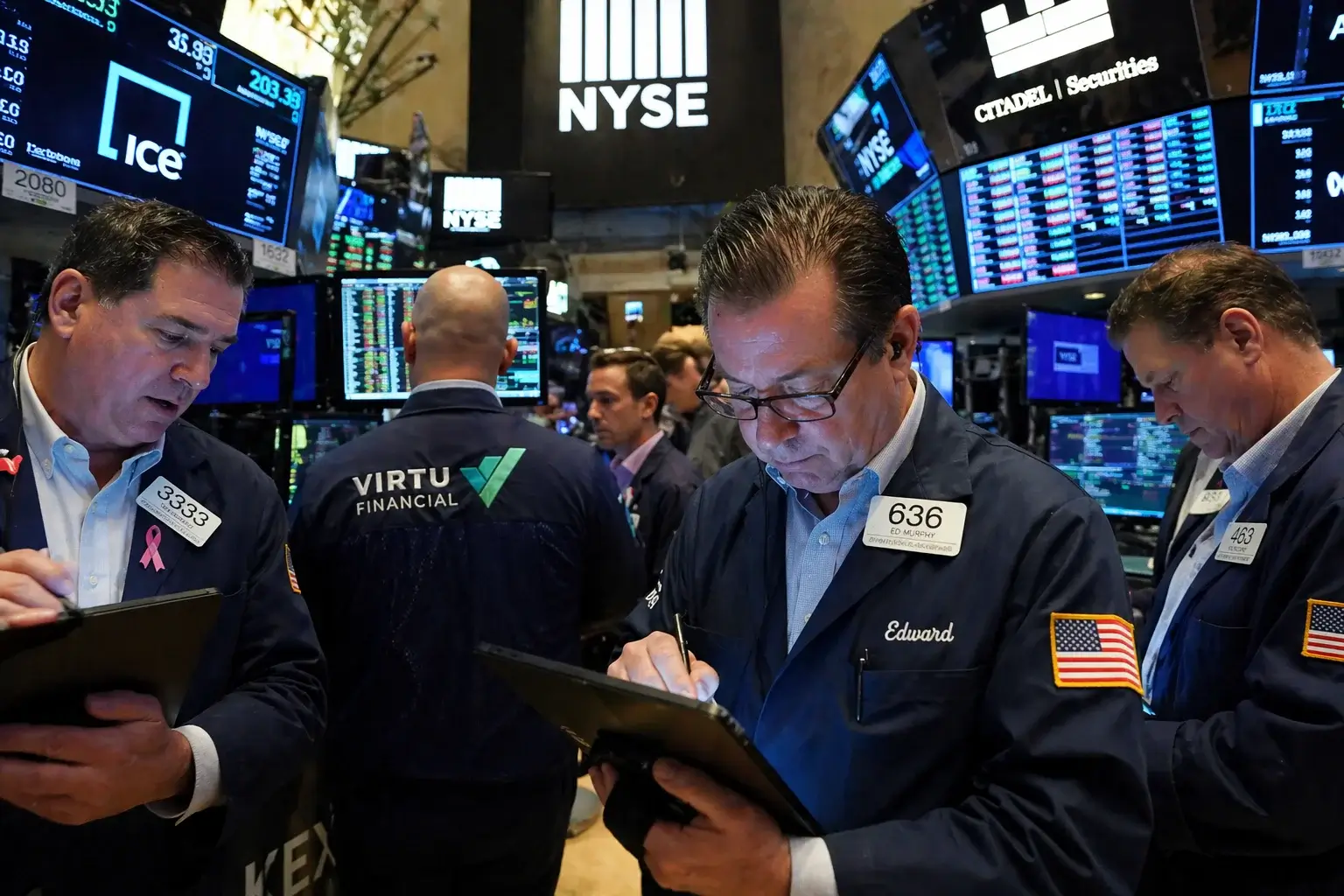
Stock Market Today: Dow (^DJI), S&P 500 (^GSPC), Nasdaq (^IXIC) Climb as UNH Soars 8.5%, AAPL Slips on Cook Exit
Russell 2000 (^RUT) eyes fourth straight record at 2,816; Avis (CAR) squeeze pushes stock to $673, Spirit (FLYYQ) explodes 87% | That's TradingNEWS
Key Points
- Dow (^DJI) climbs 175 points to 49,618 as UnitedHealth (UNH) surges 8.5% to $351 on strong Q1 guidance raise.
- S&P 500 (^GSPC) hits 7,125 and Nasdaq (^IXIC) adds 86 points; semis (SOXX) extend record 15-session win streak.
- Apple (AAPL) dips 0.7% after Tim Cook names John Ternus CEO; Avis (CAR) jumps 10.6% to $673 on short squeeze.
Equities pushed deeper into record territory Tuesday with the Dow Jones Industrial Average (^DJI) pacing the advance at 49,618, up roughly 175 points or 0.35%, while the S&P 500 (^GSPC) added 16 points to 7,125 and the Nasdaq Composite (^IXIC) tacked on 86 points to 24,490. The Russell 2000 (^RUT) was the quiet outperformer, climbing 0.85% to 2,816.83 and setting up what would be its fourth consecutive record close — a streak not matched since February 2021. Volatility refused to panic, with the Cboe Volatility Index (^VIX) barely budging at 19.10, a reading that implies expected daily swings of roughly 1.2% for the benchmark. The tape's calm stands in sharp contrast to a news docket carrying a Fed-chair confirmation hearing, a CEO succession at a $4 trillion company, a Middle East ceasefire hours from expiration, and retail sales that blew past forecasts.
Apple (AAPL) Enters a Post-Cook Era With a Technical Breakout Hanging in the Balance
The succession plan disclosed late Monday confirms what the supply-chain rumor mill has been whispering for months: Tim Cook will vacate the chief executive seat on September 1 and hardware engineering chief John Ternus inherits one of the most consequential jobs in global tech. Cook stays on as executive chairman with a narrower mandate focused on policy engagement. The handoff arrives at a delicate moment — the April 30 fiscal report will be Cook's final earnings call as sitting CEO, and Apple shares slipped roughly 0.7% in the opening minutes on no real volume conviction.
The fourteen-year Cook era is worth measuring in hard numbers before pivoting forward: a market capitalization that ballooned from roughly $350 billion at handover in August 2011 to north of $4 trillion at Monday's close, a staggering 1,000% appreciation. Services revenue alone now clears $100 billion annually, a line item that barely existed when Cook inherited the reins from Steve Jobs. The iPhone remains the cash engine, but Apple Watch, AirPods and the MacBook Neo are all Cook-era launches.
From a chart-reading standpoint, AAPL just punched through a downward-sloping trendline anchored at the December all-time high, and the breakout is now being stress-tested in real time. The 200-day moving average is rising — a meaningfully healthier backdrop than what Meta (META) or Tesla (TSLA) are working with, where their 200-days have flattened. Resistance sits at $278–$280 first, then the $286–$289 all-time-high zone. Support is clean at $245–$250, just beneath the 200-day. My read: AAPL is a Hold into the print, tilting constructive above the trendline. A decisive break above $289 converts this into an outright Buy; a retest of $250 that fails is where the thesis would need rewriting. Succession risk is real, but Ternus is a continuity choice, not a wildcard.
Kevin Warsh Walks Into the Banking Committee and Wall Street Listens for the Rate Subtext
The confirmation hearing for the Federal Reserve chair nominee kicked off at 10 a.m. ET and the prepared text telegraphed a very specific message: the institution has strayed from its price-stability remit and must return to lane discipline. Warsh also signaled that the long public feud between the White House and the central bank may be winding down, though he conspicuously avoided firm guidance on the policy path.
The real fireworks risk sits with Senator Thom Tillis, a Banking Committee vote who has repeatedly pledged to block any Fed chair nominee until the Justice Department walks back its criminal investigation of sitting Chair Jerome Powell. That single vote could swing the calculus. Rates markets are positioning accordingly — the 2-year Treasury yield climbed to a session high of 3.77%, up five basis points, while the 10-year yield printed 4.288%, a 3.4-basis-point move. The directional read: traders are increasingly leaning toward zero rate cuts through 2026, a dramatic shift from the easing cycle that was priced in just weeks ago.
Retail Sales (March) Crush Expectations at +1.7%, Rewriting the Consumer Narrative
The Census Bureau's March advance estimate landed at +1.7% month-over-month against a consensus looking for +1.3%, and February was revised upward to +0.7%. Year-over-year growth printed +4.0%. That is a consumer who is absolutely not rolling over, despite gasoline prices that surged 24.1% during the same month per Energy Information Administration data, and despite a global oil market that has spiked more than 30% since the U.S.-Israeli conflict with Iran ignited.
Auto sales did heavy lifting as manufacturers leaned into incentives, and tax refunds running larger than last year's cycle padded household purchasing power. The Census Bureau has finally caught up on its reporting backlog from last year's government shutdown, and April's release arrives on the normal calendar. My interpretation: this print pulls forward the argument for a "no landing" economy, supports the steeper Treasury curve, and undercuts the case for near-term cuts — another arrow in Warsh's quiver if confirmed.
UnitedHealth (UNH) Delivers the Dow's Single-Stock Engine With an 8.5% Rip
UNH is where the index outperformance came from — shares surged 8.54% to $351.11, adding $27.63 in a single session after the health insurer raised its profit guidance and beat on the bottom line by a wide margin. Because the Dow is price-weighted, that move alone contributed roughly 110 points to the blue-chip gauge. Strip out UnitedHealth and the Dow's rally cuts roughly in half.
The rally masks ugly tape elsewhere in the healthcare complex. Merck (MRK) shed 3.79% to $112.66, Amgen (AMGN) lost 2.18% to $342.53, and Johnson & Johnson (JNJ) slipped 1.96% to $226.18. This isn't a healthcare rally — it's a UNH-specific re-rating. My call on UnitedHealth: Buy on strength, given the guide-raise and margin recovery, but recognize that this move has front-loaded the easy gains. On the laggard trio, MRK, AMGN and JNJ are all Holds until their own earnings catalysts clarify pricing power and pipeline momentum.
Avis Budget (CAR) Is the Short Squeeze That Refuses to Cool
Shares of the car rental operator tacked on another 10.66% Tuesday to $673.71 after a 23% surge Monday. Zoom out and the math gets genuinely absurd — CAR is up roughly 500% over the past month. Short interest sits at 25% of float, well into extreme territory (anything above 20% signals severe squeeze risk). Two investors, SRS and Pentwater, hold 71% of the shares outright, and once synthetic swap exposure is layered in, effective control pushes to 108% — a mathematical impossibility that is precisely why the squeeze mechanics are self-reinforcing.
This isn't Avis's first rodeo with violent price action. On November 2, 2021, the stock more than doubled from $163 to $357, with an intraday spike to $545, after a strong print and news that management had repurchased 16% of its own shares in the prior quarter. My view on CAR at $673: Sell into this strength. The fundamentals do not justify the current level — this is mechanical float pressure, not earnings power. Shorts getting destroyed is not a thesis; when the forced buying exhausts, the unwind will be violent and brutal.
Amazon (AMZN) Deepens Its Anthropic Bet to $33 Billion Total, Stock Rips 1.85%
Amazon (AMZN) shares climbed 1.85% to $252.88 after disclosing an incremental $5 billion commitment to Anthropic (ANTH.PVT) with another $20 billion tranche conditional on commercial milestones — stacking on top of the $8 billion previously deployed. Total capital earmarked for Anthropic now runs up to $33 billion, and the broader cloud arrangement carries a headline figure of $100 billion.
The strategic context: Amazon's in-house Nova model family has struggled to generate buzz relative to frontier labs, even as AWS continues to dominate the infrastructure layer of the AI economy. Management guided full-year capital expenditure to roughly $200 billion, the vast majority of which is going toward AI compute. Earlier this year the company also committed up to $50 billion to OpenAI (OPAI.PVT). AMZN thesis: Buy. The capex is real but so is the optionality — Amazon is becoming the landlord to the entire generative AI build-out while simultaneously owning equity in its two most valuable tenants.
Iran Ceasefire Expires Wednesday and Trump Is Telegraphing Bombs
The two-week U.S.-Iran truce runs out late Wednesday local time and the president's CNBC interview Tuesday morning made no attempt to soften the rhetoric — he openly said he expects to be bombing because he views that as "a better attitude" going into negotiation. U.S. officials are en route to Islamabad for second-round talks, and Tehran signaled it will dispatch a delegation as well, though leadership of that team remains unclear.
Brent crude (BZ=F) is around $95.73 after dropping as low as $94.44 earlier — a 1.1% slide on hopes the talks prevent a blowup in the Strait of Hormuz, through which roughly a fifth of global crude transits daily. U.S. benchmark WTI (CL=F) is trading near $87.74, and elsewhere the quoted level is around $91.14 depending on contract. Unresolved flashpoints go well beyond oil: Iran's nuclear program and Israel's Lebanon operations both remain live issues. My read on the energy complex: oil majors remain a Buy as a geopolitical hedge regardless of the talks' outcome; a failed negotiation pushes Brent back above $100 in short order.
Semiconductor Complex (SOXX) and Mega-Cap Tech (XLK) Mint Record Streaks
The PHLX Semiconductor Index (^SOX) climbed 0.83% to 9,679.09, extending the index's winning streak to 15 sessions — the longest run since June 2014, when it also strung together 15 straight up days. The iShares Semiconductor ETF (SOXX) is now on pace for its 10th consecutive intraday all-time high, a record for the fund. The Technology Select Sector SPDR (XLK) is threading its own 15-session streak, and the small-cap tech fund PSCT printed a seventh straight intraday record.
Names doing the heavy lifting across chip equipment, design and foundry exposure include KLA Corp (KLAC), Marvell Technology (MRVL), Teradyne (TER), Texas Instruments (TXN), Lattice Semiconductor (LSCC), MKS Instruments (MKSI), Monolithic Power Systems (MPWR), ONTO Innovation (ONTO), FormFactor (FORM), Photronics (PLAB), Amkor Technology (AMKR), Kulicke & Soffa (KLIC) and ASE Technology (ASX). Networking plays are riding along too — Arista Networks (ANET) and Hewlett Packard Enterprise (HPE) both notched fresh highs, and Keysight (KEYS) joined the list. SOXX remains a Buy on this momentum; the 15-day streak has historical analogs that typically resolve with two to four weeks of consolidation before another leg, not an outright reversal.
Dow Transports (^DJT) Join the Party With Eight Record Closes in Ten Sessions
The transportation complex has quietly become a leadership group, with the Dow Jones Transportation Average printing eight intraday record highs in the past ten trading days. CSX (CSX), J.B. Hunt Transport Services (JBHT), FedEx (FDX), Ryder System (R) and Kirby (KEX) are all in this cohort. That breadth — rail, trucking, marine and air — tells you something real about freight demand, not just financial engineering. Industrials more broadly are participating through Caterpillar (CAT), Cummins (CMI), Eaton (ETN), Emcor (EME), GE Vernova (GEV), Nucor (NUE), Quanta Services (PWR), Steel Dynamics (STLD), Trane Technologies (TT) and TE Connectivity (TEL).
Spirit Aviation Holdings (FLYYQ) Explodes 87% on Trump's "I Love Mergers" Riff
Shares of Spirit Aviation Holdings (FLYYQ), the OTC-traded parent of the budget airline, detonated 87.23% Tuesday to $0.5309, adding 26 cents on the session after the president told CNBC he would "love" to see somebody buy Spirit and even floated the idea of federal assistance to facilitate an acquisition, citing the 14,000 U.S. jobs at stake. The airline has been a serial M&A target and a serial M&A disappointment — Frontier proposed a tie-up in 2022 that JetBlue interrupted with an all-cash counter; the DOJ blocked that deal in January 2024; Spirit filed for bankruptcy in late 2024 and again mid-2025.
The same president also threw cold water on a rumored United Airlines (UAL) – American Airlines (AAL) combination that United reportedly floated and American rejected. The Wall Street Journal reported Monday that Spirit is in active conversations about direct federal investment to offset jet fuel cost pressure from the Iran conflict. My take on FLYYQ: avoid — trading below a dollar with bankruptcy baggage, this is a lottery ticket, not an investment, regardless of how bullish any headline sounds. UAL reports after the bell tonight, and the read-through on jet fuel margins will matter more than any rumor. Full airline sector analysis at tradingnews.com/stock/united-airlines-ual.
Goldman and JPMorgan Both Park Their Year-End S&P 500 Targets at 7,600
Goldman Sachs strategist Ben Snider reiterated his 7,600 year-end target for the S&P 500, which implies 7% upside from current 7,125 levels. His core argument is continued earnings expansion, plus GDP growth that comes in solid if below trend. JPMorgan, which had cut its target to 7,200 from 7,500 just last month, reversed course overnight and lifted the number back to 7,600 — the strategists held their earnings multiple assumption at 22x, but acknowledged a "meaningful risk" of short-term consolidation before the next leg higher.
The benchmark has already run 12% since the March 30 lows, the sharpest multi-week rally since April 2020 and before that March 2009. Per Bespoke Investment Group's records going back to 1928, the S&P just logged the fastest round-trip to record highs following a drawdown of 5% or more. And yet the American Association of Individual Investors' weekly survey for the week ended April 16 still registered more bears than bulls — a remarkable disconnect that RBC's Lori Calvasina flagged in her Sunday client note, describing conversations with long-only institutional managers who viewed the rally as pricing in "too much optimism" with Middle East ripple effects still unresolved. That wall-of-worry setup is historically bullish for continuation, not exhaustion.
Call-Option Demand Is Surging — The FOMO Trade Is Back
Cboe flow data shows investors aggressively bidding call options, a classic signature of fear-of-missing-out positioning. Call buyers are expressing directional upside conviction through leverage, and the demand has been concentrated in the highest-beta corners of the tape. The iShares MSCI High Beta Factor ETF (SPHB), the Vanguard Value ETF (VLUE substitute reference), the iShares Micro-Cap ETF (IWC), the iShares MSCI Canada ETF (EWC) and the iShares MSCI Taiwan ETF (EWT) all printed record intraday highs Tuesday. When micro-caps and high-beta ETFs are simultaneously breaking out, it is almost always a late-cycle signal — enjoyable while it runs, but not a regime to chase with both hands.
Read More
-
Yen Stalls at 160 Despite a 3% JGB and Tokyo Core CPI at 2.0% — Intervention Sits at 164, Friday's Payrolls Decide
02.09.2026 · TradingNEWS ArchiveEnergy
-
QQQ ETF ($739) Fades From an Early Tech Rally as a 77.9 ISM Prices Index Meets Micron's $61.5B Guide — $760 Record Test Ahead
01.10.2026 · TradingNEWS ArchiveStocks
-
XRPR and XRPI Follow XRP's $1.49 Test as Spot Funds Hold 1.16B XRP and a 1 Billion Token Escrow Release Lands — $1.70 in Play
01.10.2026 · TradingNEWS ArchiveCrypto
-
November NG Slips Below $3 as Decade-High Storage Meets Capped LNG Exports — $2.75 in Sight
01.10.2026 · TradingNEWS ArchiveCommodities
-
Dollar-Yen at 158 Presses Toward 160 as a 363 bp Carry Gap Meets Katayama-Bessent Intervention Risk — 159 in Sight
01.10.2026 · TradingNEWS ArchiveForex
Top Short-Interest Names Not Named Avis
Beyond CAR, the most heavily shorted stocks across U.S. markets per MarketWatch's March 31 data include indie Semiconductor (INDI) at $3.46, SoundHound AI (SOUN) at $8.36, Serve Robotics (SERV) at $10.34, Hims & Hers Health (HIMS) at $29.83 (down 3.80%), Recursion Pharmaceuticals (RXRX) at $3.69, MARA Holdings (MARA) at $11.50 (down 1.12%), Strive Inc Class A (ASST) at $15.97, CleanSpark (CLSK) at $11.95, IonQ (IONQ) at $47.89 and BigBear.ai Holdings (BBAI) at $4.00. The meme-stock machinery is clearly not asleep, and with Avis providing the blueprint this month, expect the algorithms to probe the rest of this list for the next forced-cover setup. BBAI and SOUN are the two I'd flag as most vulnerable to a copycat squeeze; HIMS is a Hold — the fundamentals are genuine even if the short interest is elevated.
Consumer Discretionary Records: Travel, Luxury and Rentals All in Motion
Hilton Worldwide (HLT) and Marriott International (MAR) both notched intraday records, and Ralph Lauren (RL) joined on the luxury side. The signal is that travel and higher-end discretionary spending are intact despite the $4-per-gallon gasoline backdrop. Digital Realty Trust (DLR) printed a record on the REIT side, a clean proxy for data-center demand tied to the AI infrastructure build-out referenced in the Amazon-Anthropic deal above.
Financials Are Quietly Ripping: Custody and Trust Banks Lead
Bank of New York Mellon (BK), Northern Trust (NTRS) and State Street (STT) all hit new intraday records Tuesday. Custody banks benefit from elevated asset values through fee structures that scale with AUM — when the S&P is at 7,125 and record territory across the board, fee income mechanically expands. AEHR Test Systems (AEHR) also made the record-high list on the specialized semiconductor test equipment angle. BK, NTRS and STT are all Buys on this setup — rate expectations trending away from cuts is a direct tailwind to their net interest margin trajectory.
Gold (GC=F) and Bitcoin (BTC) Go Their Separate Ways
Gold futures (GC=F) are getting hit, down $43 to $4,785 (-0.90%), as the Iran de-escalation narrative and rising real yields pull capital out of the safety trade. Bitcoin (BTC-USD) is running the opposite direction, up $1,409 to $76,482 (+1.88%), with chatter of a massive Strategy purchase fueling the crypto bid. The divergence tells you traders are differentiating between geopolitical hedges (gold is falling on peace hopes) and liquidity/risk-on exposure (Bitcoin is rising as the broader risk appetite expands). Gold remains a Buy on dips below $4,750 — one failed Iran talk and the bid returns violently. Bitcoin is a Hold at $76K — extended, but momentum is genuine.
The Trading Setup Into Wednesday
Earnings tonight from United Airlines (UAL) will set the tone for the broader travel and leisure complex on Wednesday, with jet fuel margin pressure the line item to watch. The Iran ceasefire expiration late Wednesday U.S. time is the single binary risk on the calendar — positioning suggests the tape is leaning toward resolution, which creates asymmetric downside if talks collapse. Warsh's testimony, particularly the Tillis exchange, will shape the rate path expectation and by extension the 2-year yield, which at 3.77% is now pricing in essentially zero cuts through year-end. The breadth picture remains constructive — small caps, mid caps, equal-weight and transports all at records alongside mega-cap tech is the healthiest configuration the market has shown all year, and it argues for continuing to buy pullbacks rather than fading strength. The single biggest risk is that this combination of record highs, surging call-option demand, and lingering AAII bearishness resolves with a sharp but short-lived flush — likely triggered by either an Iran headline or a hawkish Warsh soundbite — before the trend resumes toward the 7,600 targets that Goldman and JPMorgan both have staked out.