Oil Price Forecast: Brent (BZ=F) Tops $119 and WTI (CL=F) Cracks $107 Up 7% as 8-Day Rally Hits 30%
Goldman raises forecast as $1.94B in supply tightness drives short-term contracts higher | That's TradingNEWS
Key Points
- Brent BZ=F tops $119 and WTI CL=F hits $107 up 7%, breaking wartime highs as Trump extends Iran blockade.
- Oil rallies 30% in 8 days as Strait of Hormuz stays closed; Goldman raises forecast, gas hits $4.18/gallon.
- UAE exits OPEC May 1, BP profits double, Brent eyes $125 as supply shock locks Fed out of rate cuts.
Brent crude (BZ=F) is trading at $117.81 to $119.40 across the session with an intraday high punching through the wartime peak that defined the early phase of the Iran war, while WTI crude (CL=F) has cleared $106.30 to $107.30 with a 7.41% one-day rip that compounds into the cleanest momentum tape the energy complex has produced across 2026. The single-day gains read as +5.9% to +7.45% on WTI, +5.3% to +7.31% on Brent, and the eight-day cumulative move now stretches roughly 30% from the early April lows. WTI Midland sits at $111.50 with a 7.69% gain, Murban Crude at $109.30, the OPEC Basket at $109.40, and the Indian Basket at $112.80. The downstream products have moved in lockstep — gasoline is up 5.26% to $3.748 per gallon and heating oil ripped 6.55% to $4.231 per gallon, both running well ahead of the crude move because U.S. refining margins are absorbing the inflationary pressure faster than wholesale fuel pricing can pass through. The pre-war benchmark for Brent was roughly $70 per barrel — meaning the market has now repriced energy roughly 70% higher in two months. The catalyst stack that triggered the breakout is concrete and reads cleanly. President Donald Trump told Axios on Wednesday that the U.S. naval blockade against Iran would continue until Tehran agrees to a nuclear deal, with the line that destroyed any near-term ceasefire optimism: "The blockade is somewhat more effective than the bombing. They are choking like a stuffed pig, and it is going to be worse for them. They can't have a nuclear weapon." The Wall Street Journal reported earlier in the week that Trump instructed aides to prepare for an extended blockade rather than walk away or escalate to direct conflict. Energy executives including Chevron (CVX) CEO Mike Wirth met with Trump at the White House Tuesday to discuss how to limit consumer fallout — a meeting the oil market read as confirmation that the Hormuz closure will persist for a prolonged window rather than resolve on the next round of mediated talks. The U.S. Federal Reserve decision drops at 14:00 ET with Jerome Powell's press conference at 14:30 ET, but no version of a hold-and-wait Fed framing reverses the supply shock playing out in the physical crude market. The trade has shifted decisively away from a peace-resolution thesis and toward pricing in months of additional disruption.
The Strait of Hormuz Closure Is the Single Variable That Defines Everything
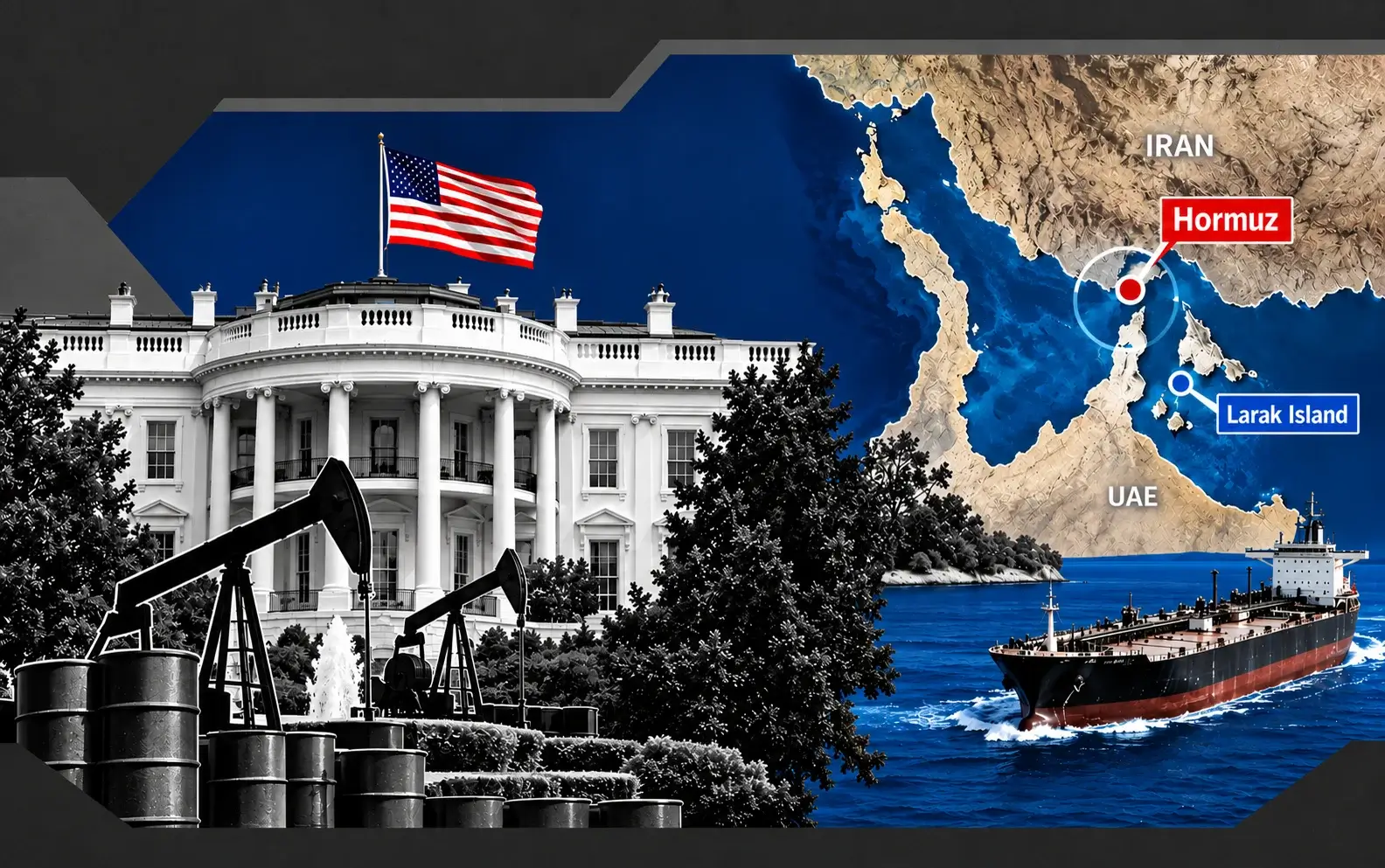
The Strait of Hormuz has been effectively closed since the conflict erupted on February 28, and the strait normally carries roughly 20% of the world's oil and liquid natural gas supply on any given day. The current configuration reads as follows: Iran has severely restricted shipping through the strait in retaliation for U.S. and Israeli strikes, Tehran warned this month that any vessel approaching the strait would be targeted, and the U.S. responded by announcing forces would intercept or turn back vessels traveling to or from Iranian ports. The blockade has now stretched into its third month with no genuine breakthrough on the diplomatic side. BBC Verify analysis confirmed at least four vessels tracked from Iranian ports appear to have crossed the U.S. blockade line, suggesting some workaround flows are happening at the margin but not enough to materially relieve the supply chokehold. The International Energy Agency flagged that global oil supply plunged by roughly 10 million barrels per day in March, the largest "disruption in history" by their own characterization. Iranian oil tankers are reportedly piling up outside Hormuz as the U.S. blockade tightens, and Chinese oil tankers have been attempting exits with mixed success. The first LNG tanker reportedly broke the Hormuz blockade earlier in the cycle, but those isolated successes do not change the macro picture of physical flows running 50% to 70% below pre-war volumes through the world's most critical energy chokepoint. Tehran's latest diplomatic proposal calls on the U.S. to lift the naval blockade of Iranian ports while sidestepping the nuclear weapons question entirely — a non-starter framing that Trump explicitly rejected this week. Iranian officials have stated they could withstand the blockade by using alternative trade routes, but the macroeconomic data tells the opposite story. Iran's annual inflation rate has climbed to 53.7% according to the country's Statistical Center. The Iranian rial has fallen to a record low. Roughly two million Iranians have lost their jobs directly or indirectly because of the war, per the Iranian government's own admission last week. The economic squeeze is working — the question is whether Tehran breaks before the global energy market does.
The Wartime Peak Just Got Tested — And It's About to Break
The cleanest technical read on the Brent (BZ=F) chart is the relationship between the current $119.40 print and the prior wartime high just under $120 per barrel. Brent dropped to $90 a barrel on April 17 after the temporary ceasefire announcement and has now climbed steadily across 12 consecutive sessions back toward the wartime peak. The June Brent contract — where the front-month action sits — printed $117.81 with a 5.9% one-day gain, while the July contract (where rolling volume is now concentrating) hit $109.92 with a 5.3% advance. The front-to-back curve dynamic matters enormously for anyone reading the market correctly. Short-term oil contracts are pricing higher than long-term contracts, a structural backwardation pattern that signals immediate supply tightness compared to expectations of looser conditions later in 2026 once traders price the war ending. That curve shape is exactly what energy strategists watch for as a real-time read on physical supply stress. WTI (CL=F) at $106.37 to $107.30 has cleared the prior monthly highs and printed the highest level since the early April peak. The 8-day cumulative gain of nearly 30% across both benchmarks marks the cleanest sustained rally the energy complex has produced since the war erupted, and it is happening into a backdrop where Goldman Sachs has raised its oil price forecast yet again and SEB Bank Chief Analyst Bjarne Schieldrop wrote that "alarm bells will ring loudly if the Strait of Hormuz doesn't reopen during May." Schieldrop's framing of the timeline matters: if no reopening occurs before June or July, the risk grows significant for "a real crisis where the world may be forced to reduce its oil consumption closer to the level of availability." That is not a recession scenario — that is a forced demand-destruction scenario where physical shortages reset consumption patterns globally. The World Bank forecast on Tuesday that energy prices would surge by 24% in 2026 to the highest level since Russia's full-scale invasion of Ukraine four years ago, conditional on the most acute disruptions ending in May. Every additional week the disruption persists pushes that forecast higher.
The Corporate Earnings Confirmation — BP, TotalEnergies, Phillips 66 All Printing
The energy supermajors have become the cleanest real-money confirmation of the supply-shock thesis, and the corporate earnings reports landing across this week tell the story without ambiguity. BP (BP) profits more than doubled in Q1 2026 as the Iran war drove oil prices higher, with BP shares up 20% since the war began — leading all the supermajors on relative performance. TotalEnergies (TTE) raised its dividend as oil trading profits surged through the quarter, capitalizing on the volatility and dislocations in physical crude markets. Phillips 66 (PSX) beat Q1 estimates by $0.88 per share as refining margins surged on the spread between elevated crude inputs and even higher product prices. Sinopec posted 28% higher profit in Q1 driven by elevated oil prices. Saudi Aramco (2222.SR) saw record $19.50 premiums on Asian crude pricing during the height of the supply squeeze, although the Saudis are eyeing sharp cuts to June Asia prices as the curve dynamics shift. Exxon Mobil (XOM) and Chevron (CVX) both stand to report earnings later in the week, and the bar for both names has been raised by the supermajor cohort already printing. Eni and Repsol are betting big on post-Maduro Venezuela as Western oil capital looks for non-Hormuz supply alternatives. Shell (SHEL) is committing $16.4 billion to Canadian gas in a major LNG growth push. The capital allocation pattern across the integrated majors confirms that management teams running real money believe the elevated price environment persists into 2027 rather than reverses on a single peace headline. The trade for energy equities is structurally aligned with the underlying commodity at this point, and the cohort has run accordingly.
The UAE Just Quit OPEC — And the Cartel's Pricing Power Is Fragmenting
The United Arab Emirates announced its departure from OPEC and OPEC+ effective May 1, marking the most significant fragmentation of the cartel's coordination structure in decades. The timing could not be worse for cartel discipline — the UAE exit lands precisely as the Strait of Hormuz sits closed and Middle East producer alignment matters most for managing the supply response to the Iran war. Barclays sees UAE oil supply growth accelerating post-OPEC as the country pursues independent production targets without the quota constraints that OPEC membership imposed. Dutch bank ING strategists wrote that the UAE exit represents "a big blow" to OPEC and would certainly be welcomed by Trump as it erodes the cartel's influence in the oil market while benefiting importers and consumers over the long run. The near-term price impact has been muted because the Hormuz crisis is dominating the tape, but the medium-term implications are structural. OPEC will survive the UAE exit, but the medium-term supply threat is real — particularly if Saudi Arabia responds by reasserting market discipline through production cuts, or if other smaller producers follow the UAE path and exit independently. The EU has warned that the energy crisis from the Iran war could last years and is urging Southeast Asia to diversify oil supply without leaning on Russia. Germany scrambled for Polish oil routes after Russia halted Druzhba flows. Pakistan's prime minister disclosed that oil import costs are up 167% since the Iran war began, capturing the magnitude of the strain on energy-import-dependent emerging markets. Saudi Arabia holds the key swing variable in the post-UAE structure — a decision to lean into spare capacity to take UAE market share would actually weaken the cartel's pricing power further, while a coordinated production cut alongside the remaining OPEC+ members could partially offset the UAE departure but at the cost of sustaining elevated prices that work against Trump's domestic political interests.
Asian Demand Is Cracking Underneath Higher Prices
The demand-side story has begun to fracture in a way the bull case for oil prices needs to honestly engage with. China's LNG imports collapsed to a six-year low as prices surged through April, with the country's metals boom hitting the highest profit levels since 2016 even as energy import volumes dropped sharply. Asia's LNG imports hit a 7-year March low as the war choked Qatari supply through the Strait of Hormuz. Japan's top utility JERA has secured LNG supply through July but cancelled a long-term LNG deal with Commonwealth, signaling a broader retrenchment from forward energy commitments. India's renewable surge cut fossil fuel power use in 2025, and a heatwave has now boosted India's power demand to a record high — creating the dynamic where rising electricity demand collides with elevated fossil fuel prices and accelerates renewable build-out as a structural offset. China may restart fuel exports in May as domestic stockpiles surge, and the country will allow higher fuel exports through the month — both signals that Beijing is repositioning to capitalize on global product price spreads while managing its own consumption patterns. The IEA's Birol said the Iran war will permanently cut into future oil demand, framing the structural shift away from oil dependency as one of the lasting consequences of the conflict regardless of how it ultimately resolves diplomatically. The demand destruction read is real — but it is happening too slowly to offset the immediate supply shock from Hormuz, which means the price tape continues to work higher despite the longer-term demand erosion underneath.
The U.S. Is the Marginal Beneficiary — And the Most Resilient Economy
The United States is the marginal beneficiary of the global energy shock through three distinct channels that pull against the broader inflationary pressure showing up in U.S. CPI data. The U.S. is a net energy exporter, which means rising crude prices flow through to trade balance improvements and revenue gains for domestic producers. U.S. crude oil exports surged to a record this week, capitalizing on the international price premium. The Permian Basin and shale producers have ramped output to capture the elevated pricing, and Continental Resources, Pioneer Natural Resources (now part of ExxonMobil), Diamondback Energy (FANG), and EOG Resources (EOG) have all benefited from the curve structure. The United States is described as the most resilient economy to the energy shock — until it isn't. The vulnerability point is the consumer fuel passthrough. The U.S. national average for regular gasoline hit $4.18 per gallon according to AAA, breaking the prior April 9 peak of $4.17 and printing the highest level since August 2022. The pre-war benchmark on February 28 was $2.98, meaning gasoline has surged 40% in two months. Bank of America Institute deposit data shows just over 10% of U.S. households now spend at least 10% of disposable income on gasoline alone, the highest share since 2022 when nearly 15% of households were squeezed that hard. The New York Fed's March consumer survey pinned year-ahead gas-price expectations at 9.4%, the highest since March 2022. March CPI printed +0.9% month-over-month and +3.3% year-over-year, with energy up 12.5% on the month and gasoline alone surging 21.2%. Those data points are exactly why the Federal Reserve cannot deliver the rate cut Trump has been demanding — the inflation channel is mechanically locked into "higher for longer" until oil rolls over.
The Equity Market Reaction — Energy Wins, Travel Loses, Tech Holds
The cross-asset response to the oil shock has been clean and informative across the U.S. equity tape. Energy stocks have been the cleanest beneficiaries: Chevron (CVX) has been a relative winner alongside ExxonMobil (XOM), TotalEnergies (TTE), and BP (BP). The supermajors are pricing the elevated environment as durable rather than transitory, and the dividend increases at TotalEnergies confirm management confidence in sustained cash flow generation. The losers cluster around energy-import-sensitive sectors. Booking Holdings (BKNG) swung between losses and gains after the online travel company said the Iran war is affecting results and is keeping potential customers from booking rooms — the company expects the conflict to continue affecting business through the end of June, with travel impact extending beyond the Middle East into major transit corridors between Europe and Asia. Expedia Group (EXPE) has tracked Booking lower in sympathy. Visa (V) jumped 8.8% after delivering stronger results than analysts expected, with CEO Ryan McInerney noting consumer spending remained resilient — the cross-border payments line is the part of the V print that mattered most because it held up despite weaker travel demand visible at Booking. Starbucks (SBUX) climbed 10% after better results than expected, with management noting customers spent more per visit, particularly in North American stores. GE Healthcare Technologies (GEHC) dropped 12.6% after missing analyst forecasts. Robinhood Markets (HOOD) tumbled 13% on softer-than-expected profit growth tied to the crypto revenue collapse. The major U.S. indexes were mixed: the S&P 500 (^GSPC) slipped 0.1% to 0.15%, the Dow Jones Industrial Average (^DJI) fell 314 points or 0.6%, the Nasdaq Composite (^IXIC) held virtually unchanged ahead of the Big Tech earnings flood. European markets sold harder as the energy shock hit harder. The FTSE 100 closed down 1.2%, the pan-European Stoxx 600 dropped 0.7%, France's CAC lost 0.39%, and Germany's DAX declined 0.27%. Asian markets actually rebounded across the session as the regional risk premium repriced — Hong Kong's Hang Seng jumped 1.7% in one of the strongest moves globally.
Read More
-
Yen Stalls at 160 Despite a 3% JGB and Tokyo Core CPI at 2.0% — Intervention Sits at 164, Friday's Payrolls Decide
02.09.2026 · TradingNEWS ArchiveEnergy
-
CHAT Fund Holds $96.37 as Korean Memory and Chip Exposure Drive a 109.73% Year — Break of $98.02 Opens $105.20
18.09.2026 · TradingNEWS ArchiveStocks
-
First-Generation XRPR and XRPI Ride XRP's Rebound to $1.386 as Spot Funds Post First Outflow — Break of $1.40 Opens $1.54
18.09.2026 · TradingNEWS ArchiveCrypto
-
NG Holds $2.9255 as Storage Surplus Narrows From 5.5% to 3.7% in 3 Weeks — Break of $3.00 Opens $3.15
18.09.2026 · TradingNEWS ArchiveCommodities
-
Dollar Surges to 157.90 as BoJ's Divided Hike Fails to Lift the Yen — Break of 158.87 Opens 159
18.09.2026 · TradingNEWS ArchiveForex
The Forecast Stack — Goldman, El-Erian, McNally, and the $200 Tail Risk
The professional forecasting community has lifted oil price targets in lockstep with the supply shock, and the dispersion across the forecasts captures the binary nature of the trade. Goldman Sachs has raised its oil price forecast yet again, joining the broader analytical consensus that pushed forecasts higher across the past two weeks. Mohamed El-Erian described the Iran war timeline as a "volatile wildcard" with the conflict potentially lasting several more months. He framed the dynamic as a "high-stakes economic game of chicken" with the central question being which side blinks first — and noted that Iran is imposing economic dislocations on the U.S. and, more consequentially, on most of the rest of the world. Bob McNally, the president of Rapidan Energy Group and former White House energy advisor, sees only a one-in-five chance that the U.S. would be able to reopen the Strait of Hormuz through a peace deal. McNally speculated the market could soon see a "mad scramble" for available reserves as supply runs low, leading to a global hoarding problem that pushes prices higher still. David Morrison, senior market analyst at Trade Nation, pointed to the front-month curve dynamic as evidence of physical supply tightness pressing on near-term contracts compared to longer-dated futures. Lindsay James, investment strategist at Quilter, noted that the war's impact in the UK has been largely limited to higher petrol and diesel so far, but every additional day without supply resumption raises the risk of physical shortages and steeper price rises across a broader range of goods. The most aggressive scenario floating in the analytical community is a Persian Gulf shock that could send crude toward $200 per barrel — an outcome that would require either direct U.S.-Iran kinetic escalation, a complete shutdown of the Strait of Hormuz with no workaround flows, or a coordinated Gulf supplier disruption that takes additional barrels offline. None of those tail scenarios are base cases, but the probability has risen meaningfully across the past two weeks.
The Bear Case — Why Oil Could Crack Hard If Hormuz Reopens
Honest framing of the bear case for oil prices requires engaging with the variables that could flip the tape lower without warning. A genuine Iran-U.S. peace deal that reopens the Strait of Hormuz triggers an immediate supply normalization that could drive Brent (BZ=F) below $90 per barrel within days — exactly the move the market saw in mid-April when the temporary ceasefire was announced. Iran is feeling the economic pain at a level that creates real incentive to negotiate: 53.7% inflation, record-low rial, two million job losses, and an oil export pipeline that has effectively run dry. Tehran's alternative trade routes claim has not been validated by independent flow data, and the regime described its own situation as "a State of Collapse" in communications with the U.S. earlier this week. Trump has explicitly stated his preferred path is the blockade rather than escalation, which means a face-saving framework that lets both sides claim victory remains the most plausible peace outcome — and it could land suddenly. The UAE exit from OPEC could ultimately weaken the cartel's pricing power if Saudi Arabia pursues market share rather than coordinated cuts, layering structural downside onto any cyclical relief. Asian demand is already fracturing under elevated prices — China's LNG imports at a six-year low, Japan's retrenchment from long-term LNG commitments, India's renewable substitution accelerating, and the broader IEA assessment that the war will permanently cut future oil demand. Demand destruction is a slow-moving variable, but it eventually shows up in the price tape if the supply shock resolves and producers are left with overcommitted barrels into a softer demand environment. The U.S. crude oil exports record print this week is itself a potential bearish signal — domestic shale producers are responding to elevated pricing by ramping output aggressively, and that incremental supply hits the market with a lag of two to three quarters before pressuring prices lower.
The Verdict — Buy Energy on Dips, Hold WTI Long Above $100, Sell Only on Hormuz Reopening
Brent crude (BZ=F) at $117.81 to $119.40 and WTI (CL=F) at $106.30 to $107.30 sit at the cleanest momentum setup the energy complex has produced in two months running, and the catalyst stack supporting the rally is structurally durable rather than headline-driven. The bull case requires the Strait of Hormuz to remain closed through May, Trump to maintain the blockade posture without backing down, Iran to refuse the U.S. nuclear framework, OPEC to absorb the UAE exit without rapid production response, and the asian demand destruction to lag the supply tightness rather than overtake it. All five conditions are currently in place. The bear case requires either a sudden peace deal reopening Hormuz, Saudi Arabia flooding spare capacity, or U.S. shale ramping output faster than the supply shock can compound. None of those three conditions are imminent. The level map for the trade: Hold long oil exposure above $100 on WTI with the Hormuz closure as the structural underpinning. Buy aggressively on any flush below $100 on WTI or below $112 on Brent because those levels provide the cleanest entry against the supply-shock thesis and are likely to be defended by physical buyers covering immediate consumption needs. Sell only on a clean break of $95 on WTI combined with confirmed Hormuz reopening news — that combination would invalidate the war-premium thesis and trigger the rapid normalization back toward $80. The first target on Brent sits at $119.40 (the wartime high already touched today). The second target sits at $125 if Hormuz remains closed through mid-May. The third target sits at $140 in a Persian Gulf escalation scenario that pulls additional barrels offline. The tail-risk target of $200 requires direct kinetic escalation that no current policy framework supports — but the probability is no longer zero. For energy equity exposure: Buy CVX, XOM, BP, TTE, and PSX as the cleanest supermajor proxies for the elevated-price environment, with TTE offering the cleanest dividend-growth setup and BP offering the highest beta to the war premium. Hold OXY (Occidental Petroleum) and EOG on the U.S. shale side as second-derivative beneficiaries of the export-record dynamic. Sell BKNG and EXPE on rallies because the travel sector cannot recover until Hormuz reopens. The position thesis at current levels is structurally bullish — oil is not pricing for failure, it is pricing for sustained disruption that the supply chain genuinely cannot resolve quickly. Anyone trading the four-hour chart should respect the parabolic move and wait for either confirmation above $120 on Brent with volume or a flush back to $112 with momentum reset before sizing up. Anyone running a multi-month book should treat the current $117 to $119 zone as accumulation territory ahead of the May seasonal demand pattern that historically tightens crude further. The asset trading with the Strait of Hormuz closed for the first time in modern oil-market history, Brent above $119 and approaching wartime highs, U.S. blockade policy locked in for months rather than weeks, OPEC fragmenting via the UAE exit, U.S. crude exports at record levels, gasoline at $4.18 per gallon and 40% above pre-war, March CPI at 3.3% with energy at +12.5%, and the Federal Reserve locked into a hold-and-wait posture is not a sell. It is a Buy on weakness, a Hold long across multi-week horizons, and a structurally bid commodity trading at a discount to where the policy framework and physical supply data say it should be. The market is pricing oil for a slow grind higher. The catalyst stack supports a violent acceleration. That gap between price and reality is exactly where the trade lives — and the next 96 hours of Powell commentary, U.S.-Iran diplomatic posturing, and Hormuz physical-flow data decide whether Brent breaks $120 cleanly toward $130 or chops in the current range while the supply shock continues to compound underneath the surface.