Pound Jumps to $1.3377 as the Dollar Tumbles on the Jobs Miss — but the $1.32 Political Low and $1.35 Cap Box Cable In
GBP/USD ripped 0.7% to a two-week high near $1.3377 after June US payrolls printed just 57,000 versus 115,000 expected | That's TradingNEWS
GBP/USD is trading near $1.3377 into the July 4 weekend, up roughly 0.7% on the day and at a two-week high after the soft US jobs report triggered heavy dollar selling. That looks like a sterling win. It is mostly a dollar loss — the bounce comes off a seven-month low near $1.32 that the pound carved out just days ago, dragged there by a UK-specific political shock rather than any dollar strength. The move up is the external story lifting cable off a floor that domestic turmoil built.
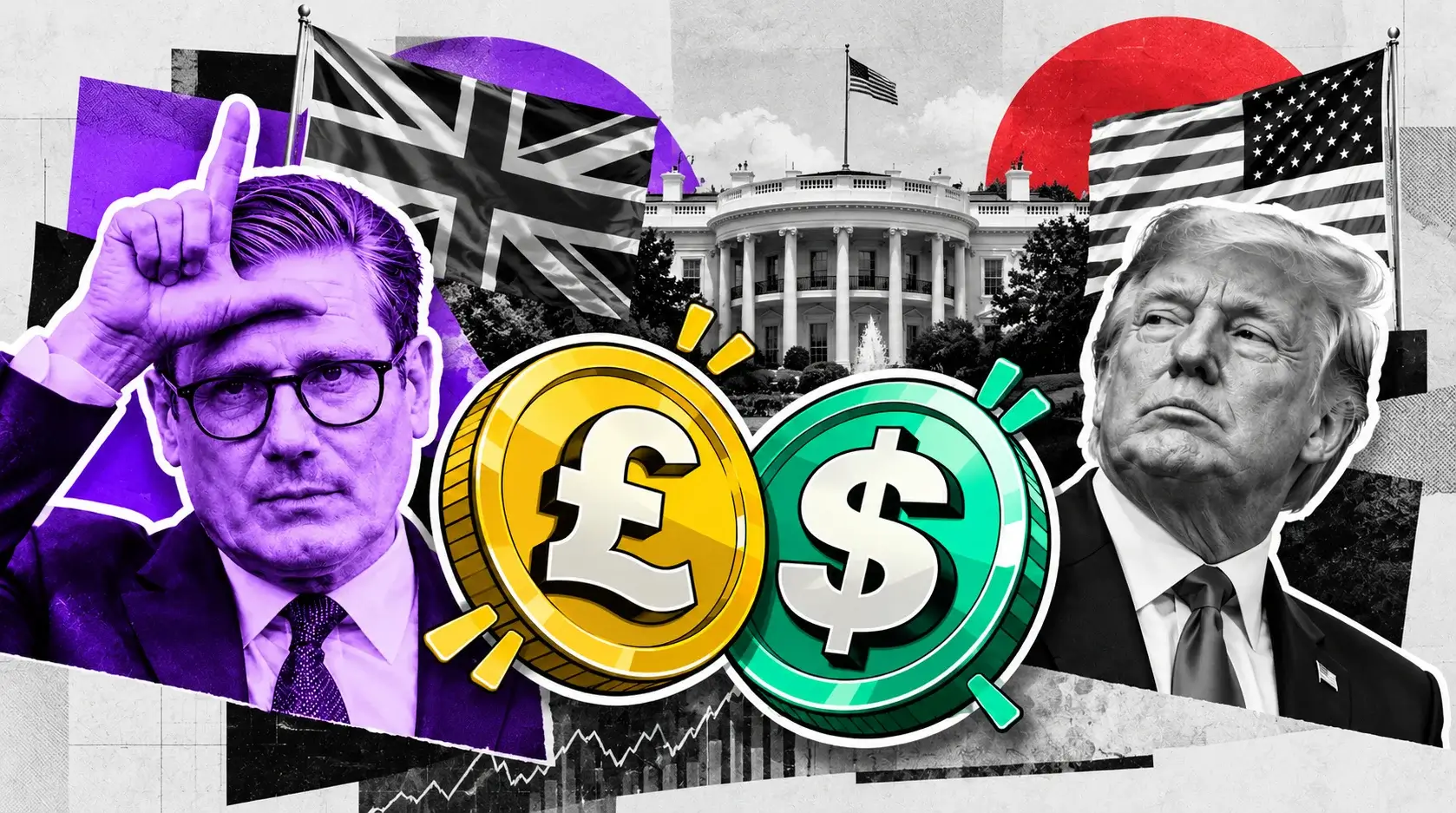
The thesis is a two-front battle. On the external front, the June US payrolls print of 57,000 against a 115,000 consensus hammered the dollar, cut September Fed hike odds to roughly 50% from 67%, and pulled the Dollar Index off its 101.80 highs toward 101.00 — a clean tailwind for cable. On the domestic front, the pound is carrying a political and fiscal overhang: Prime Minister Keir Starmer resigned, the Chancellor is being replaced, a Labour leadership contest is underway, and the Bank of England has pulled back rate-hike bets as oil fell. Those two forces are pulling GBP/USD in opposite directions, and the pair is pinned between them.
That tug-of-war is why the bounce is capped. The soft Fed is bullish for cable, but the UK political uncertainty is bearish, and the two roughly offset. The pound surged to $1.3377 on the dollar's tumble, but it is doing so from a seven-month low, which tells you the domestic weight has been the dominant force. Sterling fell more than 1.4% against the dollar in June on the political shock, a stronger dollar, and shifting rate expectations — and the jobs-driven bounce is the first real push against that decline.
GBP/USD at $1.3377 sits between the $1.32 political low and the $1.34-$1.35 resistance that has capped it, well below the $1.3850 high from January. Bank of England Governor Andrew Bailey has turned moderately hawkish this week — saying rate cuts are off the table — which gives sterling some support, and two BoE members dissented in favor of a hike. But the political transition is the weight. The July 29 Fed and July 30 BoE meetings, plus the Labour leadership contest, are the catalysts that break the range. Everything below builds that out.
The 57,000 US Jobs Print and the Dollar's Tumble
The dollar tumble is the external engine of cable's bounce. June nonfarm payrolls rose just 57,000, less than half the 115,000 the desks expected and the weakest gain in several months, with downward revisions to April and May confirming the US labor market is not as resilient as previously thought. The unemployment rate fell to 4.2% only because participation dropped. The dollar sold off hard on the release, and GBP/USD surged to its two-week high as the greenback gave back ground across the board.
The rate-market read is what drove the move. The soft print cut the odds of a September Fed hike to roughly 50% from 67%, and the Dollar Index eased toward 101.00, down from its 101.80 one-year high. For cable, a weaker dollar mechanically lifts the pair — GBP/USD is quoted as pounds per dollar, so dollar weakness pushes it higher regardless of what sterling itself is doing. The 0.7% jump to $1.3377 is the dollar-weakness story expressing itself through the pound.
The context is that the dollar had been strong all year, which had pressed cable lower. The Fed under Kevin Warsh signaled possible hikes at its June meeting, and that hawkish stance had supported the dollar and weighed on GBP/USD, contributing to the pound's slide toward its seven-month low. The jobs miss cracked that dollar-strength narrative, and cable caught the relief. The dollar going from the hawkish-Fed bid to the soft-jobs sell-off is the external swing that produced the bounce.
For the forecast, the dollar's reaction to the US data is the bullish variable for cable. If the labor market keeps softening and the Fed's hike odds keep falling, the dollar drifts lower and GBP/USD gets room to press toward $1.35. If the US data re-firms and the Fed's hawkish signal reasserts, the dollar climbs back and cable gets pushed toward its floor. The dollar side is currently the pound's friend, but it is only half the equation — the UK side is pulling the other way.
The UK Political Shock: Starmer's Resignation
The domestic weight on sterling is a genuine political shock. Prime Minister Keir Starmer announced his resignation, triggering a political uncertainty episode that dragged the pound to a seven-month low near $1.32. Political shocks of this kind have a specific, severe history for sterling — the 2022 Truss episode, when gilt yields spiked to levels not seen since 2008 and forced the Bank of England into emergency intervention to prevent a pension-fund liquidity crisis, remains the defining precedent for how quickly UK political turmoil can hit the pound.
The current shock is smaller in scale than the 2022 crisis but real. Starmer's resignation opened a Labour leadership contest with no clear resolution, injecting the kind of uncertainty that markets discount through a weaker currency and higher risk premium. The pound fell more than 1.4% against the dollar in June, pressured by the political uncertainty on top of the stronger dollar and shifting rate expectations. Sterling was on track for a monthly decline of over 1.5%, with the political shock the distinctly UK-specific driver separating it from the broader dollar story.
The leadership contest is the specific uncertainty markets are pricing. Andy Burnham emerged as the frontrunner to succeed Starmer and pledged fiscal discipline, which offered some reassurance, but he offered no detail on potential ministerial appointments, stating he would announce them only after the leadership contest concludes. That lack of clarity on the composition and policy direction of the next government is the overhang — markets cannot price the fiscal and policy path until the transition resolves, and uncertainty of that kind weighs on the currency.
For the forecast, the political transition is the bearish weight that offsets the dollar-weakness bounce. As long as the leadership contest remains unresolved and the policy direction unclear, sterling carries a political risk premium that caps its upside even when the dollar weakens. A smooth transition to a fiscally disciplined government would lift that premium and let cable extend higher; a messy or fiscally alarming transition would deepen the pressure and pull the pound back toward its lows. The politics are the domestic swing factor, and they are currently a drag.
The Fiscal Question: The Chancellor Reshuffle
Layered on top of the leadership contest is a fiscal question that markets watch closely for the pound. The Chancellor is being replaced — Rachel Reeves is out — and markets are assessing who takes the Treasury and what it means for UK fiscal policy. The Chancellor role is critical for sterling because it sets the fiscal path, and the 2022 crisis demonstrated how a fiscally alarming Treasury can trigger a gilt-market and currency crisis. The identity and policy stance of the next Chancellor is a direct sterling variable.
The candidates carry different fiscal signals. Andy Burnham's pledge of fiscal discipline eased some concerns, and markets have been weighing the likelihood of Ed Miliband becoming Chancellor, with fiscal concerns moderating after Burnham's discipline pledge. The reassurance is partial — the pledges provide some comfort, but without concrete appointments and a stated fiscal plan, the market cannot fully price the outcome. The fiscal uncertainty is the mechanism through which the political transition threatens the pound.
The gilt market is the transmission channel to watch. Sterling's political risk premium shows up first in UK government bond yields — a fiscally alarming transition would spike gilt yields as it did in 2022, and that gilt-market stress would drag the pound lower. So far the reaction has been contained, with Burnham's discipline pledge and the moderating fiscal concerns keeping gilt yields from spiking. But the gilt market is the early-warning system, and any sign of fiscal alarm there would hit cable directly.
For the forecast, the fiscal question is the acute risk within the broader political overhang. A credible, disciplined fiscal path from the next government would remove the risk premium and support the pound; a fiscally loose or uncertain path would revive the 2022-style fears and pressure sterling. The market is currently giving the transition the benefit of the doubt on fiscal discipline, which is why the pound could bounce to $1.3377 rather than crater. But the fiscal resolution is a binary risk that the leadership contest will determine, and it is the sharpest edge of the domestic weight.
Bailey's Mixed Signals: Cuts Off the Table
The Bank of England's stance is the third leg of the sterling story, and Governor Andrew Bailey has been sending mixed signals that turned more hawkish this week. Earlier, Bailey struck a dovish tone — telling markets the BoE was not rushing to respond to rising oil prices, that inflation was on track to return to the 2% target though later than desired, and forecasting inflation rising to about 3.2% later this year from the current 2.8%. That dovishness contributed to the pound's June weakness alongside the political shock.
This week Bailey shifted. He struck a moderately hawkish tone, suggesting that interest rate cuts are currently off the table and warning that the recent energy price spike could still have a delayed impact on inflation. That is a meaningful shift for sterling — a central bank taking cuts off the table and flagging inflation risk supports its currency by keeping rates higher for longer. A scheduled Bailey speech on Friday is a key near-term catalyst; if he repeats the hawkish tone, it could provide another lift for the pound on top of the dollar-weakness bounce.
The inflation backdrop explains the mixed messaging. UK inflation sits at 2.8%, above the 2% target, and Bailey's own forecast sees it rising toward 3.2% later this year. That above-target and rising inflation is what keeps the BoE from cutting and what underpins Bailey's cuts-off-the-table stance. At the same time, the reopening of the Strait of Hormuz and the fall in oil prices have reduced the inflation threat, which pulled back some of the BoE rate-hike bets. Bailey is balancing above-target inflation against a softening economy and falling energy prices.
For the forecast, Bailey's stance is a sterling-supportive counterweight to the political drag. His shift to cuts-off-the-table is bullish for the pound, and a hawkish Friday speech would reinforce it. The risk is that the softening UK economy and falling oil prices push the BoE back toward a dovish stance, which would remove sterling support. Bailey's messaging is the monetary-policy variable that partly offsets the political weight, and its direction at the July 30 BoE meeting is a key catalyst.
The BoE's 7-2 Hold and the Hawkish Dissenters
The Bank of England's most recent decision underscores the hawkish tilt within the committee. The BoE held Bank Rate at 3.75% on June 18 in a 7-2 vote, with two members dissenting in favor of a hike. A hawkish dissent of that kind — policymakers wanting to raise rates rather than cut — is a sterling-supportive signal, because it flags that the committee's risk is tilted toward tightening rather than easing. The two hike-dissenters are the hawkish tail that supports the pound.
The hold itself reflects the BoE's balancing act. At 3.75%, Bank Rate sits at a level the committee judges appropriate for an economy showing softening signs but above-target inflation. The May and June holds reflected the assessment that the UK economy is softening, which argues against hikes, while the above-target inflation and Bailey's cuts-off-the-table stance argue against cuts. The 7-2 vote captures that tension — a majority holding, a hawkish minority wanting more, and no doves pushing for cuts.
The hawkish dissent distinguishes the BoE from a purely dovish central bank. Two members voting to hike, combined with Bailey taking cuts off the table, means the BoE's directional risk leans hawkish even as it holds. For sterling, that is a support — a central bank whose next move is more likely a hike than a cut keeps the pound's rate appeal intact. It contrasts with the dovish turns at other central banks and gives cable a domestic monetary anchor even amid the political turmoil.
For the forecast, the BoE's hawkish tilt is a structural support for sterling that the July 30 meeting will test. If the committee maintains the 7-2 hold with hawkish dissent and Bailey's cuts-off-the-table framing, the pound retains its rate support. If the softening economy and falling oil prices push the committee dovish — the dissenters falling back in line, Bailey softening — sterling loses that anchor. The July 30 vote split and Bailey's guidance are the monetary catalysts that either reinforce or remove the pound's domestic support.
The Rate Differential: BoE 3.75% Versus Fed 3.75%
The rate differential between the two central banks is roughly neutral, which shapes how cable trades. The BoE holds Bank Rate at 3.75%, and the Fed holds its range at 3.50-3.75%, putting the two policy rates essentially level at the top end. That near-parity means the interest-rate differential — normally a primary driver of currency pairs — is not pulling cable decisively in either direction. Neither currency has a clear rate advantage, which leaves the pair to trade on relative shifts in expectations rather than the current gap.
The expectations dynamic is where the action is. With both central banks near 3.75% and both facing above-target inflation, the market trades cable on which bank's next move diverges first. The Fed under Warsh had been signaling hikes, which supported the dollar; the soft jobs print cut those hike odds, which weakened it. The BoE has a hawkish dissent and cuts off the table, which supports the pound. The relative direction of those expectations — Fed hike odds falling while BoE stays hawkish — is what lifted cable to $1.3377.
The neutral differential makes cable sensitive to the meetings. Because neither currency has a standing rate advantage, the July 29 Fed and July 30 BoE decisions carry outsized weight — they are where the rate expectations either diverge or stay aligned. A dovish Fed hold paired with a hawkish BoE hold would widen the differential in sterling's favor and push cable higher; a hawkish Fed paired with a dovish BoE would push it lower. The back-to-back meetings are the rate catalyst.
For the forecast, the neutral rate differential means cable's direction hinges on the relative policy shifts rather than the current gap. The soft-jobs-driven fall in Fed hike odds, combined with the BoE's hawkish tilt, currently favors the pound at the margin, which is part of why cable bounced. But the July meetings can flip that — a hawkish Fed or a dovish BoE would reverse the differential trade. With rates level near 3.75%, the pair trades on expectations, and the meetings are where those expectations get set.
The Technical Map: $1.32 Floor, $1.35 Cap
The chart frames cable's range around the political low and the recovery resistance. The floor is $1.32, the seven-month low the pound carved out on the political shock, backed by the $1.3165 support below it and the $1.31-$1.3110 zone that some analysts target for further weakness. The ceiling is the $1.34-$1.35 area, the resistance that has capped the recovery attempts. GBP/USD at $1.3377 sits in the upper part of that range after the jobs-driven bounce, testing the lower edge of the resistance zone.
The moving-average structure defines the medium-term as bearish but recovering. As of late June, cable was trading below its 50-day EMA by roughly 0.6% and below its 100-day EMA by about 0.93% — the signature of a downtrend, reflecting the June slide on the political shock. The 200-day SMA sits near $1.34, right at the resistance the bounce is testing. Reclaiming and holding above the $1.34 200-day average would be the first sign the medium-term structure is repairing; failing there leaves cable vulnerable to resume its decline toward the $1.32 floor.
The near-term pivots sit inside the range. Analytical pivot points cluster around $1.3306 and $1.3353, the levels desks watch for the next directional read. A hold above $1.3353 keeps the bounce alive and points toward the $1.34-$1.35 resistance; a break below $1.3306 puts the $1.32 floor back in play. The two-week high at $1.3377 is testing whether the jobs-driven momentum can carry cable through the $1.34 200-day average and the resistance zone above it.
For the forecast, the technical map follows the fundamental tug-of-war. Hold $1.32 and clear $1.34, and the dollar-weakness bounce extends toward $1.35; fail at $1.34 and lose $1.3306, and the political weight pulls cable back toward $1.32 and potentially $1.31. The $1.34 200-day average is the pivotal level — a sustained break above it eases the bearish bias and opens a more convincing recovery, while a rejection leaves the pair vulnerable to the downtrend. The battle between the $1.32 floor and the $1.35 cap is the near-term trade.
Read More
-
Yen Stalls at 160 Despite a 3% JGB and Tokyo Core CPI at 2.0% — Intervention Sits at 164, Friday's Payrolls Decide
02.09.2026 · TradingNEWS ArchiveEnergy
-
QQQ ETF ($706.22) Slides 7.4% Below Its High as the Market Reprices the AI Capex Bill — $686.57 Target if $700 Breaks
22.10.2026 · TradingNEWS ArchiveStocks
-
XRPI ($7.00) and XRPR ($10.74) Slide Toward 52-Week Lows as Spot XRP ETF Flows Stall at $708,510
22.10.2026 · TradingNEWS ArchiveCrypto
-
NG ($2.775) Decoupled From Europe’s €88 Gas Crisis as LNG Feedgas Hits 18.9 Bcf/d — $3.30 Upside on Cold Weather
22.10.2026 · TradingNEWS ArchiveCommodities
-
Dollar-Yen (157.35) Loses 157.65 as the Yen Rallies on Haven Demand — 155 Target if 156 Breaks
22.10.2026 · TradingNEWS ArchiveForex
The 2026 Round Trip: From $1.3850 to $1.32
To size the current setup, cable's 2026 round trip needs context. The pair reached its 2026 high near $1.3850 in late January, driven by a dollar-weakness narrative — expectations that the Fed would keep cutting while the BoE held at a relatively high rate, with two dissenting BoE members already voting to hike providing sterling support via carry demand. That was the high-water mark, and cable has been trending lower ever since, down roughly 4% from the January peak.
The descent came in waves tied to external shocks. The Strait of Hormuz conflict and US tariff threats drove a broad risk-off episode in March, taking cable back to approximately $1.29 and erasing most of the year's gains in weeks. The pound recovered through April and May as ceasefire hopes improved sentiment, climbing back to the mid-$1.34s. Then the week of June 16-22 reshaped the outlook — the BoE held at 3.75%, the Fed turned hawkish, and Starmer resigned, combining a hawkish-Fed dollar bid with a UK political shock to push cable toward its seven-month low.
The round trip illustrates cable's sensitivity to both sides. The January high was built on dollar weakness and BoE hawkishness aligning in sterling's favor; the June low was built on dollar strength and UK political turmoil aligning against it. The pair has swung between those extremes on the interplay of the external dollar story and the domestic UK story. The current bounce to $1.3377 is the dollar side turning favorable again, but from a low that the domestic side built — the same two-front dynamic that has driven the whole year.
For the forecast, the 2026 pattern shows what it takes to move cable durably in each direction. A sustained rally back toward the $1.3850 high requires both the dollar to weaken and the UK story to improve — the alignment that drove the January peak. A move back toward $1.29 requires both a dollar bid and UK turmoil — the alignment that drove the March low. The current setup has the dollar side favorable but the UK side uncertain, which is why the bounce is capped in the range rather than trending. Both fronts need to align for a durable move.
Sterling Versus the Euro: A One-Year High
While cable trades in its range against the dollar, sterling has been outperforming the euro, and that cross tells a useful story. GBP/EUR hit a one-year high as the single currency weakened on softer-than-expected European inflation data, with Eurozone CPI cooling to 2.8% and ECB President Lagarde turning dovish at Sintra. Sterling's strength against the euro, even as it weakened against the dollar, shows the pound's troubles are relative — it is being dragged down by dollar strength and its own politics against the dollar, but it is holding up against a euro with its own dovish central bank.
The divergence between the two crosses is instructive. Against the dollar, cable fell to a seven-month low on the political shock and dollar strength. Against the euro, sterling rose to a one-year high because the BoE's hawkish tilt — cuts off the table, two hike-dissenters — contrasts favorably with the ECB's dovish turn after its June hike. The pound is stronger than the euro on the monetary-policy comparison, even as both are weaker than the dollar. The BoE's relative hawkishness is sterling's anchor on the euro cross.
The cross dynamic matters for the cable forecast because it isolates the drivers. The pound's weakness against the dollar is primarily a dollar story and a UK political story; its strength against the euro is a monetary-policy story favoring the BoE over the ECB. That separation suggests that if the dollar weakens further and the UK political transition resolves smoothly, sterling has room to recover against the dollar the way it has against the euro — the BoE's hawkish tilt would then support cable, not just the euro cross.
For the forecast, the euro cross is a signal that sterling's fundamentals are not uniformly weak. The pound's one-year high against the euro shows the BoE's relative hawkishness is a genuine support that has been overwhelmed against the dollar by the dollar's strength and the UK politics. If those two headwinds ease — a softer dollar, a smoother transition — the same BoE hawkishness that lifted GBP/EUR could lift GBP/USD. The euro cross is the tell that sterling has an underlying support the cable price is currently masking.
The Bank Forecasts: 1.36 to 1.47
The institutional forecasts cluster bullish for cable into year-end, resting on dollar weakness. The broad consensus among major banks is that GBP/USD rises modestly from around $1.33 by year-end, primarily because they assume the dollar will weaken as Fed rate expectations normalize. Goldman targets 1.36, Scotiabank 1.37, and Morgan Stanley's bull case reaches 1.47 — all above the current level, and all built on the premise that the dollar's 2026 strength fades as the Fed's hike path comes off the table.
The aggregated forecasts point to a gradual climb. Exchange Rates UK's weighted quarterly projections see cable at 1.3355 by September 2026, 1.3467 by December 2026, and 1.3560 by March 2027 — a modest but steady appreciation from current levels. The path assumes the dollar softens and the UK political and fiscal uncertainty resolves without a crisis. The soft US jobs print that lifted cable to $1.3377 is consistent with that dollar-weakness thesis beginning to play out.
The bearish forecasts provide the counterweight. UOB sees scope for further pound weakness toward 1.3110, and Credit Agricole is cautious on sterling, forecasting further weakness against both the euro and dollar. The bear case rests on the UK political and fiscal uncertainty deepening, the BoE turning dovish as the economy softens, or the dollar reasserting its strength. Those risks are real given the unresolved leadership contest and the softening UK economy that Bailey has acknowledged.
For the forecast, the bank consensus leans toward modest cable appreciation, conditional on dollar weakness and a smooth UK transition. The $1.36-$1.37 year-end targets from Goldman and Scotiabank imply upside from $1.3377, and the soft-jobs-driven bounce is the first step. But the forecasts assume the UK politics resolve without a crisis and the dollar keeps softening — two conditions that are not guaranteed. The dispersion between the 1.31 bear case and the 1.47 bull case reflects the two-front uncertainty that defines cable right now.
The Two Meetings and the Leadership Contest
Three events will resolve cable's direction, and they cluster into the coming weeks. The Fed meeting lands July 29 and the BoE meeting July 30 — back-to-back central bank decisions that will set the rate expectations driving the pair. Alongside them, the Labour leadership contest to replace Starmer will resolve the political and fiscal uncertainty weighing on the pound. Together, the two meetings and the contest are the catalysts that break cable out of its $1.32-$1.35 range.
The Fed meeting is the dollar's test. With September hike odds cut to 50% after the jobs miss, the market expects a hold, but the guidance is what matters — whether Warsh's Fed keeps the hike alive or signals the softening labor market has shelved it. A dovish hold weakens the dollar and lifts cable; a hawkish hold supports the dollar and caps it. The July 8 FOMC minutes are the preview, and the July 29 decision is the event that sets the dollar's direction.
The BoE meeting is sterling's test. With Bank Rate at 3.75% and a 7-2 hold with hawkish dissent last time, the market wants to know whether the committee maintains its hawkish tilt or turns dovish as the economy softens and oil falls. Bailey's cuts-off-the-table stance points to a hawkish hold, which would support the pound. A dovish shift — the dissenters falling in line, Bailey softening — would remove sterling's rate anchor. The July 30 vote split and guidance are the pound's monetary catalyst.
For the forecast, the combination determines the breakout. The bullish trigger is a dovish Fed on July 29 paired with a hawkish BoE on July 30 and a smooth resolution of the leadership contest — the alignment that would push cable through $1.35 toward the bank targets. The bearish trigger is a hawkish Fed, a dovish BoE, or a messy political transition — any of which would pull cable back toward $1.32 and potentially $1.31. The two meetings and the contest are the events that resolve the two-front tug-of-war.
The Forecast and the Levels That Decide It
GBP/USD heads into mid-July at $1.3377, bounced to a two-week high on the dollar's post-jobs tumble but capped by the UK political overhang that dragged it to a $1.32 seven-month low. The forecast is a range-bound tug-of-war with a modest upward bias, conditional on the meetings and the transition. The weight of evidence — a soft US jobs print weakening the dollar, the BoE's hawkish tilt with cuts off the table and two hike-dissenters, and bank targets clustered at $1.36-$1.37 — leans toward cable grinding higher if the dollar keeps softening and the UK politics resolve smoothly.
The levels that decide it are precise. On the upside, a sustained break above the $1.34 200-day average opens the $1.35 resistance, and beyond that the path toward the bank targets and the $1.3850 January high. On the downside, a break below the $1.3306 pivot puts the $1.32 political low back in play, with $1.3165 and $1.31 below it if the transition turns messy. Between those lines, cable chops as the dollar-weakness bounce fights the political overhang, with the $1.34 200-day average the pivotal level.
The catalysts to track are specific and clustered. Bailey's Friday speech is the near-term sterling read — a repeat of the hawkish tone lifts the pound. The July 8 FOMC minutes preview the Fed. The July 29 Fed and July 30 BoE meetings are the rate catalysts that set the differential. And the Labour leadership contest is the political resolution — a smooth, fiscally disciplined transition lifts the pound, a messy one pressures it. The gilt market is the early-warning system for the fiscal risk.
The one-thesis read holds from top to bottom: GBP/USD's bounce to $1.3377 is a dollar-weakness move off a $1.32 political low, and cable is now a tug-of-war between a soft Fed that lifts the pound and the UK's leadership and fiscal turmoil that weighs on it. The pair is pinned between $1.32 and $1.35 until either the dollar or the domestic story breaks the deadlock. The BoE's hawkish tilt and the softening dollar lean the bias higher; the political overhang is the drag. The confirmation of the bullish case is a break above the $1.34 200-day average with the leadership contest resolving smoothly — the alignment that turns the jobs-driven bounce into a recovery. Until then, cable trades the two-front battle, and $1.34 is the line that matters most.