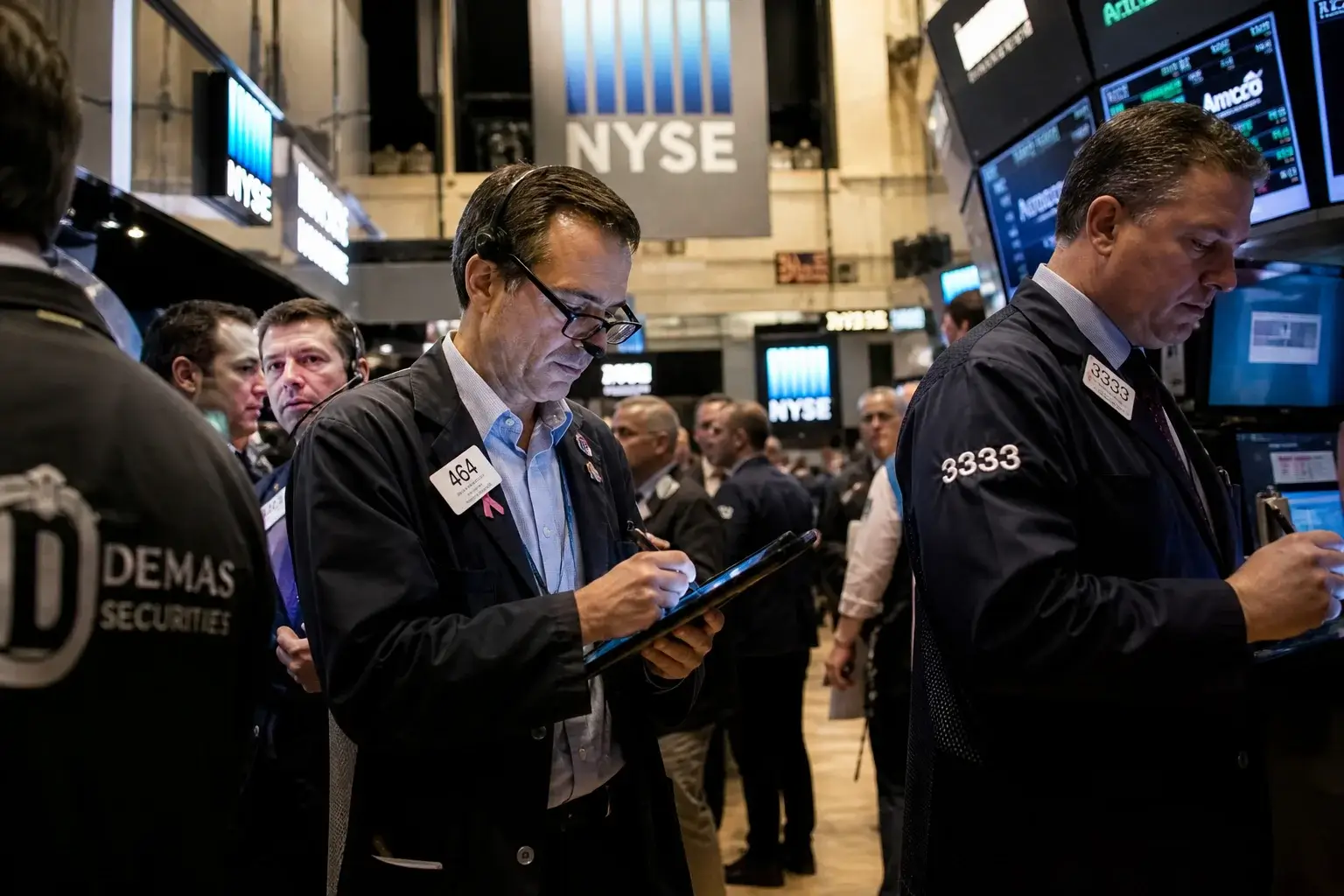
Stock Market Today: Dow Drops 174 Points on Hormuz Tensions; eBay Rockets 6.5% on $56 Billion GameStop Takeover Offer
S&P 500 (SPX) holds at 7,235 and Nasdaq (COMP) climbs to 25,163 as semiconductors hit fresh records | That's TradingNEWS
Key Points
- Dow (DJIA) drops 174 points to 49,325.15 (-0.35%); S&P 500 (SPX) holds at 7,235.50 (+0.07%); Nasdaq (COMP) advances to 25,163.25 (+0.19%)
- eBay (EBAY) surges 6.52% to $110.86 after GameStop (GME) launches unsolicited $56 billion takeover bid at $125 per share; GME slides 7.03% to $24.66.
- UPS plunges roughly 9% and FedEx (FDX) drops more than 7% after Amazon (AMZN) launches Supply Chain Services with P&G, 3M, and American Eagle as inaugural clients
Monday's open had the unmistakable rhythm of a session where headline risk runs the show and fundamentals show up late to the meeting. The Dow Jones Industrial Average (DJIA) was bleeding 174 points to 49,325.15, off 0.35%, weighed down by a logistics rout and a defensive rotation out of cyclicals. The S&P 500 (SPX) was scratching out a four-point gain to 7,235.50, up 0.07% — barely green, but green enough to keep the record-chase narrative alive. The Nasdaq Composite (COMP) added 47 points to 25,163.25, up 0.19%, riding the same chip wave that's been doing the heavy lifting all year. The real flex came from the Russell 2000 (RUT), climbing 0.45% to 2,825.44 and printing its first intraday all-time high in nearly two weeks — the small-cap gauge's fourth record of 2026, which is quietly one of the most underdiscussed signals on the tape.
Volatility woke up, then went back to sleep. The Cboe Volatility Index (VIX) spiked as high as 18.88 in the predawn hours — its loftiest read since late April — before easing back to 17.29, up 1.77%. The U.S. 10-Year Treasury yield climbed to 4.425%, with the two-year north of 3.94% and bond traders unwilling to sit still while oil pricing was being rewritten in real time. The U.S. Dollar Index firmed 0.10% to 95.18 in one quote system and 98.32 in another (depending on the basket weighting and source), but the directional signal was the same: capital is parking in dollars while the Strait situation gets sorted. Gold went the other way, dropping 1.36% to $4,581.20 — proof that under genuine geopolitical risk, energy and the greenback are eating the safe-haven flow, not the metal.
Project Freedom Hits The Water And The Tape Reacts
The trigger for all the predawn fireworks was President Trump's "Project Freedom" announcement on Truth Social — a U.S. plan to start guiding stranded commercial vessels out of the Strait of Hormuz beginning today. The plan stops short of formal naval escorts, which the Wall Street Journal's reporting confirmed, but does include enforcement of a naval blockade on Iranian ports. Trump's social-media post warned that any interference with the "humanitarian process" would "have to be dealt with forcefully" — a phrasing the oil pits read exactly the way it was written.
Tehran answered fast. Iran's navy claimed it had blocked "American-Zionist" warships from entering the strait, per state TV. Then Fars News Agency reported that two missiles had struck a U.S. Navy frigate near Jask Island after it ignored warnings — a claim picked up by Press TV. U.S. Central Command (CENTCOM) rejected the strike narrative outright, posting on X that "no U.S. Navy ships have been struck" and confirming that two U.S.-flagged merchant vessels had successfully transited the waterway. A Reuters dispatch citing a senior Iranian source softened the original Fars reporting, suggesting only a warning shot had been fired with no clarity on whether anything actually connected — language consistent with CENTCOM's denial of a hit. The United Arab Emirates added its own complication, confirming that an Abu Dhabi National Oil Company tanker was struck by two Iranian drones. U.S. military leadership separately warned vessel owners that Iranian-laid mines are now scattered across the strait. The UK Maritime Trade Operations logged a separate report of a tanker struck by projectiles 78 nautical miles north of Fujairah; the crew was reported safe, the vessel unidentified.
The energy reaction was textbook. Brent crude (BZ=F) ricocheted in a brutal range of $105.55 to $114.30 over a 24-hour stretch before settling around $111.56, up 3.13% — though intraday it had been as much as 5% higher on the missile reports. West Texas Intermediate (CL=F) added 0.57% to $102.52 after touching gains as wide as 3% earlier. The pullback from the morning highs came once CENTCOM confirmed the merchant transit and the missile-strike narrative lost steam.
The Gas Pump Story That Doesn't Get Enough Airtime
Here's the quiet macro point most market commentary is glossing over. Friday's average U.S. retail gasoline price was $1.41 a gallon higher than nine weeks earlier — right before the Iran war kicked off. That's the steepest nine-week surge in Energy Department records going back to at least the early 1990s. The absolute level isn't 2022's nightmare ($5.07 a gallon in June 2022), but the velocity is unprecedented. Households that fill up multiple times a week haven't had time to absorb the shock into their budgets, which is going to show up in the consumer-discretionary numbers in three to six weeks if Brent stays pinned above $108. That's a setup that bleeds quietly into restaurant, retail, and travel earnings — and it's already showing up in the cruise space.
GameStop Throws The Punch Of The Year — EBAY, GME
Forget Iran for a second. The single most audacious story of the morning is GameStop Corp. (GME) Chief Executive Ryan Cohen's unsolicited cash-and-stock proposal to acquire eBay Inc. (EBAY) at $125 per share — a roughly 20% premium to Friday's $104.07 close, and a 46% premium to the Feb. 4 closing price when GameStop began quietly building its position. Total deal value: about $56 billion, with the consideration split evenly between cash and GameStop common stock.
The structure is what makes this fascinating. GameStop has already accumulated roughly 5% of eBay, locked in a $20 billion debt commitment from TD Bank, and is targeting $2 billion in annualized cost savings within 12 months of close. Cohen pitched the strategic logic to the WSJ as a path for eBay to become a real competitor to Amazon under combined leadership. The size mismatch is staggering: GameStop's market cap was about $12 billion going in, with roughly $9 billion in cash on its balance sheet. eBay was sitting near $46 billion. A target nearly four times the size of the acquirer doesn't usually get bid-up cleanly without a hostile fight — and that's almost certainly what's coming.
The market split the difference perfectly. EBAY was last trading at $110.86, up 6.52%, on track for a fresh record close and its biggest one-day move since July 31, 2025, when the stock added more than 18%. GME got punished for the ambition, falling 7.03% to $24.66 as shareholders priced in equity dilution, debt risk, and the high probability that eBay's board doesn't fold quietly. The arbitrage spread between the offer and the current EBAY quote tells you the market is pricing meaningful deal-failure risk — but also enough strategic floor support that a counterbid or sweetener could materialize if Cohen pushes hard enough. Stance: EBAY is a hold-to-buy at current levels — even if the deal fails, the rerating reflects a strategic floor that didn't exist last week. GME is a sell on funding-structure overhang and execution risk; the cost-savings number is fine on paper but rarely lands clean in opposed deals of this scale.
Amazon's Logistics Reveal Detonates UPS And FedEx — UPS, FDX, AMZN
The other tape-moving story Monday came from Seattle. Amazon (AMZN) announced Amazon Supply Chain Services (ASCS), a productized version of its global supply-chain backbone now offered to outside companies — letting firms move, store, and deliver everything from raw materials to finished products through Amazon's own network. The launch customer list reads like a who's-who of U.S. manufacturing and consumer goods: Procter & Gamble (PG), 3M (MMM), and American Eagle Outfitters (AEO).
The reaction in the parcel duopoly was unforgiving. United Parcel Service (UPS) got hammered, off roughly 9%. FedEx (FDX) dropped more than 7%, on pace for its worst single-session decline in over a year. Both names landed among the five worst performers in the S&P 500 today, per Dow Jones Market Data. AMZN added about 1% on the news. This isn't a quarterly headwind — it's a structural shift in last-mile and middle-mile economics. The U.S. parcel market has effectively had two scaled players for two decades, with the U.S. Postal Service serving as a third leg primarily on residential. Now there's a fourth player with the data, the routing density, and the balance sheet to undercut on price while monetizing capacity that already exists. Stance: bearish on UPS and FDX heading into the next earnings cycle. Sell-side models haven't reset yet, and when they do, the multiple compression follows.
Semiconductors Refuse To Stop Running — SOX, AMD, MU, SNDK, STX, NXPI, GOOGL
The single most consistent trade in the U.S. market remains anything plugged into AI hardware. The PHLX Semiconductor Index (SOX) ticked up to 10,598.67, locking in what's tracking as its 22nd winning session in the last 23, and printing its 15th intraday record of 2026. The list of names hitting fresh all-time highs this morning is the AI capex stack itself: Micron (MU), Sandisk (SNDK), Seagate (STX), Western Digital (WDC), STMicroelectronics (STM), NXP Semiconductors (NXPI), Silicon Motion (SIMO), MaxLinear (MXL), AXT (AXTI), and Alphabet (GOOG/GOOGL). The iShares MSCI South Korea ETF (EWY), the iShares Semiconductor ETF (SOXX), and the Invesco S&P 500 High Beta ETF (SPHB) also notched intraday records.
Asia carried the morning before the U.S. open even rang. The MSCI Asia Pacific Index surged as much as 2.3% — its biggest single-day move since April 8 — with tech-heavy benchmarks in South Korea and Taiwan ripping more than 4% each. Taiwan Semiconductor Manufacturing Co. (TSM) as the world's largest foundry, plus memory leaders Samsung Electronics and SK Hynix, formed the trifecta doing the work. The setup heading into U.S. semiconductor earnings this week is loaded.
Seagate (STX) is the cleanest hardware story going right now after a blowout fiscal Q3 print, dragging MU and SNDK higher in sympathy on storage capex tailwinds. Advanced Micro Devices (AMD) reports Tuesday after the close. The stock is up nearly 70% year-to-date, with Friday's close just above $360. Options markets are pricing an 8% post-print swing in either direction — the high band lands near $389, the low end at $331. D.A. Davidson upgraded AMD to a Buy and lifted the price target to $375 from $220 following Intel's strong report last month, citing meaningful upside from rising AI chip demand and partnerships with Meta (META) and OpenAI. Lattice Semiconductor (LSCC) and Arm Holdings (ARM) also report this week, rounding out a chip-heavy calendar. Stance: AMD is a hold into the print with bullish skew. The valuation is paying for a beat-and-raise, but the cycle backdrop, hyperscaler capex, and partnership monetization tailwinds justify the risk-reward.
Norwegian Cruise Line Slams Into Real Demand Erosion — NCLH
Norwegian Cruise Line Holdings (NCLH) dropped as much as 9% Monday after a brutal full-year guidance cut. Management slashed 2026 adjusted EPS guidance to $1.45 to $1.79 from a prior $2.38 — that's not a rounding error, that's a confession. CEO John Chidsey called out "near-term pressures" tied to higher fuel and signs of softer demand as travelers actively reevaluate Mediterranean and European itineraries on the back of the Iran war. The company also lowered guidance for net yield, adjusted net cruise cost ex-fuel per capacity day, adjusted EBITDA, and adjusted EBITDA margin. NCLH entered the week already off more than 15% year-to-date.
This is where the gas-price-velocity point connects to corporate earnings. Cruise operators carry massive fuel exposure with limited near-term hedge coverage, and they sell discretionary travel into the exact demographic most likely to flinch at a $1.41-a-gallon nine-week jump in pump prices. The combination of a fuel cost shock and a demand-curve flatten is the worst macro setup imaginable for the cruise model. Stance: sell. The earnings revision math doesn't bottom here, and historically these multi-line guidance cuts come in pairs — the second one usually shows up two quarters later.
Transports Test The Line Bulls Cannot Afford To Lose — DJT
Quiet signal that's not getting enough screen time: the Dow Jones Transportation Average (DJT) is down 3.92% today to 19,790.19, off roughly 20% from its April 22 intraday peak near 25,000. The index is now retesting the February breakout zone that started this entire leg up. If transports hold this level, the move gets to look like a normal post-breakout retest. If they fail, this rapidly starts to look like a false breakout in one of the cycle's most reliable economic bellwethers.
Underneath the index move, the picture is messy. Avis Budget (CAR) has stabilized after being annihilated roughly 80% off its short-squeeze high. Big one-month gains in RXO (RXO), Ryder System (R), and J.B. Hunt Transport Services (JBHT) haven't been enough to keep the broader cohort intact. The transports cracking while the S&P 500 and Nasdaq are at records is the kind of intermarket divergence that historically precedes a tradable correction.
Read More
-
Yen Stalls at 160 Despite a 3% JGB and Tokyo Core CPI at 2.0% — Intervention Sits at 164, Friday's Payrolls Decide
02.09.2026 · TradingNEWS ArchiveEnergy
-
QQQ ETF ($739) Fades From an Early Tech Rally as a 77.9 ISM Prices Index Meets Micron's $61.5B Guide — $760 Record Test Ahead
01.10.2026 · TradingNEWS ArchiveStocks
-
XRPR and XRPI Follow XRP's $1.49 Test as Spot Funds Hold 1.16B XRP and a 1 Billion Token Escrow Release Lands — $1.70 in Play
01.10.2026 · TradingNEWS ArchiveCrypto
-
November NG Slips Below $3 as Decade-High Storage Meets Capped LNG Exports — $2.75 in Sight
01.10.2026 · TradingNEWS ArchiveCommodities
-
Dollar-Yen at 158 Presses Toward 160 as a 363 bp Carry Gap Meets Katayama-Bessent Intervention Risk — 159 in Sight
01.10.2026 · TradingNEWS ArchiveForex
The Breadth Story Is Quietly Decaying
Stack the breadth picture on top of transports and you get a more troubling read. The S&P 500 advance-decline line is starting to resemble a possible double top — breadth stalling even as the index pushes to fresh highs. It's not isolated to one exchange. Both NYSE and Nasdaq advance-decline lines have been sputtering in tandem, which means this is a market-wide narrowing, not a quirk of one venue.
Double tops only get confirmed once the neckline breaks, so this isn't a confirmed breakdown signal yet. But participation has visibly thinned, and the rally is leaning harder on megacap tech and chips than it has all year. The Dow Industrials still haven't cleared and held 50,000. When transports test breakouts and breadth decays simultaneously, the burden of proof shifts back to the bulls. Stance: tighten stops on momentum names, raise cash incrementally, and respect the divergence.
Berkshire Hathaway's First Quarter Without Buffett — BRK.A, BRK.B
Berkshire Hathaway (BRK.A, BRK.B) delivered Greg Abel's first quarterly print as CEO, and the headline number was the cash hoard: $397.38 billion — a fresh record. The portfolio activity was net seller during the quarter, with $24.09 billion in equity sales versus $15.94 billion in purchases. Top equity holdings remain Apple (AAPL), American Express (AXP), Bank of America (BAC), Coca-Cola (KO), and Chevron (CVX).
Operating earnings jumped nearly 18% to $11.35 billion, a clean rebound from the prior quarter's roughly 30% year-on-year drop that came on writedowns of stakes in Kraft Heinz (KHC) and Occidental Petroleum (OXY). The most signal-rich data point: Abel restarted the buyback program for the first time in nearly two years, repurchasing $234.2 million of Berkshire shares during the quarter. That's not a huge dollar number — what matters is the message. Abel is also buying Berkshire stock personally, a textbook insider-confidence signal. Combine that with the buyback restart and the implication is straightforward: the new CEO thinks intrinsic value is being underpriced in the market.
Abel told shareholders Saturday that he sees a "unique opportunity" for Berkshire to excel across its diversified business mix. With $397 billion in dry powder sitting against any market drawdown, the optionality is enormous — Berkshire becomes the buyer of last resort whenever a serious dislocation hits. Stance: BRK.B is a hold-to-accumulate on weakness. The cash position underwrites the downside, the insider buying flags upside conviction, and the buyback restart says the multiple has room to expand.
The AI Distribution Wars Get Real Money Behind Them
Two enterprise-AI deal structures dropped in the same news cycle, and they tell you the AI investment thesis just moved out of the "infrastructure spend" phase and into the "distribution monetization" phase.
Anthropic announced a joint venture with Goldman Sachs (GS), Blackstone (BX), Hellman & Friedman, Apollo Global Management (APO), and Sequoia Capital to push its Claude technology into mid-sized companies across sectors. Applied AI engineers from Anthropic will deploy alongside enterprise teams to identify high-impact use cases, build custom solutions, and provide long-term support. OpenAI answered with "The Deployment Company" — a private-equity-backed JV that raised more than $4 billion at a $10 billion valuation, with OpenAI retaining majority control. The investor list runs deep: TPG, Brookfield Asset Management (BAM), Advent, Bain Capital, Dragoneer Investment Group, and SoftBank Group (SFTBY), plus a handful of consulting firms. Combined partner exposure across both deals reportedly touches more than 2,000 portfolio companies and clients. The financial sponsors are now writing the checks for AI distribution — that's a genuinely new chapter in the cycle.
Other Movers The Tape Won't Stop Talking About — BB, COIN, GBTG, XNDU, TSLA, PLTR, TSN, AAPL
BlackBerry (BB) popped roughly 9% on a WSJ piece reporting its software is now embedded in 275 million cars on the road today. The narrative reset matters — this is an automotive software story now, not a smartphone footnote.
Coinbase Global (COIN) rallied after a deal was reached on a key provision in landmark crypto legislation, potentially clearing the bill's path to advance through the U.S. Senate. The regulatory tailwind here is real, and the COIN setup has been quietly improving for weeks.
Global Business Travel Group (GBTG) surged nearly 60% on a Bloomberg report that Long Lake Management — a startup backed by General Catalyst Partners — is in advanced talks to acquire the company. GBTG was previously spun out from American Express (AXP), and the deal logic looks clean for a strategic buyer with corporate-travel ambitions.
Xanadu Quantum Technologies (XNDU) got destroyed, falling 59% after the company filed to register 293.6 million Class B subordinate voting shares for resale by a selling securityholder. That's textbook dilution, and the market priced it accordingly. Sell signal, no nuance required.
Tesla (TSLA) crossed the 10-billion-mile threshold on its Full Self-Driving (Supervised) fleet — the same data marker Elon Musk previously framed as the prerequisite for "safe unsupervised" driving. Separately, the Austin Robotaxi fleet has begun running unsupervised during evening hours for the first time, expanding beyond the daylight-only window. Tesla's recent earnings featured a surprise profit beat on a slight revenue miss.
Palantir Technologies (PLTR) added 2% ahead of its post-close print Monday — one of the most-watched government and enterprise AI plays on the calendar. Tyson Foods (TSN) slipped 1% after earnings. Apple (AAPL) shed 1% after Friday's 3%-plus pop.
Bitcoin (BTC-USD) briefly punched through $80,000 to its highest level since late January, last printing near $80,261, up 1.88%. The KBW Nasdaq Bank Index dropped 0.98% to 167.35, a quiet sign that financials aren't participating in the broad-tape strength — another piece of the breadth-narrowing puzzle.
Brazil Quietly Becomes The Best Hedge In Emerging Markets — EWZ, PBR
The Brazil rotation is one of the most under-discussed trades of the year. The Bovespa is up 16% year-to-date, and the Brazilian benchmark now offers the highest dividend yield among major emerging markets. Rising oil exports have insulated the Brazilian economy from the energy shock that's punishing import-heavy peers, and the largest U.S.-listed Brazil ETF, the iShares MSCI Brazil ETF (EWZ), bounced back from the war-driven selloff faster than the S&P 500 itself. Petrobras (PBR) is among the stocks hitting intraday records in today's session.
The thesis writes itself: if Hormuz risk persists, oil exporters with stable currencies and shareholder-friendly capital returns benefit. Brazil checks every box. Stance: bullish on Brazilian equity exposure as both a hedge against U.S. concentration risk and a direct beneficiary of sustained energy-price elevation.
The Week Ahead: Payrolls Friday And A Loaded Earnings Calendar
Friday's April nonfarm payrolls report is the macro event that matters most this week. Markets need to know whether March's stronger-than-expected hiring print was the start of a trend or a one-off. Companies have largely been frozen in place — neither hiring aggressively nor firing materially — while waiting on tariff outcomes, immigration enforcement, and the energy-price knock-on effects to resolve. The Fed is reading the same tape as it calibrates its next interest-rate move.
The earnings calendar is loaded. Tonight: Palantir (PLTR). Later this week: Advanced Micro Devices (AMD), Arm Holdings (ARM), Lattice Semiconductor (LSCC), and Paramount Skydance (PSKY). The consumer side rolls in heavy with Walt Disney (DIS), Marriott International (MAR), Airbnb (ABNB), Restaurant Brands International (QSR), and Wendy's (WEN). That cluster is going to give the cleanest read of the year on the K-shaped consumer story — whether higher-income households are still propping up discretionary while lower-income cohorts pull back at the drive-through. With Q1 GDP already coming in below expectations, this earnings cluster will do more to move the macro narrative than any one Fed soundbite.
The Concentration Risk Point That Deserves More Airtime
The personal saving rate is back to levels last seen in the inflationary stretch of 2022, and consumption is increasingly carried by spending and capex tied to a single hot sector — AI. Households and businesses are defying gloomy survey data by spending and investing through the cycle, but the income side is logging the slowest growth in years. That asymmetry is exactly what makes the breadth narrowing in U.S. equities such a high-stakes signal. If the AI capex story stumbles — even temporarily — the cushion underneath consumer behavior thins out fast, and the second-order effects roll into earnings within two quarters.
This is also why the DJT February breakout zone matters so much. Transports historically reflect real-economy goods movement, and when they crack while the index is at records, the divergence is rarely benign.
The Tactical And Strategic Read
Pull the threads together and the tape is sending a coherent message under all the noise. Records in semiconductors, Korea, Taiwan, Brazil, small-cap tech, and a long list of individual industrial names tell you the bid is real and reasonably broad at the surface. But transports are cracking, the advance-decline line is flattening into a possible double top, the KBW Bank Index is in the red, gold is being sold, and the VIX is flaring on Hormuz headlines. That's a market that's running on AI-capex faith and a narrowing leadership cohort.
Tactical positioning: stay long semis (MU, NXPI, STX, SNDK, STM), get bullish on EBAY rerating but pair-trade against GME sell, lean bearish on UPS and FDX into the next earnings cycle, sell NCLH outright, hold AMD into the print with bullish skew, accumulate BRK.B on weakness, hedge the book with energy exposure (PBR, Brent length), and use EWZ as the EM diversifier. TSLA is a hold on the FSD/Robotaxi catalyst path. BB looks like a buy on the automotive software rerating. COIN is a buy on the legislative tailwind. XNDU is a sell on dilution.
Strategic positioning: with the S&P 500 at 7,235.50 and the Nasdaq at 25,163.25, this is a market that requires tighter stops on momentum trades, active monitoring of the DJT February breakout zone, and a willingness to raise cash incrementally if breadth keeps decaying. Don't confuse a record close with a confirmed trend when the participation indicators are rolling over and the Dow can't hold 50,000.
The number that matters most this week isn't an index level. It's whatever Iran does next in the Strait of Hormuz, because everything else — AMD's print, Friday's payrolls, the Berkshire buyback signal, the GameStop-eBay fight — gets filtered through that single lens. Project Freedom either holds, in which case oil eases and risk-on resumes, or it cracks, in which case the energy spike runs through gasoline pumps, into consumer spending, into corporate earnings, into the breadth that's already wobbling.