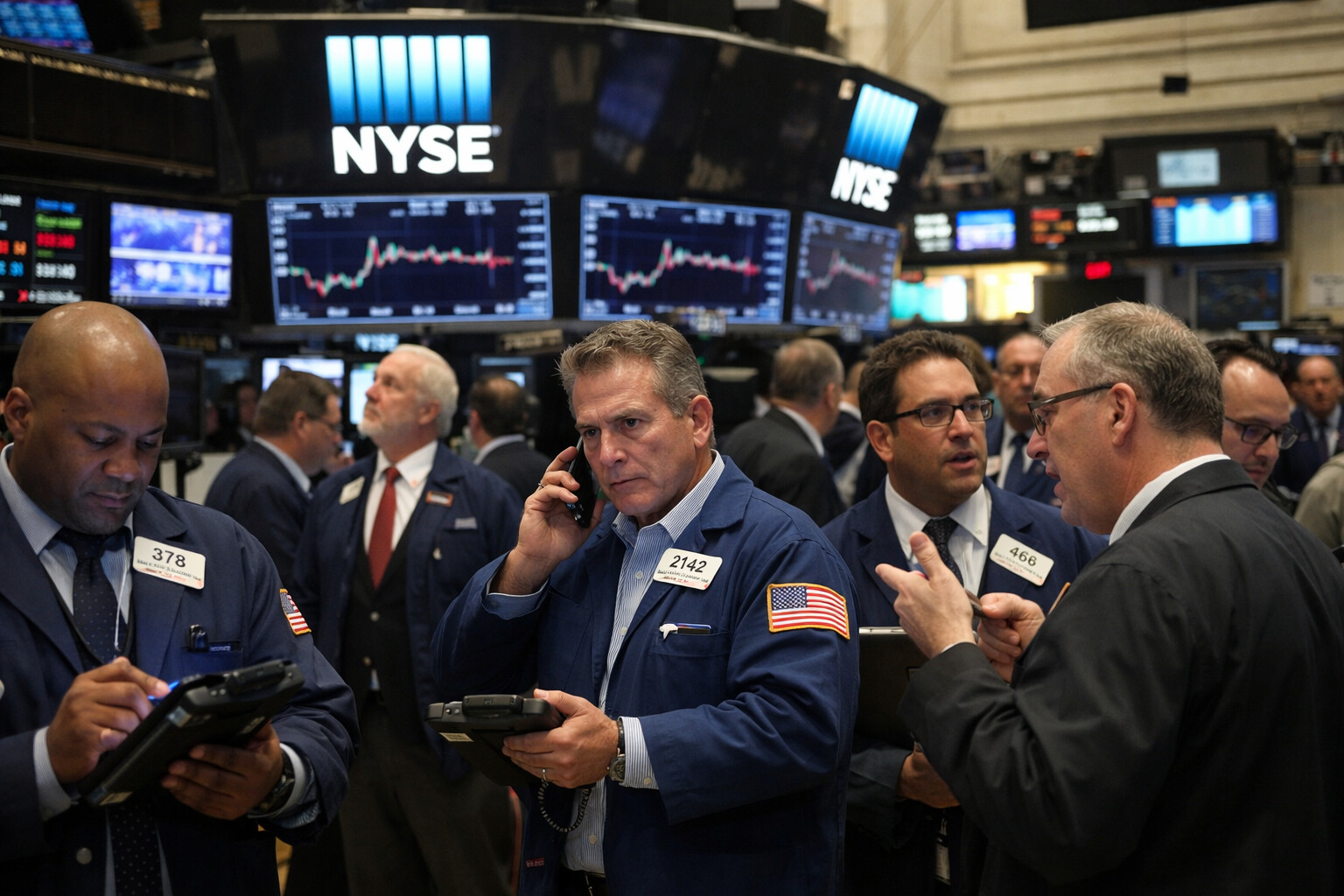
Stock Market Today: Dow Near 49,000 as S&P 500 Tops 7,000 and Nasdaq Climbs
AI chips power gains with NVDA, ASML, TSM, TXN and STX surging, gold at $5,300 and traders eye the Fed decision plus MSFT, META, TSLA results | That's TradingNEWS
Stock Market Today - AI trade lifts Wall Street as S&P 500 breaks 7,000
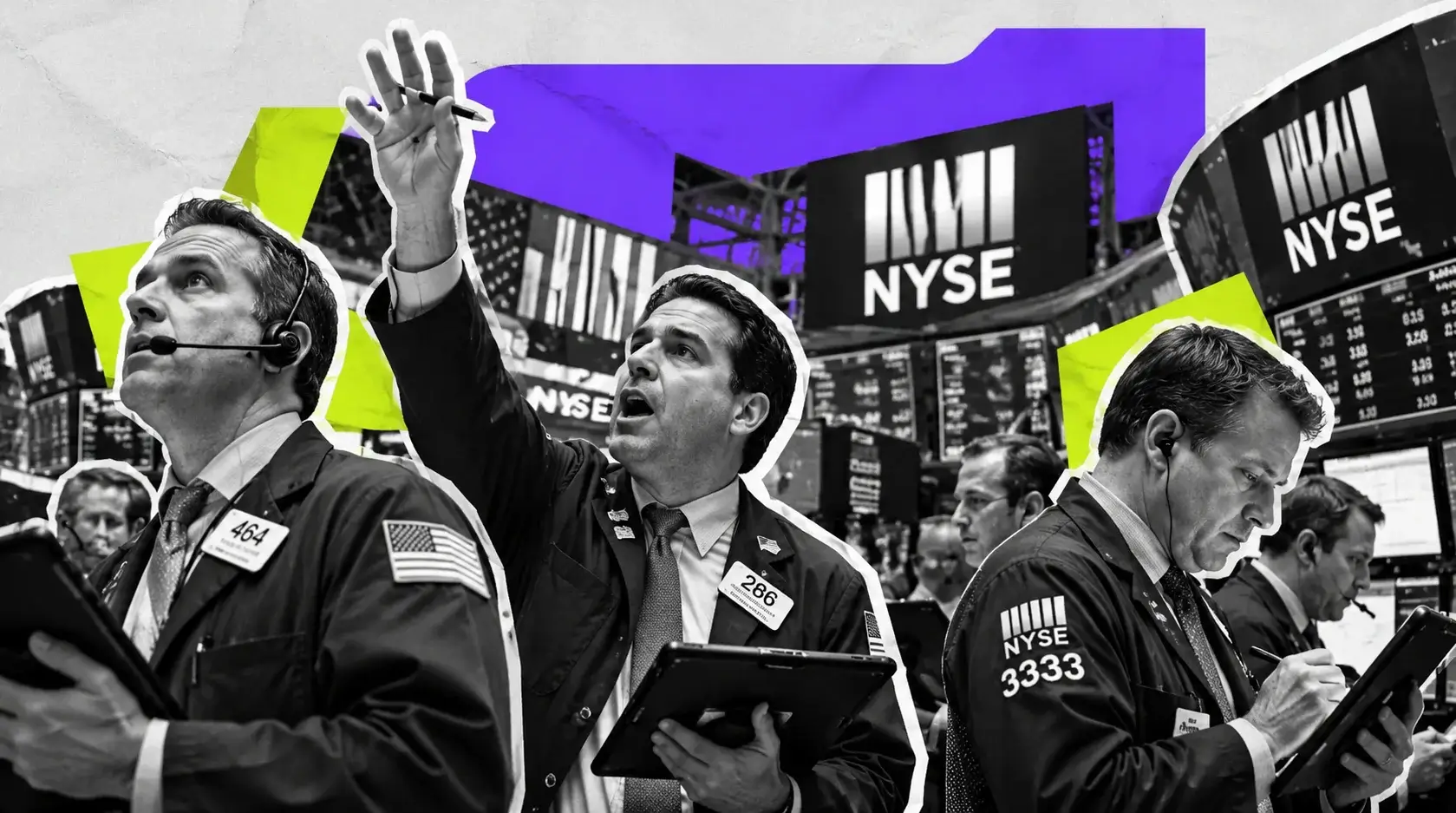
U.S. equities are being driven almost entirely by artificial intelligence enthusiasm. The S&P 500 (^GSPC) opened above 7,000 for the first time, trading around 6,994, up roughly 0.3%. The Nasdaq Composite (^IXIC) is up about 0.6% near 23,9xx, while the Dow Jones Industrial Average (^DJI) hovers just above 49,000, up roughly 0.1%–0.3% depending on the feed. Smaller names are quietly catching up: the Russell 2000 (RUT) is up about 0.7% near 2,684, a sign that the rally is widening beyond the “Magnificent Seven” even while mega-caps still dominate index points. Volatility is subdued, with the VIX sitting in the mid-16s, confirming that this is a momentum-driven, low-fear tape rather than a panicked melt-up.
Fed decision day: easy financial conditions despite a “hold”
The Federal Reserve is expected to keep the funds rate at 3.50%–3.75%, with the market far more focused on Chair Jerome Powell’s language than on the decision itself. Fed funds futures price roughly two quarter-point cuts by the end of 2026, not an aggressive easing path, yet risk assets are trading as if liquidity will stay loose indefinitely. The 10-year Treasury yield is pinned around 4.25%, barely changed from Tuesday, supporting equity valuations but far from the ultra-low-rate era that fueled the last tech bubble. Layer on top the political risk: the Trump administration has opened a criminal investigation into Powell over testimony related to Fed building renovations, and the market is also waiting for Trump to name Powell’s successor. The message for traders: rates are on hold, but institutional risk around Fed independence and communication is rising, which directly impacts the U.S. Dollar Index (DXY), equity risk premia, and the AI capital-spending cycle.
Dollar slide and record gold: classic bubble signal or regime shift?
The dollar just suffered its worst one-day slide since last April, dropping about 1.3% and roughly 10% over the past year. The Dollar Index (DX-Y.NYB) is trading around 96.2 after hitting its weakest level since early 2022. President Donald Trump has effectively endorsed the weaker currency, calling the dollar “doing great” and explicitly rejecting the usual complaints about a falling greenback. That stance feeds the so-called debasement trade: money leaving the dollar and Treasuries and migrating into hard assets and equities. The result is extraordinary: gold futures (GC00) just hit another record above $5,300 an ounce and are still trading around $5,270, up roughly 3.5% on the day, while silver is near $114, up about 7.5%. Seeing gold at all-time highs at the same time the S&P 500 is punching through 7,000 is not normal. In prior cycles, one of these asset classes usually signaled fear while the other reflected optimism. Today, both are screaming “liquidity and protection,” which is exactly the backdrop you see in late-cycle booms and in the early phase of new regimes. Traders need to treat this as a powerful signal that the market is hedging an AI-led boom with hard-asset insurance, not as a simple risk-on / risk-off narrative.
Semiconductor complex: AI buildout looks like a boom, not just a story
The most concrete evidence that AI is more than hype sits in the semiconductor order books. ASML Holding (ASML) reported a monster quarter: bookings of about €13.2 billion, almost double the roughly €6.85 billion analysts expected. These orders are concentrated in its most advanced EUV tools used by Taiwan Semiconductor (TSM), Nvidia (NVDA) and Intel (INTC) to manufacture the chips powering AI data centers. U.S.-listed ASML stock is up around 5% pre-market and holding gains after the open, pulling European chip names higher and driving a sharp move in the VanEck Semiconductor ETF (SMH), which trades around $416, up more than 2%.
On the analog side, Texas Instruments (TXN) has flipped the narrative. The company now guides first-quarter revenue to $4.32–$4.68 billion versus expectations near $4.42 billion, and EPS between $1.22 and $1.48 versus a $1.26 consensus. The stock has jumped roughly 7%–8% toward the low-$210s, signaling that industrial, automotive, and embedded demand is stabilizing. When both leading-edge AI tools (ASML) and more traditional analog chips (TXN) print upside guidance, it tells you this is not just GPU hype—it is a full supply-chain expansion.
Data storage is confirming the same story. Seagate Technology (STX) smashed expectations with adjusted EPS of $3.11 vs. $2.81 and revenue of $2.83 billion vs. $2.73 billion. The stock has exploded higher, up roughly 15%–17% to the mid-$430s after already rallying about 30% in the past month. This is classic late-cycle behavior for a secular trend: capital spending on AI is spilling into all the adjacent hardware layers—lithography, memory, storage, interconnect.
The one weak link is Qorvo (QRVO). Despite an EPS beat (about $2.17 vs. $1.85 expected) and revenue slightly over estimates at $993 million, guidance disappointed. The stock is down roughly 9% after hours, a reminder that not every chip name is a pure AI winner. The market is starting to discriminate between companies riding structural AI demand and those reliant on slower handset or legacy markets.
Nvidia, TSMC and SMH: AI leaders still controlling the Nasdaq
The Nasdaq and Nasdaq-100 continue to be driven by a narrow group of leaders. Nvidia (NVDA) remains the world’s most valuable public company and is up roughly 1.6%–2% today near $191.5 after reports that China has approved the sale of its H200 AI accelerators to domestic giants like ByteDance, Alibaba and Tencent. That approval locks in another demand leg even as the U.S.–China tech war intensifies. TSMC (TSM) is up more than 2% in Taiwan, reflecting both ASML’s record orders and the ongoing wave of AI-driven foundry demand. The SMH ETF is now a pure barometer of AI infrastructure; with top holdings in NVDA, TSM and Broadcom (AVGO), its move above $416 (+2%+) is exactly why the Nasdaq Composite is outpacing the Dow and even the S&P 500 today.
This is the core of the AI boom argument: the spending is real, multi-year, and visible in hard orders and capex plans across the ecosystem. Prices are high, but the revenue being booked by the suppliers is equally extreme.
Mega-cap earnings overhang: Microsoft, Meta, Tesla and Apple
The next catalyst is the earnings wave from the AI platform owners. Microsoft (MSFT), Meta Platforms (META) and Tesla (TSLA) all report after the close, with Apple (AAPL) following on Thursday. Options markets are already pricing major moves: traders expect MSFT to move close to 5% in either direction by the end of the week. With shares trading around $480, the implied range is roughly $459–$502.
The three names reporting tonight account for about 10.6% of the S&P 500 by weight. That concentration means a positive surprise across AI cloud spending, advertising monetization, and Tesla’s autonomy story can extend the breakout beyond 7,000. A “capex hangover” or disappointment on margins—especially if MSFT signals slower returns on AI infra—could unwind part of the move. At the index level, this is where the AI bubble narrative gets tested: if earnings and guidance justify the trillions in AI market cap, the boom thesis strengthens; if not, the price action begins to look like classic multiple expansion unsupported by cash flow.
Amazon restructures again: layoffs, store closures, and AI optionality
Amazon (AMZN) is reshaping its cost structure while keeping AI optionality intact. The company is laying off about 16,000 corporate employees, after already cutting around 14,000 roles just three months earlier. The explicit goal is to “reduce layers, increase ownership, and reduce bureaucracy,” aligning with CEO Andy Jassy’s push to have Amazon “operate like the world’s largest startup.” The stock is modestly higher, around $246 (+0.5%).
Strategically, Amazon is also exiting its weaker physical grocery bets (Amazon Fresh, Amazon Go) to focus on delivery and on Whole Foods, which offers stronger brand equity and pricing power. The company plans to evaluate each location for potential conversion to Whole Foods. For AI/bubble watchers, the key is that Amazon is not cutting AI or data-center investment; it is trimming peripheral experiments while doubling down on core, high-margin, and AI-adjacent areas like AWS and logistics optimization. That supports the idea of a rational boom rather than indiscriminate expansion.
Starbucks and the consumer: early proof that Main Street is still spending
Starbucks (SBUX) is a litmus test for discretionary demand. Under CEO Brian Niccol’s “Back to Starbucks” strategy, the company just posted its first quarter of U.S. and North America same-store sales growth in two years. Comps rose 4% in the U.S., beating 2% expectations, driven by a 3% increase in transactions and a 1% boost in average ticket size. Revenue hit $9.9 billion vs. estimates around $9.65 billion. EPS missed slightly ($0.56 vs. $0.59), reflecting spending on the turnaround. The stock is up about 4%–7%, trading around $100.
This is critical for the broader market outlook. Consumer confidence readings are depressed—Conference Board sentiment has dropped to its weakest since 2014, and surveys show mood roughly 20% below a year ago—yet spending remains robust, especially among higher-income households. Starbucks’ traffic recovery fits that picture: people complain about inflation, tariffs, and health costs but still buy premium coffee. For S&P 500 earnings, that divergence between “vibes” and spending is why strategists like JPMorgan can stay tactically bullish despite constant recession headlines.
Telecom and infrastructure: AT&T leans into fiber and 5G
AT&T (T) has turned in one of the day’s more important non-AI stories. The stock is up roughly 3% around $23.75 after the company forecast 2026 profit above Wall Street expectations, anchored by aggressive investment in fiber and wireless spectrum. AT&T is committing nearly $6 billion to buy Lumen’s consumer fiber business and about $23 billion to acquire EchoStar spectrum licenses. Roughly 42% of its fiber households already take 5G mobile in a bundle, illustrating the cross-sell economics.
This matters for the AI theme because data-heavy applications require fat last-mile and mid-mile pipes. Telecom carriers like AT&T that successfully add fiber plus 5G bundles stand to capture cash flows from the AI usage explosion rather than just watching the hyperscalers monetize it. In valuation terms the stock is still inexpensive relative to AI leaders, but here the story is steady cash flow and yield rather than hyper-growth. It fits into a “boom, not bubble” regime where infrastructure must be upgraded across the stack.
Health insurers: volatility after UNH shock and Elevance guidance
The Dow selloff yesterday—more than 400 points down—was driven by a brutal hit to managed care. UnitedHealth (UNH) and Humana (HUM) both dropped more than 20% after a Medicare payment proposal underwhelmed expectations. Today, there is partial stabilization: UNH is up roughly 1.5% while HUM is still under pressure, off about 1.5%, and Elevance Health (ELV) is down roughly 5% after guiding 2026 profit below forecasts as it braces for persistently elevated medical costs.
These moves reinforce that 2026 is not an everything-bubble. The S&P 500 headline level hides sharp sector dispersion. Health insurers face a structural problem: Medicaid churn has left them with a sicker, more expensive pool after healthier enrollees dropped off the rolls, while demand for behavioral health and specialty drugs remains high. The market is clearly willing to punish sectors where pricing power and earnings visibility have deteriorated. That contrast with AI and chips—where customers are begging to secure supply—argues against a uniform speculative mania.
Europe, banks and regulatory risk: Deutsche Bank under scrutiny
Outside the U.S., the DAX is trading around 24,560 and is roughly flat, but beneath the index, Deutsche Bank (DBK) is down about 3% after German authorities raided its Frankfurt headquarters in a money-laundering investigation. Around 30 investigators from the federal criminal police reportedly entered the building, targeting as-yet unnamed employees. For global investors, this is another reminder that financials still carry idiosyncratic regulatory risk even in a strong macro environment. It also partly explains why global capital has been happiest sitting in U.S. AI leaders and in dollar-priced gold rather than European banks.
Oil and Bitcoin: side shows in a liquidity-rich market
While AI and gold dominate headlines, other macro assets confirm the same liquidity story. West Texas Intermediate (CL=F) is trading around $63.35 a barrel, up about 1.5%, a modest move that keeps real-economy inflation in check while giving energy equities a floor. That keeps the Energy Select Sector SPDR (XLE) supported without triggering Fed panic.
Bitcoin (BTC-USD) is trading near $90,000, close to the day’s high. A crypto rally alongside record equities and record gold is not the sign of a fragile, risk-off environment; it is classic “too much money chasing scarce assets.” For AI bubble watchers, crypto is now a parallel high-beta expression of the same liquidity cycle.
The takeaway: oil is behaving like a stabilizer, Bitcoin like a leverage gauge. Both currently confirm that the market is betting on growth plus liquidity rather than recession.
Tax, capex and AI jobs: the fiscal fuel behind the boom
Under the “One Big Beautiful Bill,” bonus depreciation has been restored to a permanent 100% first-year deduction for qualifying business investment placed in service after January 19, 2025. Previously, the deduction was phasing down from 50% and was scheduled to disappear by 2027. Now, companies can expense the full cost of data centers, servers, networking gear, and buildings in the first year. That is a direct subsidy for AI infrastructure spending and a structural reason why MSFT, GOOGL, META and others can justify aggressive capex budgets without destroying reported earnings.
On the labor side, Goldman Sachs estimates that 6%–7% of U.S. workers may be displaced by AI over the next decade, with displaced workers taking about a month longer than average to find new jobs and suffering around a 4% income hit when they do. That is double the earnings hit for other displaced workers. From an equity perspective, this is bearish for wage growth but bullish for margins and productivity if companies manage the transition. It is exactly the kind of real-economy shift that underpins multi-year earnings cycles, not just story-stock spikes.
Read More
-
Yen Stalls at 160 Despite a 3% JGB and Tokyo Core CPI at 2.0% — Intervention Sits at 164, Friday's Payrolls Decide
02.09.2026 · TradingNEWS ArchiveEnergy
-
SOFI ($16.71) Posts Its Best Day of the Quarter as Profit Guidance Finally Rises — Holding $15.70 Unlocks $20
27.10.2026 · TradingNEWS ArchiveStocks
-
XRP-USD ($1.30) Defends a $1.27 Double Bottom as Whales Hold 68.5% of Supply — Break of $1.31 Opens $1.35 and $1.40
27.10.2026 · TradingNEWS ArchiveCrypto
-
Brent ($113.88) Trades a $2.35 Range as Houthi Strikes Meet Saudi-Iran Diplomacy — Break of $117 Unlocks $120
27.10.2026 · TradingNEWS ArchiveCommodities
-
Nasdaq Rips 1.3%, S&P 500 Hits 7,728, Dow Stalls as BA Drops to $171
27.10.2026 · TradingNEWS ArchiveMarkets
-
GBP/USD (1.3310) Can’t Cash In on 5.43% Gilt Yields as Budget Risk Meets a Firm Dollar — Break of 1.3274 Opens 1.3200
27.10.2026 · TradingNEWS ArchiveForex
Buffett’s discipline vs. AI euphoria: what the tape is really pricing
Warren Buffett’s latest comments at the 2025 Berkshire Hathaway (BRK.A / BRK.B) meeting are extremely relevant to today’s AI debate. He emphasized that emotional intelligence—leaving emotions at the door when making investment decisions—is what separates investors who survive market drops from those who chase bubbles and panic-sell. Right now, emotional narratives around AI are everywhere, but the actual cash positioning shows something more subtle: Buffett himself has allowed Berkshire’s cash pile to grow to record levels while staying highly selective about new equity purchases.
The simultaneous breakout in gold, the S&P 500, and AI hardware shows that global investors are doing both things at once: participating in the AI theme, hedging with hard assets, and keeping optionality. That positioning is consistent with a boom that investors know could morph into a bubble if discipline disappears.
Strategists’ playbook: stock pickers’ market, not index beta
Street houses are not in full-blown bubble mode. Piper Sandler has set a year-end target for the S&P 500 at roughly 7,150, implying only about 2% upside from current levels. That is a very modest return profile if we were truly in a “everything goes to the moon” phase. Their view is that 2026 becomes a market for stock pickers, not for passive bulls. They expect better breadth, with capital rotating from mega-caps to small and mid caps as the cycle matures.
JPMorgan remains tactically bullish on U.S. equities based on three pillars: resilient macro data, positive earnings momentum in this reporting season, and a potential thaw in the tariff war that could lower effective trade headwinds. In contrast, Standard Chartered argues that higher U.S. real yields should eventually reverse the dollar’s weakness, challenging the current debasement trade that is supporting gold and non-U.S. risk assets. These cross-currents argue against a simplistic AI bubble call and support a nuanced boom narrative with pockets of froth.
AI bubble or sustainable boom: separating evidence from narrative
On the bubble side, the case is straightforward:
– The S&P 500 at 7,000 and Nasdaq near record highs;
– NVDA as the world’s most valuable company, with AI hardware multiples far above traditional semis;
– Gold at over $5,300 and Bitcoin near $90,000, both classic speculative barometers;
– SoftBank reportedly considering another $30 billion allocation into OpenAI, and SpaceX targeting a $1.5 trillion IPO at mid-June’s planetary alignment, aiming to raise up to $50 billion—exactly the kind of storytelling deal size and timing that appear near sentiment peaks.
On the boom side, the evidence is equally blunt:
– ASML booking a record €13.2 billion in quarterly orders vs. ~€6.85 billion expectations is real demand, not narrative.
– TXN, STX, and SMH all confirming broad-based hardware strength beyond just GPUs is what you see in secular cycles, not one-product bubbles.
– Corporate tax policy (100% bonus depreciation) actively incentivizes AI-related capex.
– Consumer-facing companies like SBUX are seeing traffic growth again, and T is monetizing fiber and 5G, meaning the downstream effects of AI and digital demand are showing up in “old-economy” cash flows.
– Health insurers (UNH, HUM, ELV) and banks (DBK) are being punished when fundamentals deteriorate, which is the opposite of the indiscriminate buying you see at the peak of a bubble.
Netting all of that: the tape is pricing a genuine AI-led productivity boom with very expensive valuations in the core winners. The bubble risk is in the extrapolation of growth and in the willingness to pay any price for AI exposure, not in the reality of the spending itself.
Trading stance: AI leaders vs. the rest of the market
For AI hardware and core infrastructure—names like NVDA, ASML, TSM, and the broader SMH complex—the data supports a Bullish / Buy-on-pullbacks stance. Orders, guidance, and tax incentives justify high multiples, but the move is already aggressive, so disciplined entries matter.
For mega-cap platforms—MSFT, META, TSLA, AAPL, AMZN—the short-term risk is event-driven. With options implying ~5% swings for MSFT and the three name basket holding 10.6% of the S&P 500, this is a Selective Hold with a bullish bias. If earnings and AI monetization commentary confirm current capex and margin assumptions, these names remain core holdings. If not, they are the first place where an AI mini-bubble can deflate.
For the broad U.S. indices—S&P 500, Nasdaq, Dow, Russell 2000—current levels argue for a Hold stance. Upside from 7,000 on the S&P 500 exists, but the easy beta gains are behind us; the better risk-reward is in picking the structural AI winners, quality cyclicals like T, and selective small/mid caps rather than chasing the entire index.
For gold and silver, moves to $5,300 and $114 look parabolic. Given the dollar backdrop and political risk around the Fed, the strategic justification for a gold allocation is strong, but the near-term price action is stretched. That warrants a Hold / partial trim stance rather than fresh aggressive buying at record highs.
For the dollar, policy pressure and structural factors favor continued weakness in the short term, but higher U.S. real rates could reverse that over time. Positioning is becoming crowded on the bearish side; risk-managing dollar shorts is prudent.
Overall, the market behavior points to an AI boom with localized froth, not a fully formed systemic bubble. The winners are companies with visible AI cash flows and hard orders—NVDA, ASML, TSM, MSFT—while structurally challenged sectors like managed care and some financials are still punished. That is exactly the pattern you see in powerful but survivable booms, where discipline and stock selection matter more than raw index exposure.