Stock Market Today: Dow Rockets 617 Points, S&P 500 and Nasdaq Print Fresh Records as AMD Explodes 16%, Corning Rips 14%
Iran peace memo crushes oil 7%, AMD guides Q2 to $11.2B, SMCI surges 16%, Disney climbs 7% | That's TradingNEWS
Key Points
- AMD ripped 16% to $413 on a Q1 beat with data-center revenue up 57% and Q2 guidance of $11.2 billion.
- Brent crude crashed 7% below $100 after Axios reported a one-page US-Iran memo to end the war and reopen Hormuz.
- Corning soared 14% on a Nvidia optical deal, SMCI jumped 16%, and Samsung crossed $1 trillion as Kospi hit records.
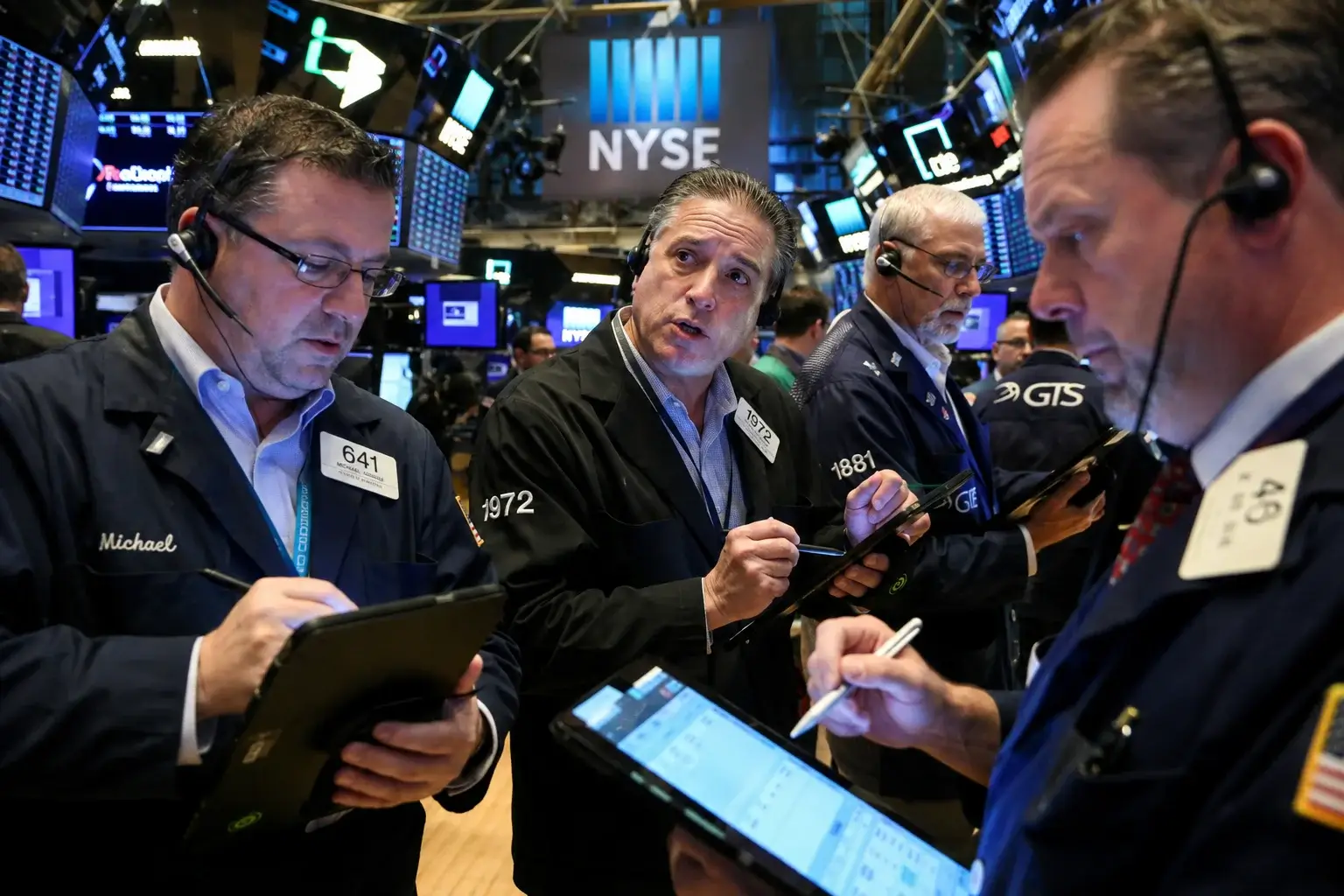
The opening stretch of Wednesday's session has produced one of the cleaner risk-on moves of the year, with the U.S. equity complex catching simultaneous tailwinds from a credible diplomatic off-ramp in the Iran conflict and a chip-earnings cycle that refuses to lose altitude. The Dow Jones Industrial Average ripped roughly 617 points, or 1.26%, to 49,919.71, finally pushing above the 49,683.30 line that officially exits the index from correction territory according to Dow Jones Market Data — a level it had been chasing since pulling back more than 10% from its February peak. The S&P 500 (^GSPC) advanced 1.21% to 7,347.38, printing fresh intraday record highs, while the Nasdaq Composite (^IXIC) out-muscled the broader tape with a 1.47% surge to 25,699.04, also at all-time peaks. The Russell 2000 (^RUT) added 0.94% to 2,873.03, a more restrained move that reflects the small-cap complex's continued sensitivity to financing costs even as the long end of the curve catches a meaningful bid. The Cboe Volatility Index (VIX) has slipped to 17.02, down roughly 2% on the session, tracking toward its lowest close since Israel and the United States opened hostilities against Iran at the end of February — a clear sign that the options market is pricing a higher probability of de-escalation than it had as recently as Friday's close.
The Oil Collapse Is the Single Cleanest Story on the Board
Crude is doing the heavy lifting on the macro narrative. WTI (CL=F) has cratered roughly 7% to the low $95s, with intraday lows briefly punching below $91 a barrel, while Brent (BZ=F) has shed as much as 11% to dip beneath the psychologically loaded $100 handle before stabilizing near $102.13. To frame the violence of this repricing properly: Brent was trading above $126 a barrel just last week, meaning the international benchmark has compressed nearly 20% in a handful of sessions. The driver is an Axios report — corroborated separately by Bloomberg and Reuters — that Washington and Tehran are circling a one-page, fourteen-point memorandum of understanding designed to halt the war, freeze Iranian nuclear enrichment, lift sanctions, release billions in frozen Iranian funds, and reopen the Strait of Hormuz to unrestricted commercial traffic. President Trump reinforced the optimism Tuesday evening by pausing "Project Freedom," the U.S. naval operation escorting tankers through the chokepoint, citing on Truth Social what he called "Great Progress" toward a final agreement. Iran's foreign ministry confirmed to CNBC that Tehran is evaluating the proposal and will respond, reportedly via Pakistani intermediaries, within 48 hours. Trump has since tempered the enthusiasm by warning that Iranian acceptance remains "a big assumption" and that the bombing would resume "at a much higher level and intensity" should talks collapse, a comment that has trimmed but not erased the risk-on impulse. My read on this complex is that the asymmetry has clearly shifted — energy length looks treacherous here, and any rebound in crude likely needs a hard breakdown in the diplomatic process to extend, which means the path of least resistance for WTI and Brent in the near term is sideways to lower with a bias toward the mid-$80s if the memo gets signed in any form.
AMD Detonates the Chip Trade With a Data-Center Print That Makes Bears Look Stranded
The most consequential single-name catalyst on the tape today is Advanced Micro Devices (AMD), ripping 16.34% to $413.30 and headed for its strongest single-session performance in roughly seven months. The shape of Lisa Su's print is hard to argue with on any line that matters. First-quarter adjusted earnings landed at $1.37 per share on revenue of $10.25 billion, a 38% year-over-year top-line surge that crushed sell-side modeling. The data-center segment — which now generates more than half of total company revenue — exploded 57% from a year ago on combined demand for Instinct AI accelerators and EPYC server processors, prompting Su to characterize the unit as "the primary driver of our revenue and earnings growth." The forward guide is where the print became a structural event rather than a beat-and-raise: management is calling for second-quarter revenue of $11.2 billion plus or minus $300 million, well above the $10.52 billion the Street was modeling, and Su's commentary that "server growth to accelerate meaningfully as we scale supply to meet demand" tells you the constraint is fab capacity, not order intake. Wedbush flagged the genuinely interesting subplot, which is that CPUs — long written off as the boring half of the silicon trade — are showing fresh life as agentic AI workloads need general-purpose silicon to coordinate tasks across software stacks, not just GPU horsepower to crunch tensors. That dynamic is a tailwind for AMD and Intel (INTC) simultaneously, with Intel adding nearly 2% on the session and printing fresh highs on the back of the read-through. My call here is unambiguous: AMD is a Buy at these levels with the May 20 Nvidia (NVDA) print as the next confirmation event, and the multiple expansion case is intact so long as cloud capex commitments out of the hyperscalers continue to ratify the spending trajectory.
Super Micro's Margin Story Reasserts Itself Despite a Revenue Whiff
Super Micro Computer (SMCI) is up roughly 16% on the session despite missing the consensus revenue line, a divergence that tells you exactly what the buy side cares about right now. The fiscal third quarter delivered adjusted earnings of $0.84 per share on revenue of $10.24 billion, against Visible Alpha consensus calls for $0.62 and $12.38 billion respectively — a clean beat on profitability paired with a top-line shortfall. What rescued the print, and then some, was the fiscal fourth-quarter guide: management is modeling earnings between $0.65 and $0.79 per share on revenue of $11.0 billion to $12.5 billion, against Street expectations of $0.55 and $10.92 billion. Founder and chief executive Charles Liang framed the quarter around the company's transition into what he called a total datacenter infrastructure provider, citing new U.S. manufacturing capacity in Silicon Valley as the reason the firm is positioned to absorb AI-driven demand without the supply chain breakage that has periodically derailed the story. Heading into Wednesday, SMCI was actually down roughly 5% year-to-date, a reminder that even AI infrastructure beneficiaries have had a rougher 2026 than the index-level prints would suggest. The setup has now clearly improved, and SMCI rates a Buy for those with the stomach for its idiosyncratic governance overhang, with the caveat that position sizing should reflect the higher-beta profile of the name relative to the broader semi cap-equipment trade.
Disney Validates the Resilient-Consumer Thesis Under Its New Chief Executive
The Walt Disney Company (DIS) is up roughly 7% to $107.59 after delivering a fiscal second-quarter beat on both lines in chief executive Josh D'Amaro's first quarterly report at the helm. Adjusted earnings came in at $1.57 per share against the $1.51 consensus, with revenue rising 7% year-over-year to $25.2 billion versus the $24.8 billion the Street was modeling. Total operating income climbed to $4.6 billion from $4.4 billion in the year-ago period. The wrinkle worth dissecting is the experiences division, which D'Amaro previously ran before being elevated: that segment's revenue slipped to $9.5 billion from a record $10 billion, with U.S. park attendance down 1% even as per-capita spending on admissions, food, and merchandise rose 5%. Management telegraphed that current demand is strong and that fiscal third-quarter attendance should improve year-over-year. Streaming and parks were the engines behind the beat, and the read-across to Uber Technologies (UBER) — which is up 8.14% to $78.89 on its own beat, with rising trips, rising revenue, and a constructive guide — points to a U.S. consumer that is still discretionary-spending in size despite higher gasoline prices and an active geopolitical overhang. Both names look like Buys here, with DIS offering the more compelling re-rating story given the multiple compression that preceded the print and the leadership transition's clean execution.
Corning Becomes an Optical-Infrastructure Pure Play Overnight
Corning (GLW) has surged 13.92% to $184.66 after announcing a partnership with Nvidia (NVDA) that includes three new manufacturing facilities in North Carolina and Texas focused entirely on advanced optical connectivity for AI data centers. The deal is expected to generate at least 3,000 American jobs and increase Corning's domestic optical manufacturing capacity by roughly tenfold, though financial terms were not disclosed. Jensen Huang's framing — that the two companies are jointly "inventing the future of computing with advanced optical technologies" — is the kind of language that signals long-duration commitment rather than a one-off supply agreement. Coming into Wednesday, GLW was already up roughly 85% year-to-date on surging fiber-optic demand inside hyperscale data centers, while NVDA, the world's most valuable company, had advanced just 5% over the same window. Today's reaction — Nvidia adding 2% to 4% and Corning ripping double digits — captures the rotation underway in the AI trade, where the picks-and-shovels names with industrial and materials exposure are catching the bid that pure GPU plays already discounted into the price. GLW is a Buy on the back of this announcement, with the structural thesis that optical interconnect bandwidth is the next bottleneck after compute and memory, both of which the market has already priced aggressively.
Oracle Looks Like a Mispriced Compute Operator With a Clear Catalyst Path
Oracle Corp (ORCL) is up 1.68% to $188.46 after Barclays reiterated its outperform rating with a $240 price target, implying roughly 29% upside from Tuesday's close. Analyst Raimo Lenschow's argument is sharp and worth absorbing: the bear case on Oracle currently rests on two contradictory narratives — that AI is going to disrupt traditional software and that the AI buildout is going to prove overdone — and these two theses cannot both be true simultaneously. Oracle is down more than 40% from its September all-time highs even as other vendors positioned in the same compute-provider role have ripped meaningfully higher over the same window, a divergence Lenschow characterizes as fundamentally illogical. The credit-default-swap concern that some have raised is being mischaracterized; the elevated CDS levels are insurance against AI-related project exposure rather than core debt risk. Shares have already rebounded roughly 36% off their February lows, but the gap to the September peak remains wide enough to sustain a multi-quarter mean-reversion trade. ORCL rates a Buy with the caveat that the position requires patience through earnings cycles where the optical reaction can be sharp in either direction; the next catalyst is the upcoming print, and the burden is on management to articulate cleaner OCI growth metrics that justify the multiple.
Novo Nordisk Restores Confidence With an Oral GLP-1 That's Actually Selling
Novo Nordisk (NVO) is trading roughly 3% higher after delivering quarterly results that topped the consensus, with adjusted earnings of 6.63 Danish kroner — about $1.04 — per share on revenue of 96.82 billion kroner, or roughly $15.26 billion. The story underneath the headline is the launch trajectory of the new oral Wegovy formulation, which has surpassed two million prescriptions since its January debut, with 1.3 million of those scripts written in the first quarter alone. Management is now guiding for full-year sales to decline 4% to 12%, a slight upgrade from the prior 5% to 13% range, with the moderation reflecting both the Trump administration price agreement and the expiration of patent exclusivity in select international markets. Even after Wednesday's rally, NVO remains down roughly 10% year-to-date, which provides a cleaner risk-reward profile than the AI-adjacent leadership names. NVO is a Buy for portfolios with structural healthcare exposure, particularly given the competitive moat the oral formulation provides relative to the injectable-only competitive set.
ADP Lands Above Consensus and Effectively Repriced the Fed Path
The ADP National Employment Report showed private payrolls expanded by 109,000 in April, the strongest monthly gain since January 2025 and well ahead of the Dow Jones consensus call for 84,000 and the Bloomberg estimate of 120,000. The March print was revised lower by a thousand jobs to 60,000, but the trend is clearly accelerating off the early-year softness. ADP chief economist Nela Richardson characterized the labor market as bifurcated — small and large employers are hiring while mid-cap firms remain cautious — and Bill Adams at Fifth Third Commercial Bank is now calling for Friday's nonfarm payrolls release to print 120,000 with the unemployment rate steady at 4.3%. The straightforward implication for the rates complex is that the case for near-term Federal Reserve cuts has weakened, since persistent labor-market resilience paired with sticky inflation removes the urgency for accommodation. The 10-year Treasury yield has dropped roughly 7 basis points to 4.353% on the day despite that hawkish read, which tells you the bid is being driven by the oil-driven inflation relief rather than recalibrated growth expectations.
Yields, Gold, Silver, and the Dollar Are All Telling the Same Story
The cross-asset response to the Iran headlines has been remarkably coherent. The 10-year Treasury yield is down to 4.353% from Tuesday's 4.43% close, a move that has dragged the iShares U.S. Home Construction ETF (ITB) up 3.28% as the affordability math improves at the margin. The 30-year fixed mortgage rate hit 6.45% Tuesday, the highest in over two weeks, and any sustained move lower in the 10-year would provide direct relief to the homebuilders. Gold (GC00) futures have surged 3.11% to $4,710 an ounce, silver (SI00) has exploded 5.82% to $77.86, and copper (HG00) added 3.11% to $6.18 — a combination that is hard to reconcile with conventional safe-haven flows and instead points to dollar weakness as the dominant driver. The U.S. Dollar Index (DXY) is down 0.46% to 97.99, hitting a two-month low against the basket. Bitcoin (BTC) climbed to a fresh three-month high earlier in the session, currently trading around $81,520 after touching $82,000 intraday. Across the curve in Europe, U.K. 10-year Gilts dropped more than eight basis points to 4.973% and German 10-year Bunds fell more than six basis points to 3.0027%. The combined message: rate volatility is collapsing as the inflation tail risk associated with the energy shock dissipates.
Asia Delivers a Generational Tape, Led by Samsung's Trillion-Dollar Milestone
The Asia-Pacific session that preceded the U.S. open was extraordinary. South Korea's Kospi surged 6.45% to a record close of 7,384.56, building on what is now more than a 70% year-to-date gain. The catalyst was Samsung Electronics, which rose more than 14% intraday to cross $1 trillion in market capitalization, becoming only the second Asian company in history — after Taiwan Semiconductor Manufacturing (TSM) — to clear that threshold. SK Hynix rallied more than 10% to its own record high. The story behind the rally is the tightening grip Korean and Taiwanese memory and foundry players have on the AI infrastructure stack: HBM, advanced foundry nodes, and packaging are all running at structural-shortage economics, and the buy side has finally stopped treating memory as a cyclical pricing trade and started pricing it as a secular utility. The small-cap Kosdaq was an outlier, slipping 0.29% to 1,210.17. China's CSI 300 rose 1.45% to 4,877.09 on its first trading day after the Labor Day break, Hong Kong's Hang Seng added 0.62% with the Hang Seng Tech subindex up 1.05%, India's Nifty 50 finished flat, and Australia's S&P/ASX 200 climbed 1.3% to 8,793.6. Japan was closed for a public holiday, though the yen had strengthened more than 1% to 156.15 against the dollar, a move consistent with broad-based USD softness.
Read More
-
Yen Stalls at 160 Despite a 3% JGB and Tokyo Core CPI at 2.0% — Intervention Sits at 164, Friday's Payrolls Decide
02.09.2026 · TradingNEWS ArchiveEnergy
-
QQQ ETF ($739) Fades From an Early Tech Rally as a 77.9 ISM Prices Index Meets Micron's $61.5B Guide — $760 Record Test Ahead
01.10.2026 · TradingNEWS ArchiveStocks
-
XRPR and XRPI Follow XRP's $1.49 Test as Spot Funds Hold 1.16B XRP and a 1 Billion Token Escrow Release Lands — $1.70 in Play
01.10.2026 · TradingNEWS ArchiveCrypto
-
November NG Slips Below $3 as Decade-High Storage Meets Capped LNG Exports — $2.75 in Sight
01.10.2026 · TradingNEWS ArchiveCommodities
-
Dollar-Yen at 158 Presses Toward 160 as a 363 bp Carry Gap Meets Katayama-Bessent Intervention Risk — 159 in Sight
01.10.2026 · TradingNEWS ArchiveForex
Europe Joins the Risk-On Wave With Mining and Autos Out Front
European bourses rallied across the board, with the Stoxx 600 up 2.26% to 623.48. France's CAC 40 led the regional move with a 3.07% advance to 8,310.11, Germany's DAX added 2.20% to 24,939.11, Spain's IBEX 35 rose 2.42% to 18,096, Italy's FTSE MIB climbed 2.18% to 49,614.92, and the U.K.'s FTSE 100 gained 2.17% to 10,441. Mining and auto stocks were the standouts at sector level, popping roughly 4.5% as the combined impulse of falling crude — which compresses input costs for industrial producers — and the broader risk-on tone fed directly into cyclical leadership. Banks and construction names also delivered above-market gains. European energy names, predictably, took the offsetting hit as crude unwound.
Sector Dispersion in the U.S. Reveals What's Working and What Isn't
The intraday sector tape in the U.S. mirrors the global pattern. The S&P 500 Energy Sector is the worst performer, down roughly 4% and on pace for its largest single-session drop since April 10, 2025, when it fell 6.4%. The Energy Select Sector SPDR (XLE) is down 3.87% to $57.15. On the other side of the ledger, technology and semiconductor exposure is doing the bulk of the lifting. The VanEck Semiconductor ETF (SMH) is up roughly 3%, and the PHLX Semiconductor Index (^SOX) is at fresh highs. The intraday record-high list reads like a roll call of every cyclical, industrial, and AI-adjacent name that has caught a structural bid this year — Caterpillar (CAT), Cummins (CMI), Comfort Systems (FIX), Jabil (JBL), Quanta Services (PWR), Rockwell Automation (ROK), Nucor (NUE), Steel Dynamics (STLD), Iron Mountain (IRM), Alphabet (GOOGL), Broadcom (AVGO), Applied Materials (AMAT), Lam Research (LRCX), Marvell Technology (MRVL), Micron (MU), Dell (DELL), Sandisk (SNDK), and Wolfspeed (WOLF) are all printing new peaks. Financial names including Morgan Stanley (MS), Interactive Brokers (IBKR), and Principal Financial (PFG) also hit records, alongside healthcare standout DaVita (DVA).
Earnings Season Is Quietly Becoming One of the Best in Two Decades
Deutsche Bank's running tally has the S&P 500 reporters at roughly 85% beat rates on profit and 77% on revenue, with the blended figure exceeding 80% — a beat rate that is competitive with the strongest earnings cycles of the past 20 years. More structurally significant, all eleven top-level GICS sectors are tracking toward year-over-year earnings growth for the first time in four years, a breadth metric that argues against the popular thesis that index gains are dependent on a narrow leadership cohort. RBC Capital Markets head of U.S. equity strategy Lori Calvasina captured the dynamic neatly when she suggested that participants viewing the tape through a geopolitical lens may be underestimating the AI-driven earnings buffer that is supporting S&P 500 EPS revisions, and that upward revision rates remain positive across the AI-adjacent complex. Her framing — that the market is "climbing a wall of worry" without being overheated — has held up well against the price action.
Watch List for the Bell and Tomorrow's Setup
Arm Holdings (ARM) reports after the close, with options pricing implying a roughly 10% move by week's end. Off Tuesday's $209 close, that translates to a range of approximately $188 to $230, with the upper bound approaching last week's record high. Consensus is calling for fiscal fourth-quarter revenue of $1.47 billion, up nearly 20% year-over-year, and adjusted earnings of $0.59 per share. The stock has rallied roughly 90% year-to-date alongside the broader chip complex, helped by the company's transition into selling its own silicon while continuing to license designs to Nvidia and Google (GOOGL). UBS recently raised its price target to $245 from $175 on the thesis that the server CPU total addressable market — currently dominated by Intel, AMD, and Arm — could expand to $170 billion by 2030 from roughly $30 billion last year. AppLovin (APP) also reports after the bell. Arista Networks (ANET) is the conspicuous loser of the cycle, down roughly 12% after its adjusted gross margin came in at 62.4% versus the 62.7% StreetAccount consensus — a narrow miss on a metric the market has zero tolerance for in cloud-networking names. Restaurant Brands International (QSR) is off 4.5% on its own results. CVS Health (CVS) is up roughly 6% after raising its full-year earnings guide alongside a clean beat. Tomorrow's data event is the Challenger, Gray & Christmas April layoffs report, which will provide a useful check on whether the ADP-implied labor-market firmness extends across the cycle.
Two Macro Footnotes Worth Tracking This Week
A pair of structural items have moved into the foreground without yet showing up in the price. The Securities and Exchange Commission formally proposed Tuesday giving public companies the option to file semiannual rather than quarterly reports — a regime change that has been in place since the 1970s and could materially alter how the equity market metabolizes corporate fundamentals if adopted. Supporters argue it cuts costs and discourages short-termism, while detractors point to reduced transparency and longer windows of insider information asymmetry, which could meaningfully complicate the regulatory framework around insider transactions and 10b5-1 plan governance. Separately, the Census Bureau reported that U.S. imports from China collapsed 40.7% in the first quarter, with $60.87 billion in goods imported in 2026 through March versus $102.66 billion in the same period of 2025. The tariff regime has reshaped the supply chain meaningfully without yet producing the manufacturing renaissance it was designed to engineer — domestic manufacturing employment has continued to slip and the trade deficit was still $60 billion in March, only modestly improved from $66 billion in March 2024.
Verdict on the Tape
The structural read on this session is that the equity complex has now priced a meaningfully higher probability of Iran de-escalation, and the cross-asset confirmation — collapsing crude, falling yields, weakening dollar, surging gold, expanding Bitcoin — is internally consistent. The chip earnings cycle has reasserted itself as the dominant structural narrative, with AMD, SMCI, Corning, Samsung, SK Hynix, and the broader semiconductor complex all delivering price action that ratifies the AI infrastructure thesis at progressively higher levels. My overall stance is bullish on U.S. equities at the index level, with specific Buys on AMD, SMCI, DIS, UBER, GLW, NVO, and ORCL, a Hold on NVDA ahead of its May 20 print given how much positioning has already accumulated, and a clear avoid on the energy complex until the Iranian response to the U.S. memo is clarified. The risk to this view is not the path of corporate earnings, which is tracking historically strong, but rather a breakdown in the diplomatic process that would force crude back above $110 and reignite the inflation tail that has been pressing on the long end of the curve. Until and unless that breakdown materializes, the path of least resistance for the S&P 500, Nasdaq, and Dow is higher, and the smart positioning continues to favor AI infrastructure, semiconductor capital equipment, optical connectivity, resilient-consumer beneficiaries, and homebuilders levered to a softer 10-year yield.