Tesla Stock Price Forecast: Bulls Eye $600 as Michael Burry Bets Against TSLA
Tesla (NASDAQ:TSLA) hovers around $430 as the “Big Short” investor renews his bearish position, citing extreme dilution and valuation risk, while bulls point to robotaxi expansion | That's TradingNEWS
NASDAQ:TSLA – Tesla Faces Fresh Short Pressure as AI Dreams Collide With Valuation Reality
Tesla Inc. (NASDAQ:TSLA) trades near $431.77 on December 2, 2025, with a market capitalization of $1.35 trillion, maintaining its place as one of the world’s most polarizing equities. The stock has surged over 7% year-to-date, outperforming most EV peers, but a sharp debate has reignited around its valuation after Michael Burry renewed his short position, claiming Tesla’s market cap is “ridiculously overvalued.” The tension between Tesla’s slowing fundamentals and its high-growth AI narrative defines the current market psychology.
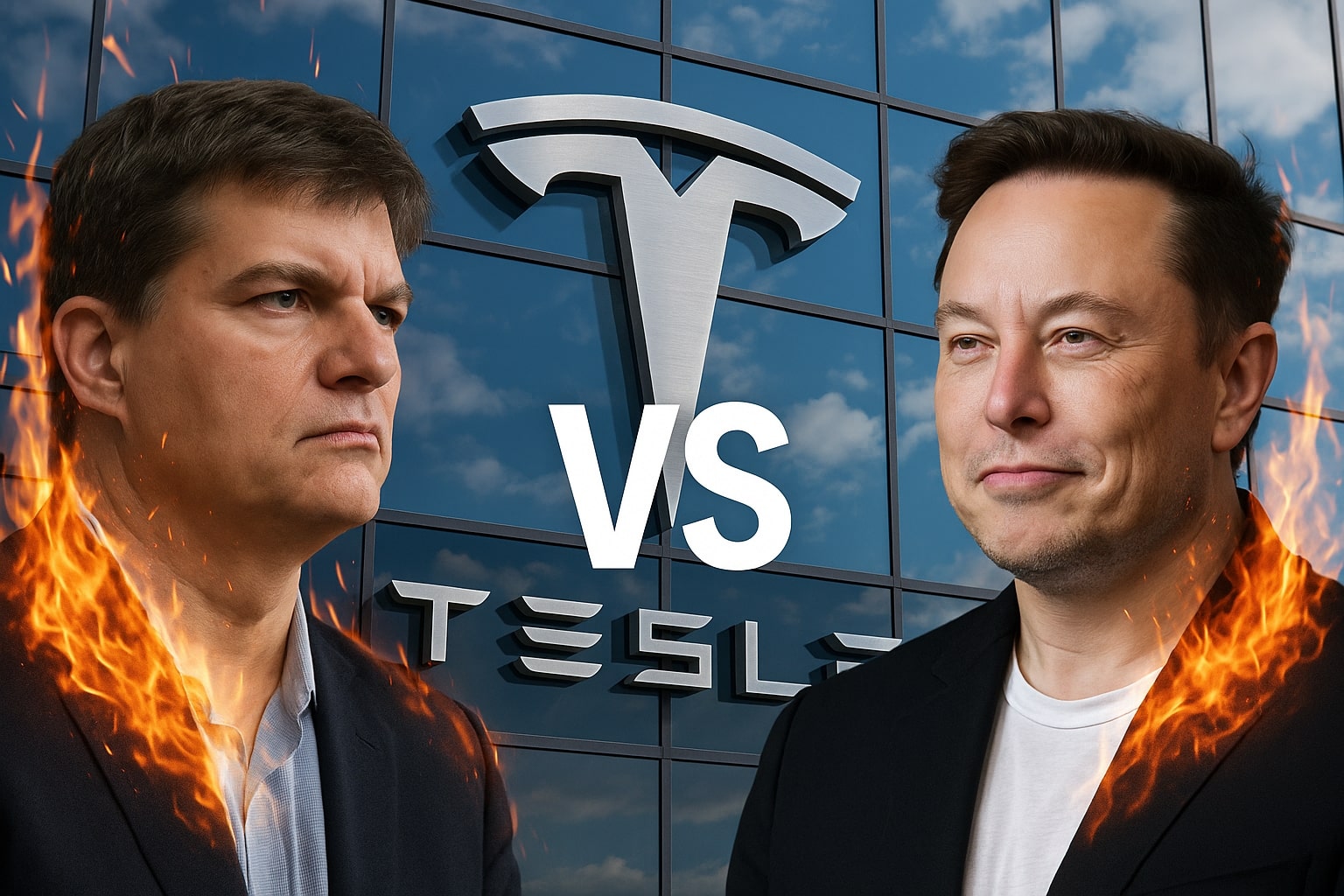
Michael Burry’s Renewed Short Against NASDAQ:TSLA
Michael Burry, known for his prescient 2008 housing short, has reopened his bearish bet against NASDAQ:TSLA, arguing that Tesla’s fundamentals cannot justify its ~289x P/E ratio. He points to persistent shareholder dilution of roughly 3.6% annually and warns that Elon Musk’s $1 trillion compensation plan could expand dilution dramatically.
Despite Tesla’s $5.1 billion in net income on $95.6 billion in trailing revenue, Burry emphasizes the gap between valuation and profit reality — a forward P/E of ~209x compared to the S&P 500 average of 22x. He insists Tesla’s valuation is built on speculative AI potential, not on its weakening core automotive margins.
Institutional resistance is also rising — Norges Bank Investment Management, the world’s largest sovereign wealth fund, voted against Musk’s compensation, citing dilution and excessive concentration risk. The skepticism now extends beyond short sellers to major asset managers reassessing Tesla’s governance profile.
Fundamentals Under Strain as Margins Erode
Tesla’s most recent quarter underscores why critics argue fundamentals don’t align with its trillion-dollar tag.
In Q3 2025, Tesla reported $28.1 billion in revenue, up 11.57% year-over-year, but net income plunged 36.82% to $1.37 billion. The company’s net profit margin fell to 4.89%, less than half its 2022 peak, as aggressive price cuts and rising operating expenses compressed profitability.
Operating costs climbed 43.46% year-over-year, reaching $3.19 billion, while EPS dropped 30.56% to $0.50. Tesla’s EBITDA margin has shrunk from ~22% in 2022 to 11.25% TTM, signaling an end to its former cost advantage.
Tesla’s balance sheet remains strong, with $41.65 billion in cash and $133.7 billion in total assets, but the company’s return on assets (3.55%) and return on capital (5.01%) reveal how quickly operational efficiency has fallen.
China Rebounds While Europe Collapses
Tesla’s regional picture in late 2025 is uneven. In China, the Shanghai Gigafactory achieved a 9.95% year-over-year sales increase in November, totaling 86,700 units, with exports to Europe rising 41% month-over-month. The gains stem from updated Model 3 and Model Y variants, including a six-seat Model Y L, tailored for local buyers.
However, the backdrop remains fiercely competitive. Domestic EV makers such as BYD, Geely, Leapmotor, and Xiaomi have eroded Tesla’s market share, with Xiaomi surpassing 350,000 annual EV sales through its SU7 and YU7 lineup.
Across Europe, Tesla’s sales have sharply deteriorated — November registrations plunged over 50% in France and Sweden, 49% in Denmark, and over 40% in the Netherlands and Portugal. In Spain, sales fell 8.75%, even as the broader EV market nearly doubled. The drop coincides with a 16-point rise in consumer interest for Chinese EVs, while one-third of European buyers now perceive Tesla as a mainstream, not premium, brand.
Only Norway remains an outlier, where Tesla controls 31% of the total auto market after tripling registrations year-over-year and breaking annual sales records before 2025’s end. Norwegian buyers accelerated purchases ahead of tax incentives expiring in 2026, creating a temporary boom that may not sustain.
AI and Robotaxi Narrative Dominates Tesla’s Bull Case
While financial metrics soften, bullish analysts continue to reframe NASDAQ:TSLA as an AI-driven autonomy platform rather than an automaker. Tesla’s AI chip roadmap (AI4–AI6) and robotaxi economics are now central to the bullish thesis.
According to Deep Value Investing, Tesla’s AI6 chip could enable a 1:12 operator-to-robotaxi ratio by 2028, potentially generating $11.4 billion in annual profit from 100,000 robotaxis. These projections rely on substantial labor cost savings — reducing human supervision from $120,000 per robotaxi per year to around $10,000 — and Tesla achieving TPU-like cost efficiency, cutting compute depreciation by 80%.
Tesla’s AI5 chip, produced in partnership with Taiwan Semiconductor (TSM) under a $16.5 billion deal, will enter limited production in 2026. The company plans to refresh its AI hardware every 12 months, targeting AI6 volume production by 2028. Musk also floated building a “gigantic chip fab” in Texas and incentivizing car owners to run idle-vehicle AI inference for $100–$200/month, turning the fleet into a distributed compute grid.
Full Self-Driving (FSD) v14.2 and the Road to Autonomy
Tesla’s Full Self-Driving (FSD) Supervised v14.2 represents a significant technical step toward full autonomy. The system now integrates a vision encoder capable of recognizing human gestures, emergency vehicles, and obstacles with greater accuracy. Users report smoother unprotected turns, lane merges, and detours, suggesting near-human driving quality in optimal conditions.
Wall Street remains divided — TD Cowen reaffirmed a $509 target after testing the Austin robotaxi service at $1.08 per mile, while Wedbush maintains a $600 target, calling the rollout “a trillion-dollar autonomy revolution.” In contrast, regulatory and technical hurdles persist: California still bans Tesla’s driverless operation, and Austin’s fleet remains supervised, raising doubts about a rapid nationwide rollout.
Energy and Robotics Segments Gain Traction
Tesla’s energy and storage division now contributes 12.1% of total revenue, expanding 27% year-to-date, signaling diversification beyond vehicles. The Optimus humanoid robot project, though still pre-commercial, remains a symbolic pillar for future growth.
Musk projects the humanoid robot market could exceed 10 billion units by 2040, each priced around $20,000–$25,000, with Tesla aiming to dominate early adoption. Realistically, even 1 million Optimus units would yield only $6 billion in EBITDA, a small fraction of Tesla’s valuation — illustrating the speculative nature of current optimism.
Valuation Split: Bulls See $600+, Bears Target $350
Analyst consensus reflects the market’s divide. The average 12-month target sits near $384, implying ~10% downside from current prices. Ratings remain mixed: 13 Buys, 11 Holds, and 10 Sells, showing near-even polarization.
Price targets stretch from $19 to $600, highlighting uncertainty around Tesla’s AI and autonomy timeline. 24/7 Wall St. estimates fair value closer to $353, assuming revenue grows from $112B in 2025 to $300B by 2030 and EPS from $2.85 to $11.61 — still implying an excessive forward multiple of ~75x 2030 earnings.
Read More
-
Yen Stalls at 160 Despite a 3% JGB and Tokyo Core CPI at 2.0% — Intervention Sits at 164, Friday's Payrolls Decide
02.09.2026 · TradingNEWS ArchiveEnergy
-
SPY Stalls Below Its Record As A 4.63% Earnings Yield Loses To A 4.74% Treasury
03.09.2026 · TradingNEWS ArchiveStocks
-
Bitwise Holds 286.8M XRP At A $480M Cost And $393M Of Value — The Category Bought Every Dip And Is Still Underwater
03.09.2026 · TradingNEWS ArchiveCrypto
-
Natural Gas Stalls Under $3 As Record 111.5 Bcf/d Production Absorbs Every Bullish Signal
03.09.2026 · TradingNEWS ArchiveCommodities
-
Dow 53,461, S&P 500 7,702 And Nasdaq 26,392 Climb On Waller's Dovish Turn — HOOD Explodes 14.9%
03.09.2026 · TradingNEWS ArchiveMarkets
-
Yen Rips Four Yen In A Session As Japan Takes Control Of The Dollar — Brent At $97.62 Could Not Stop It
03.09.2026 · TradingNEWS ArchiveForex
Technical Landscape and Institutional Sentiment
From a technical standpoint, NASDAQ:TSLA remains above its 200-day moving average, supported near $428, with short interest around 2.14%. The upper resistance zone sits between $480 and $488, representing the 52-week high.
Institutional sentiment has cooled — hedge fund net exposure has shifted toward neutral after a surge in August, while insiders remain mostly inactive following the approval of Musk’s compensation package. Investors can review the company’s insider activity through this link.
The Critical Debate: AI Valuation or Auto Reality?
Tesla’s market value depends on whether it can transition from an auto manufacturer with thin margins to an AI-enabled platform commanding software-like profitability.
Bulls argue that Tesla deserves its premium because of vertical AI integration, energy scalability, and robotics potential, predicting $770–$780 technical upside if the next Wave 3 rally unfolds. Bears counter that without FSD monetization, regulatory clarity, or margin recovery, the company risks compression toward $330 support, implying a 3:1 risk-reward ratio for cautious investors.
At $431, Tesla trades at a valuation that already discounts massive success in autonomy and AI. The next quarters will determine whether the story remains belief-driven or transitions into measurable performance.
Verdict: NASDAQ:TSLA – Hold With Bearish Skew
Tesla’s fundamentals show slowing growth and collapsing margins against a euphoric valuation. Its AI6 chip roadmap, robotaxi rollout, and energy diversification could justify future upside, but execution risk, governance dilution, and competitive erosion remain severe.
At $431.77, the stock trades above consensus fair value, pricing in a best-case scenario. The setup favors holding for those already positioned, but new entries face poor risk-reward until tangible progress in robotaxi deployment and AI economics materializes.
Verdict: Hold, with a bearish bias toward $380–$350 over the next 6 months unless robotaxi and chip milestones accelerate.