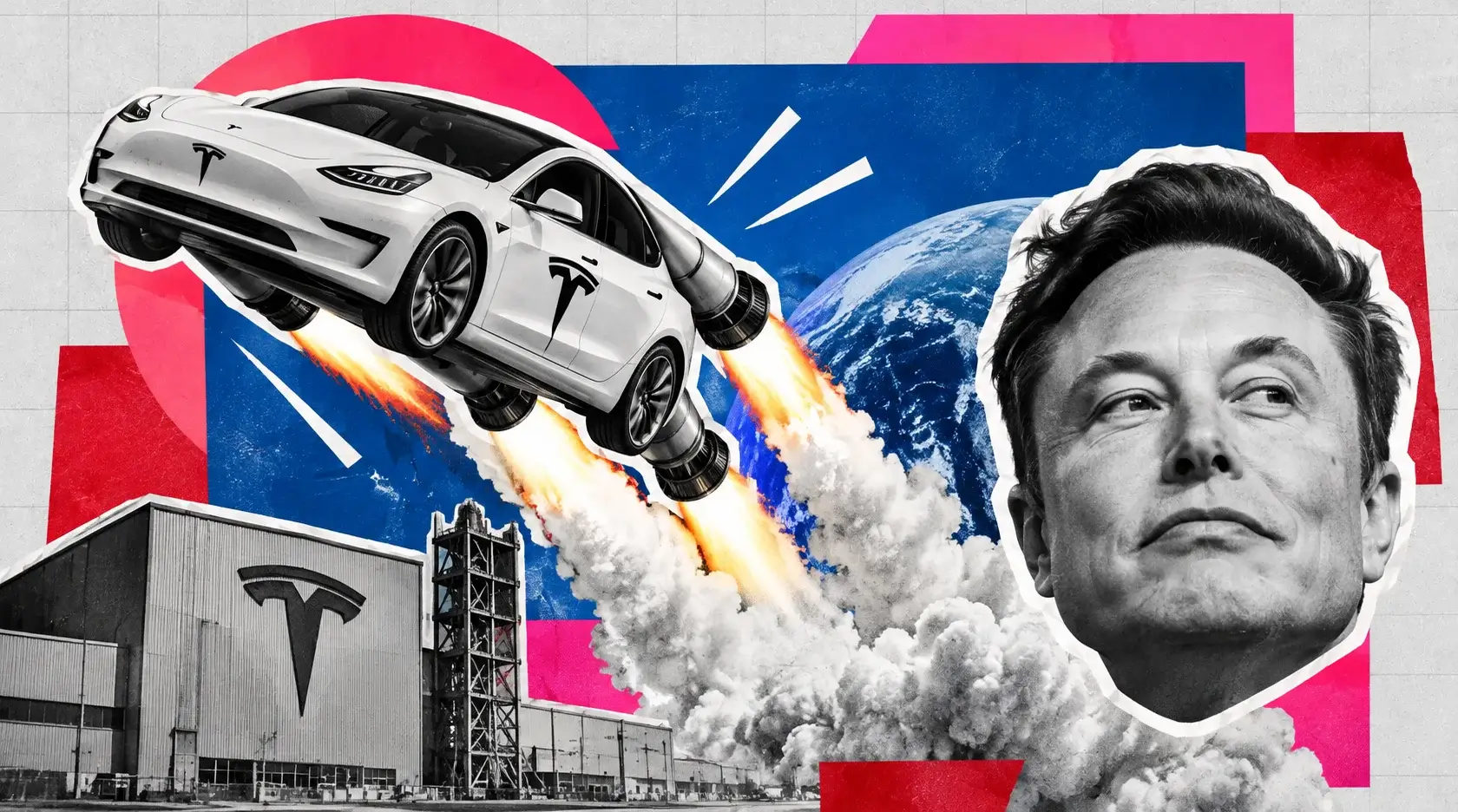
TSLA ($359) Falls Below Thursday’s Close After the Flying Roadster Reveal — Earnings Set the Next Move
Q3 deliveries of 486,532 beat consensus by 5.3%, and the Cybercab fleet in Austin passed 300 vehicles | That's TradingNEWS
Key Points
- Tesla fell 0.78% to $359.60 after giving up a 5.4% premarket gain driven by the Roadster unveiling.
- Q3 deliveries reached 486,532 vehicles, beating the 461,974 consensus by 24,558 units, or 5.3%.
- Tesla trades at 333 times trailing earnings, with a market value of $1.42 trillion.
Tesla stock is trading at $359.60 at 11:10 a.m. ET, down $2.84, or 0.78%, on the day. That is below Thursday’s close of $362.44. The overnight rally sparked by the Roadster unveiling is gone, and Tesla is now in negative territory.
The move happened quickly. In the premarket session, Tesla rose as much as 5.4%, to roughly $382, after Thursday night’s event at SpaceX’s facility in Texas. It was quoted at $379.04 and $379.70 in early premarket trading and at $375.29 just after 8:30 a.m. The stock opened at $369.04, already well below the premarket peak. It hit $370.58 shortly after the bell, then sold off steadily to an intraday low of $359.29.
From the premarket high to the session low, Tesla lost close to $23 a share, or 6%, in under three hours. With 1.42 trillion dollars of market value, that swing erased more than $80 billion of value. Volume reached 28.98 million shares by 11:10 a.m., against a full-day average of 37.29 million. Most of a normal day’s trading has already happened, and nearly all of it came while the stock was falling.
The broader market added to the pressure. The Nasdaq Composite is down 1.11% to 26,416.15, and the S&P 500 is down 0.30% to 7,720.98. Semiconductors are on a ninth straight session of losses, and AI-related stocks are under pressure from debt concerns. Meta is down 2.18% to $720.63, and Alphabet is down 1.35% to $340.24. Tesla is moving with the weakest part of the market, not with the Roadster news.
The longer-term numbers show how much the stock has struggled. Tesla is down 20.00% year to date and 16.08% over 12 months. Over five sessions it has lost 5.99%. The 52-week range is $297.38 to $498.83. At $359.60, the stock is 27.9% below its 52-week high and 20.9% above its low.
The stock had already been falling before the event. It closed at $382.70 on October 9 and dropped for four straight sessions to $362.44 on October 15, a 5.3% decline. Friday’s premarket rally briefly looked like it would end that streak. Instead, it extended to a fifth session if the current level holds.
The message from the tape is clear. Investors were willing to bid up the Roadster overnight, but they sold into the opening bell. The stock is now trading on what comes next: the third-quarter earnings report on Wednesday, October 21, after the close.
From $382 to $359.29: How the Session Unfolded
The trading pattern on Friday shows how investors are weighing the Roadster against the rest of Tesla’s business.
The rally started overnight. Tesla traded on alternative venues after the event ended Thursday night, and enthusiasm built through the European morning. By 7:53 a.m. ET, the stock was quoted at $373.64, up 3.09%. It continued to climb to $379.04 and $379.70, up 4.6% to 4.76%, and peaked at roughly $382 in the early premarket session, up 5.4%.
That peak matched an important level. Tesla closed at $382.70 on October 9, before its four-session slide. The premarket high stopped within a dollar of that close. Sellers who had held the stock through the drop used the rally to exit at their earlier price.
Selling started before the open. At 8:29 a.m., Tesla was at $375.29, up 4%. At 9:03 a.m., it was up 3.3%. By the 9:30 a.m. open, it was at $369.04, up 1.82%. The stock lost more than half of its premarket gain before regular trading began.
After the open, the stock briefly reached $370.58, then turned lower. At 9:54 a.m., Tesla was at $369.45, up 1.93%. By 10:12 a.m., it had dropped further. At 11:11 a.m., it was at $360.43, down 0.55%, and then $359.60, down 0.78%, with a session low of $359.29.
This pattern is a classic gap fade. A stock that opens higher on news and then trades below the prior day’s close shows that buyers did not follow through. When a gap fade happens on heavy volume, it often signals that the news has been fully priced in, and that the stock’s next move will be driven by other factors.
The broader market reinforced the selling. As the Nasdaq slid from 0.3% down at the open to 1.11% down by late morning, high-beta stocks fell with it. Tesla’s five-year beta is 1.92, meaning it typically moves almost twice as much as the overall market. A 1.11% drop in the Nasdaq usually means a bigger move in Tesla.
SpaceX traded the same way. SpaceX was up 1.16% to $150.35 premarket on a price-target increase and the Roadster news. By mid-morning it was at $146.46, down 1.45%, with a $1.931 trillion market value. Both Musk-linked companies opened higher and sold off.
For the forecast, the session sets two key levels: roughly $382, the premarket high that matched the October 9 close and acted as resistance, and $359.29, the session low that now serves as immediate support.
The Roadster: What Tesla Showed and What It Left Out
The Roadster unveiling was a spectacle. It was not a business update, and the stock reaction reflects that.
The event took place Thursday night at SpaceX’s test facility in Texas, two weeks later than planned after the original October 1 date was pushed back because of weather. The car drove partway up an inverted ramp, held in place by a suction fan system, then launched off it upside down. It flipped in the air, corrected itself with cold-gas thrusters and landed on the tarmac. A second stunt had the Roadster jump over a row of Teslas, including a Semi, invert itself and land using thrusters. “Well, it worked,” Elon Musk said afterward.
Tesla claimed a 0–60 mph time of 0.81 seconds and called it the world’s fastest car. Musk said the top speed could reach Mach 0.5, roughly half the speed of sound. The thruster system uses 10 nozzles fed by two tanks with a combined capacity of 600 liters of compressed air.
Three versions were introduced. The Performance model is road-legal, seats two and uses the suction system, with a 0–60 time under 1.6 seconds. The Thrust model adds rear-mounted cold-gas thrusters for a 0–60 time under 0.9 seconds. The Rocket model is limited to off-road use, reaches a top speed of 230 mph and has a 0–60 time under 0.59 seconds. All three claim a range above 300 miles.
What Tesla did not provide matters more for the stock. There is no price. There is no confirmed production site. Production is set for 2028. Musk added “actually” when giving that date, a nod to the history of delays. The second-generation Roadster was first unveiled in November 2017 with a 2020 production target and a 620-mile range. The new 300-mile claim is half the original promise, and Tesla did not say whether the original target still applies.
Reservations require a $5,000 deposit, followed by a $45,000 wire transfer within 10 days, for a total of $50,000. Musk called the Roadster “not necessarily a safety optimized car,” while stressing it would be an “actual car that’s on roads.”
Musk has previously said the Roadster would not contribute significantly to Tesla’s finances. It is a technology and brand showcase. A low-volume car with a 2028 start date and no announced price will not show up in revenue, margins or cash flow for at least two years.
The event also strengthened the link between Tesla and SpaceX. The thrusters were developed by SpaceX, and the event was held at a SpaceX site. That fueled speculation about a merger between the two companies. Any combination would require shareholder approval and comes with significant downside risks, including governance and valuation questions.
For the forecast, the Roadster is not a reason to own or sell Tesla. Friday’s fade shows investors agree.
Q3 Deliveries: 486,532 Units and a Faster Inventory Drawdown
The most recent hard data on Tesla’s core business is the third-quarter delivery report, released October 2. It was better than expected, and it has been mostly overlooked during the stock’s slide.
Tesla delivered 486,532 vehicles in the third quarter. That was up 1.3% from 480,126 in the second quarter, but down 2.1% from the record 497,099 a year earlier. The company-compiled consensus of 24 analysts was 461,974. Tesla beat it by 24,558 vehicles, or 5.3%.
The Model 3 and Model Y accounted for 478,237 deliveries, compared with 481,166 a year earlier. “Other Models,” which now covers the Cybertruck, Semi and remaining Model S and Model X inventory, delivered 8,295, down 48% from 15,933. The core product line is holding steady. The premium and new products are shrinking.
Production totaled 464,391 vehicles: 457,387 Model 3 and Model Y and 7,004 other models. Tesla delivered 22,141 more vehicles than it built. That is the second straight quarter in which deliveries exceeded production. In the first quarter, Tesla produced 408,386 vehicles and delivered only 358,023, building 50,363 excess units. Across the second and third quarters, it has now cleared that surplus.
Clearing inventory matters for margins. Excess inventory forces discounting, and holding cars costs money. Working down 50,000 extra vehicles over two quarters means Tesla can now match production more closely to demand. That should reduce pressure on average selling prices in the fourth quarter.
Energy storage continued to grow. Tesla deployed 13.7 GWh of storage products in the third quarter, up from 13.5 GWh in the second quarter and 8.8 GWh in the first. Energy storage has become one of Tesla’s most consistent businesses, and its margins are generally higher than in automotive.
Only 1% of third-quarter deliveries were subject to operating lease accounting. Nearly all deliveries were recognized as sales in the quarter, which supports revenue.
The year-to-date picture shows a recovery from a weak start. First-quarter deliveries of 358,023 were followed by 480,126 in the second quarter and 486,532 in the third, a total of 1,324,681 for the first nine months.
For the forecast, the delivery beat is the strongest fundamental point in Tesla’s favor heading into earnings. But deliveries do not equal profit. As Tesla’s own release notes, financial results depend on average selling prices, costs, currency moves and other factors. The October 21 report has to show that 486,532 deliveries translated into margins.
China: Exports Up 58%, Domestic Sales Down 9.4%
China tells two different stories for Tesla. Its Shanghai factory is running at record levels, while sales inside China are falling.
Tesla’s Shanghai plant sold 95,366 vehicles at wholesale in September, up 5% from 90,812 a year earlier. That was Tesla China’s best month of 2026 and its 11th straight month of year-over-year growth. September was up 10.7% from August’s 86,166 and above July’s previous 2026 high of 93,579.
The third quarter was a record for the Shanghai plant. Wholesale sales reached 275,111 vehicles, up 13.7% from 241,890 a year earlier. That was 8.1% above the previous record of 254,551, set in the second quarter. For the first nine months, Shanghai wholesale totaled 743,060 vehicles, up 22.54%.
The Model Y accounted for 62,948 of September’s wholesale total, up 5.1%. It was China’s second-best-selling passenger car at wholesale in September, behind BYD’s Song.
The growth came from exports. Shanghai exports rose 58% in September to 30,529 vehicles. Domestic retail sales fell 9.4% to 64,837. For the first nine months, exports more than doubled to 361,972, while domestic sales dropped 12% to 381,088. Exports now account for close to half of Shanghai’s output.
The Chinese market is weak overall. New-energy vehicle retail sales fell 16.7% in September to 1.084 million units, even as electric and hybrid cars reached a record 67% share of all passenger car sales. Total passenger car retail sales fell 28% to 1.618 million. A buying rush before subsidy changes last September made the comparison difficult.
BYD is facing the same pressure. Its domestic retail sales fell 28.9% to 246,816 in September, giving it a 22.8% share of the NEV market. Tesla moved up to fourth place in China’s NEV rankings. Leapmotor was the only top-10 brand to increase domestic sales, rising 30.8% to 78,202. Geely sold 119,682.
China is also exporting heavily across the board. The country exported 558,000 new-energy passenger vehicles in September, up 163.5%. BYD exported 175,877 NEVs, Chery 85,990 and Geely 72,893. Tesla was the fourth-largest NEV exporter. Competition is spreading into Europe and Asia-Pacific, the markets Tesla Shanghai supplies.
Tesla has offered discounts in China, including 5,000 yuan on the Model 3 and 7,000 yuan on selected Model Y versions. Discounts support volume but reduce margins.
For the forecast, China supports Tesla’s delivery numbers through exports but adds margin pressure through discounting and weaker domestic demand. The October 21 report needs to show whether Tesla is earning enough on export volume to offset the slowdown at home.
Margins and the Q2 Miss: $0.33 Against $0.50
Margins are the biggest question for Tesla heading into October 21, and the second-quarter report set a low bar.
In the second quarter, Tesla reported record revenue of $28.24 billion, up 26% from a year earlier. Net income was $1.11 billion, a 3.95% profit margin. Adjusted earnings per share were $0.33, against a consensus of $0.50. That was a 34% miss.
The revenue beat and earnings miss point to cost pressure. Automotive sales, excluding leasing and regulatory credits, were $20 billion. Automotive gross margin excluding regulatory credits was 16.3%, up from 15% a year earlier but down sharply from 19.2% in the first quarter. In a single quarter, the core car business lost 2.9 percentage points of gross margin.
Regulatory credit revenue has also dropped. It fell to $146 million in the second quarter from $439 million a year earlier. Those credits used to flow almost entirely to profit. Losing $293 million of them in a year removes a key earnings buffer, and the trend is likely to continue as other automakers build more of their own EVs.
Operating margin was 1.4%. For a company valued at $1.42 trillion, earning 1.4 cents of operating profit for every dollar of sales is a weak result. Trailing twelve-month figures show revenue of $103.62 billion, net income of $3.81 billion and a 3.67% profit margin. Return on equity is 4.67% and return on assets is 1.93%.
Three factors pressured second-quarter margins. First, Tesla used price cuts and incentives to clear the excess inventory built in the first quarter. Second, the vehicle mix shifted further toward lower-priced Model 3 and Model Y versions as premium models declined. Third, spending on AI, Cybercab, Optimus and Semi production lines rose sharply.
Some of those pressures should ease in the third quarter. The inventory drawdown is complete. Deliveries exceeded production for a second straight quarter, so Tesla does not need to discount as heavily to move cars. Energy storage deployments, which carry higher margins, hit 13.7 GWh.
Other pressures remain. Chinese discounts continue. Regulatory credit revenue is shrinking. Spending on new products is still rising. And with deliveries down 2.1% from a year earlier, Tesla has less volume to spread fixed costs across.
For the forecast, the key number on October 21 is automotive gross margin excluding credits. A reading above 17% would show recovery from the second-quarter dip and support the stock. A reading below 16% would point to continued pressure and likely push the stock toward its 52-week lows.
The October 21 Setup: $0.43 to $0.45 on $27.8 to $27.9 Billion
Tesla reports third-quarter results after the close on Wednesday, October 21. The earnings call follows at 5:30 p.m. ET. Thursday, October 22 will be the first full session to react.
Expectations are low. Consensus earnings per share sit between $0.43 and $0.45, down from $0.50 a year earlier, a decline of 10% to 14%. Consensus revenue sits between $27.79 billion and $27.94 billion, down 0.6% to 1.1% from $28.10 billion a year earlier.
The consensus has been falling. Earnings estimates have dropped 3 cents over the past 30 days. Analysts have cut their forecasts after the second-quarter miss and amid continued pressure in China.
Tesla’s earnings record is mixed. It has beaten earnings estimates in four of the last eight quarters. Over the trailing four quarters, it missed twice and beat twice, with an average miss of 3.7%. The second-quarter miss of 34% was the largest in that stretch.
The delivery beat gives Tesla a cushion on revenue. With 486,532 deliveries, 1.3% more than the second quarter, and higher energy storage deployments, revenue should be close to the second quarter’s $28.24 billion. If average selling prices held up, revenue could beat the $27.8 billion to $27.9 billion consensus.
Earnings are harder to predict. If margins recover from the second quarter, earnings could clear $0.45. If spending on AI and new products continued to rise, or if China discounting deepened, earnings could miss again.
Four other numbers will matter on October 21. The first is Full Self-Driving subscriptions, which stand at 1.48 million and provide recurring software revenue. The second is paid robotaxi miles, which will show how quickly the Cybercab service is growing. The third is revenue by geography, which will show the balance between U.S., China and export markets. The fourth is free cash flow. Tesla’s second-quarter free cash flow was negative, and a return to positive free cash flow would ease concerns about the $25 billion capital spending plan.
Guidance matters as much as results. Investors want to hear when Cybercab production will scale, how fast the robotaxi service will expand beyond Austin and Dallas, and when Optimus will be revealed and produced. Musk has said Optimus generation 3 will be unveiled closer to the start of production.
For the forecast, October 21 is the main event. The stock is likely to trade in a range until then, with the result setting the direction for the rest of the year.
Cybercab and Robotaxi: 300-Plus Vehicles in Austin and a NHTSA Deadline on October 30
The robotaxi business is Tesla’s main long-term growth story, and it is making real progress.
Tesla began producing the Cybercab in February 2026. The purpose-built robotaxi has two seats and no steering wheel or pedals. Tesla held an invitation-only launch event in Austin on September 3 and began offering paid public Cybercab rides the next day through its existing Robotaxi service.
The fleet is growing fast. On October 10, Tesla’s Robotaxi account said it had “300+ Cybercabs serving Austin,” an “8x increase in 30 days.” Texas vehicle records now show 319 registered Cybercabs, up from 169. The service started in Austin last month with an estimated 38 Cybercabs. Tesla’s combined robotaxi and Cybercab fleet in Texas passed 500 vehicles on September 26, with 420 Model Y robotaxis and 126 Cybercabs at that time. Tesla has since stopped adding Model Y robotaxis and is focusing on the Cybercab.
Dallas is next. Tesla’s head of AI software, Ashok Elluswamy, named Dallas as the next city for the Cybercab service. Large numbers of Cybercabs have also been spotted in Houston, suggesting a launch there soon. Tesla started an Asia road show for the Cybercab in Hong Kong on September 9, with plans to show it in Japan and China.
Demand appears strong. Cybercab fares have been higher than Uber and Tesla’s own Model Y robotaxi because of high demand. Tesla is also adjusting service hours; the Robotaxi service only recently extended its hours from 10 p.m. to 11 p.m.
Regulatory risk is the main obstacle. The National Highway Traffic Safety Administration is investigating the Cybercab. Tesla received a 30-day extension, until October 30, to answer 21 questions about how it certified the steering wheel-less vehicle under federal safety standards and its plans to scale commercial operations. Tesla’s answers could shape how quickly it can expand. A finding that the Cybercab does not meet federal standards would be a major setback.
The robotaxi business is not yet profitable at scale. A fleet of 300 to 500 vehicles generates only a small fraction of Tesla’s $103.62 billion in annual revenue. The value case depends on scaling to tens of thousands, then hundreds of thousands, of vehicles. Musk has previously targeted at least 2 million Cybercabs a year across more than one factory.
Full Self-Driving software supports the robotaxi effort. Tesla rolled out FSD version 14.3.12 in mid-October. The 1.48 million FSD subscriptions provide recurring revenue and data for training the autonomous system.
For the forecast, the robotaxi is the part of the story most likely to move the stock on October 21. Clear numbers on paid miles, fleet growth and NHTSA progress could offset weak auto margins. Vague answers would leave the stock exposed to the auto business alone.
Capital Spending at $25 Billion, $30 Billion in New Credit and $43.52 Billion in Cash
Tesla is spending heavily on its future, and investors are watching how it pays for it.
Tesla expects capital expenditures of at least $25 billion in 2026. That spending covers new production lines for the Cybercab, the Semi and the Optimus robot, along with AI computing infrastructure. The Semi and Optimus are getting dedicated new factories. Capital spending could keep rising for another two to three years.
On September 29, Tesla said in a regulatory filing that it had secured $30 billion in new credit lines. The company said it does not plan to draw on these facilities this year. The credit lines give Tesla flexibility to fund Cybercab, Optimus and Semi production at scale in 2027 and beyond without issuing new shares.
The balance sheet is still strong. Tesla has $43.52 billion in cash and investments. At the end of the second quarter it had around $9 billion of debt. Total debt to equity is 18.37%. Trailing twelve-month levered free cash flow is $4.84 billion.
That is a key difference from the AI infrastructure companies selling off this week. CoreWeave, down 8% on Friday, has more than $50 billion of debt and bonds yielding 15.78%. Tesla funds most of its spending from cash and operating cash flow and has untapped credit available. It is not exposed to the debt market the way the most leveraged AI companies are.
But the scale of spending matters. A $25 billion capital budget is close to a quarter of Tesla’s $103.62 billion in annual revenue. With a 3.67% profit margin and $3.81 billion in trailing net income, Tesla is spending more than six times its annual profit on capital projects. Free cash flow turned negative in the second quarter. If spending rises as planned, free cash flow could stay negative for several quarters.
That raises the bar for the new products. Cybercab, Optimus and the Semi all need to reach high volume and generate meaningful margins to justify the investment. If any of them is delayed, Tesla carries the cost without the revenue.
The interest-rate backdrop adds pressure. The 10-year Treasury yield is at 5.09%. Higher rates make future earnings worth less today, which hurts growth stocks with valuations based on long-term projects. They also make Tesla’s own borrowing more expensive if it draws on its credit lines.
For the forecast, the balance sheet is a source of stability. Tesla is not at risk of a funding crisis. But the spending plan increases the importance of October 21. Investors need clear evidence that the new products are on track and that free cash flow will turn positive again within a reasonable timeframe.
Valuation: $1.42 Trillion, 333 Times Trailing Earnings and 13.7 Times Sales
Tesla’s valuation is the heart of the bull and bear debate. On every standard measure, it is priced well above traditional automakers.
At $359.60, Tesla’s market value is $1.42 trillion. Trailing twelve-month earnings per share are $1.08, giving a price-to-earnings ratio of 333. Trailing revenue is $103.62 billion, a price-to-sales ratio of 13.7. Annualizing the third-quarter consensus of $0.44 a share gives $1.76, which still implies a multiple above 200 times earnings.
Comparisons with other automakers show the gap. Ford trades at $12.63 with a market value of $50.4 billion. Rivian trades at $13.15 and Lucid at $3.50, both still unprofitable. BYD, which sells far more electrified vehicles than Tesla, trades at a much lower multiple. Tesla is valued as a technology company, not a carmaker.
The valuation rests on three assumptions. The first is that the robotaxi business scales to a large share of global ride-hailing. The second is that Optimus robots become a major product. The third is that energy storage keeps growing quickly. Car sales alone do not justify a $1.42 trillion valuation.
Tesla’s earnings are not growing. Consensus expects third-quarter earnings to fall 10% to 14% from a year earlier and revenue to slip 0.6% to 1.1%. Deliveries are down 2.1%. Profit margin is 3.67% and operating margin is 1.4%. A stock trading at 333 times earnings needs earnings to grow fast, and they are falling.
Insider activity offers another data point. There have been no insider purchases in the past 12 months and $87.7 million in insider sales. Insiders selling stock is common and has many reasons, but the absence of buying at these levels does not support the bull case.
The stock has already given up a lot of value. It is down 20% year to date and 27.9% below its 52-week high of $498.83. At the high, Tesla was worth close to $2 trillion. The decline has removed some of the speculative premium, but the stock is still far from cheap on current earnings.
The bear case is straightforward. A company with falling earnings, shrinking regulatory credits, 1.4% operating margins and $25 billion of capital spending trades at more than 300 times earnings. If the robotaxi or Optimus timelines slip, there is little to support the price.
The bull case is also clear. Tesla has 300-plus Cybercabs on the road, 1.48 million FSD subscribers, $43.52 billion in cash and a record quarter for energy storage. If autonomy scales, today’s earnings are irrelevant to the long-term value.
For the forecast, valuation limits upside in the near term. Without a clear improvement in margins or robotaxi scale on October 21, the stock is unlikely to return to the $400 to $500 range.
The Musk Factor: SpaceX, Merger Talk and an Executive Exit
Tesla’s stock is closely tied to Elon Musk’s other ventures, and that link was on full display this week.
The Roadster event made the Tesla-SpaceX connection explicit. The thrusters were developed by SpaceX. The event was held at a SpaceX facility. Musk described the car as the work of an electric vehicle maker partnering with a rocket engine company. Tesla and SpaceX are widely expected to merge at some point as part of Musk’s plan to build a combined company.
Merger speculation lifted both stocks overnight. Some on Wall Street now see a Tesla-SpaceX merger announcement as possible before December. But a deal faces real obstacles. It would require approval from shareholders of both companies. The relative valuation would be contentious: SpaceX is worth $1.931 trillion and Tesla $1.42 trillion. Governance issues would draw scrutiny, given Musk’s control of both companies.
SpaceX’s stock reflects the same mood as Tesla’s. SpaceX shares debuted at $135 on June 12 and hit a record $225.64 on June 16. At $146.46, the stock is 35% below that peak. It gained in the premarket on the Roadster news and a price-target increase, then fell 1.45% in regular trading. Both stocks are being sold on rallies.
Tesla also has an executive transition. Reports say Mike Snyder, head of Tesla’s energy business, is leaving. Energy storage is one of Tesla’s strongest segments, with deployments of 13.7 GWh in the third quarter. A change in leadership at a high-growth unit adds uncertainty heading into earnings. Tesla’s stock fell 1.29% on Thursday as those reports circulated, before the Roadster event.
Musk’s attention across multiple companies is a long-standing concern for Tesla shareholders. He runs SpaceX, which recently went public, along with other ventures. The Roadster event showcased SpaceX technology as much as Tesla’s. Investors who want Musk focused on Tesla’s car margins and robotaxi rollout may see the event as a distraction.
The Tesla-SpaceX overlap also creates questions about related-party arrangements. If SpaceX supplies thrusters for the Roadster, the terms of that arrangement matter for Tesla’s margins on the car. Tesla has not disclosed them.
Political exposure remains a factor. Musk’s public profile and political involvement have affected Tesla’s brand in some markets, particularly in Europe. Tesla’s European registrations have been recovering, which suggests that drag is easing, but it remains a risk.
For the forecast, the Musk factor adds volatility in both directions. A formal merger announcement could lift both stocks sharply in the short run. A failed merger, a governance dispute or more executive departures would weigh on Tesla. None of these factors changes the near-term focus on October 21, but they add risk around it.
Read More
-
Yen Stalls at 160 Despite a 3% JGB and Tokyo Core CPI at 2.0% — Intervention Sits at 164, Friday's Payrolls Decide
02.09.2026 · TradingNEWS ArchiveEnergy
-
Ford ($12.75) Breaks Out of Its October Range Ahead of Earnings as Super Duty Hits a 19-Year Production High — Upside to $13.35
16.10.2026 · TradingNEWS ArchiveStocks
-
XRP ($1.34) Defends $1.29 as Cross River and Standard Chartered Adopt RLUSD — Upside to $1.50
16.10.2026 · TradingNEWS ArchiveCrypto
-
WTI Jumps 5.6% This Week as U.S. Stocks Fall 8.56M Barrels While Brent Stays Near $105 — Upside to $102.50
16.10.2026 · TradingNEWS ArchiveCommodities
-
Dow Gains 0.48%, Nasdaq Loses 210 Points, S&P 500 at 7,735 as MU Slides 3.8%
16.10.2026 · TradingNEWS ArchiveMarkets
-
Sterling (1.3366) Tests the 100-Day SMA as 54 of 63 Economists Expect a BoE Hike — Upside to 1.3435
16.10.2026 · TradingNEWS ArchiveForex
The Technical Map: $359.29 Support, $382 Resistance
Friday’s price action defines the key levels for Tesla heading into earnings.
Immediate support is $359.29, Friday’s session low. The stock is trading just above it at $359.60. A break below would put Tesla at its lowest level since mid-September. The one-month return of +0.48% shows that the stock traded near $358 in mid-September, making the $358 to $360 zone an important support area.
The next support is $350, a round-number level where buyers often step in. Below that, the 52-week low of $297.38 is far away. A drop of that size would require a significant earnings miss or a broader market selloff.
On the upside, the first resistance is $369 to $370.58. Tesla opened at $369.04 and hit its regular-session high of $370.58 before turning lower. Sellers are active at that level.
The key resistance is $382 to $382.70. The premarket high near $382 matched the October 9 close of $382.70 almost exactly. Sellers who held through the October 9 to October 15 decline used the rally to exit. A move back above $382.70 would recover the entire five-session decline and suggest that buyers have regained control.
Above that, $400 is a major psychological level. The 52-week high of $498.83 is 38.7% above the current price.
The gap fade on Friday is a bearish signal in the short term. When a stock gaps up on news and then trades below the previous close, it often indicates that the news has been sold and buyers are not committed. The pattern is stronger when it happens on high volume, as it did on Friday. Tesla traded 28.98 million shares by 11:10 a.m., close to 78% of a full day’s average.
Volatility is high. A 6% swing from the premarket high to the session low, with Tesla’s 1.92 beta, means daily moves of 3% to 5% are normal. Options markets are likely pricing a large move around the October 21 report.
The broader tape is a headwind. The Nasdaq is down 1.11%, chips are on a nine-day losing streak and AI-linked stocks are under pressure. The 10-year Treasury yield is at 5.09%, keeping pressure on high-valuation growth stocks. A broader tech recovery would help Tesla; continued weakness would push it toward $350.
For the forecast, the trading range into earnings is $350 to $382.70. A daily close below $350 would point to a test of lower levels before the report. A daily close above $382.70 would suggest the market is positioning for a strong result.
Tesla Stock Forecast Verdict: Hold, With a $350 to $382.70 Range Into October 21
Tesla stock is at $359.60, down 0.78% on the day after giving up a 5.4% Roadster-driven premarket gain. The verdict is Hold. The stock is fairly priced for a range trade into October 21, and the earnings report will set the next direction.
The bull case rests on four points. First, third-quarter deliveries of 486,532 beat the 461,974 consensus by 5.3%, and Tesla cleared its excess first-quarter inventory. Second, the Cybercab fleet in Austin grew eightfold in 30 days to more than 300 vehicles, with Dallas next. Third, energy storage hit 13.7 GWh in the third quarter, and Shanghai wholesale set a quarterly record of 275,111 vehicles. Fourth, the balance sheet holds $43.52 billion in cash with $30 billion of untapped credit, so Tesla is not exposed to the debt stress hitting AI infrastructure stocks.
The bear case rests on four points. First, second-quarter earnings of $0.33 missed the $0.50 consensus by 34%, and automotive gross margin excluding credits fell to 16.3% from 19.2%. Second, consensus expects third-quarter earnings to fall 10% to 14% from a year earlier, with operating margin at 1.4%. Third, the stock trades at 333 times trailing earnings and 13.7 times sales with falling earnings. Fourth, China domestic sales fell 9.4% in September, regulatory credits are shrinking and capital spending of at least $25 billion is pushing free cash flow negative.
The Roadster does not change any of these points. Friday’s gap fade confirms that investors see it as a brand showcase with a 2028 production date and no announced price, not as a driver of near-term earnings.
The near-term range is $350 to $382.70. Support sits at Friday’s $359.29 low and the $350 round number. Resistance sits at the $369 to $370.58 opening zone and the $382 to $382.70 level, where the premarket high matched the October 9 close.
October 21 is the decisive event. A bullish result would show automotive gross margin excluding credits above 17%, earnings at or above $0.45, positive free cash flow and clear Cybercab scaling plans with progress on the NHTSA review due October 30. That combination could push Tesla through $382.70 and toward $400. A bearish result would show margins below 16%, earnings below $0.43, continued negative free cash flow and vague robotaxi guidance. That would likely send the stock below $350 toward the low $330s.
The risk-reward is balanced at the current price. From $359.60, the distance to $382.70 resistance is $23.10 and the distance to $350 support is $9.60. Inside the range the setup favors buyers near $350 and sellers near $382. Beyond that, the earnings report will decide the trend.
The verdict is Hold: trade the $350 to $382.70 range into October 21, then follow the result.