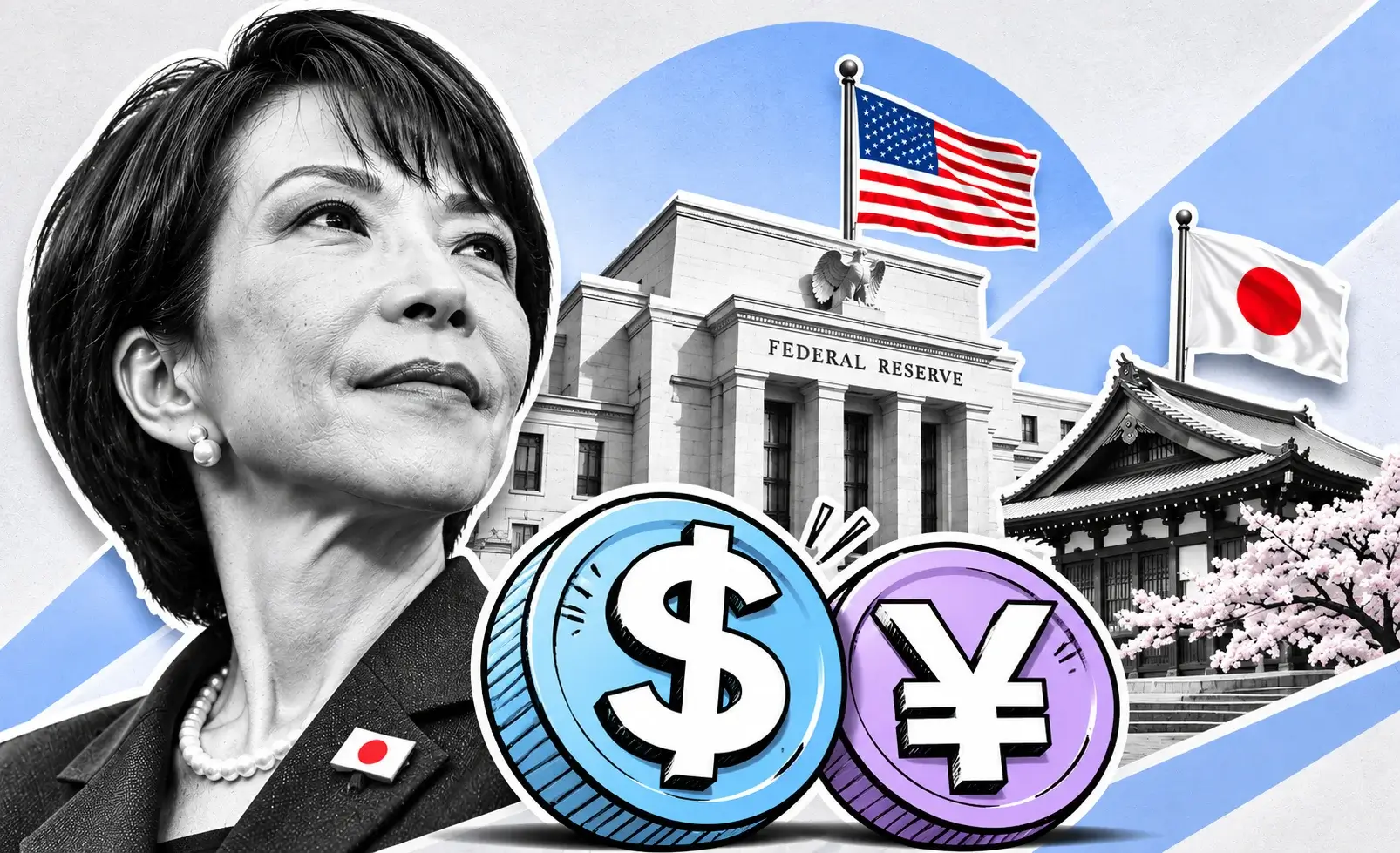




USD/JPY Stalls at 159.20 as a Steady Rate Gap Meets Tokyo's 160 Line; 160.20 Retest Target
A 262.5bp gap guards 158.55; a close above 159.75 opens 160.20 | That's TradingNEWS
Key Points
- USD/JPY held at 159.20 inside a 159.00 to 159.50 range, with no daily close above 160 since September 1.
- Markets price a 98% Fed hike on December 9 and a 70% to 85% BoJ hike to 1.50% on December 18.
- Japan's services prices rose 4.2% in October, the fastest pace since 1990.
USD/JPY barely moved on Wednesday, November 25, even as markets around it swung hard. The pair traded at 159.20 by mid-morning in New York, down 0.01% on the day, and closed the European session near 159.19, down 0.05%. It spent the whole day in a 159.00 to 159.50 range, inside Tuesday's 158.75 to 159.58 range. The high came during the Tokyo afternoon at 159.50, and the pair slipped back to 159.00 when U.S. equity futures fell. It traded at 159.25 ahead of the U.S. data and held near 159.20 after it.
The flat price hides a real tug-of-war. On one side, the U.S. data was firm: core PCE at 3.3% against a 3.2% forecast, third-quarter GDP revised up to 4.3% against 3.5% expected, and initial jobless claims at 189,000. A 98% probability of a December Fed hike gives the dollar a rate advantage. On the other side, the Nasdaq Composite fell more than 3.5% at the open, the Nasdaq 100 entered a bear market, and haven demand for the yen picked up. Japan's own data showed price pressures building, strengthening the case for a December Bank of Japan hike. The two forces cancelled out.
The bigger picture is a pair pinned against a ceiling. USD/JPY has not closed a day above 160.00 since September 1. It peaked at 160.20 on November 13, and every bounce since then has stopped a little lower. Since November 11, it has traded in a band of less than 200 pips. Over the past seven days, the range ran from 158.55 to 159.75. The yen has weakened 1.07% over the past month and 1.73% over the past year, but the pace has slowed sharply as the pair approaches 160.
The thesis of this forecast is that the rate gap pushes USD/JPY up while the threat of intervention holds it down. The Fed's midpoint rate of 3.875% sits 262.5 basis points above the Bank of Japan's 1.25%. If both central banks hike in December, as markets expect, the gap stays at 262.5 basis points. That gap keeps carry trades profitable and supports the dollar. But Japan's finance ministry has made clear it will act near 160, and it already stepped in jointly with the U.S. Treasury in July and August.
The upside target is 160.20, the November 13 peak. It is 100 pips, or 0.6%, above current levels. Reaching it requires a daily close above 159.75 and a hawkish Fed message that pushes U.S. yields back up. Above 160.20, the intervention risk rises sharply.
Session Map: 159.50 in Tokyo, 159.00 on the Risk-Off Turn
Wednesday's session ran in three phases. The first was Tokyo. USD/JPY opened just above 159.00 and drifted in a tight band during Asian hours, struggling to extend the small gains of the previous two sessions. The pair reached 159.50 during the Tokyo afternoon, its session high, as the dollar found buyers on dips after Tuesday's pullback from a 20-month high.
The Japanese data pulled the other way. The Bank of Japan's preferred measure of underlying inflation rose to 3.5%, its fastest pace in more than three years. Separately, the Corporate Services Price Index rose 4.2% year over year in October, well above the 3.6% forecast and the fastest pace since 1990. Both readings strengthened the case for a December hike and gave the yen support.
The second phase came in the European morning. Reports of fresh U.S. tariffs on 14 trading partners, including up to 20% on China and up to 25% on South Korea and Taiwan, hit Asian stock markets. Korea's Kospi fell 6.16%. U.S. equity futures followed lower. USD/JPY slipped back to 159.00 as yen demand rose with the risk-off mood. The yen tends to strengthen when stocks fall, which has kept USD/JPY from rising as much as the dollar's broader strength would suggest.
The third phase came with the U.S. data at 8:30 a.m. ET. The firm readings on inflation, growth and jobless claims lifted the dollar, and USD/JPY moved back toward 159.25. Then the U.S. equity open hit, with the Nasdaq down more than 3% in the first minutes. The dollar index rose 0.12% to 103.97 on its own haven bid, but the yen matched it, and USD/JPY settled at 159.20, essentially unchanged.
The two-day picture shows the balance. On Tuesday, as equity markets recovered, demand for the yen faded and USD/JPY rose 80 pips from 158.75 to 159.55. On Wednesday, as equities fell, yen demand returned and the pair slipped 50 pips from its high. Risk sentiment drives the intraday swings, while the rate gap keeps the pair from falling far. Neither force has been strong enough to break the range.
The Rate Gap: 262.5 Basis Points and Holding
The rate gap between the Fed and the Bank of Japan is the main reason USD/JPY trades near 160. The Fed's target range is 3.75% to 4.00%, a midpoint of 3.875%. The Bank of Japan's policy rate is 1.25%. The difference is 262.5 basis points. An investor who borrows yen at Japanese rates and holds dollars at U.S. rates earns that gap, minus hedging costs, which keeps demand for the carry trade strong.
December is expected to leave the gap unchanged. Rate markets price a 98% probability of a 25-basis-point Fed hike on December 9, which would take the range to 4.00% to 4.25%. The Bank of Japan meets on December 17 and 18, and markets price a 70% to 85% chance of a 25-basis-point hike to 1.50%. A Reuters survey found that 86% of economists, 61 of 71, expect the December hike. If both central banks deliver, the gap stays at 262.5 basis points.
That stability matters for the forecast. A widening gap would push USD/JPY higher. A narrowing gap would pull it lower. A stable gap means the rate channel neither adds pressure nor relieves it, which leaves the pair dependent on risk sentiment and intervention risk.
January is where the gap could move. Rate markets price close to 60% odds of another Fed hike in January. The Bank of Japan's next meeting after December falls in late January. If the Fed hikes in January and the Bank of Japan does not, the gap widens to 287.5 basis points, which would push USD/JPY toward a test of 160 and possibly beyond. If the Fed pauses after December, the gap stays at 262.5, and the pair stays range-bound.
The Bank of Japan's path also matters for the long run. One economist said the bank is probably thinking of raising its rate to 2%. If the Bank of Japan keeps hiking toward 2% through 2027 while the Fed stops near 4.25%, the gap would narrow toward 225 basis points. That would reduce the incentive for carry trades and support the yen. But that is a 2027 story, not a December one.
For the forecast, the rate gap is the floor under USD/JPY. As long as the gap stays at 262.5 basis points or wider, the pair has a structural bid that makes deep declines unlikely. The 158.55 to 158.75 zone, where the pair bounced twice this week, is where carry-trade buyers step in.
The Bank of Japan: Third Hike of 2026 in Sight
The Bank of Japan is preparing to raise rates for the third time this year. It hiked in June, then raised its policy rate to 1.25% in September. It held at 1.25% at its October 29 to 30 meeting, but the summary of that meeting showed many board members see a near-term hike as necessary. One member said the bank should decide on the next hike when possible without being overly cautious. Governor Kazuo Ueda said after the October meeting that underlying inflation had reached 2% and signaled strong prospects for a December hike.
Ueda has repeated the message since. On November 18 and 19, he told parliament that the bank will keep raising its policy rate in line with economic, price and financial developments. He said monetary conditions remain accommodative and that underlying inflation could overshoot the 2% target. He did not express concern about a recent food tax cut, which some had expected to lower measured inflation and give the bank a reason to wait.
A December hike would be historic. If the Bank of Japan raises rates to 1.50% on December 18, it will be the first time in 37 years that the bank has hiked three times in a single calendar year. That would confirm that Japan has moved out of its decades-long era of zero and negative rates and into a normal tightening cycle.
The data supports a move. Japan's national inflation rose to 2.3% in October from 2.1%. Core inflation, which excludes fresh food, rose to 2.2%, above the bank's 2% target for a second month. Core-core inflation, which also excludes energy, was 2.2%. The bank's own underlying inflation gauge rose to 3.5% on Wednesday, a three-year high. Services prices are rising at the fastest pace since 1990.
Growth is the one weak spot. Japan's economy contracted unexpectedly in the third quarter. A shrinking economy would normally argue against rate hikes, but the bank has made clear it sees inflation as the priority. The contraction does create some risk that the bank waits until January, which is why overnight swaps price only a 70% chance of a December move, compared with 86% of economists.
For the forecast, the Bank of Japan is the yen's main support. A December hike would keep the rate gap stable and show the bank is willing to keep tightening. A delay would widen the gap and likely push USD/JPY through 160, forcing Japan's finance ministry to act.
Japan's Inflation Data: Services at a 36-Year High
Japan's price data this week has turned decisively hawkish. The Corporate Services Price Index rose 4.2% year over year in October, well above the 3.6% forecast. That is the fastest pace since 1990, when Japan was at the peak of its asset bubble. The index measures prices that companies charge each other for services such as transport, advertising, rent and IT. A jump of that size shows that cost pressures are spreading from goods into services, which is the kind of broad inflation central banks watch most closely.
The Bank of Japan's own underlying inflation measure rose to 3.5%, its fastest pace in more than three years. That gauge strips out temporary price swings and tries to measure the persistent trend. At 3.5%, it sits well above the 2% target, and it has been rising for several months.
Consumer prices are rising more slowly but steadily. National CPI rose to 2.3% in October from 2.1% in September. Core CPI, excluding fresh food, came in at 2.2%. Core-core CPI, excluding both fresh food and energy, was also 2.2%. All three measures sit above the 2% target, and all three have risen for at least two months.
Tokyo inflation for November is the next test. It is due on Thursday, November 26, when U.S. markets are closed for Thanksgiving. Tokyo CPI is released about three weeks before national CPI and is watched as an early read on the national trend. A reading above October's level would lock in a December hike. A drop would revive doubts about the timing.
The source of the inflation matters. Some of Japan's price pressure comes from a weak yen, which makes imports more expensive. Some comes from energy, which has risen with the Middle East conflict. But the services jump points to domestic demand and wages, which is what the Bank of Japan needs to see before it can tighten with confidence. Rising wages and services prices suggest inflation will stay above 2% even if the yen strengthens and energy prices fall.
For the forecast, the inflation data supports the yen through the rate channel. Each strong reading makes a December hike more likely and increases the chance of further hikes in 2027. That narrows the expected long-term rate gap, which should eventually pull USD/JPY lower. But in the short term, the market has already priced a December hike, so the data mainly protects the yen from a sharp drop rather than driving it higher.
Intervention: Tokyo's 160 Line and Joint Action With Washington
The threat of intervention is the ceiling over USD/JPY. Japan's finance ministry intervened in the currency market jointly with the U.S. Treasury in July and August, buying yen to stop it from weakening further. Traders remember those episodes, and the market treats 160 as the level where Tokyo is likely to act again.
Officials have kept up the warnings. Finance Minister Satsuki Katayama warned against excessive and one-sided exchange rate movements and stressed Japan's readiness to coordinate with the U.S. Treasury. That reference to coordination is important. Joint intervention, with both Japan and the United States selling dollars, is far more powerful than Japan acting alone, because it signals that both governments want a stronger yen. Japan spent ¥27.13 trillion on intervention during earlier episodes, showing it has the reserves and willingness to act at scale.
The price action shows the ceiling is working. USD/JPY has not closed above 160.00 since September 1. It touched 160.20 on November 13 but could not hold above 160. Each bounce since then has stopped lower: 159.75 this week, 159.58 on Tuesday, 159.50 on Wednesday. That pattern of lower highs near a known intervention level is typical of a market where traders are reluctant to push the price into official action.
Intervention works best when the fundamentals support it. In July and August, Japan acted when the Fed was hiking and the Bank of Japan was still cautious, so the rate gap pushed against intervention. The effect faded within weeks. Now, with the Bank of Japan also hiking, intervention would have more lasting power, because the rate gap is no longer widening.
The U.S. role adds a new variable. If the U.S. Treasury is willing to join Japan in selling dollars, it suggests Washington sees a weak yen as a problem, perhaps for trade reasons. That fits with the administration's broader focus on trade imbalances, shown by Wednesday's proposed tariffs on 14 partners. A U.S. government that wants a weaker dollar against the yen is a powerful force against USD/JPY rallies.
For the forecast, intervention caps the upside at 160.20 to 160.50. Any move above that zone would likely trigger official action, sending USD/JPY down 300 to 500 pips in hours, as happened in past episodes. That makes the risk-reward for chasing USD/JPY above 160 poor, even with a strong rate gap.
US Data: Core PCE at 3.3%, GDP at 4.3%, Claims at 189,000
The U.S. side of the pair got a lift from Wednesday's data. October core PCE rose 0.3% month over month, in line with forecasts, and 3.3% year over year, above the 3.2% forecast and up from 3.1%. That is the highest core reading in three years. Headline PCE rose 0.3% on the month, down from 0.5% in September, and climbed to 3.8% year over year.
Growth was stronger. The second estimate of third-quarter GDP came in at 4.3% annualized, up from 3.4% in the first estimate and above the 3.5% consensus. Initial jobless claims fell to 189,000, a low level that signals a tight labor market. Tuesday's Conference Board consumer confidence index jumped to 103.3 from 91.9, far above the 92.4 forecast, with stronger views on jobs.
Together, the data gives the Fed every reason to keep hiking. Rate markets now price a 98% chance of a December hike and close to 60% odds of another in January. March odds sit at 35%, down from above 50% a week ago, after Treasury Secretary Scott Bessent warned the Fed against hiking too aggressively.
The data supports USD/JPY through U.S. yields. Higher U.S. short-term yields widen the gap over Japanese yields and make dollar assets more attractive. But Wednesday's data did not lift long-term yields. The 10-year Treasury yield fell more than 6 basis points to 4.84%, its lowest since November 9, as money moved into bonds during the equity selloff. USD/JPY is closely tied to U.S. long-term yields: last Friday, it fell 110 pips to 158.60 when Treasury yields dropped. Falling long yields cap the pair even when short-term rate expectations rise.
The next U.S. test is the November jobs report on December 4. A strong report would firm January Fed hike odds above 70% and lift U.S. yields, pushing USD/JPY toward 160. A soft report would pull January odds below 50% and send yields lower, taking USD/JPY back toward 158.
For the forecast, U.S. data provides support but not momentum. The data confirms the Fed's December hike, which is already priced. It would take a surprise, either a strong jobs report or a hawkish Fed statement, to push U.S. yields high enough to break USD/JPY's ceiling.
The Yen as a Haven: Risk-Off Limits Dollar Gains
The yen's role as a haven currency is one of the main reasons USD/JPY has not broken higher. When global stocks fall, Japanese investors bring money home and traders close carry trades, both of which raise demand for yen. That pattern showed up clearly on Wednesday. As the Nasdaq fell more than 3.5% and the Nasdaq 100 entered a bear market, yen demand rose enough to offset the dollar's own haven bid.
The yen did not stand out on Wednesday. The Swiss franc outperformed, with USD/CHF falling to as low as 0.8285. The dollar itself rose 0.12% against a basket of currencies on haven demand. The Australian dollar, a classic risk currency, dropped 0.83% to $0.6582, its lowest level this year. Against those, the yen held roughly flat against the dollar, a middle position.
The yen crosses show where the real yen strength was. EUR/JPY fell 0.18% to 174.34. GBP/JPY fell 0.21% to 208.43. AUD/JPY fell 0.94% to 104.75. The yen gained against every major currency except the dollar and the franc. That shows that risk-off demand for the yen is real, but the dollar's own haven status and rate advantage balance it out in USD/JPY.
The carry trade is the main channel. Investors who borrowed yen to buy higher-yielding assets, such as U.S. tech stocks, Australian bonds or emerging-market debt, have to buy yen to close those positions when markets fall. In past risk-off episodes, especially in August 2024, carry-trade unwinding sent the yen sharply higher in days. The current carry trade is large, given the 262.5-basis-point gap, which means a deep enough selloff could set off a fast yen rally.
For now, the unwinding has been gradual. The equity selloff has been steady rather than panicked, and carry traders have been able to reduce positions without a rush for the exit. USD/JPY has slipped from its 160.20 peak to 159.20, a 100-pip decline over two weeks, which fits an orderly unwind.
For the forecast, risk sentiment is the biggest downside risk. If the Nasdaq bear market deepens, especially around Nvidia chief executive Jensen Huang's congressional testimony from December 1 to 3, carry trades could unwind faster and push USD/JPY toward 157. If equities stabilize, carry demand would return and support a move back toward 160.
JGB Yields and the Long End: A Slow Squeeze on the Gap
Japanese government bond yields are the slow-moving force behind the yen. The 10-year JGB yield fell to a four-month low of 2.67% in early November as the global equity selloff drove money into bonds. Japanese long-term yields have risen sharply over the past two years as the Bank of Japan ended its yield-curve control policy and began raising rates. At 2.67%, the 10-year JGB yields far more than at any point in the decade before 2024.
The long-end spread matters for USD/JPY. The 10-year U.S. Treasury yield stood at 4.84% on Wednesday, giving a gap of around 217 basis points over the 10-year JGB. That gap is narrower than the 262.5-basis-point policy rate gap, which shows that bond markets expect the Bank of Japan to keep hiking and the Fed to stop. Over time, the long-end gap tends to pull USD/JPY toward a level consistent with expected future rates, not current ones.
Japanese investors' behavior is shifting. With JGB yields now meaningfully positive, Japanese pension funds, insurers and banks have less need to buy foreign bonds for yield. Each rise in JGB yields makes holding money at home more attractive and reduces the steady flow of Japanese savings into dollar assets that has weighed on the yen for years. That shift is gradual but powerful, because Japanese investors hold trillions of dollars in foreign assets.
The fiscal side adds complexity. Japan's government debt is above 200% of GDP, and rising yields increase the cost of servicing it. A recent food tax cut added to fiscal pressure. If markets worry about Japan's fiscal position, JGB yields could rise for the wrong reasons, reflecting risk rather than growth. That could weaken the yen rather than strengthen it.
For the forecast, JGB yields support a lower USD/JPY over the long run. As Japanese yields rise and U.S. yields fall, the gap narrows and the yen strengthens. That process will take months, not days, and depends on the Bank of Japan continuing to hike into 2027. In the short term, it adds to the factors that make a sustained move above 160 unlikely.
Technical Structure: 158.55 Floor, 159.75 Pivot, 160.20 Target
USD/JPY's technical picture is a tightening range just below a ceiling. The pair peaked at 160.20 on November 13 and has made lower highs since. It has held above the 100-day simple moving average at 158.74, which marks the lower edge of the uptrend, and has bounced off the 158.55 to 158.75 zone twice in the past week. The overall uptrend is paused near a key Fibonacci level, not broken.
Support starts at 159.00, Wednesday's session low. Below it, the 158.74 to 158.75 zone combines the 100-day moving average and Tuesday's low. The key floor is 158.55, the seven-day low and the level where the pair bounced last Friday after falling to 158.60. A daily close below 158.55 would break the November range and open 158.00, then 157.00.
Resistance is layered and close. The first level is 159.50 to 159.58, Wednesday's and Tuesday's highs. Above that sits 159.75, the seven-day high and the pivot for the near-term trend. The upside target is 160.20, the November 13 peak. A daily close above 160.20 would be the first since September 1 and would open 160.85 to 160.90, but it would also be the level most likely to trigger intervention.
The 160.20 target is 100 pips, or 0.6%, above current levels. That is a small move for USD/JPY, which covered 110 pips in a single session last Friday. Reaching it requires a daily close above 159.75 first. The bigger question is not whether the pair can reach 160.20 but whether it can hold there. Every previous attempt this autumn has failed.
Momentum is neutral. The pair is neither overbought nor oversold after two weeks of narrow trading. The range between 158.55 and 160.20 is 165 pips, and the pair has stayed within it since November 11.
The levels are clear. A daily close below 158.55 cancels the bullish scenario and opens 158.00 to 157.00. A daily close above 159.75 confirms a push toward 160.20. A move above 160.20 is likely to meet intervention, which could reverse the pair by 300 to 500 pips quickly.
Read More
-
Yen Stalls at 160 Despite a 3% JGB and Tokyo Core CPI at 2.0% — Intervention Sits at 164, Friday's Payrolls Decide
02.09.2026 · TradingNEWS ArchiveEnergy
-
AGG ETF Climbs to $96.68 as Bonds Rally on Tech Rout; 5.29% Yield Backs a $97.50 Upside Target
25.11.2026 · TradingNEWS ArchiveStocks
-
Bitwise XRP Near $10.27, XRPI $4.89, XRPR $7.53 as ETFs Bleed All November; XRP at $1.03 Opens $11.50
25.11.2026 · TradingNEWS ArchiveCrypto
-
January Natural Gas Holds $3.65 After First 24 Bcf Draw; Record 22.1 Bcf/d LNG Backs a $3.85 Target
25.11.2026 · TradingNEWS ArchiveCommodities
-
GBP/USD Slips to 1.3079 as US Data Trumps Hawkish BoE; 1.3000 Floor Guards a 1.3200 Rebound Target
25.11.2026 · TradingNEWS ArchiveForex
Calendar Risk: Tokyo CPI, Huang, Payrolls, the Fed and the BoJ
The next three weeks hold an unusually dense calendar for USD/JPY. Thursday, November 26, brings Tokyo's November CPI, released while U.S. markets are closed for Thanksgiving. With thin liquidity, a surprise in either direction could move the pair more than usual. A strong reading would push USD/JPY toward 158.55. A weak reading would push it toward 159.75.
December 1 through 3 bring Nvidia chief executive Jensen Huang's House interviews and public Senate Banking Committee testimony. The yen's haven role makes this a direct catalyst. A calm testimony that stabilizes U.S. tech stocks would reduce yen demand and support USD/JPY. A testimony that deepens the equity selloff would strengthen the yen and push the pair toward 158.
Friday, December 4, brings the U.S. jobs report. A strong report would lift U.S. yields and push USD/JPY toward 160. A soft report would lower yields and send the pair toward 158.
Wednesday, December 9, brings the Fed decision. A hike is priced at 98%, so the focus will be on the statement and the dot plot. A signal of more hikes in 2027 would widen the expected gap and push USD/JPY toward 160.20. A signal that the cycle is ending would narrow it and pull the pair lower.
Thursday and Friday, December 17 and 18, bring the Bank of Japan decision. A hike to 1.50% is priced at 70% to 85%. A hike with a hawkish message, signaling more increases toward 2% in 2027, would strengthen the yen and push USD/JPY toward 157. A hike with a cautious message would leave the pair in its range. A hold would be a surprise and would likely push USD/JPY through 160, setting up a test of Japan's intervention resolve.
Intervention can happen at any time. Japan's finance ministry has not announced its interventions in advance in recent episodes. The risk is highest when USD/JPY moves quickly toward 160 on thin liquidity, such as during holiday trading or overnight sessions.
Verdict: Range-Bound Below 160, With 160.20 as the Upside Target
USD/JPY's short-term verdict is range-bound with an upward bias that faces a hard ceiling. At 159.20, the pair is flat on the day, inside a 159.00 to 159.50 session range and a 158.55 to 159.75 weekly range. It has not closed above 160.00 since September 1 and has made lower highs since its 160.20 peak on November 13. The yen has weakened 1.07% over the past month, but the pace has slowed sharply near 160.
The dollar's supports are strong. The Fed-BoJ policy gap stands at 262.5 basis points and should stay there if both central banks hike in December. U.S. data is firm, with core PCE at 3.3%, GDP growth at 4.3%, jobless claims at 189,000 and a 98% probability of a December Fed hike. Carry-trade demand keeps buyers active near the 100-day moving average at 158.74.
The yen's supports are building. The Bank of Japan is on track for its third hike of 2026 on December 18, which would be the first time in 37 years it has raised rates three times in one year. Japan's services prices are rising at the fastest pace since 1990, and the bank's underlying inflation gauge is at a three-year high of 3.5%. The finance ministry has warned against one-sided moves and stressed coordination with the U.S. Treasury, after joint intervention in July and August. The yen gains as a haven whenever U.S. equities fall, as the Nasdaq 100's bear market showed on Wednesday.
The forecast is two-sided with a clear hierarchy. The base case through the December 18 Bank of Japan decision is a range between 158.55 and 159.75, with risk sentiment driving daily swings and the rate gap holding the floor. The upside case is a move to 160.20, set off by a strong U.S. jobs report on December 4, a hawkish Fed on December 9, or a Bank of Japan delay. The downside case is a daily close below 158.55, which opens 158.00 and 157.00 and would need a deeper equity selloff, a soft jobs report or a hawkish Bank of Japan hike.
For a position holder, 158.55 is the line that must hold and 160.20 is the upside target, 100 pips or 0.6% above current levels, on a confirmed daily close above 159.75. For a trader, the risk-reward favors buying near the 158.55 to 158.75 support zone with a stop below 158.00, and taking profit into 160.00 to 160.20 rather than holding through the intervention zone. USD/JPY's verdict for November 25 is range-bound below 160, with a defined upside target of 160.20 if 158.55 holds and a hard ceiling set by Tokyo's intervention threat.