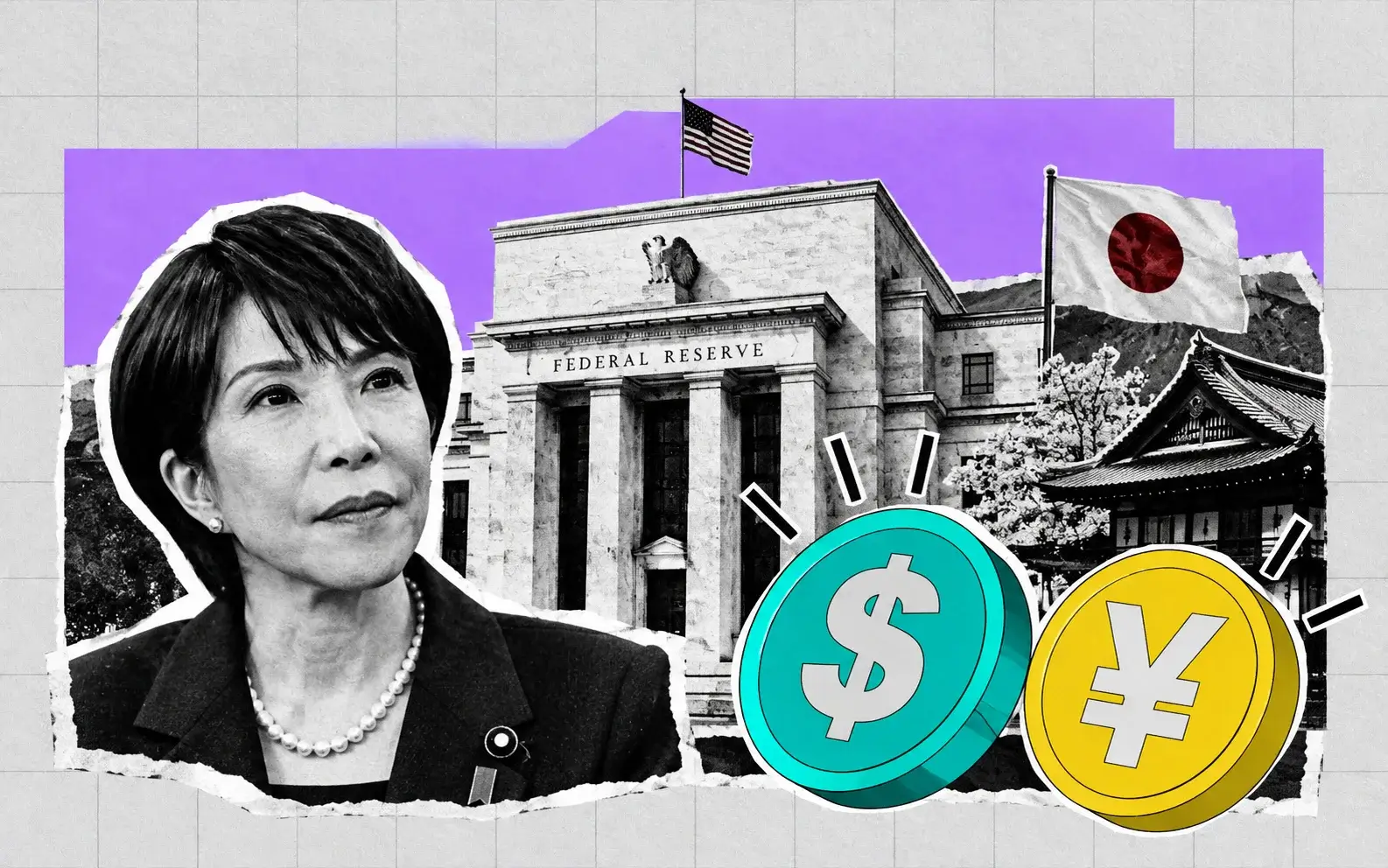
USDJPY (163.70) Grinds Below 164 as a 250bp Differential Overwhelms ¥11.73T of Intervention
Japan spent a record ¥11.7349 trillion buying yen between April 28 and May 27 and the pair has since returned above 163 | That's TradingNEWS
The yen changed hands around 163.7 per dollar on Tuesday, lingering near its weakest level in four decades after hitting a fresh 40-year low of 163.99 in the prior session. The pair has been consolidating in a tight band beneath 164.00, with the hourly chart showing a pullback from resistance at 163.900 to 164.000 and price slipping below its 20-period average at 163.818.
The dollar side is doing the work. The Dollar Index sits at 101.52, a one-month high, on speculation the Federal Reserve could raise rates as soon as this week. Repeated warnings of possible intervention from Japanese authorities have failed to curb the currency's weakness.
The scale of the move deserves stating plainly. USD/JPY has been trading in breakout territory above 163 for the first time in nearly four decades. The 2025 range ran between 139 and 158. The pair was at 159.46 in late May. It has added more than four figures in two months and is testing levels last seen when Japan's asset bubble was still inflating.
The sequence through July has been relentless. The pair cleared 162.70 — the zone where intervention risk was thought greatest — then printed 163.24 on July 21, briefly retreated to 163.03 on reports that Bank of Japan officials were open to faster tightening, and pushed to 163.99 last week.
Two central bank decisions land inside four days. The Federal Reserve announces Wednesday at 2 p.m. Eastern with the target range at 3.50% to 3.75% and overnight index swaps implying roughly a one-in-three chance of a 25 basis point increase. The Bank of Japan decides Friday, alongside its quarterly Outlook Report, with the policy rate at 1.00%.
One of those will determine where this pair trades into August, and it is probably not the Japanese one.
The broader tape offers no help to the yen. Japan's Nikkei fell 3.95% overnight in a semiconductor rout that took South Korea's benchmark down 10.84% and tripped a circuit breaker. Risk-off sessions have historically supported the yen through safe-haven demand. That relationship has broken down entirely this year, because the carry trade now dominates the flow.
Crude has collapsed roughly 10% across three sessions to $87.05 Brent, which should be materially yen-positive for an economy that imports nearly all its energy.
It has not helped either.
A 250 Basis Point Differential That One Hike Cannot Close
The arithmetic underneath this pair is the entire explanation, and it is unforgiving.
The Federal Reserve's target midpoint sits at 3.625%. The Bank of Japan's policy rate sits at 1.00% — the highest since 1995 after June's increase, and still exceptionally low relative to every other major economy. That is a gap of roughly 250 to 275 basis points.
Run the consensus scenario. A poll of 87 economists conducted on July 23 found 86% expect a 25 basis point hike to 1.25% by the end of December, with markets pricing roughly 80% odds of an October move. If the BoJ delivers and the Fed holds, the differential narrows to 225 to 250 basis points.
That is still comfortably profitable in a leveraged position. Gradual convergence does not unwind a carry trade — it makes carry marginally less attractive while leaving it fully intact.
The longer horizon does not fix it either. Seventy percent of surveyed economists expect the BoJ to reach at least 1.50% by the second quarter of 2027, with 51% treating 1.50% as the terminal rate. Against a Fed that has removed its rate cut and carries a 35.8% probability of hiking this week and roughly 80% in September, the gap could plausibly widen before it narrows.
The bond market says the same thing in different units. US Treasury yields sit near the upper end of recent ranges, with the 10-year at 4.628%. Japanese yields have not risen enough to offset that advantage.
There is a nuance in the cross-border comparison worth flagging, because it cuts the other way. A Japanese government bond paying 2.9% unhedged is now a credible alternative to a Treasury at 4.6% carrying currency risk and hedging costs. For domestic institutions with yen liabilities, the case for holding foreign paper has weakened substantially.
That is the mechanism that eventually turns this pair, and it operates independently of the BoJ. It is also slow.
For now, the differential is what it is, and it is being harvested by leveraged positions that have no reason to close while it holds.
¥11.7 Trillion Bought a Temporary Reprieve and Nothing Else
The intervention record is the most important precedent for anyone positioning into this week, and it is discouraging for the yen.
Between April 28 and May 27, Japan's Ministry of Finance deployed ¥11.7349 trillion — approximately $71.7 billion to $73.35 billion — buying yen after USD/JPY breached 160. That figure was nearly double the largest prior effort in Japanese history. The 2024 campaign, which spent roughly $62 billion, had been the largest since 1998.
The immediate effect was dramatic. Intervention around 160.209 sent USD/JPY briefly below 152 before the pair retraced to the 159 handle. The yen strengthened for a brief period and then came back under pressure as traders began pricing rate hikes from the Federal Reserve.
By July 21, USD/JPY had returned above 163. The largest currency intervention in Japanese history bought roughly two months.
The MOF stepped in again around July 2 and 3, sparking a sharp rebound off the forty-year lows. The pair gave back half those gains within days, which the market read as a verdict that the intervention scare had faded and the underlying pressure was reasserting.
The credibility problem is now explicit. The threshold at which investors previously expected Japan to intervene — around 162 — has been breached without triggering action, effectively raising the bar. Analysis published earlier in the year had put the 2026 intervention range at 155 to 160 on the upside. The pair is at 163.70.
Finance Minister Satsuki Katayama has issued repeated warnings about intervention being available, joined by the Chief Cabinet Secretary. Markets have largely discounted those statements. Technical commentary has described the jawboning as insufficiently compelling to repel yen bears.
The operative doctrine has always been that authorities care more about velocity than level. A grind from 162 to 164 over three weeks does not meet the disorderly-move test. A 300-pip session would.
That is the asymmetry traders should hold: intervention is not coming at any particular number. It comes when the move becomes fast, and it will arrive without warning.
Speculative Net Shorts at $11.3 Billion With No Yen Bulls Left
Positioning has reached the point where it becomes a risk factor in its own right.
Speculators have steadily rebuilt net short yen positions, with the most recent weekly regulatory data showing short exposure of $11.3 billion — near the highest in two years. That has been built despite intervention worth ¥11.7 trillion and despite Bank of Japan rate hikes.
The sentiment reading is more striking than the number. One major strategy team reported that during its mid-year investor meetings, it did not meet a single yen bull — for the first time in years.
Local commentary has noted a view spreading through the market that the 160-yen range is simply the new normal. That reads as capitulation from the participants closest to the trade, and capitulation typically arrives late rather than early.
The historical parallel is August 2024, when a modest Bank of Japan policy shift triggered a violent carry-trade unwind. A sudden yen spike forced margin calls and cascading liquidation across global risk assets. The precondition for that episode was exactly the configuration visible now: extreme one-sided positioning, a wide differential, and complacency about the funding currency.
The mechanics of a carry unwind are worth stating precisely. Positions funded in yen and invested in higher-yielding assets face a double loss when the yen appreciates — the funding leg moves against them while the asset leg is being liquidated to meet margin. That forces further yen buying, which strengthens the currency further. The cascade is self-reinforcing until the leverage clears.
Corporate behaviour reinforces the setup. Uncertainty over inflation, fanned by the Middle East conflict, has pushed Japanese businesses to step up protection against foreign exchange risk. Hedging flows from exporters and importers cluster at round numbers, which is why 164 and 165 will matter mechanically as well as psychologically.
The honest framing: the yen is weak, and it is weak on borrowed time. The higher the pair climbs, the more violent the eventual reversal. That has been true at 160, at 162, and at 163. It remains an argument about timing rather than direction.
Japanese Investors Sold $29.6 Billion of US Debt and That Is the Real Story
The structural flow shift underneath this pair receives almost no attention and will matter more than any single policy decision.
Japanese investors sold $29.6 billion of US Treasuries in the first quarter of 2026 alone as domestic yields rose. That removes a historically reliable buyer from a Treasury market already absorbing large fiscal deficits.
Life insurers' foreign holdings now sit at roughly 40% of their peak. The reason is straightforward: when a Japanese government bond pays 2.9% unhedged, the case for owning a Treasury at 4.6% with currency risk and hedging costs collapses. Once hedging costs are deducted, the foreign yield advantage largely disappears for an institution with yen liabilities.
That repatriation is mechanically yen-positive. It is also structural rather than tactical — asset-liability matching decisions at Japanese life insurers do not reverse on a monthly basis. And it operates entirely independently of the Bank of Japan's policy rate.
The government is actively trying to accelerate it. On July 10, the Finance Minister said Tokyo would pursue measures encouraging the Government Pension Investment Fund and other pension funds to invest more in Japanese financial assets. That is a policy lever with far more capacity than spot intervention — GPIF alone manages assets measured in the hundreds of billions of dollars, and a shift in its allocation targets generates persistent yen demand rather than a one-off spike.
The comparison to intervention is instructive. The MOF spent $73 billion and moved the pair for eight weeks. Redirecting institutional allocation flows generates a smaller daily impact that never stops.
The reason this has not shown up in the exchange rate is timing. Repatriation happens at the pace of portfolio rebalancing cycles. Carry flows happen at the pace of overnight funding. In any given month, carry wins.
Over a multi-year horizon, the arithmetic reverses. A country whose institutions are systematically bringing money home while its rates rise and the counterparty's rates eventually fall has a currency that appreciates. That is the bear case on USD/JPY, and it has essentially nothing to do with what the BoJ does Friday.
It has everything to do with why the 176-to-180 projections at the aggressive end of the forecast range look unrealistic.
Energy Is the Reason the Yen Broke and It Has Just Reversed
The proximate cause of 2026's yen collapse is the import bill, and the input driving it has changed direction sharply.
Elevated energy costs have weighed on Japan's import bill throughout the year and have been a primary driver of yen weakness. Japan imports nearly all of its hydrocarbons, which means every dollar increase in crude is a direct transfer of purchasing power out of the country, paid in dollars, generating structural demand for the currency the barrels are billed in.
June's trade deficit widened. The mechanism is not complicated: higher crude means more dollars bought, means a weaker yen, means a higher import bill in yen terms, means more inflation, means more pressure on households.
That input has now reversed. Brent has fallen roughly 10% across three sessions to $87.05, with West Texas Intermediate at $81.59, as the US-Iran pause held into a fourth day. Crude ran from below $70 on July 1 to above $96 last week before the collapse.
Japan should be the largest beneficiary of that reversal among developed economies. The trade balance improves mechanically. Import-driven inflation eases. Household purchasing power recovers. Every channel through which the energy shock damaged the yen operates in reverse.
It has not shown up in the exchange rate, and the reason is that the market is not trading Japan's terms of trade this week. It is trading a Federal Reserve decision.
The complication is durability. Tehran has rejected characterisations of a formal ceasefire, and the president has stated that strikes resume if negotiations fail. Houthi forces claimed attacks on Saudi Red Sea infrastructure over the weekend. A collapse in the talks sends crude straight back through $95 and takes the yen with it.
Friday's Tokyo consumer price report is the near-term test of the transmission. As a timely lead indicator for national inflation, it will show whether the recent rebound in energy prices is feeding through into consumer prices faster than expected — which would strengthen the case for BoJ action.
The Bank has maintained that inflation risks are skewed to the upside, citing a weaker yen and higher import prices. Both of those inputs have just moved in its favour.
Political Pressure on the Bank of Japan Is Now an Explicit Constraint
The governance question is a genuine driver of yen weakness rather than a background concern.
Pessimism toward the currency has deepened as investors adjust to the policy backdrop under Prime Minister Sanae Takaichi, whose administration has struggled to shake off perceptions that it may pressure the Bank of Japan to delay further rate hikes.
Those concerns intensified after the government, in its final economic blueprint, retained language urging the BoJ to align its policy with that of the government. For a central bank whose independence is the foundation of its inflation-fighting credibility, that language is corrosive regardless of intent.
Political pressure from the government was cited in the July economist poll as a key factor likely to delay action on rates.
The domestic political situation compounds it. Approval ratings for the Prime Minister have slipped as government efforts to rein in inflation continue to fall short of household expectations. A weaker currency raises import costs, which raises consumer prices, which erodes approval — and the policy tool that would fix the currency is the one the administration appears reluctant to see deployed.
That is a genuine bind, and currency markets have priced it.
Against it sits a countervailing signal. Reporting indicated that Bank of Japan officials are open to raising interest rates at a faster pace than the consensus among economists. The yen got a sudden boost on that report, recovering from a 40-year low to 163.03 before resuming its slide.
The market's response to that headline is the tell: a brief bounce, then continuation. Traders have heard the BoJ signal additional increases before. The Bank signalled further tightening when it hiked in June, and the yen made new lows anyway. Expectations for normalisation have been priced repeatedly without changing the pair's direction.
Friday's Outlook Report is where the credibility gets tested. It is expected to upgrade Japan's GDP forecast to 0.8% for fiscal 2026. A growth upgrade combined with inflation risks skewed to the upside is the analytical case for an October hike, and the press conference language is what will determine whether the market believes it.
The Technical Structure Is Cleanly Bullish and Increasingly Extended
The chart offers no comfort to yen bulls at any timeframe.
USD/JPY is in breakout territory above 163 for the first time in nearly four decades, having cleared a consolidation range after holding above its 50-day moving average through a narrowing pattern. The extended uptrend remains intact.
The shorter-frame structure shows the current pause. On the hourly chart, price reached resistance near 163.900 to 164.000, dropped below the 20-period simple moving average at 163.818, and broke out of a tight high-level consolidation zone to trade around 163.699. Sellers are pushing toward 163.500 and 163.200. The overall uptrend remains structurally intact as long as price holds above the primary ascending trendline near 163.300 to 163.400.
The intraday averages are clustered tightly. The 50-period moving average sits at 163.335 and the 200-period at 163.819. Price is sandwiched between them, which is precisely why the pair has been chopping in a 60-pip band.
A quick recovery back above 163.820 would be required to resume momentum toward 164.000.
The longer-horizon comparison shows how far this has travelled. The 200-day moving average — historically the best trend indicator for this pair over the past three years — sat near 153.80 in late April with price at 159. It has climbed since, but the gap between spot and the 200-day remains enormous. That is the definition of an extended trend, and extended trends revert violently when they revert.
Round numbers matter more for this pair than almost any other. Japanese exporters and importers place substantial hedging orders at 160, 165, and 170. Those levels function as genuine liquidity magnets rather than psychological markers.
The trend structure that would break: a decisive daily close below 162.00, which would weaken the bullish structure and suggest the market is pricing a stronger yen catalyst — intervention, a softer dollar, or a hawkish BoJ interpretation.
Nothing shorter than that changes the picture. The pair has absorbed a record intervention, a rate hike, and repeated verbal warnings without breaking trend.
The Levels: 163.30 Below, 163.82 Above, 165 in View
The immediate map is unusually tight because the pair has compressed into a narrow band ahead of the Fed.
Support begins at 163.500, then 163.300 to 163.400 where the primary ascending trendline sits, then 163.200. Beneath that, the 50-period average at 163.335 has already been referenced and the July uptrend line runs around 163. The next zone of interest is 162.93 and 162.77, then horizontal support at 162.70 — the level whose break opened this entire leg.
Below 162.70, the map thickens: 162.35, then 162.20, then 162.15 to 162.16 where the 20-day exponential average and the former breakout zone converge, then the 162.00 to 162.10 pivot.
That 162.00 level is the line that matters. A break under it would weaken the bullish structure materially and would be the first genuine signal that a yen catalyst has arrived.
Overhead, the first hurdle is 163.818 to 163.820 at the 200-period average, then the 163.900 to 164.000 resistance band, then 164.00 itself and last week's high at 163.99. Above that, 164.40 and 164.50, then the 165 psychological level that multiple institutional targets identify as the next objective.
A convincing break above 164 brings 165 into view, with the broader uptrend expected to extend.
The forecast distribution across major desks is wide and clustered on the upside. Year-end 2026 targets span 150 to 164 — a 14-point spread reflecting genuine disagreement. One house targets 164 by early 2027, arguing intervention creates volatility but not reversal and that only a US slowdown or aggressive BoJ tightening could turn the trend. Another maintains 165 with pushed-back timing. A third targets 164 on structural dollar demand from Japanese corporates plus persistent carry flows.
The most aggressive projections reach 176 to 180, levels that would almost certainly trigger intervention. Model-based paths put September at 166.33 and December at 170.96 within a 2026 range of 161.35 to 170.96.
The contrarian case projects a decline toward 140 on continued BoJ tightening, an eventual Fed pivot, and safe-haven demand in a risk-off environment. That view argues the differential compresses faster than the market expects and that a carry unwind accelerates the recovery violently.
Wednesday Decides This, Not Friday
The sequencing of the week is what traders should internalise, because the two decisions carry very different weights.
The Federal Reserve announces Wednesday with the target range at 3.50% to 3.75%. Overnight index swaps imply roughly a one-in-three chance of a 25 basis point hike, with other readings clustering between 30% and 38%. Odds of a September increase have run as high as 80%.
That meeting produces no Summary of Economic Projections and no dot plot, under a chair who has committed to reducing forward guidance and who declined to submit individual projections at his first meeting. Everything runs through statement language and the press conference.
The Bank of Japan announces Friday and is overwhelmingly expected to hold at 1.00%. The decision itself carries no information. The Outlook Report and the press conference language are the entire event.
The asymmetry is straightforward. A hawkish Fed adds to a differential already at 250 basis points and sends the pair through 164 toward 165. A dovish Fed compresses the differential from the side that can actually move it — a 25 basis point Fed cut narrows the gap by the same amount as a 25 basis point BoJ hike, and the market assigns far higher probability to Fed action than to a Japanese surprise.
The dollar has rallied into this meeting on the expectation of hawkishness. That is a buy-the-rumour position carrying the standard vulnerability: if the Fed holds with language softer than priced, the reversal is sharp. Crude has collapsed 10%, June payrolls came in at 57,000 against consensus near 110,000, and inflation cooled to 3.5% in June from 4.2% in May. The dovish inputs exist.
The rest of the week compounds it. Second-quarter US GDP and core PCE arrive Thursday. Tokyo CPI and the BoJ land Friday, alongside month-end rebalancing flows that can create exceptional volatility in this pair specifically.
USD/JPY is particularly vulnerable to gaps because of intervention risk. Pre-Fed ranges frequently generate false breaks. Reducing size before central bank decisions is the standard discipline, and it applies with unusual force here.
Read More
-
Yen Stalls at 160 Despite a 3% JGB and Tokyo Core CPI at 2.0% — Intervention Sits at 164, Friday's Payrolls Decide
02.09.2026 · TradingNEWS ArchiveEnergy
-
QQQI ETF Pays 13.96% While The Nasdaq-100 Rolls Over — Why Section 1256 Is Worth More Than The Yield
14.09.2026 · TradingNEWS ArchiveStocks
-
XRP ETFs Took $19M In A Week After A $110M Record — Why The Filings Tell A Different Story Than The Flows
14.09.2026 · TradingNEWS ArchiveCrypto
-
US Gas Holds $2.88 While Europe Pays $28 — Why Only A Tenth Of The War Premium Reaches Henry Hub
14.09.2026 · TradingNEWS ArchiveCommodities
-
Yen Holds Near February Highs As Tokyo Prepares Its Highest Rate Since 1995 — Why The Yield Gap Will Not Move
14.09.2026 · TradingNEWS ArchiveForex
What the Carry Unwind Would Actually Look Like
The tail risk deserves specification rather than gesture, because it is the single largest source of loss in this trade.
The setup requires three conditions, and all three are present. Extreme one-sided positioning — net shorts at $11.3 billion, near a two-year high, with no yen bulls found at mid-year investor meetings. A wide funding differential — 250 basis points, harvested through leverage. And complacency — a spreading market view that 160-plus is the new normal.
The trigger can be almost anything that moves the yen quickly: a genuine BoJ surprise, a dovish Fed pivot, a global risk-off event that forces repatriation, or an intervention that catches the market at the right moment.
The cascade mechanics follow automatically. Yen appreciation forces margin calls on leveraged positions funded in yen. Meeting those calls requires buying yen. That appreciates the currency further, triggering the next tranche. The August 2024 episode ran through global markets in days and produced moves that no fundamental analysis would have justified.
The specific vulnerability now is that the pair has travelled so far. A trade profitable at 163.70 has a shrinking margin of safety, which raises the probability that a shock triggers the cascade rather than a correction.
There is a partial hedge in the current tape. Japan's Nikkei fell 3.95% overnight and the yen did not rally, which suggests the risk-off channel has been at least temporarily disconnected. That disconnection is itself a sign of how dominant carry has become — and it means the unwind, when it comes, will not be gradual.
The intervention overlay makes it worse rather than better. Authorities have demonstrated willingness to deploy $73 billion in a month. If they act into a market that is already covering, the combined flow produces exactly the kind of move that clears hundreds of pips in hours.
That is why the discipline for anyone long this pair is not about level. It is about defining invalidation before entry, allowing for spread widening and gaps, and avoiding multiple positions carrying the same dollar exposure.
The carry is real and it pays every day. The exit will not be orderly.
Forecast: 165 on a Hawkish Fed, 162 on a Reversal, 140 as the Tail
The setup resolves through Wednesday and produces three distinct paths.
The bull case is the continuation trade and requires the Fed to hold with hardened language or hike outright. Under that outcome, the pair reclaims 163.82, clears the 163.90 to 164.00 band, and takes out last week's 163.99 high. Above 164, the round-number hedging orders and the 164.40 to 164.50 zone are the next friction, with 165 the objective that multiple institutional targets identify. That is 0.8% to 1.5% from spot — small in percentage terms, meaningful in a pair where positions are leveraged five to twenty times.
The base case has the pair chopping between 163.20 and 164.00 through Wednesday, pinned between its 50-period average at 163.335 and its 200-period at 163.819, before the Fed resolves it. Nothing about the current structure argues for a break in either direction absent the catalyst.
The bear case requires a dovish surprise. A Fed hold with language acknowledging the 10% crude collapse and the 57,000-payroll print unwinds the buy-the-rumour dollar position. The pair loses 163.30 trendline support, then 162.93 and 162.77, and tests the 162.00 to 162.20 zone where the 20-day average sits. A break of 162.00 would be the first genuine structural damage since the breakout and would open a considerably larger move given how crowded the short-yen position has become.
What would confirm the bull case: a daily close above 164.00, the Fed hiking or signalling September explicitly, or a collapse in the Iran talks sending crude back through $95. What would confirm the bear case: a close below 162.00, confirmed intervention rather than jawboning, a Tokyo CPI print Friday that forces the BoJ's hand, or any evidence that pension-fund repatriation is accelerating.
The honest summary: the differential says higher, the positioning says lower, and the timing belongs to Washington rather than Tokyo. A record ¥11.73 trillion intervention bought eight weeks. Nothing since has bought anything at all.
The yen is not weak because Japan lacks tools. It is weak because the only tool that works is a Federal Reserve that stops raising rates, and that decision gets made Wednesday afternoon.