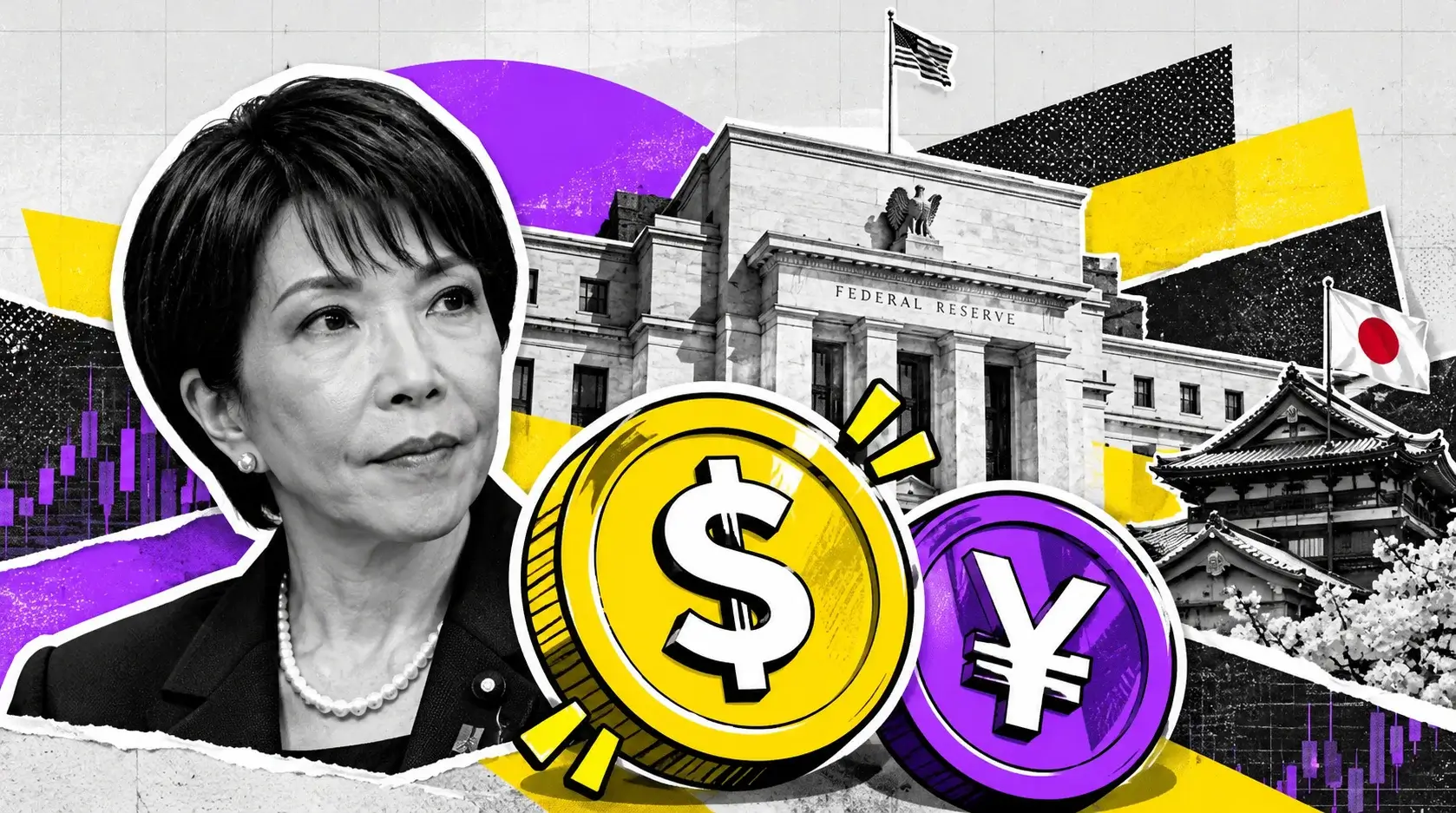
USD/JPY Price Forecast - Pairs at 159.70: Japan's Energy Vulnerability and 250% Debt-to-GDP
BoJ intervention warnings create the dip — not the reversal. With Brent at $113 and Fed pricing potential hikes | That's TradingNEWS
Key Points
- Japan imports ~90% of its energy with major Gulf exposure — $113 Brent directly hits Japan's current account and real purchasing power simultaneously
- Fed repriced from 2+ cuts to potential hike; BoJ prices full hike by June but still cannot close the yield gap
- Intervention Can Slow the Yen's Decline — It Cannot Reverse It Past intervention spent ~$60 billion without reversing USD/JPY's structural trend
USD/JPY is trading at 159.70 Monday, pulling back sharply from a fresh high since July 2024 touched during the Asian session near the mid-160.00s. The retreat is not a trend reversal — it is a short-term pressure release driven by verbal intervention from Bank of Japan Governor Kazuo Ueda and Japan's Vice Finance Minister for International Affairs Atsushi Mimura, whose comments fueled speculation that authorities would step in to stem the yen's freefall. The aggressive short-covering those comments triggered has pushed USD/JPY from its session highs down to the 159.70 to 159.65 region — but the downside potential is limited, the technical structure remains bullish, and the fundamental backdrop that is driving this pair has not changed by a single basis point because two central bank officials chose their words carefully on a Monday morning.
The pair has been printing higher highs and higher lows consistently. The ascending support trendline that originated around 157.20 remains intact. The 100-period EMA on the 4-hour chart sits below current price and rising, confirming the bullish trend structure is undamaged by the morning's intervention chatter. The RSI at approximately 54 to 60 keeps momentum in neutral-to-positive territory — not overbought, not flashing a reversal signal, just a market consolidating before the next leg. The MACD line sits marginally above its signal line in positive territory, though with a contracting histogram that confirms upside momentum is present but decelerating rather than accelerating. That deceleration is a pause, not a pivot.
Why the Yen Is the Worst Currency in the World Right Now — And It Has Nothing to Do With Carry Alone
The defining characteristic of USD/JPY in the current environment is something that fundamentally breaks the traditional yen playbook. For decades, the yen was the world's premier safe-haven currency — when global risk sentiment deteriorated, capital flooded into yen-denominated assets and the yen strengthened. That dynamic has completely inverted. USD/JPY is now showing a positive relationship with U.S. bond and equity volatility while remaining negatively correlated with global and U.S. equities. In plain terms: when fear rises and stocks fall, the yen weakens. When the VIX — currently at 30.72 — spikes, USD/JPY goes up. The yen is behaving like a risk asset, not a safe haven, and that structural shift is the most important analytical development in the currency markets right now.
The reason for this inversion is Japan's position as a major energy importer facing an acute supply shock. The Iran war has driven Brent crude (BZ=F) to $113.58 — up more than 55% in March alone — and Japan sources a large share of its crude from Gulf producers. Every dollar increase in Brent is a direct hit to Japan's import bill, its current account, and its real purchasing power. Higher oil prices weaken the yen's fundamental support through the current account deterioration channel simultaneously with the monetary policy channel — making the yen uniquely vulnerable to exactly the shock that is currently unfolding. The United States, by contrast, is largely insulated. Its vast domestic shale production and self-sufficiency in energy means the oil shock hits the U.S. primarily through inflation rather than through a current account deterioration. That asymmetry — U.S. inflation higher, Japan inflation higher plus growth weaker plus current account worse — is the core engine driving USD/JPY toward multi-decade highs.
Japan's 250% Debt-to-GDP Problem Is Getting Worse by the Week
The yen weakness story is not purely an energy shock story. It is building on a pre-existing structural vulnerability that the Iran conflict has exposed and amplified. Japan is operating with a public debt burden of approximately 250% of GDP — the highest among developed economies — alongside rapidly ageing demographics and an economy highly exposed to global trade disruption. These vulnerabilities were already elevated before the conflict began, following the election of reflationist Prime Minister Sanae Takaichi with a strong lower house majority. Takaichi's election had already raised fiscal concerns before a single bomb fell on Iran. The energy shock has layered a supply-side inflation problem on top of a demand-side fiscal problem, creating a combination that the Bank of Japan's policy toolkit was not designed to address simultaneously.
The simultaneous sell-off in the yen and Japanese Government Bonds — both falling at the same time — is the clearest market signal that this is not a routine FX story. When a country's currency and its government bonds decline together, it signals that the market is demanding greater compensation for the risk of holding both. Investors are questioning Japan's fiscal sustainability under an extended energy shock scenario, and they are expressing that concern by selling both the currency and the bonds that underpin the country's debt refinancing. This yen-JGB correlation is the most dangerous dynamic in Japanese markets right now. The Bank of Japan cannot easily escape it. If it intervenes in FX markets to support the yen, it risks pushing pressure into JGBs as investors demand higher yields to compensate for the reduced currency hedge they were previously running. If it buys JGBs to cap rising yields, it injects additional liquidity that widens rate differentials with the United States and adds further downward pressure to the yen. Every option the BoJ has creates a trade-off that pushes the problem to a different part of the balance sheet.
The Fed vs. BoJ Divergence: A Gap Wide Enough to Drive a Truck Through
The interest rate differential between the United States and Japan is the structural foundation of USD/JPY's multi-year bull trend, and it is getting wider rather than narrower despite the Bank of Japan's tightening cycle. Markets are now pricing the risk of a Federal Reserve rate hike — a sharp hawkish reversal from early March when more than two cuts were expected for 2026. That repricing from multiple-cuts-expected to potential-hike-priced has been driven directly by the Iran war's inflationary impact through oil prices. The Fed's dual mandate — price stability and full employment — creates a policy constraint that the BoJ does not face. The BoJ is focused primarily on its inflation objective, leaving further tightening more firmly embedded in market pricing, with a hike close to fully priced by June and nearly two hikes priced by October 2026. Even with that more hawkish BoJ profile, it has not been enough to offset the widening yield differentials across the curve over the past month. A fully priced BoJ June hike is still not enough to close a gap that is as wide as it has been since the peak of the 2024 carry trade era.
The U.S. Federal Reserve is holding rates at 3.50% to 3.75% while the Bank of Japan's policy rate is a fraction of that. The U.S. 10-year Treasury yield at approximately 4.37% against Japanese Government Bond yields that have risen but remain dramatically below U.S. levels creates a yield differential that continues to incentivize capital to flow out of yen and into dollar-denominated assets. Every dollar that flows from a yen-funded position into U.S. Treasuries weakens the yen further. The carry trade — borrow in yen at near-zero rates, invest in U.S. assets at 4%-plus — is the most powerful systematic flow in currency markets, and it operates 24 hours a day, 5 days a week, regardless of what a central bank official says at a press conference.
160 Is Not Just a Number — It Is a Threshold With a 36-Year History
USD/JPY at 160 is not a random round number. Between 160 and approximately 160.40, there is a structural resistance barrier that stretches back to 1990 — a 36-year overhead supply zone built up from multiple touches, rejections, and historical market memory that professional currency traders track with the kind of attention that retail traders reserve for much shorter timeframes. The 2024 high at 161.95 is the most recent concrete ceiling — the exact level at which the Bank of Japan acted previously, making it both a technical resistance and a policy trigger zone. Above 161.95, there is meaningfully less historical resistance until the September 1978 low of 177.05 becomes the next reference point. That 177.05 level sounds like a distant fantasy until you consider that USD/JPY has moved approximately 25 points in the past two years under the structural force of Fed-BoJ divergence, and 161.95 to 177.05 is a 15-point move from the next breakout level.
The significance of the 160 to 160.40 zone is not just technical — it is policy-sensitive in a way that very few levels in any currency pair are. The Japanese Ministry of Finance and the Bank of Japan have both made verbal interventions at this level, and the market has learned to expect actual intervention — physical selling of dollars and buying of yen — when USD/JPY trades convincingly above 160 for any sustained period. That expectation creates a natural premium of uncertainty in the price action above 160, slowing the advance and generating the kind of volatile, high-frequency oscillation around 160 that is visible on any intraday chart. The pair is not going to sprint from 160 to 165 in a straight line. It is going to grind, test, back off, retest, and eventually — if the fundamental divergence persists — break through in the same grinding, exhausting way that meaningful structural breakouts typically occur.
Read More
-
Yen Stalls at 160 Despite a 3% JGB and Tokyo Core CPI at 2.0% — Intervention Sits at 164, Friday's Payrolls Decide
02.09.2026 · TradingNEWS ArchiveEnergy
-
QQQ ETF ($706.22) Slides 7.4% Below Its High as the Market Reprices the AI Capex Bill — $686.57 Target if $700 Breaks
22.10.2026 · TradingNEWS ArchiveStocks
-
XRPI ($7.00) and XRPR ($10.74) Slide Toward 52-Week Lows as Spot XRP ETF Flows Stall at $708,510
22.10.2026 · TradingNEWS ArchiveCrypto
-
NG ($2.775) Decoupled From Europe’s €88 Gas Crisis as LNG Feedgas Hits 18.9 Bcf/d — $3.30 Upside on Cold Weather
22.10.2026 · TradingNEWS ArchiveCommodities
-
Dollar-Yen (157.35) Loses 157.65 as the Yen Rallies on Haven Demand — 155 Target if 156 Breaks
22.10.2026 · TradingNEWS ArchiveForex
The Intervention Paradox: Tokyo Can Slow the Move but Cannot Reverse the Trend
Japanese intervention in currency markets is the primary near-term risk for USD/JPY longs, and it needs to be taken seriously without being overestimated. The history of BoJ and Ministry of Finance intervention in currency markets is clear on one point: intervention is most effective when it aligns with shifting underlying fundamentals, and least effective when it is fighting a fundamental trend. In 2022, Japan spent approximately $60 billion in intervention operations to support the yen, achieving meaningful short-term rallies but failing to prevent USD/JPY from eventually reaching its structural destination. The yen weakened past every intervention level within months because the underlying fundamental driver — Fed-BoJ rate divergence — had not changed. The current situation is fundamentally similar. The yen is weak because Japan is an energy importer facing a historic oil shock, because its fiscal position carries 250% debt-to-GDP, because its demographics are structurally deflationary in the long run but currently creating import-cost inflation, and because the rate differential is still as wide as ever. Intervention does not fix any of those four problems. It merely shifts where the pressure shows up.
A physical intervention — actual dollar selling by Japanese authorities — could produce a sharp short-term pullback in USD/JPY. Past episodes suggest levels like 157.50, 156, and even 152.10 could come back into view in an aggressive intervention scenario. The January 2026 swing low at 152.10 is the key downside reference — the 200-day moving average sits just above that level and is rising, providing a technical floor that has structural significance beyond the intervention question. If intervention occurs and is backed by a meaningful fundamental shift — a BoJ hike that is larger than expected, a U.S. jobs report that is weak enough to flip the market toward pricing Fed cuts — then 152.10 and potentially 150.90 could come into view. Without that fundamental backing, the intervention creates a buying opportunity rather than a reversal signal. Buy the intervention dip at 156 to 158 is the correct strategic posture as long as the Fed-BoJ differential remains as wide as it currently is.
The 4-Hour Chart Technical Structure: Every Level That Matters
On the 4-hour chart, USD/JPY holds above the rising 100-period EMA — the dynamic support that defines the current bullish channel. The ascending trendline from 157.20 is the structural floor that must hold for the bull case to remain intact. Any pullback toward 159.40 is likely to find buyers — that is the first meaningful support below current price. Below 159.40, the 159.00 region is the next support, followed by a deeper floor at the 100-period EMA around 158.70. A sustained break below 158.70 would negate the near-term upside bias and signal that a broader corrective phase is underway — but the probability of reaching that level without an actual intervention event is low given the technical structure. To the upside, resistance sits at 160.20, followed by the 160.30 zone — the recent high area from the current rally. A clear break above 160.30 would open the path toward 160.80. Above that, 160.40 to 161.95 is the zone of maximum intervention risk and maximum historical resistance. Breaking above 161.95 — the 2024 high — changes the entire strategic picture and potentially opens a multi-year run toward the 177.00 area.
The daily chart reinforces the weekly bias. USD/JPY is printing higher highs and higher lows. The RSI is approaching elevated levels but has not yet formed a clear bearish divergence — it is flattening near recent highs, suggesting momentum deceleration rather than reversal. The MACD is positive. The 1-hour SMA60 and the 4-hour SMA20 are the short-term support levels for any tactical long entries on dips. The support at 159.00 and 157.60 are the two levels to watch for any deeper pullback. A break below 157.60 specifically could signal an exit of short-term long positions and trigger a deeper corrective phase. That scenario is the tail risk, not the base case.
Japan's Energy Vulnerability Is Structural and Cannot Be Hedged Away
The specific mechanism through which the Iran war is destroying yen value goes beyond the rate differential narrative. Japan imports approximately 90% of its energy, with a substantial portion sourced from Gulf producers. The effective closure of the Strait of Hormuz — through which roughly 20% of global oil and LNG flows — creates both a price shock and a potential supply availability shock for Japan. The price shock raises Japan's import bill dramatically, widening the current account deficit and creating structural yen selling pressure as importers buy dollars to pay for more expensive crude. The potential availability shock introduces a scenario where Japan cannot access sufficient Gulf energy supplies regardless of price — a scenario that is not fully priced but is represented in the simultaneous JGB sell-off that reflects the fiscal risk premium the market is assigning to Japan's energy vulnerability.
The Bank of Japan's March meeting summary confirmed that policymakers are discussing the need for further rate hikes specifically in response to rising oil prices adding to domestic inflation pressures. One BoJ member warned explicitly that there is a risk the central bank "might unintentionally fall behind the curve" as second-round inflation effects from overseas energy developments become more likely to emerge. A central bank that is being pushed toward tightening by an oil shock it cannot control is in a fundamentally weaker position than a central bank like the Federal Reserve that is also facing inflation but from a country with significant domestic energy production. The BoJ is fighting inflation with one hand and worrying about energy availability with the other. The Fed's primary concern is avoiding overtightening. The asymmetry between those two institutional positions is reflected in every pip of USD/JPY's current trend.
The Data That Could Break the Trade — NFP and Tokyo CPI
The two data events that have the most power to shift the USD/JPY trend in either direction are the U.S. Nonfarm Payrolls report — releasing Friday, April 3, on Good Friday while markets are closed, creating a gap risk for Sunday night futures — and the Tokyo CPI release, which serves as the primary leading indicator for Japan's national inflation series and provides the BoJ with the data it needs to justify its next policy decision. A weak U.S. NFP print — below 50,000 — would flip the market toward pricing Fed cuts rather than hikes, taking significant pressure off the USD/JPY uptrend and potentially producing the kind of broad dollar weakness that could send the pair toward 157.50 to 158.00 even without intervention. A strong NFP above 150,000 would cement the hawkish Fed narrative, reinforce the rate differential, and send USD/JPY back above 160 with conviction.
Tokyo CPI matters for the BoJ's timing decision. Strong Tokyo CPI would bring forward market pricing for a June BoJ hike, which should theoretically support the yen by narrowing rate differentials marginally. However, the historical track record of BoJ rate hikes actually supporting the yen is mixed — the August 2024 hike triggered a violent yen strengthening but also a global carry trade unwind that created enormous volatility across asset classes. The market's memory of that episode creates additional caution about holding large short-yen positions heading into a potential BoJ policy surprise. That memory is one reason the pair has been oscillating near 160 rather than sprinting past it — the risk of a disorderly carry unwind at this specific price level is historically documented, and sophisticated participants are sizing positions accordingly.
The Carry Unwind Risk: The Most Violent Downside Scenario
The single most dangerous scenario for USD/JPY longs — more dangerous than direct intervention, more dangerous than a weak NFP — is a disorderly carry trade unwind. The global carry trade has USD/JPY as its primary vehicle: borrow yen cheaply, invest in higher-yielding assets globally. When global asset prices decline sharply — as they have been doing, with the S&P 500 (^GSPC) and Dow Jones Industrial Average (^DJI) both in correction territory after five consecutive weeks of losses — the economics of the carry trade deteriorate because the assets purchased with borrowed yen are losing value faster than the yen carry is providing income. If global equities deteriorate further and the VIX spikes sharply above 35 to 40, carry traders may be forced to simultaneously unwind positions — selling the invested assets and buying back yen — creating a self-reinforcing yen strengthening dynamic that bypasses both intervention and rate differentials. The August 2024 carry unwind sent USD/JPY from 161.95 to 140 in a matter of weeks. A similar unwind from 160 could target 145 to 148, or even the 140 range, in an extreme scenario. This is not the base case but it is the tail risk that must define position sizing for any USD/JPY long.
The Verdict: USD/JPY Is a Buy on Every Dip to 158-159 With a Target of 161.95
USD/JPY at 159.70 is a buy. Every technical indicator — ascending trendline from 157.20, price above the 100-period 4-hour EMA, higher highs and higher lows on the daily chart, RSI in neutral-to-positive at 54-60, MACD positive — confirms the bullish structure. Every fundamental driver — 160 basis point-plus Fed-BoJ rate differential, Japan's energy import vulnerability amplified by $113 Brent, 250% debt-to-GDP fiscal fragility under an oil shock, yen behaving as a risk asset rather than a safe haven — points toward further yen depreciation. The intervention risk from BOJ Governor Ueda's verbal warnings creates the pullbacks that should be bought rather than feared. A pullback to 159.00 is the first entry. A deeper pullback to 158.70 at the 100-period EMA is the higher-conviction entry. If an actual intervention event drives the pair toward 156, that becomes a major accumulation level where the fundamental bull case is at its most favorable risk-reward. The upside target is 161.95 — the 2024 high and the level where the BoJ previously acted — with a break above that opening a potentially significant extension toward 165 and ultimately 177.05 if the oil shock persists through Q2 and the Fed maintains its hawkish posture. Stop-loss for longs sits below 157.50 on a daily close basis. A sustained break below 157.50 would signal the corrective phase is deeper than expected. Below 156, intervention is the likely explanation and the position should be paused rather than stopped — intervention dips are buying opportunities when the fundamental trend remains intact.