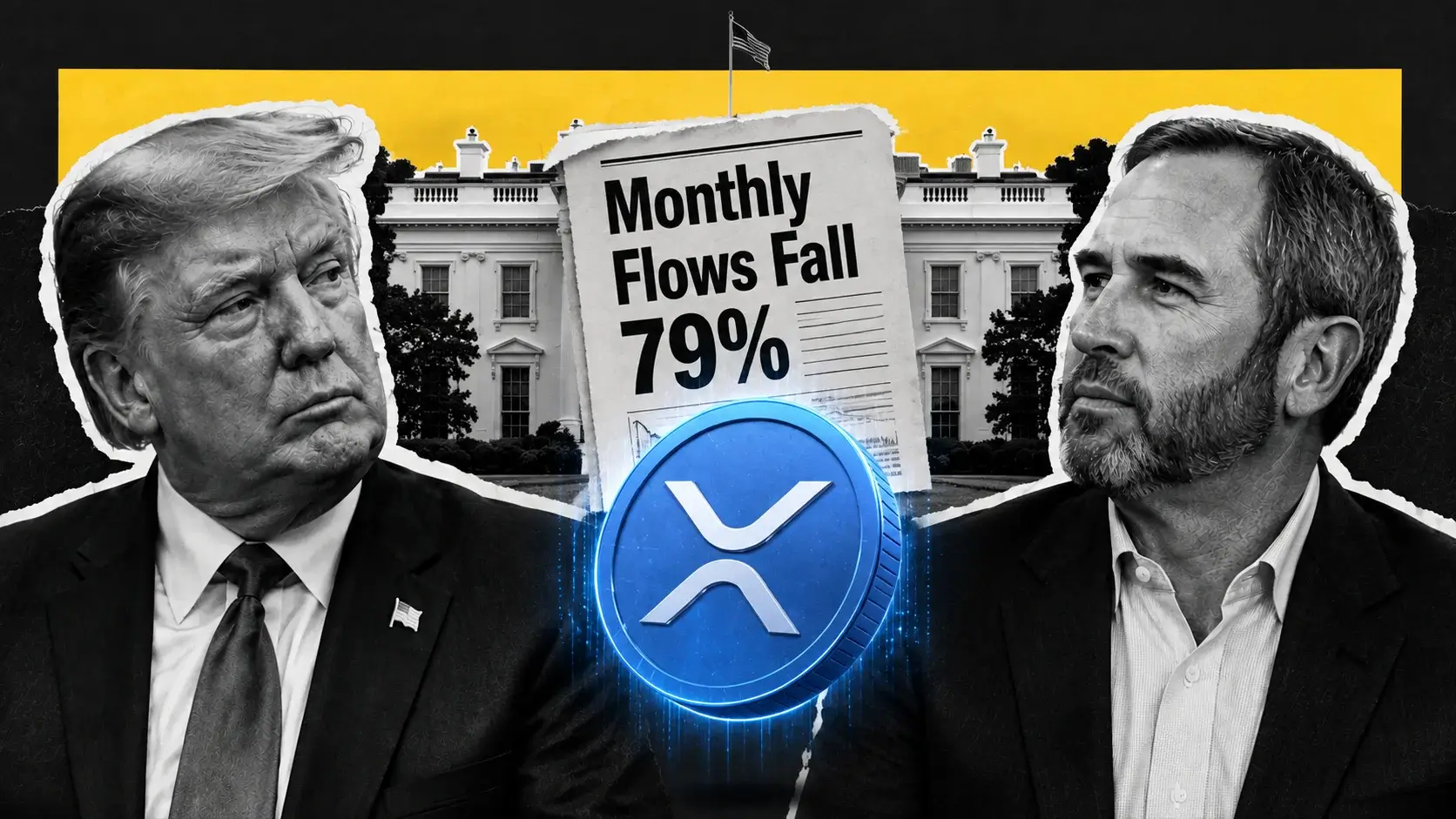
XRP ETFs Hold $993M on $1.51B of Inflows as Monthly Flows Fall 79%
Bitwise leads at $510.21M cumulative and $312.82M in assets, ahead of Canary's XRPC and Franklin's XRPZ | That's TradingNES
Key Points
- US spot XRP ETFs hold $1.51 billion in cumulative inflows against just $993 million in current assets.
- Monthly flows fell from $131.94 million in May to $59.46 million in June and $27.29 million in July.
- Three funds — Bitwise, Canary and Franklin — hold 82% of category assets across seven live products.
U.S. spot XRP exchange-traded funds hold cumulative net inflows of $1.51 billion. Combined assets under management across the seven live products sit near $993 million.
That gap — $517 million, or 34% of everything ever contributed — is the entire story of the category in a single subtraction. Investors put $1.51 billion into these funds and the funds are worth $993 million.
The destruction is not a flow problem. It is a price problem. XRP trades at $1.012 against a market capitalization near $63.3 billion, down more than 40% since the start of 2026 and roughly 72% below the July 2025 high of $3.657. The funds delivered exactly what they promised: clean, regulated, brokerage-accessible exposure to XRP's price. XRP's price collapsed.
The performance figures at the product level make it concrete. The Bitwise fund was down 41.7% year to date through July 30. Franklin Templeton's XRPZ was down 43.1% through August 6.
Seven funds now trade in the United States: Bitwise (XRP), Canary Capital (XRPC), Franklin Templeton (XRPZ), Grayscale (GXRP), 21Shares (TOXR), REX-Osprey (XRPR) and the Bitwise 10 Index product (BITW). Fees range from 0.19% to 0.75%, with custody handled by Coinbase Custody or BitGo.
Collectively they hold approximately 992.5 million XRP, representing about 0.98% of total supply and 1.56% of the circulating float.
Against the comparable categories, the scale gap is severe. U.S. spot Bitcoin ETFs hold $79.50 billion in net assets — 6.10% of Bitcoin's market capitalization. Ethereum's complex holds $9.72 billion. Solana's five funds have drawn $1.12 billion cumulatively. XRP's $993 million in assets represents roughly 1.57% of the token's market cap, a quarter of Bitcoin's penetration ratio.
The daily flow data has become almost immaterial. On August 5 the category recorded its first outflow since July 8 at $3.58 million, entirely attributable to Bitwise. On August 6 it recovered $3.45 million, with Bitwise contributing $2.89 million and Franklin's XRPZ $561,560. No other fund recorded any net flow at all that session.
Two funds moving three and a half million dollars is what constitutes a category-wide event in this market.
Monthly Flows Collapsed 79%: $131.94M in May to $27.29M in July
The trajectory of monthly creations is the single most damaging dataset in the XRP ETF complex.
May delivered $131.94 million in net inflows. June fell to $59.46 million. July registered $27.29 million. That is a 79% decline from the May peak across two months, and it occurred while XRP itself was falling.
Set against the launch, the deterioration is steeper still. The funds drew $666 million in their first month of trading. By January 2, 2026, U.S. XRP products had attracted roughly $1.2 billion in net inflows. Cumulative flows now stand at $1.51 billion, meaning the entire 2026 contribution is approximately $329 million — an average of $55 million per month across six months against a $666 million opening month.
July was worse than the headline suggests. Zero flows were recorded on 11 of the month's 22 trading days. Half of all sessions across a seven-fund complex saw no net creation or redemption activity whatsoever.
August has continued the pattern with a different texture. The category logged a fourth consecutive week of inflows in early August, which sounds constructive until the amount is stated: the weekly figure fell roughly 93% to approximately $1 million.
Four consecutive positive weeks at $1 million is not accumulation. It is a handful of small allocations arriving on a schedule while nothing else moves.
That combination — persistent positivity at immaterial size — defines what this category has become. There is a narrow base of genuinely loyal holders who continue adding on weakness, and there is no mechanism to scale that base.
The comparison to the other crypto ETF categories in the same window sharpens it. Bitcoin funds drew $853.5 million across five sessions in early August. Ethereum drew $244 million in a week. Solana recorded $8.8 million on August 10, its strongest day in three months, on a $1.12 billion cumulative base.
XRP's best recent day was $3.45 million.
What would change it is platform-scale allocation from wirehouses and model portfolios. That requires something the flow data cannot generate on its own.
Three Funds Hold 82% of Assets
Concentration in this category is extreme and it is worth mapping precisely, because the aggregate numbers obscure how few products actually function.
Bitwise leads with $510.21 million in cumulative inflows against $312.82 million in assets. Canary Capital's XRPC follows at $468.12 million cumulative and roughly $250 million in assets. Franklin Templeton's XRPZ sits at $426.53 million cumulative and roughly $254 million.
Those three funds hold 82% of the category's total assets.
Below them the picture deteriorates sharply. Grayscale's GXRP has given back more than half of its $131.46 million in cumulative inflows. The 21Shares TOXR product has never been cumulatively positive since launch — every dollar that entered has left, and then some.
That structure means four of the seven live products are functionally inert. They trade, they carry expense ratios, and they contribute nothing to the demand picture. On August 6, when the category recorded $3.45 million in net inflows, only two funds registered any flow at all.
The concentration is not unusual for a new ETF category, but the direction is. In the Bitcoin complex, BlackRock's IBIT has absorbed $61.09 billion in cumulative net flows against the entire eleven-fund category's $52.18 billion — meaning competitors in aggregate are net redemption vehicles, but the dominant fund is enormous and growing. In Solana's, the five funds have distributed flows more evenly across a $1.12 billion base.
XRP's structure is three mid-sized funds sharing a shrinking pool, with no single dominant product large enough to command institutional routing by default.
That matters for future flows. Institutional allocators concentrate on the deepest, cheapest, most liquid vehicle in any category. Bitcoin's allocators know where to route. XRP's have three roughly equivalent options at $250 million to $313 million in assets, none of which has established the liquidity moat that attracts platform-scale money.
Until one fund breaks away, the category will continue to fragment its own demand.
Bitwise at $510.21 Million and 296.7 Million XRP
The largest fund in the category holds approximately 296.7 million XRP, worth roughly $300 million at current prices, against $312.82 million in reported assets.
Franklin Templeton's XRPZ held around 240 million XRP in early August. Together those two funds control roughly 537 million tokens — more than half the category's estimated 992.5 million XRP.
Bitwise's behaviour has also been the category's swing factor. It accounted for the entire $3.58 million outflow on August 5, then delivered $2.89 million of the $3.45 million recovery on August 6. A single fund reversing its own position across two sessions produced both the category's first outflow in a month and its subsequent rebound.
That is not institutional accumulation. It is one authorized participant adjusting inventory.
The token-count framing is more useful than the dollar framing for anyone modelling supply impact. Every ETF creation requires the delivery of actual XRP into custody, removing it from circulating float. At 992.5 million tokens the category has immobilized approximately 1.56% of circulating supply — meaningful in absolute terms and small against the mechanism releasing supply on the other side.
Ripple's escrow puts 200 to 400 million XRP into circulation net every month. On August 1 the company pre-locked 700 million XRP back into escrow in two tranches before releasing the standard 1 billion in portions of 500 million, 300 million and 200 million, producing net new supply of 300 million — the tightest release in recent memory.
Against that, the ETF complex has absorbed approximately 109 million XRP per month since launch.
The subtraction is 191 million tokens of monthly surplus, roughly $193 million of supply the open market must clear that the funds do not. That is the arithmetic that has capped every rally.
For the ETF category to neutralize the escrow release, monthly absorption would need to roughly triple. At $27.29 million in July inflows against a requirement near $200 million, it is not close.
Every Product Sits At or Near an All-Time Low
The share-price table across the category tells the story that flow data softens.
XRPI trades at $5.87. XRPR at $8.75. XRPC at $11.36. XRPZ at $11.62. GXRP at $20.73.
Every one of those products sits at or near an all-time low.
XRPI broke its $6.50 June floor and has lost 23% across four months. XRPR has traded through its $9.50 floor. The two structured products in the category have underperformed the spot funds, and the reason is mechanical rather than sentiment-driven.
For the pure spot products, the price decline simply tracks XRP. At $1.012 against a launch-period price above $2, the funds have delivered a roughly 50% decline from listing plus fee drag. XRPC at $11.36 and XRPZ at $11.62 reflect that arithmetic almost exactly.
Investors holding since the November 2025 launches are down between 40% and 50% depending on entry point and fee level. Investors who added during the January 2026 rally toward $2.41 are down closer to 58%.
That cohort is the overhead. It is the same structural feature that caps gold at $4,470 with 298 tonnes of underwater ETF inventory, and Bitcoin at $65,400 with 1.79 million coins carrying a $62,000 to $65,000 cost basis. Every rally into breakeven meets sellers who have been waiting months to exit at cost.
XRP's version of that overhang is broad rather than concentrated, because the token has traded in a descending pattern all year rather than building a single dense accumulation zone. From $2.41 in January down through $1.11 in February, a $1.27 to $1.67 consolidation from mid-February to mid-May, and then the slide to $1.05 by end-May, holders are distributed across the entire range above spot.
The practical consequence is resistance at every level rather than a single wall. That is consistent with the technical picture on the token itself, where the 7-day average at $1.03, 20-day at $1.06, 50-day at $1.08 and 200-day at $1.31 are all stacked overhead in ascending order.
XRPI at $5.87 and the Cost of Daily-Reset Drag
The worst-performing product in the category is not a spot fund, and the reason is worth understanding for anyone considering the structured alternatives.
XRPI has lost 23% over four months on daily-reset drag, breaking through its $6.50 June floor to reach $5.87. That decline is larger than the underlying token's move across the same window.
Daily-reset products rebalance their exposure at the close of each session to maintain a constant leverage or exposure ratio. In a trending market that mechanism compounds favourably. In a choppy, range-bound market it compounds against the holder, because the fund sells into weakness and buys into strength on every reset.
XRP's 2026 price action has been the worst possible environment for that structure: a persistent downtrend punctuated by sharp counter-trend bounces, with 30-day annualized realized volatility running near 50.1%. Every bounce toward $1.10 and every retest of $1.00 has cost the daily-reset products a fraction of their base.
Over four months that fraction has compounded to a 23% gap against spot.
REX-Osprey's XRPR at $8.75, through its $9.50 floor, sits in a similar structural category. Both products serve tactical purposes for traders holding positions over days rather than months, and both are corrosive as buy-and-hold instruments.
The lesson generalizes across the crypto ETF landscape. Bitcoin's IBIT charges 0.25% deducted from holdings, meaning a decade of holding consumes roughly 2.5% of the underlying position. GLD's 0.40% consumes about 4% over the same period. A daily-reset product can consume 23% in four months in the wrong tape.
For XRP specifically, the spot funds — XRPC, XRPZ, the Bitwise product and GXRP — are the appropriate vehicles for any holding period beyond a week, and the fee differential between them at 0.19% to 0.75% becomes the relevant consideration.
That said, the structured products have contributed to the category's optics. Their inclusion in aggregate tracking data drags reported performance below what a spot holder actually experienced.
The November Launch Was the Best of 2025 and It Peaked There
The category's history matters because it establishes what these funds are capable of when conditions align, and the answer is a great deal more than they are producing now.
Canary Capital's XRPC debuted on Nasdaq on November 13, 2025 and produced the most successful exchange-traded fund launch of 2025 by first-day trading volume across any asset class. Not the most successful crypto launch — the most successful launch of any kind, in any category, that year.
The Bitwise product followed on November 20. Grayscale's GXRP listed on NYSE Arca on November 24. Franklin's XRPZ and 21Shares' TOXR came shortly after. REX-Osprey's XRPR had been first to market on the Cboe BZX Exchange.
Across that entire first month, U.S. spot XRP funds did not record a single net outflow day.
That performance surprised participants who had assumed institutional adoption of XRP would lag Bitcoin's by a wide margin. It arrived three months after the Securities and Exchange Commission dropped its appeals in August 2025, ending the multi-year litigation with Ripple and sending XRP up more than 23% to $3.38.
The sequence — litigation resolved, ETFs approved, record launch volumes, $666 million in month one, $1.2 billion by January 2 — was the most favourable set-up any altcoin has received.
And the token peaked at $2.41 in January and has fallen every month since.
The distance between that launch and the present is the most important context for interpreting current flows. This is not a category that never found demand. It is a category that found demand immediately, at scale, and then watched it evaporate as the token's price collapsed and the regulatory framework failed to convert from interpretive guidance into statute.
The March 2026 joint SEC-CFTC guidance classifying sixteen digital assets provided operational comfort. It did not provide the durable statutory certainty that model-portfolio committees require, and any future administration can rescind it without a vote.
That is the gap the flows have been waiting on for nine months.
August: Four Consecutive Weekly Inflows Down 93% to $1 Million
The current streak is the clearest illustration of the category's condition, and it requires both halves of the description to be accurate.
XRP ETFs logged a fourth consecutive week of inflows in early August. The weekly amount fell approximately 93% to roughly $1 million.
Four positive weeks in a row is a genuine signal of holder persistence. It means the base that bought these funds has not capitulated, is still adding on weakness, and is doing so consistently rather than opportunistically.
One million dollars per week against a $993 million asset base is 0.10% — an annualized growth rate of about 5% from flows alone, in an asset that has fallen 40% year to date.
The daily texture reinforces the picture. August 5 produced the first outflow since July 8 at $3.58 million. August 6 recovered $3.45 million. Both moves were driven entirely by one or two funds, with no participation from the other five.
Compare that with the broader crypto ETF market on the same day. On August 6, spot Bitcoin ETFs recorded $128.69 million in net inflows with BlackRock alone contributing $128.33 million, partially offset by $32.77 million of VanEck outflows and $9.07 million from Valkyrie.
Bitcoin's single largest fund moved 37 times the entire XRP category's daily total.
The threshold that would signal a change is specific and has been articulated clearly: four consecutive weeks above $10 million would indicate a trend reversal, while four consecutive weeks below $5 million would confirm the collapse is structural. The category is currently running at $1 million.
What that means for anyone watching flows as a trading signal is that XRP ETF data has stopped containing information at the daily and weekly level. The numbers are too small relative to the token's $936 million in daily spot volume to move price, and too small relative to the $993 million asset base to indicate positioning shifts.
The monthly figure remains the only meaningful frequency, and the monthly figure has fallen 79% in two months.
Read More
-
Yen Stalls at 160 Despite a 3% JGB and Tokyo Core CPI at 2.0% — Intervention Sits at 164, Friday's Payrolls Decide
02.09.2026 · TradingNEWS ArchiveEnergy
-
QQQ ETF ($739) Fades From an Early Tech Rally as a 77.9 ISM Prices Index Meets Micron's $61.5B Guide — $760 Record Test Ahead
01.10.2026 · TradingNEWS ArchiveStocks
-
XRPR and XRPI Follow XRP's $1.49 Test as Spot Funds Hold 1.16B XRP and a 1 Billion Token Escrow Release Lands — $1.70 in Play
01.10.2026 · TradingNEWS ArchiveCrypto
-
November NG Slips Below $3 as Decade-High Storage Meets Capped LNG Exports — $2.75 in Sight
01.10.2026 · TradingNEWS ArchiveCommodities
-
Dollar-Yen at 158 Presses Toward 160 as a 363 bp Carry Gap Meets Katayama-Bessent Intervention Risk — 159 in Sight
01.10.2026 · TradingNEWS ArchiveForex
The Supply Arithmetic: 109 Million Absorbed Against 300 Million Released
The reason XRP ETF flows have failed to support the token reduces to a subtraction that no amount of institutional interest currently solves.
Ripple releases 200 to 400 million XRP net into circulation every month through its escrow mechanism. The August 1 operation was the tightest in recent memory: 700 million pre-locked before the unlock, then 1 billion released in tranches of 500 million, 300 million and 200 million, netting 300 million tokens of new supply.
Every spot XRP ETF in existence has absorbed approximately 109 million XRP per month since launch.
The monthly surplus is roughly 191 million tokens — about $193 million at current prices — that the open market must clear without ETF support.
Annualized, the escrow releases roughly 3.6 billion net tokens while the ETF complex absorbs approximately 1.3 billion. The funds would need to more than triple their absorption rate simply to reach supply-demand equilibrium, and monthly flows have been moving in the opposite direction at a 79% decline.
Cumulative immobilization currently stands at 992.5 million XRP — 0.98% of total supply and 1.56% of circulating. That is a real removal of float and it is dwarfed by what enters.
The comparison across categories is instructive. Bitcoin's new issuance runs roughly 450 coins per day, about $28.6 million or $870 million monthly, against a category holding $79.50 billion. During the strong first week of August, Bitcoin ETFs absorbed nearly a month of new supply in five days.
XRP's ETF complex absorbs roughly a third of monthly escrow release in a good month and a tenth in a bad one.
Exchange balances add context on the other side. Labelled exchange wallets hold roughly 12.7 billion XRP, about 20% of circulating supply. Transfers above 1 million XRP represented 55.3% of Binance outflow value in early August, indicating large holders continue moving tokens off exchanges — which is constructive for float.
Whales holding between 10 million and 100 million XRP have continued accumulating through the decline. That cohort is doing what the ETF complex cannot: absorbing supply at scale without requiring institutional mandates.
Fees From 0.19% to 0.75% and a Category Splitting on Cost
Fee dispersion across the seven products is unusually wide for a category this small, and it will determine which funds survive consolidation.
Franklin Templeton's XRPZ carries the lowest cost structure at 0.19%. The range across the category runs to 0.75%, meaning the most expensive product costs nearly four times the cheapest for identical spot exposure.
Franklin's positioning is showing results at the margin. XRPZ has drawn $426.53 million in cumulative inflows against roughly $254 million in assets, placing it third by cumulative flow but competitive with Canary's XRPC on assets despite launching later. On August 6 it was one of only two funds to record any flow at all.
The fee competition matters more in a declining market than a rising one. When an asset falls 40% in a year, the difference between 0.19% and 0.75% is 56 basis points of additional drag on a position already deeply underwater. Cost-sensitive allocators notice.
The pattern is visible across every crypto ETF category. In Bitcoin, IBIT's 0.25% against a cryptocurrency ETF average near 0.86% net drove consolidation so complete that a single fund now holds 58.5% of a $79.50 billion market. In gold, GLD's 0.40% has been steadily losing long-duration allocation to cheaper siblings while retaining the trading flow.
XRP's category has not yet resolved that competition, which is part of why no fund has broken away. Bitwise leads on cumulative inflows at $510.21 million and assets at $312.82 million but does not carry the lowest fee. Franklin has the lowest fee but launched into a falling market.
Custody is standardized across the category through Coinbase Custody or BitGo, meaning the products are genuinely fungible on everything except cost and liquidity. That commoditization normally produces rapid consolidation toward the cheapest option.
That it has not happened here suggests the allocator base is too small and too retail-weighted for fee optimization to drive routing decisions. Institutional money optimizes on basis points. Retail money follows brand recognition and platform availability.
Liquidity Is Real: 0.08% Spreads and $936 Million Daily Volume
One element of the XRP ETF story has performed as designed, and it deserves acknowledgment against the flow data.
Major XRP ETFs have shown 30-day median bid-ask spreads near 0.08% to 0.09%. That is genuinely tight for a category with under $1 billion in assets and compares favourably with many equity sector ETFs carrying multiples of the asset base.
The underlying market supports it. XRP shows approximately $936 million in 24-hour trading volume against a $63.3 billion market capitalization, with 41,842 active addresses over a 24-hour window and 30-day annualized realized volatility near 50.1%.
Tight spreads on thin assets are a function of market-maker willingness rather than fund size, and market makers have stayed engaged because the underlying spot market is deep enough to hedge against. Authorized participants can create and redeem efficiently, which keeps ETF prices tracking net asset value closely.
That infrastructure has value independent of current flows. When institutional demand arrives — if it arrives — the plumbing works. There is no liquidity bottleneck preventing a wirehouse from allocating $500 million to XRPC tomorrow.
The correlation structure adds context on how the funds behave in a portfolio. XRP's seven-day correlation with Bitcoin has run around +0.70, high enough that XRP ETF exposure duplicates much of what a Bitcoin allocation already provides. For an allocator building a diversified crypto sleeve, a 0.70 correlation to the dominant asset weakens the diversification argument substantially.
That correlation is the quiet reason institutional adoption has lagged. A model portfolio committee evaluating XRP exposure has to justify why it adds something Bitcoin does not, and a 0.70 correlation coefficient makes that a difficult case in a category where governance committees default to the largest, most liquid asset.
The infrastructure is ready. The investment case is what remains unresolved.
The CLARITY Act Is the Only Variable That Changes This
Everything in this category runs through one legislative outcome, and it slipped for a second time this month.
The Digital Asset Market Clarity Act cleared the Senate Banking Committee on May 14 by a 15–9 vote, with all thirteen Republicans joined by two Democrats. On June 1 it landed on the Senate Legislative Calendar as Calendar No. 423. It then sat through June and July without reaching the floor.
The Senate shelved it before the August recess. On August 8 the chamber filed a cloture motion on the motion to proceed — a procedural step that positions the bill for a vote on return but does not constitute a vote on passage. The Senate comes back on September 14 with three weeks of floor time, and a first procedural vote could occur as early as September 15.
For XRP specifically, the bill would split oversight between the SEC and CFTC and classify the token as a commodity under permanent federal law, replacing the March 2026 joint SEC-CFTC guidance covering sixteen digital assets. In 2026 XRP is generally treated as a digital commodity, and that treatment has supported ETF approvals — but the classification rests on administrative interpretation rather than statute.
The connection to flows is direct and observable in the data. Inflows ran at $131.94 million in May while the bill was advancing through Senate Banking. They fell to $59.46 million in June after it stalled on the calendar, and $27.29 million in July after it failed to reach the floor.
Prediction market odds on passage reached 43% at one point, up from a low of 32%, before the recess delay pushed the timeline. Appropriations fights and the election calendar make floor time scarce through the autumn.
Model-portfolio committees and wirehouse platforms do not add assets whose legal classification can be reversed by an incoming administration without a vote. That is the specific institutional barrier, and legislation is the only thing that removes it.
Passage would not guarantee inflows. It would remove the reason for their absence, which is the necessary precondition for the platform-scale allocation this category needs.
Scenarios and Targets: $900M Floor, $1.1B Base, $1.5B on Passage
The base case, carrying the highest probability, is continued drift with assets between $900 million and $1.05 billion through the September Senate session. This assumes weekly flows hold in the $1 million to $5 million band, XRP defends the $1.00 level, and no legislative resolution arrives before September 15. Monthly inflows stabilize near the July run rate of $27 million, cumulative flows reach roughly $1.55 billion by quarter-end, and assets track the token. Target: $1.1 billion in assets, implying XRP near $1.10.
The bullish case requires the CLARITY Act to advance. Cloture succeeding on September 15 or 16 followed by floor passage would classify XRP as a commodity under permanent law and remove the barrier that has kept model portfolios and wirehouses on the sidelines. Under that scenario weekly flows would need to reach $50 million to signal genuine institutional entry, and monthly absorption would need to approach 200 million XRP — roughly double the current rate — to neutralize the escrow release. Assets reach $1.5 billion on a combination of inflows and price recovery toward $1.22, with $1.31 at the 200-day average as the extension. Target: $1.5 billion.
The bearish case begins with XRP losing $1.00 decisively. That exposes $0.97 at Fibonacci support, then $0.95 and $0.90. At $0.90 the category's assets fall below $900 million even with flat flows, and cumulative inflows of $1.51 billion would represent a 40% aggregate loss. Triggers: another CLARITY Act delay pushing the vote past the autumn calendar, four consecutive weeks of flows below $5 million confirming structural collapse, a September Federal Reserve hike at roughly 40% probability, or a larger-than-usual escrow release moving to exchanges. Target: $900 million in assets, with $850 million as the extension.
The consolidation scenario sits alongside all three. With four of seven products functionally inert — GXRP having given back more than half its $131.46 million, TOXR never cumulatively positive, and the two structured products at all-time lows — issuer rationalization is a live possibility within twelve months. Fund closures would not change the category's aggregate demand but would concentrate remaining assets and potentially create the dominant vehicle the category currently lacks.
Prediction market positioning on the token assigns 68% probability to XRP printing $1 or below during August against roughly 13% for $1.20 or higher.
Verdict: A Category With Real Loyalty, Real Liquidity, and No Path to Scale
U.S. spot XRP ETFs have taken in $1.51 billion since launch and hold $993 million. That $517 million gap is not redemptions — it is a 40% token decline in nine months applied to a fully invested asset base.
The flow trajectory is the more damaging number. Monthly inflows fell from $131.94 million in May to $59.46 million in June to $27.29 million in July, a 79% collapse across two months, with zero flows on 11 of July's 22 trading days. The entire 2026 contribution to cumulative flows is $329 million, averaging $55 million monthly against a $666 million opening month. August has produced a fourth consecutive positive week at approximately $1 million — down 93%.
The structure explains why no single fund can fix it. Bitwise at $510.21 million cumulative and $312.82 million in assets, Canary's XRPC at $468.12 million and roughly $250 million, and Franklin's XRPZ at $426.53 million and roughly $254 million hold 82% of the category between them. Grayscale's GXRP has surrendered more than half its $131.46 million. The 21Shares TOXR has never been cumulatively positive. XRPI at $5.87 has lost 23% in four months to daily-reset drag and XRPR sits at $8.75 through its $9.50 floor. Every product is at or near an all-time low.
The supply arithmetic is the binding constraint. Ripple releases 200 to 400 million XRP net monthly — 300 million on August 1 after pre-locking 700 million, the tightest release in memory. The ETF complex absorbs roughly 109 million monthly. That leaves 191 million tokens, about $193 million, that the open market must clear every month without fund support. Absorption would need to triple to reach equilibrium.
What works is the infrastructure. Bid-ask spreads at 0.08% to 0.09% on a sub-$1 billion category are genuinely tight. Custody through Coinbase and BitGo is standardized. Fees run 0.19% to 0.75% with Franklin at the low end. Creation and redemption function cleanly. There is no plumbing problem preventing a $500 million allocation tomorrow.
What does not work is the investment case. A 0.70 seven-day correlation with Bitcoin undermines the diversification argument, and a classification resting on March 2026 interpretive guidance rather than statute keeps model portfolios out. Flows tracked the CLARITY Act's progress precisely: $131.94 million in May while it advanced, $27.29 million in July after it stalled.
November 2025 proved the demand exists. XRPC produced the most successful ETF launch of 2025 by first-day volume across any asset class, and the category recorded no outflow day in its entire first month.
Base case $1.1 billion in assets. Bull case $1.5 billion on CLARITY Act passage plus sustained flows above $50 million weekly. Bear case $900 million on a decisive break of $1.00. The signal to watch is four consecutive weeks above $10 million, and the date is September 15.