Yen (161.06) Surges as Japan Appears to Intervene, Sending EUR/JPY Down 400 Pips Hours Before the BOJ's 1.00% Decision
USD/JPY fell from 163.50 through 161.00 on suspected Ministry of Finance yen buying | That's TradingNEWS
Key Points
- USD/JPY trades near 161.06, down 1.43% on the session and 1.69% over seven days, after reaching a 40-year low of 163.99.
- EUR/JPY plunged more than 400 pips in minutes, falling 2.54% to around 182.60 on the same flow.
- The BOJ is expected to hold at 1.00% on Friday, with fiscal 2026 growth upgraded to about 0.8% from 0.5%.
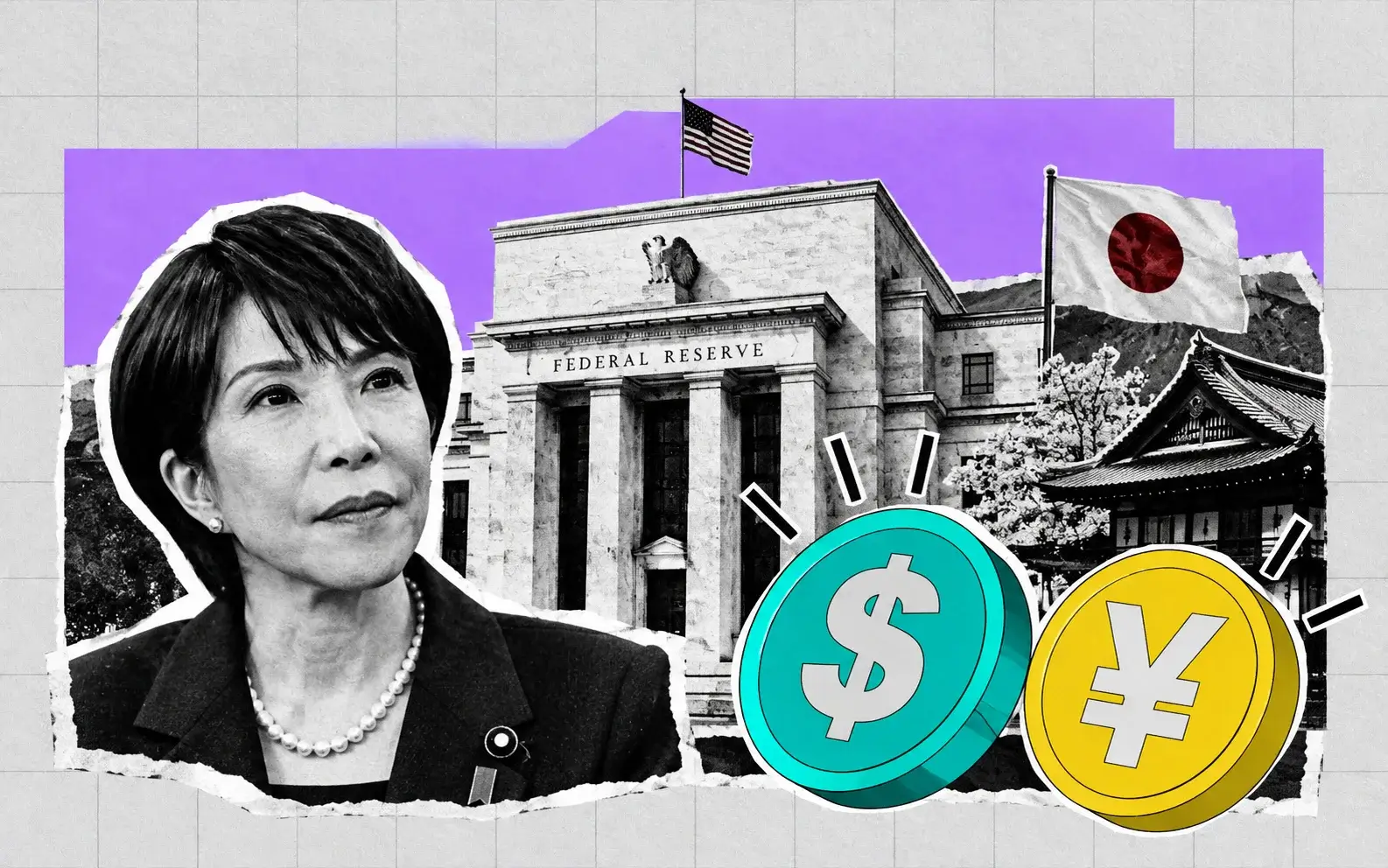
USD/JPY trades around 161.06, down roughly 1.43% on the session, after Japanese authorities appear to have entered the market to buy yen. The pair was at 163.50 earlier in the day, up 0.06% and holding near the top of its range, before a violent move in the New York morning took it through 162.00 and then below 161.00. Over seven days the pair is down 1.69%.
The move carried every yen cross with it. EUR/JPY plunged more than 400 pips in minutes, falling 2.54% on the day to around 182.60. The rally came without any obvious economic catalyst, which is itself the strongest evidence of official participation — genuine data-driven moves do not remove four hundred pips from a major cross inside a few minutes without a print to point at. Broad-based losses across the yen complex are the standard signature of a Ministry of Finance operation rather than a positioning unwind.
The level it struck from matters. The yen had reached a fresh forty-year low of 163.99 in the session preceding, a rate against the dollar not seen since the mid-1980s. The pair had climbed steadily from around 162.65 on July 21, accelerated above 163.80 on July 23, and spent the following week consolidating between roughly 163.25 and 164.00 with the weekly high pressing the round number. The one-month climb ran from the low 160.50s.
The annual arithmetic explains why Tokyo acted. The yen is down 8.41% against the dollar over twelve months and weakened a further 0.57% over the past month. That is a currency in a persistent, one-directional decline against the world's reserve asset, in a country that imports nearly all of its energy, during a quarter in which Brent has traded between $72 and $101.
What makes today's operation genuinely consequential rather than another verbal skirmish is the timing. It landed the day before the Bank of Japan's policy decision and the quarterly Outlook Report, and it landed on a session in which the dollar was already vulnerable from a second-quarter GDP miss and a Federal Reserve hold. The Ministry chose a moment of maximum dollar softness to deploy reserves, which is a considerably more sophisticated execution than the market has come to expect. Whether it holds through tomorrow's Tokyo announcement is the entire question, and the carry arithmetic underneath is not on Tokyo's side.
The Execution: Buying Yen Into Dollar Weakness Rather Than Against It
The operational detail deserves attention because it marks a change in how Tokyo is fighting this. Reporting characterises the intervention as producing the dollar's largest single-day decline since 2022, with the Ministry of Finance exploiting the Federal Reserve's three-way hawkish dissent and the second-quarter GDP miss to buy yen at a point of peak dollar weakness.
That is a materially better trade than the April operation. Intervening against a strengthening dollar means fighting the flow — reserves get absorbed by the same carry demand that drove the move, and the effect decays within days. Intervening into an already-softening dollar means the official flow is additive to a move the market was making anyway, which produces more displacement per dollar of reserves deployed and leaves speculative longs facing a trend rather than a spike.
The macro setup Tokyo used was genuinely favourable. The Fed held at 3.50% to 3.75% on a 9–3 vote, second-quarter GDP came in at 1.5% against a 1.8% consensus, core PCE eased to 3.3% from 3.4%, headline PCE fell to 3.7% from 4.1%, and jobless claims printed 197,000. That is a slower economy with cooling inflation, which under normal conditions weakens a currency. The dollar had held up anyway on geopolitical demand and the long-end yield story. Buying yen into that configuration puts the official bid on the same side as the fundamental case.
The coordination angle is the other new element. Japanese officials have referenced continuous communication with US counterparts — described as around the clock, every day of the year — under a bilateral understanding reached with the American Treasury, under which both capitals confirmed they would take coordinated steps on currencies if required. A September joint statement between the two governments contained explicit language on intervention.
That framework matters more than the size of any single operation. Unilateral intervention against a 260 basis point rate differential is a losing proposition and every carry trader knows it. Genuinely coordinated intervention — where the counterparty central bank is not simply acquiescing but participating — changes the risk calculus for anyone short yen, because it removes the assumption that Washington will tolerate the position indefinitely. Whether today's action was coordinated or merely tolerated has not been confirmed. Tokyo's decision to foreground the communication channel in its messaging suggests it wants the market to assume the former.
April's Precedent: Three Percent, and Then Right Back
The template for what happens next was set three months ago. At the end of April, with USD/JPY having reached a high of 160.72, the yen appreciated by nearly 3% in a comparable episode. Two sources familiar with the matter later confirmed that Japanese authorities had intervened to support the currency.
The verbal escalation preceding that operation followed a recognisable sequence. The Finance Minister warned that decisive action was imminent. The top currency diplomat described the situation as the market's final warning. Then the operation came. Since then the Minister has continued to warn that further intervention remains possible, and the yen has continued to weaken regardless — from 160.72 in April to 163.99 last week, a further 2% of depreciation despite an intervention that briefly moved the pair 3% the other way.
That is the uncomfortable arithmetic every yen bear has internalised. April's operation bought roughly three months and roughly three yen. The pair not only recovered the intervention loss but printed a new forty-year low on top of it. Each subsequent verbal warning has produced a smaller reaction: on July 24 a series of remarks from the Finance Minister moved the pair only from 163.93 to 163.72 — twenty-one pips — before yen-buying momentum faded and the dollar regained its footing.
Twenty-one pips is not a market that fears the Ministry of Finance. It is a market pricing verbal intervention as noise, which is precisely why the escalation to physical action was necessary and why the credibility question now dominates.
The distinction that determines whether today differs from April is the follow-through. A single operation into a favourable macro window buys a level. Sustained defence — repeated operations on any bounce, with size, over weeks — establishes a ceiling. Tokyo has the reserves to do the latter and has historically lacked the appetite. What the market will test over the next fortnight is whether the Ministry defends 163 on the way back up, or whether today was a one-off designed to buy the Bank of Japan room ahead of a decision where the Governor has to talk hawkishly without actually tightening.
Tomorrow's Decision: A Hold at 1.00% and an Upgraded Growth Forecast
The Bank of Japan concludes its two-day meeting on Friday, with the policy statement and quarterly Outlook Report published together and the Governor's press conference following. The benchmark rate is overwhelmingly expected to remain at 1.00%. That level was reached with a 25 basis point increase in June 2026, passed by a 7–1 vote, after a 0.75% plateau held since December 2025 — itself the highest level since 1995 and maintained through the January, March and April meetings.
Timing matters for anyone holding a position. The statement typically lands at 11:30 a.m. Tokyo time, which during northern summer is roughly 10:30 p.m. the previous evening in New York and 3:30 a.m. in London. The Governor's press conference follows at 3:30 p.m. Tokyo, or approximately 2:30 a.m. Eastern. That means the decision and the commentary both hit while Western desks are thinly staffed, which is exactly the condition in which a hold with unexpected language produces a disorderly move.
The Outlook Report is the substantive event rather than the rate. The board is expected to revise its fiscal 2026 growth forecast upward to approximately 0.8% from the 0.5% projected in April, on receding fears of a severe hit from the Middle East conflict. It is simultaneously expected to trim its inflation forecast, reflecting the effect of subsidies and a drop in oil costs from April levels — though jittery crude markets and rising import costs from a weak yen should keep any downgrade small.
That combination is awkward for the yen. Higher growth with lower projected inflation is a configuration that argues for patience rather than urgency, and patience is what has driven this currency to a forty-year low. The board is nonetheless expected to maintain its view that risks to the price outlook are skewed to the upside, and to signal scope for further hikes through hawkish communication while staying deliberately ambiguous on pace and timing.
Consensus for the next move clusters on October or December, with one house explicitly modelling December and a pace of roughly one increase every six months. Markets are not pricing a July surprise. A hike tomorrow would be the single most violent yen-positive event available, and it is not the base case.
Ueda's Communication Trap: Hawkish for the Market, Silent for the Government
The Governor faces one of the most demanding communications exercises of his tenure, and the constraint is political rather than economic. He must talk down yen bears through hawkish language while avoiding antagonising a government widely seen as critical of further policy tightening.
That tension is not abstract. The Prime Minister has pursued an expansionary fiscal agenda, and reporting through the past year has repeatedly described political pressure on the central bank to hold rates. A nine-member board in Tokyo delivering a hold can move the currency 1% in minutes purely on the Governor's choice of words, and those words are being drafted under constraints that have nothing to do with the inflation target.
The mechanics of what the market is listening for are narrow. Any explicit reference to the currency as a factor in the policy calculus would be read as opening the door to an October move and would be worth two to three yen immediately. Repetition of the existing framework — hikes contingent on underlying inflation moving sustainably toward 2%, with trade and supply risks flagged as uncertainties — would be read as the status quo and would allow the carry trade to reload against today's intervention level.
The Governor has already shifted the reaction function once, stating that rate increases depend on whether underlying inflation is likely to sustainably reach the target rather than requiring it to be firmly there before acting. That was a genuine easing of the hurdle. It has not been followed by action, which has cost it credibility in the same way verbal FX intervention has lost credibility.
The dissent count is the underappreciated tell. June's hike passed 7–1, with the lone dissenter preferring to hold. A growing number of dissents in favour of higher rates through early 2026 has suggested the board's centre of gravity is shifting toward further tightening. If tomorrow's statement carries a dissent in the hawkish direction — a member voting for an immediate increase — that is a stronger signal than anything in the press conference, because it establishes a bloc rather than a preference.
For the yen, tomorrow's statement is the moment where the Ministry's intervention either gets institutional backing or is exposed as a solo effort. Those are very different trades.
Core CPI at 1.6% Is the Reason the Bank Cannot Move Faster
The fundamental obstacle to yen recovery is that Japan does not currently have the inflation problem that would force tightening. June national core consumer prices rose 1.6% year over year, below a 1.7% market consensus and beneath the 2% target. That print, released on July 24, further dampened expectations for an early increase and contributed directly to the pair's climb toward 164.
That is a genuinely difficult position for the central bank. The currency is at a forty-year low and the domestic price data does not justify emergency action. Underlying inflation remains below target even as headline measures have been pushed around by energy and food. Raising rates to defend a currency, absent an inflation mandate justification, is the kind of decision that invites exactly the political conflict the Governor is trying to avoid.
The oil channel is where this could change, and it cuts both ways. Japan imports essentially all of its crude, so a weak yen and expensive oil compound each other in the import bill — a currency down 8.41% against the dollar paying for barrels that rose from $72 to $101 and back to $89 within a single quarter. Producer prices have surged from that energy shock, and the board is explicitly waiting on data showing the degree to which that pass-through reaches the broader economy. Brent settled at $90.74 on Wednesday after a 7.9% surge, then eased to $88.93 as US strikes on Iran continued.
The Outlook Report's expected inflation downgrade reflects the opposite force: subsidies and a drop in oil costs from April levels. But the downgrade is expected to be small precisely because crude markets remain unsettled and import costs are rising through the currency.
The honest read is that Japan's inflation picture argues for one more hike within six months and against anything faster. That trajectory is already priced. It is worth roughly 25 basis points of the 260 basis point differential, which is not enough to reverse the carry trade on its own. The currency's recovery has to come from the dollar side, from repatriation flows, or from official action — not from the Bank of Japan's reaction function to domestic prices.
The 260 Basis Point Gap That Absorbs Every Intervention
The structural obstacle is straightforward arithmetic. The Federal Reserve's target midpoint sits at 3.625% against a Japanese policy rate of 1.00% — a differential of roughly 260 basis points. Analysts responding to today's intervention have been explicit that a gap of that size will absorb any officially driven rally.
The mechanism is mechanical rather than sentimental. A trader borrowing yen at Japanese rates and holding dollars earns the differential as carry, accruing daily regardless of spot direction. An intervention that moves the pair three yen lower hands that trader an immediate mark-to-market loss and simultaneously improves the entry point on a trade that pays 2.6% annualised to hold. Unless the intervention is expected to repeat, the rational response is to re-establish the position at the better level — which is precisely what happened after April.
The long end of the US curve makes it worse. The 30-year Treasury yield surged twelve basis points on Wednesday to 5.21%, a nineteen-year high and the strongest since 2007, while the 10-year touched 4.677% before easing to 4.65% and the two-year fell four basis points to around 4.24%. Measured across the curve rather than at the policy rate, the yield advantage available to a dollar holder is wider than the 260 basis point headline suggests, and the bear steepener that produced it means the compensation for holding duration in dollars has increased rather than decreased.
The Fed's own posture reinforces it. Three regional presidents dissented in favour of a quarter-point increase, markets price roughly 80% odds of a September hike, and the chair declined to offer forward guidance while stating that persistently elevated inflation could make higher rates appropriate. A Federal Reserve that might tighten again against a Bank of Japan that will not move until October at the earliest is a widening differential, not a narrowing one.
That is the arithmetic Tokyo is fighting. Intervention can win a level and it can inflict pain on crowded positioning. It cannot change the carry, and the carry is what has taken this pair from the low 160.50s to 163.99 in a month. Anyone treating today's move as a trend change needs to explain where the differential compresses from.
The Repatriation Bid: $29.6 Billion and a Life Insurance Sector at Forty Percent
The strongest structural argument for the yen operates independently of both central banks, and it is accelerating. Japanese investors sold $29.6 billion of US debt in the first quarter of 2026 alone as domestic yields rose, removing a historically reliable buyer from a Treasury market already navigating large fiscal deficits. Life insurers' foreign holdings now sit at roughly 40% of their peak.
The logic driving it is unambiguous at current yields. When a Japanese government bond pays 2.9% unhedged, the case for owning a Treasury at 4.6% with currency risk and hedging costs attached collapses. Hedged into yen, the American asset produces a negative return for a Japanese institution; unhedged, it carries the risk of exactly the kind of three-yen move the market saw today. Asset-liability matching decisions at Japanese life insurers respond to that arithmetic and they do not reverse monthly.
That flow is mechanically yen-positive. Repatriating capital from dollar assets requires selling dollars and buying yen, and it happens on a schedule set by portfolio committees rather than by momentum. It is the single most durable source of yen demand available, and it is structural rather than tactical.
The government is actively trying to accelerate it. On July 10 the Finance Minister said Tokyo would pursue measures encouraging the national pension fund and other pension pools to invest more in Japanese financial assets. That is fiscal and regulatory policy being deployed toward a currency objective, which is a more patient instrument than intervention and considerably harder for the market to fade.
The scale, however, has to be weighed honestly against the flow it is fighting. Twenty-nine billion dollars a quarter is meaningful but it is not large relative to daily turnover in the world's third-most-traded pair, and the carry trade has been rebuilding faster than the repatriation has been draining. That is why the yen has weakened 8.41% over twelve months despite this bid operating throughout.
The correct framing is that repatriation raises the floor rather than producing the rally. It is why a yen collapse toward 175 has not happened and probably will not. It is not sufficient to reverse the trend without either a Federal Reserve pivot or a genuinely faster Bank of Japan.
The Chart: 164.00 Ceiling, 161 Broken, 158 the Next Real Level
The technical structure before today's break was tight and well defined. Resistance sat at 164.00, then 164.50 and 165.00. Support ran 163.25, then 162.75, then 162.00, with 160.50 beneath. The pair had been holding above its 50-period average at 163.70 and 200-period at 163.74 as of Monday, with the relative strength index at 59.29 against a 48.96 signal line — a mildly constructive momentum configuration inside a compressed range.
Today's move has broken all of it. Losing 162.75 and then 162.00 in a single session takes out three levels that had held for a fortnight, and the break through 161.00 puts the pair well below both short-term averages, which now become dynamic resistance overhead rather than support beneath.
The levels that matter from here are cleaner on the downside than the upside. Below 161.00, the 160.50 area is the first genuine reference — the level from which the July climb began, and the round-number zone that has anchored the range for two months. Beneath that, 158.00 is the next structural marker; the pair traded there in January during a prior intervention-warning episode, and it represents the last level at which the market meaningfully repriced the carry.
On the upside, the recovery path is stepped and each step is a potential re-intervention point. Reclaiming 162.00 would signal the operation is being faded. Getting back through 162.75 and 163.25 would put the pair inside its pre-intervention range and effectively confirm April's pattern repeating. A return above 163.70 to 163.74 restores the moving-average support and re-opens 164.00 and the forty-year low at 163.99.
The practical framework is that this is now an event-driven chart rather than a technical one. Standard levels do not survive contact with a central bank statement delivered at 10:30 p.m. Eastern into thin liquidity, followed by a press conference four hours later. Large leveraged positions face material gap and slippage risk around the announcement. Position sizing, not level selection, is the decision that matters between now and Friday's Tokyo close.
Read More
-
Yen Stalls at 160 Despite a 3% JGB and Tokyo Core CPI at 2.0% — Intervention Sits at 164, Friday's Payrolls Decide
02.09.2026 · TradingNEWS ArchiveEnergy
-
QQQI ETF Pays 13.96% While The Nasdaq-100 Rolls Over — Why Section 1256 Is Worth More Than The Yield
14.09.2026 · TradingNEWS ArchiveStocks
-
XRP ETFs Took $19M In A Week After A $110M Record — Why The Filings Tell A Different Story Than The Flows
14.09.2026 · TradingNEWS ArchiveCrypto
-
US Gas Holds $2.88 While Europe Pays $28 — Why Only A Tenth Of The War Premium Reaches Henry Hub
14.09.2026 · TradingNEWS ArchiveCommodities
-
Yen Holds Near February Highs As Tokyo Prepares Its Highest Rate Since 1995 — Why The Yield Gap Will Not Move
14.09.2026 · TradingNEWS ArchiveForex
"The 160 Range Is the New Normal" — the Capitulation Tokyo Had to Break
The most telling piece of market colour before today was linguistic. Local reporting had noted that a view was spreading in the market that the 160-yen range is simply the new normal. That reads as capitulation, and it is exactly the sentiment condition that makes intervention effective.
Capitulation in a carry trade means positioning has become one-directional and complacent. Traders stop hedging the tail. Stop losses drift further from spot. Leverage builds because the trade has paid consistently for months and the perceived risk of a reversal falls toward zero. When an official operation lands into that configuration, the resulting move is amplified by forced deleveraging far beyond the size of the reserves deployed — which is why EUR/JPY lost 400 pips in minutes rather than 100.
Market scepticism about verbal intervention had grown to the point where the Finance Minister's July 24 remarks moved the pair twenty-one pips. That scepticism was earned: repeated warnings without action train the market to fade the warnings. But it also created the conditions under which action would be maximally effective, because nobody was positioned for it.
The credibility question now flips. Before today, the argument was that Tokyo talks and does not act. After today, the argument is whether Tokyo acts once or acts repeatedly. Those produce entirely different equilibria. A single operation establishes a level that speculators will test within days. A pattern of operations establishes a ceiling that changes the risk-reward on holding the carry, because the trade's daily accrual has to be weighed against the possibility of a three-yen gap at any moment.
Japan has the reserves for the latter and has historically lacked the willingness. The variable that could change that is the energy import bill: a country buying all its crude in dollars, with the currency down 8.41% and Brent having traded to $101 this month, has a genuine terms-of-trade emergency rather than a prestige problem. That is a stronger motivation for sustained defence than any previous episode in this cycle.
The market will find out inside two weeks. Watch whether the Ministry sells dollars again on any move back through 162.50.
Gap Risk: Why the Next Twelve Hours Are the Highest-Variance Window of the Quarter
The sequencing from here is unusually hazardous and worth stating explicitly. The policy statement and Outlook Report land at approximately 10:30 p.m. Eastern tonight. The Governor's press conference follows around 2:30 a.m. Eastern. Both fall in the thinnest liquidity window of the twenty-four-hour cycle for Western participants, and they arrive on the same day as an intervention that has already displaced the pair by more than two yen.
That combination produces genuine gap risk rather than ordinary volatility. The market is short yen in aggregate, has just absorbed a large forced-deleveraging event, and faces a binary policy communication delivered when the order book is at its shallowest. Slippage on stop orders in that environment is not a theoretical concern.
The scenario map is narrow but the payoffs are wide. A hold with an unchanged framework and no currency reference reads dovish against today's action, and the carry trade reloads — expect a retest of 162.75 and potentially 163.25 within days. A hold with explicit acknowledgement of currency effects on the inflation outlook, or an additional hawkish dissent, validates the intervention and puts 160.50 in play immediately. An actual hike, which nobody is pricing, is worth four to five yen inside an hour.
Beyond Japan, the dollar leg has its own calendar. The dollar index sits near 100.93 to 101 after recovering from its initial post-Fed decline, having rallied for seven of eight sessions into July 27 inside an ascending channel. September Fed pricing near 80% keeps the differential wide, and each incoming US inflation print between now and then moves it. The Middle East remains an active variable through the crude channel and Japan's import bill.
The disciplined approach into tonight is reduced size and no fresh directional exposure. Traders should distinguish a headline reaction from a confirmed trend, and reassess when new data invalidates the original thesis. A pair that has moved 1.43% on suspected official flow and faces a central bank decision within twelve hours is not an environment for conviction positioning. It is an environment for waiting until Friday's Tokyo close reveals whether 161 was a floor or a waypoint.
What Actually Changes the Trend, and What Does Not
Separating the durable from the tactical is the most useful exercise for anyone holding a view beyond this week. Three things could genuinely reverse the yen's decline, and only one of them is currently in motion.
The first is a compression of the rate differential from the Japanese side. That requires the Bank of Japan to move faster than the once-every-six-months pace consensus expects — meaning an October hike followed by a December hike, taking the policy rate to 1.50% by year end. That would halve the gap relative to a Federal Reserve holding at 3.625%. Nothing in Japan's 1.6% core inflation print or the expected Outlook Report downgrade currently supports that pace, and the political environment argues against it.
The second is compression from the American side. A Federal Reserve that cuts rather than hikes would do more for the yen in a single meeting than any intervention. That requires US growth to deteriorate materially from the current 1.5% and core inflation to fall well below 3.3%. The three hawkish dissents at this week's meeting and 80% September hike pricing say the market expects the opposite.
The third is sustained official action backed by the repatriation flow. That is the one currently operating. Today's intervention, the pension-fund reallocation push, the $29.6 billion of first-quarter Treasury sales and life insurers at 40% of peak foreign holdings form a coherent policy programme rather than a panic response. It is slow, it is structural, and it raises the floor without producing a rally on its own.
What does not change the trend: verbal warnings, which now move the pair twenty-one pips. Single interventions, which April demonstrated buy three months and three yen. Hawkish-sounding Outlook Report language unaccompanied by a rate change, which the market has learned to discount.
The synthesis is that the yen's decline is decelerating rather than reversing. Intervention has established that Tokyo will defend the 164 area. The carry gap ensures that defence gets tested. The repatriation bid means the floor is higher than it was two years ago. Those forces produce a range, not a trend change.
The Forecast: 162.50 Base, 157 Bull, 165 Bear Into the Fourth Quarter
The base case, at roughly 45% probability, is that today's intervention establishes a ceiling near 164 without reversing the trend, and USD/JPY spends August and September oscillating between 159 and 164 before settling near 162.50 into the fourth quarter. This requires the Bank of Japan to hold tomorrow with hawkish-sounding but non-committal language, an October or December hike to remain the consensus, and the Federal Reserve to hold in September. Under this path the carry trade rebuilds gradually, Tokyo defends any approach to 163.50, and the pair grinds in a wide range without resolving. Trade the boundaries, respect the intervention zone, and do not hold size through Tokyo hours.
The bull case for the yen, around 25%, requires two things together: the Bank of Japan signalling an October move explicitly — through a currency reference in the statement, an additional hawkish dissent, or unusually direct press conference language — and the Federal Reserve holding rather than hiking in September. That compresses the differential toward 235 basis points with the repatriation flow accelerating behind it. USD/JPY breaks 160.50, then tests 158.00, and 157 becomes reachable by year end. Sustained follow-up intervention on any bounce through 162.50 would strengthen this path considerably.
The bear case, around 30%, is the April pattern repeating. Tomorrow's statement lands dovish relative to today's action, the market concludes the Ministry acted alone, and the carry trade reloads at improved levels. The pair recovers 162.00, then 163.25, and retests the forty-year low at 163.99 within weeks. A September Federal Reserve hike widening the gap toward 285 basis points takes it through 164.00 toward 165.00, and the intervention becomes another entry point rather than a turning point. The 260 basis point carry gap is the reason this scenario carries the highest single weight.
The disciplined posture at 161.06 is to stand aside until Friday's Tokyo close. Today bought a level. Tomorrow decides whether it was a floor.