Apple Stock Price Forecast: AAPL Eases Toward $298 as a Record $111B Quarter and 28% China Surge
The stock dips 0.3% near its all-time high as record Q2 revenue, mid-teens guidance | That's TradingNEWS
Key Points
- Apple trades near $298 with a $4.37T market cap, just below its $300.92 record high after a 0.3% dip.
- Record Q2: revenue up 16.6% to $111.18B, iPhone up 22%, Greater China surging 28.1% to $20.5B.
- A $100B buyback and 14-17% Q3 guidance offset memory-cost margin pressure; John Ternus becomes CEO Sept 1.
Apple (AAPL) is trading modestly lower on Thursday, changing hands somewhere around $297.74 to $297.84, down roughly 0.34% to 0.38% on the session, or about $1.03, from a previous close of $298.87. The intraday range has been tightly contained between $295.38 and $300.45, and the stock is sitting right against the upper edge of its 52-week range of $193.46 to $300.92 — a positioning that frames the day's move with real precision: this is a marginal pullback at the highs, not a breakdown of any kind. The market capitalization sits at roughly $4.37 trillion to $4.39 trillion depending on the feed, a figure that makes Apple the single most valuable company on the planet and places it in a tier of corporate scale that only a tiny handful of businesses in history have ever occupied. The slight dip is arriving on a day when the broader technology tape is mixed-to-firm — Nvidia is higher by more than 4%, Broadcom close to 4%, Microsoft modestly green — so Apple's red close reads far more as quiet digestion at record territory than as anything resembling a sector-wide retreat. The trailing price-to-earnings ratio sits in the 34 to 36 zone depending on which source is used, with the forward multiple landing near 34.23, average volume running around 46 million shares, and short interest strikingly low at 0.92%. There is one piece of headline color worth flagging because it sets the tone of the session: a widely circulated item Thursday asking whether smart money is "quietly walking away" from the stock — a genuinely fair question to put against a name trading at a historically rich multiple, and one this writeup intends to confront directly rather than sidestep.
The Record March Quarter That Reset the Entire Narrative
The fiscal second quarter Apple delivered was, measured against the company's own long history, the best March quarter it has ever produced — and that is not a small statement for a business of this age and scale. Total revenue came in at $111.18 billion, up 16.6% year-over-year, comfortably beating the consensus figure that sat somewhere between $109.57 billion and $109.7 billion, and critically, it exceeded the very top end of Apple's own 13% to 16% guidance range rather than merely landing inside it. Diluted EPS landed at $2.01, a 21.8% to 22% year-over-year increase, ahead of the $1.95 the analyst community had penciled in. Net income reached $29.58 billion, growing 19.36% year-over-year, while operating income climbed from $29.6 billion to $35.9 billion over the same period. The margin profile is what genuinely separates this print from an ordinary hardware quarter: gross margin came in at 49.3%, up a striking 222 basis points year-over-year, with operating margin at 32.3%, and EBITDA hitting $39.32 billion, up 21.93%. The sequential decline of 22.7% from the holiday quarter was entirely expected and carries no signal whatsoever — it is simply the seasonal rhythm of the business. What genuinely matters is the year-over-year acceleration, and when this $111.18 billion figure is stacked against the prior quarter's $143.8 billion print, which itself was up 16%, the picture becomes clear: Apple has now strung together two consecutive quarters of mid-teens revenue growth from a company that a substantial portion of the bear camp had effectively written off as a structural single-digit grower with its best days behind it.
The iPhone Supercycle and a Services Engine Running at Record Scale
The product-line detail sitting underneath the headline number tells a genuinely broad-based story rather than a one-segment fluke. iPhone revenue came in at $56.99 billion, up 21.7% to 22% year-over-year and a March-quarter record, representing 51.3% of total revenue. There is an important nuance worth dwelling on here: the figure technically came in just shy of the roughly $57.2 billion consensus estimate, but when a marquee product line grows by more than $10 billion year-over-year in a single quarter, the print itself is the story and the so-called "miss" is statistical noise — particularly when Tim Cook explicitly attributed the shortfall to advanced processor supply constraints rather than to any softening in demand, stating plainly that demand was "off the charts" with very little flexibility in the supply chain at the moment to source more parts. Cook also went on record calling the iPhone 17 the most popular iPhone line Apple has ever introduced. Services revenue hit $30.98 billion, an all-time record, up 16.3% year-over-year — which works out to a roughly $125 billion-plus annualized run rate, compounding in the mid-teens at software-like margins, and functioning as the engine sitting directly underneath that headline 49.3% gross margin. The rest of the portfolio confirmed the breadth of the strength: Mac came in at $8.4 billion against an $8.02 billion consensus, iPad at $6.91 billion versus $6.66 billion expected, and Wearables, Home and Accessories landed at roughly $7.9 billion, with those three lines growing 5.7%, 8%, and 5% year-over-year respectively. This was not a quarter carried by a single hero product — it was strength across nearly every line and every geography.
The China Rebound and the Huawei Tailwind Sitting Underneath It
Greater China was the standout geography of the quarter, and the detail behind the number genuinely matters to the durability of the story. Revenue from the region jumped 28.1% year-over-year to $20.5 billion, marking the second consecutive quarter of strong growth after several years of sluggish, frustrating expansion in what is one of Apple's most strategically important markets. The proximate drivers are the iPhone 17 upgrade cycle combined with Beijing's electronics subsidy, which amplified that cycle considerably — and while the subsidy itself is plainly non-recurring, the structural story sitting beneath it is meaningfully more durable than a one-off government incentive. The memory shortage that is currently squeezing the entire hardware industry hits Apple's price-sensitive Chinese competitors far harder than it hits Apple, because memory represents a proportionally larger share of their bill of materials and their already-thinner margins simply cannot absorb the additional cost as easily. Those rivals have responded by scaling back their low-end lineups, and Apple has captured share in the mid-tier market as a direct result — reaching 21.8% of the China market in calendar Q4 2025. There is a second, longer-running tailwind worth understanding: Huawei's foundry partner SMIC remains roughly two full chip generations behind, stuck refining 7nm chips while TSMC has already moved Apple to 3nm and is actively preparing 2nm. For as long as that technological gap continues to widen year after year, iPhones grow structurally more competitive in the region. India added a further layer to the picture — double-digit growth in the quarter, a market Cook called a "huge opportunity" and said he was "over the moon excited" about, with Apple holding a 70%-plus premium-segment share and actively hedging its tariff exposure through new local manufacturing capacity.
Guidance That Signals Genuine Management Conviction Rather Than Caution
The June-quarter guide is arguably the single most revealing piece of the entire report, and it deserves to be read closely. Apple guided fiscal Q3 revenue to grow 14% to 17% year-over-year, set against a Wall Street consensus that sat at just 9.5% — a genuinely large 5 to 7 percentage point gap between the company's own view and the Street's, and Apple does not, as a matter of historical practice, sandbag its guidance to anywhere near that degree. CFO Kevan Parekh framed the guide as comprehending management's best view of constrained iPhone supply, which in plain terms means Apple believes it could ship materially more units if it simply had them available. The one clear area of caution sits on the margin line: gross margin was guided to a range of 47.5% to 48.5%, below the 49.3% achieved in Q2, with surging DRAM and NAND pricing eating into hardware economics as AI-compute demand continues to outstrip global memory supply. Apple had carry-in inventory secured at favorable terms that buffered the Q2 margin, but management was candid on the call that the memory squeeze is likely to get worse from here rather than better. The genuinely impressive part of all this is the context in which it is happening — Apple is delivering this growth while simultaneously absorbing roughly $3.3 billion in cumulative tariff costs across the last three quarters plus double-digit component price inflation, and it is still printing gross margins in the high-40% range, offsetting all of that pressure through a deliberate mix shift toward Services and premium iPhone configurations. That is pricing power of a kind the bear case has dismissed and underestimated for years.
The R&D Acceleration and the AI Strategy It Reveals
One number in the report deserves particular and sustained attention because it speaks directly to the most persistent criticism leveled at Apple over the past several years. Operating cash flow came in at $28 billion to $28.7 billion in the quarter, while R&D spending hit $11.4 billion — up a substantial 33% year-over-year from $8.55 billion, growing almost twice as fast as revenue and now representing 10.27% of the top line. For a company that has been criticized relentlessly for prioritizing buybacks over genuine innovation and for under-investing in both AI and cloud, that is a meaningful and visible shift in corporate behavior. The spend is going toward Apple Intelligence, the broader post-iPhone roadmap including smart glasses, foldables and robotics, and silicon development — and whichever way the number is sliced, it signals that Apple no longer behaves like a business that treats AI as someone else's problem to solve. The strategic logic underpinning the approach is genuinely distinctive: rather than burning enormous amounts of capital competing in the frontier-model arms race against OpenAI, Google, and Anthropic, Apple is positioning itself as the orchestration layer — the unavoidable toll booth through which AI experiences flow to consumers. The company plans to allow users to select rival AI models directly within future operating systems, with increasingly deep Anthropic and Gemini integrations, which lets Apple collect a toll on the broader and fiercely competitive AI market without having to absorb the crushing infrastructure burden that the model developers are carrying. With an installed base exceeding 2 billion devices, a hard-won and trusted privacy stance, and control over the payment and authentication layers, the bull argument is that distribution and ecosystem control may ultimately prove far scarcer and more valuable than raw model leadership.
The Ternus Transition and What He Is Actually Inheriting
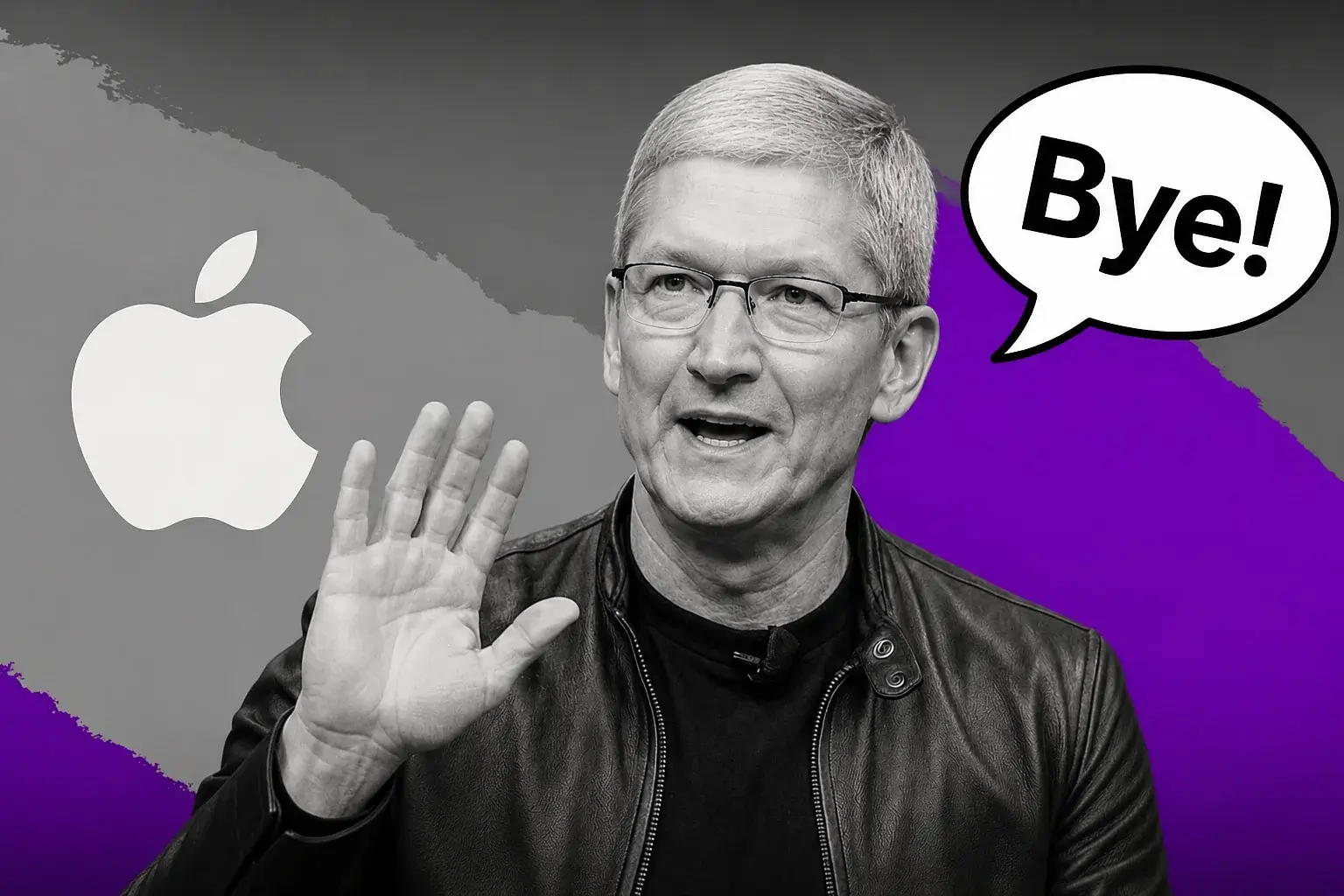
A genuine structural change is arriving at the very top of the company. Tim Cook becomes Executive Chairman on September 1, 2026, with John Ternus — currently the SVP of Hardware Engineering — stepping in as Apple's eighth CEO, while Johny Srouji takes an expanded role as Chief Hardware Officer and Art Levinson moves into the Lead Independent Director seat. The board approved the transition unanimously on April 17 and announced it publicly on April 20. The reassuring element here is continuity: Ternus brings a 25-year Apple tenure, deep and well-established engineering credibility, and a genuine track record running hardware for the iPad, the iPhone refresh cycles, AirPods, and the Mac silicon transition — he is an insider who worked under both Steve Jobs and Tim Cook, not an outsider parachuting in to learn the business on the job. The genuine open question is the softer execution risk. Cook built his entire legacy on operational mastery and skillful geopolitical navigation, with personal relationships spanning Beijing officials, Washington, and TSMC leadership that functioned as a real and underappreciated qualitative asset for the company, and it simply remains to be seen whether Ternus can preserve that intangible advantage. His first true test as CEO is unambiguous: the Siri overhaul. Siri launched all the way back in 2011 and still cannot function as a true assistant, the major overhaul has now been delayed multiple times, and it is currently expected to ship in pieces across iOS 26.5 and iOS 27 with Google's Gemini reportedly powering the backend. How that rollout actually performs is the central swing factor on whether the post-Cook narrative reads as a new chapter or a stumble.
Capital Returns That Continue to Set a Hard Floor Under the Stock
Apple's capital-return program remains among the most aggressive in the entire market, and it functions as a genuine structural support sitting beneath the share price rather than a cosmetic feature. The board authorized an additional $100 billion for buybacks and raised the quarterly dividend 4% to $0.27 per share. The $100 billion authorization is not technically a record for the company, but at the current market capitalization it works out to roughly 2.3% of shares outstanding if it is fully executed, and Apple repurchased roughly $25 billion in the most recent quarter alone, which is approximately the size of a typical full year of buyback activity for many large companies. Since fiscal 2012, Apple has returned more than $1 trillion of capital to shareholders — a figure that exceeds the entire lifetime revenue of the overwhelming majority of companies that will ever exist. Free cash flow in the quarter came in at $18.81 billion, though it is worth noting honestly that this figure was down 21.73% year-over-year, a detail that sits somewhat at odds with the otherwise strong cash-generation story and bears watching. The buyback program has reliably been the floor under the stock through multiple cycles, and it remains something that a meaningful share of the market consistently glances over or underweights when assessing the durability of the name.
Read More
-
Yen Stalls at 160 Despite a 3% JGB and Tokyo Core CPI at 2.0% — Intervention Sits at 164, Friday's Payrolls Decide
02.09.2026 · TradingNEWS ArchiveEnergy
-
QQQ ETF ($706.22) Slides 7.4% Below Its High as the Market Reprices the AI Capex Bill — $686.57 Target if $700 Breaks
22.10.2026 · TradingNEWS ArchiveStocks
-
XRPI ($7.00) and XRPR ($10.74) Slide Toward 52-Week Lows as Spot XRP ETF Flows Stall at $708,510
22.10.2026 · TradingNEWS ArchiveCrypto
-
NG ($2.775) Decoupled From Europe’s €88 Gas Crisis as LNG Feedgas Hits 18.9 Bcf/d — $3.30 Upside on Cold Weather
22.10.2026 · TradingNEWS ArchiveCommodities
-
Dollar-Yen (157.35) Loses 157.65 as the Yen Rallies on Haven Demand — 155 Target if 156 Breaks
22.10.2026 · TradingNEWS ArchiveForex
The Risks That Keep the Bull Case Honest
A complete and intellectually honest read of Apple has to take the risk side seriously, because several of these risks are concrete rather than theoretical. The most immediate is margin: surging DRAM and NAND pricing has already crept into Q2 economics, and management openly expects the squeeze to worsen, with the second half of fiscal 2026 potentially seeing gross margins compress toward the 47% level. The antitrust overhang is the sharpest near-term legal risk — the September 2025 ruling preserved the roughly $20 billion-per-year Google search deal but explicitly banned exclusivity, and the DOJ has since appealed to the D.C. Circuit, which leaves the economics of that extremely high-margin Services contributor genuinely at risk of impairment. The China position carries a subtle but real vulnerability: Apple's market-share gains in the region are partly anchored to Huawei's technological constraints, and if Huawei were removed from the U.S. Entity List as part of a trade negotiation — which is not a stretch at all given how President Trump has repeatedly used trade policy as a bargaining chip — that structural tailwind would unwind. Apple also remains genuinely behind on AI, dependent on Google's Gemini to power its next generation of foundation models, which raises the uncomfortable question of how the company defends its premium pricing power if value ultimately migrates toward the AI layer itself. The roughly $3.3 billion in cumulative tariff costs and the persistent, unresolved China supply-chain dependency round out the picture. And the valuation itself is a standalone risk — at a forward multiple in the low-to-mid 30s against a sector median near 23x and Apple's own 5-year average near 29x, there is very little margin built in for disappointment of any kind.
Where the Weight of the Evidence Ultimately Points
Pulling every thread into a single consolidated view, Apple (AAPL) presents as a company that has genuinely and visibly re-accelerated — and the honest characterization is a Buy on quality, held with a clear-eyed respect for the rich valuation that comes attached. The bull case is more defensible than it has been in years, and the evidence supporting it is substantial: two consecutive quarters of mid-teens revenue growth, a record $111.18 billion top line, a Services business at a $125 billion-plus annualized run rate compounding in the mid-teens at software margins, a 49.3% gross margin held firm against real tariff and component-cost headwinds, a China rebound running at 28.1% with a structural memory-shortage tailwind underneath it, R&D up 33% finally signaling that Apple takes AI seriously, a Q3 guide sitting a full 5 to 7 points above consensus, and a $100 billion buyback authorization setting a hard floor beneath the shares. The "smart money walking away" question circulating Thursday is a fair one to raise given the multiple, but the actual operating evidence cuts firmly in the other direction — this is a business firing on essentially every geography and every segment at once. Set against all of that, the risks are real and cannot be waved away: margin compression toward 47% from the memory squeeze, the DOJ antitrust appeal threatening the lucrative Google deal economics, the Huawei Entity List tail risk hanging over the China share gains, a genuine AI execution gap currently papered over by a Gemini dependency, and a forward multiple in the low-to-mid 30s that leaves no real room for a stumble. The single biggest swing factor from here is the Siri overhaul under incoming CEO John Ternus — the bar has been set low by years of delays, which cuts both ways, meaning a competent rollout could genuinely surprise the market to the upside while a fourth or fifth delay would harden the bear case considerably. The posture that fits the weight of the evidence is constructive ownership: Apple has rarely been a multiple-expansion story, and shareholders are quite consciously paying up for execution, a fortress balance sheet, and an ecosystem moat spanning more than 2 billion devices — but with growth visibly back on the table and the capital-return program as relentless as ever, paying up for that particular quality remains a justifiable stance heading into the Ternus era.