GBP/USD Price Forecast: Pound Pinned at 1.35 as a Hawkish Fed and a Westminster Crisis Squeeze Cable From Both Sides
Sterling holds a one-week low near 1.3520 as US CPI at 3.8% reprices the Fed toward hikes | That's TradingNEWS
Key Points
- GBP/USD clings to 1.3500 after a three-day slide, ranking as the second-weakest G10 currency vs the dollar.
- US CPI at 3.8% lifts Fed hike odds to 35.6%; the 10-year Treasury yield hits a 10-month high of 4.48%.
- A Streeting move against Starmer pushes UK 20- and 30-year gilt yields to 26-year highs on fiscal fears.
GBP/USD is changing hands around 1.3520 to 1.3528 on Thursday, having spent the bulk of the session pressed hard against the psychologically critical 1.3500 mark after an overnight decline that extended a third consecutive day of losses. The pair is now sitting close to its weakest levels since late April, and the quotes scattered across the various data feeds tell the story of a market under genuine and sustained strain — one read had it sitting at 1.3500 flat, another at 1.35062, a third at 1.3513, with an earlier European print near 1.3550 before the breakdown gathered real pace. The cross-currency map confirms beyond doubt that this is not an isolated Sterling problem but rather a broad-based dollar surge that Cable is being forcibly dragged into: the greenback gained roughly 0.25% against the pound on the session, and it did so alongside parallel advances of 0.19% versus the euro, 0.11% against the yen, 0.16% against the Australian dollar, 0.12% against the Swiss franc, and a notable 0.37% against the New Zealand dollar, while slipping just 0.02% against the Canadian dollar. That ranking places Sterling as the second-weakest G10 currency against the dollar on the session, behind only the New Zealand dollar — and the reason for that specific underperformance is the entire crux of the setup worth understanding. Cable is being squeezed from both sides of the pair at the same moment: a hotter-than-expected U.S. inflation backdrop that has fundamentally repriced Federal Reserve policy expectations, and a deepening political crisis in Westminster that has driven UK gilt yields to levels not witnessed in more than a quarter of a century. The U.S. Dollar Index has firmed by roughly 0.2% to 0.3% toward the 98.50 to 98.72 zone, with the descending channel ceiling at 98.59 standing as arguably the single most important directional pivot in the entire foreign-exchange complex right now.
The U.S. Inflation Shock That Repriced the Entire Federal Reserve Curve
The dominant force pressing down on GBP/USD originates not in London at all but squarely in Washington. The April Consumer Price Index released earlier in the week accelerated to 3.8% year-on-year, up from 3.3% in March, beating the 3.7% consensus estimate and delivering what stands as the cleanest hawkish surprise of the year so far — with the core CPI reading climbing to 2.8% from 2.6% alongside it. The drivers behind the acceleration were persistent shelter inflation and the lingering pass-through of earlier energy-price gains; the U.S.-Iran ceasefire allowed some oil to begin flowing again, but not nearly enough to break the underlying pricing trend that has taken hold. The market reaction was immediate and genuinely material: CME FedWatch probabilities for at least one Federal Reserve rate hike in 2026 surged to roughly 35.6% from 23.5% before the release, a 12 percentage point jump in a single session that mechanically rewrites the rate-differential mathematics behind every dollar pair on the board. The April Producer Price Index then added another forceful leg to the move, running at 6% year-on-year — the hottest reading in nearly four years — and entrenching the inflation-stickiness narrative even more firmly. The 10-year U.S. Treasury yield has climbed to around 4.48%, a 10-month high, which mechanically raises the opportunity cost of holding any non-dollar currency and removes the structural floor that had been quietly supporting Cable throughout its late-April recovery. Ed Yardeni went so far as to state that a 2026 Fed cut is now "essentially off the table." For Sterling specifically, the transmission is direct and unforgiving: when the Fed is actively being repriced toward hikes rather than cuts, the pound has to swim against a powerful and strengthening current simply to hold its ground, let alone advance.
The Westminster Crisis Tearing at Sterling's Political Foundation
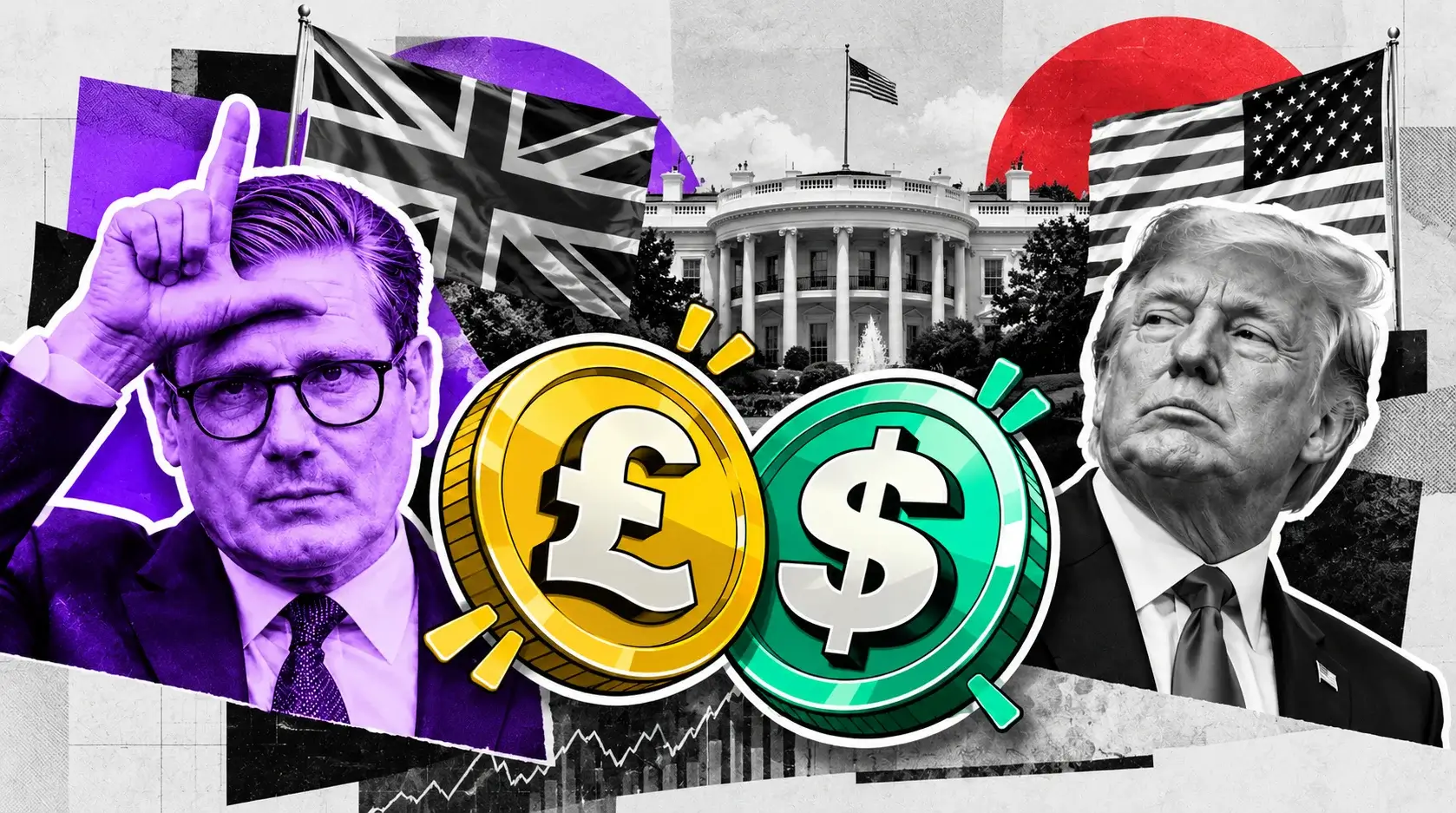
What genuinely makes GBP/USD the second-weakest performer in the G10 rather than just another routine casualty of dollar strength is the political earthquake currently unfolding in London. Prime Minister Keir Starmer is facing the most serious leadership challenge of his entire tenure, with Health Secretary Wes Streeting reportedly preparing to resign as soon as Thursday in order to trigger a formal leadership contest — Streeting confronted Starmer directly in a 16-minute meeting held ahead of the King's Speech, and Labour Party insiders have now visibly shifted from debating whether Starmer can survive to openly discussing the precise timeline of his eventual exit. The trigger for the entire crisis was a catastrophic local election performance: councillor changes show Labour down 202 seats, the Conservatives down 61, Reform UK adding a striking 270 councillors, the Liberal Democrats gaining 29, and the Greens adding 23. That 202-seat collapse on the Labour side represents the worst council-level result for a sitting government in decades, and it has effectively shattered the political cover Starmer had been operating under since the general election less than two years ago. More than 80 Labour MPs have now publicly called for him to step down. Markets, for their part, have moved entirely past the question of whether he stays and are now actively pricing whether he leaves on his own terms or is forced out against his will — and the concern, as XTB's Kathleen Brooks framed it with precision, is that a drawn-out leadership battle leaves both Starmer and Chancellor Rachel Reeves looking like lame ducks with no real grip on the public purse, a genuinely bad position for the UK given how recent the last election was. The fear sitting underneath all of it is fiscal in nature: a new Labour leadership almost certainly means looser spending designed to win back voters, layered directly on top of an already-elevated UK borrowing burden.
The Gilt Market Sends the Single Most Dangerous Signal of All
The bond market move sitting beneath Sterling is the single most important macro signal in the entire GBP/USD breakdown, and it is flashing precisely the wrong kind of warning. The 10-year UK gilt yield has climbed above 5.10%, while the 20-year and 30-year UK yields have struck 26-year highs — readings simply not seen since the late 1990s. Under ordinary circumstances, rising domestic yields would be broadly supportive of a currency through the rate-differential channel, drawing capital in. But the current move is the precise opposite signal: it is being driven by fiscal sustainability fears rather than by monetary tightening expectations, which makes it a flashing red light rather than a green one. SocGen's Kit Juckes captured the dynamic with real clarity — increased spending under a new Labour leadership is essentially a given, higher taxes including wealth and housing levies are very nearly certain, and that fiscal backdrop layered on top of geopolitical stress, rising energy costs, and a 2026 UK GDP consensus that has slipped from 1.1% at Christmas down to 0.8% now leaves very little indeed to drive Sterling higher. The Bank of England, critically, is offering no rescue from this. The latest Reuters poll of economists expects the BoE to maintain a restrictive stance for as long as inflation remains above target, and MPC member Catherine Mann explicitly stated that monetary policy cannot offset cost-push shocks from energy prices — which is, in effect, a clear signal that the central bank has no intention of cutting rates aggressively to cushion a deteriorating economy. Fiscal blow-out risk, political instability, restrictive BoE policy, and a visibly worsening growth outlook combine into a perfect storm for the pound that has nothing whatsoever to do with what the dollar is doing on the other side of the pair.
The Q1 GDP Print That Briefly Cut Against the Bearish Tide
Against that genuinely grim backdrop, the UK economic data delivered a real and meaningful positive surprise. The preliminary Q1 2026 GDP release showed the British economy accelerating to 0.6% quarter-on-quarter growth, matching consensus expectations and marking a sharp pickup from the 0.1% to 0.2% pace recorded in the prior quarter. The standout detail within the report was the 0.3% GDP growth posted specifically in March, which beat expectations of a 0.2% contraction and meaningfully eased fears of a sharp economic downturn stemming from the Iran war, with the manufacturing and industrial production figures also coming in ahead of forecasts. That 0.6% headline figure represents roughly a sixfold acceleration from the 0.1% Q4 2025 print, and on its own it signals considerably more underlying resilience in the UK economy than the dominant political narrative would otherwise suggest. It handed Sterling a temporary and badly needed footing — the pound managed to hold above 1.3500 rather than collapsing cleanly through it — but the lift proved fragile and short-lived. The IMF had already cut its UK 2026 growth forecast from 1.3% down to 0.8%, and a single quarter of decent activity data does not undo a layered fiscal and political crisis. The GDP beat bought Sterling some time; it did not, and could not, change the underlying trend.
The Technical Map Reveals a Structure That Has Rotated Bearish
The chart on GBP/USD has turned decisively and visibly heavier over the past three trading sessions. The pair currently sits below the 20-day Exponential Moving Average at 1.3530, having failed to break above the 61.8% Fibonacci retracement of the latest swing at 1.3602, and the Relative Strength Index reads around 49.6 — hovering right at the neutral line and signaling clearly waning upside momentum, which strongly suggests that rallies will remain capped for as long as price holds beneath the immediate confluence of dynamic and Fibonacci resistance. The resistance ladder stacked above runs through the 50.0% retracement at 1.3518, the 20-day EMA at 1.3530, the red moving average at 1.3535, the 61.8% retracement at 1.3602, the 78.6% level at 1.3721, and finally the 100% retracement at 1.3873. On the downside, the first genuine support sits at the 38.2% Fibonacci retracement near 1.3434, with a deeper floor at the 23.6% level around 1.3331 and the structural anchor sitting all the way down at 1.3163 should the breakdown truly extend. The intraday 2-hour chart shows price testing the ascending trendline from the early-May low at 1.3510, with the red moving average at 1.3535 acting as immediate overhead resistance and the Volume Profile identifying the 1.351 zone as the fair-value area where dip-buyers have been stepping in. The Daily Bollinger configuration places price below the 20-day SMA at 1.3540 but above the 100-day SMA at 1.3483, with the lower Bollinger band at 1.3458 representing the next stronger floor on any deeper pullback. The technical structure, taken as a whole, is increasingly threatening a clean and decisive break of the 1.3500 psychological floor.
Read More
-
Yen Stalls at 160 Despite a 3% JGB and Tokyo Core CPI at 2.0% — Intervention Sits at 164, Friday's Payrolls Decide
02.09.2026 · TradingNEWS ArchiveEnergy
-
QQQ ETF ($706.22) Slides 7.4% Below Its High as the Market Reprices the AI Capex Bill — $686.57 Target if $700 Breaks
22.10.2026 · TradingNEWS ArchiveStocks
-
XRPI ($7.00) and XRPR ($10.74) Slide Toward 52-Week Lows as Spot XRP ETF Flows Stall at $708,510
22.10.2026 · TradingNEWS ArchiveCrypto
-
NG ($2.775) Decoupled From Europe’s €88 Gas Crisis as LNG Feedgas Hits 18.9 Bcf/d — $3.30 Upside on Cold Weather
22.10.2026 · TradingNEWS ArchiveCommodities
-
Dollar-Yen (157.35) Loses 157.65 as the Yen Rallies on Haven Demand — 155 Target if 156 Breaks
22.10.2026 · TradingNEWS ArchiveForex
The Geopolitical Channel Reinforcing the Dollar From Two Directions
The geopolitical backdrop is actively reinforcing the dollar bid against GBP/USD through two distinct channels operating at once — the safe-haven channel and the oil-driven terms-of-trade channel. President Trump has rejected the latest Iranian proposals and explicitly warned that the U.S.-Iran ceasefire is now on "massive life support," language that has unsettled markets and pushed crude prices back toward $107 Brent and $102 WTI. The Strait of Hormuz remains effectively closed for the first time in recorded history, with cumulative supply losses now exceeding 1 billion barrels and the IEA forecasting a 1.78 million barrels per day deficit for 2026. Iran's Aladdin Boroujerdi, a member of Parliament's National Security and Foreign Policy Commission, has stated flatly that Iran "will by no means relinquish the achievement of the Strait of Hormuz" and will not enter negotiations regarding nuclear enrichment — signaling that the diplomatic track has fundamentally stalled. MUFG has captured the implication directly, noting that ending the conflict and reopening the Strait could take considerably longer than expected and produce a more disruptive outcome for the global economy. ING has separately flagged the risk of complacency, warning that markets have been reluctant to price renewed escalation despite Trump's life-support language, and that the longer the stalemate persists, the greater the upside risks for the dollar. The oil-driven inflation pass-through is feeding directly into the UK outlook — Britain's 2026 consensus GDP growth has fallen from 1.1% at Christmas to 0.8% now specifically because of energy cost pressures, meaning the Iran war is hitting Sterling through the growth channel even as it lifts the dollar through the safe-haven channel.
The Monetary Policy Divergence Driving the Medium-Term Path
The monetary policy divergence between the Federal Reserve and the Bank of England is the cleanest fundamental driver of the GBP/USD trajectory over the next three to six months, and it is an asymmetry that currently favors the dollar. The Fed transition arrives Friday, May 15, when Jerome Powell hands the gavel to Kevin Warsh following the Senate's 51 to 45 confirmation vote. Warsh is widely presumed to lean more dovish than Powell, but MUFG and other major institutions have argued he is unlikely to meaningfully change the status quo, because most Fed officials will remain unreceptive to easing calls given the current inflation backdrop — and four Fed policymakers already dissented at the most recent meeting, highlighting a growing internal divide that Warsh must now navigate. The Bank of England side of the equation is structurally different in a way that disadvantages Sterling: Catherine Mann's comment that monetary policy cannot offset cost-push energy shocks is effectively a statement that the BoE will hold restrictive policy regardless of how much growth deteriorates. The result is a unique and unfavorable outcome for the pound — both central banks are holding restrictive policy, but the Fed has the structural backing of accelerating inflation prints while the BoE is holding into a deteriorating growth backdrop with fiscal concerns layered underneath it. That asymmetry mechanically favors the dollar through both the rate-differential channel and the credibility channel over the coming months. The broader risk-asset complex is reinforcing rather than relieving the move — the S&P 500 is on the defensive as hot PPI fuels Fed angst, gold is revisiting $4,700 amid dollar strength, and the entire G10 pattern confirms the dollar as the dominant force.
Where the Weight of the Evidence Ultimately Points
Pulling every thread into a single consolidated view, GBP/USD is a pair where the balance of forces tilts clearly and uncomfortably against Sterling, and the honest characterization is a Sell-leaning Hold — a market where the path of least resistance points lower while price holds beneath the 1.3530 to 1.3535 resistance band, but where the 1.3500 floor has proven stubborn enough to demand respect rather than reckless conviction. The bearish case is layered and substantial: a U.S. CPI at 3.8% and PPI at 6% repricing the Fed toward hikes with 2026 cut odds collapsing, a 10-year Treasury yield at a 10-month 4.48%, a Westminster leadership crisis with Streeting poised to move against Starmer, UK long-end gilt yields at 26-year highs on fiscal panic rather than monetary strength, a BoE explicitly unwilling to ease into weakness, and an Iran war pressing UK growth down to 0.8% while lifting the safe-haven dollar. Set against that, the pound is not entirely without support — the 0.6% Q1 GDP beat showed genuine economic resilience, the 1.3500 level has held as support repeatedly over the past month, the BoE's restrictive stance keeps UK real rates competitive, and a quick resolution of either the political turmoil or the Iran war would unwind the risk premium fast. But those are conditional lifelines, not present-tense supports. The disciplined posture is to treat 1.3500 as the decision line that settles the argument: a decisive break below it opens 1.3434, then 1.3331, and ultimately the 1.3163 structural anchor; a firm defense of the level with a reclaim of 1.3535 reopens room toward 1.3602. Until the Fed transition, the Westminster contest, and the Hormuz stalemate resolve, Cable grinds — and for now, the grind has a clear downward bias with the burden of proof resting squarely on the bulls.