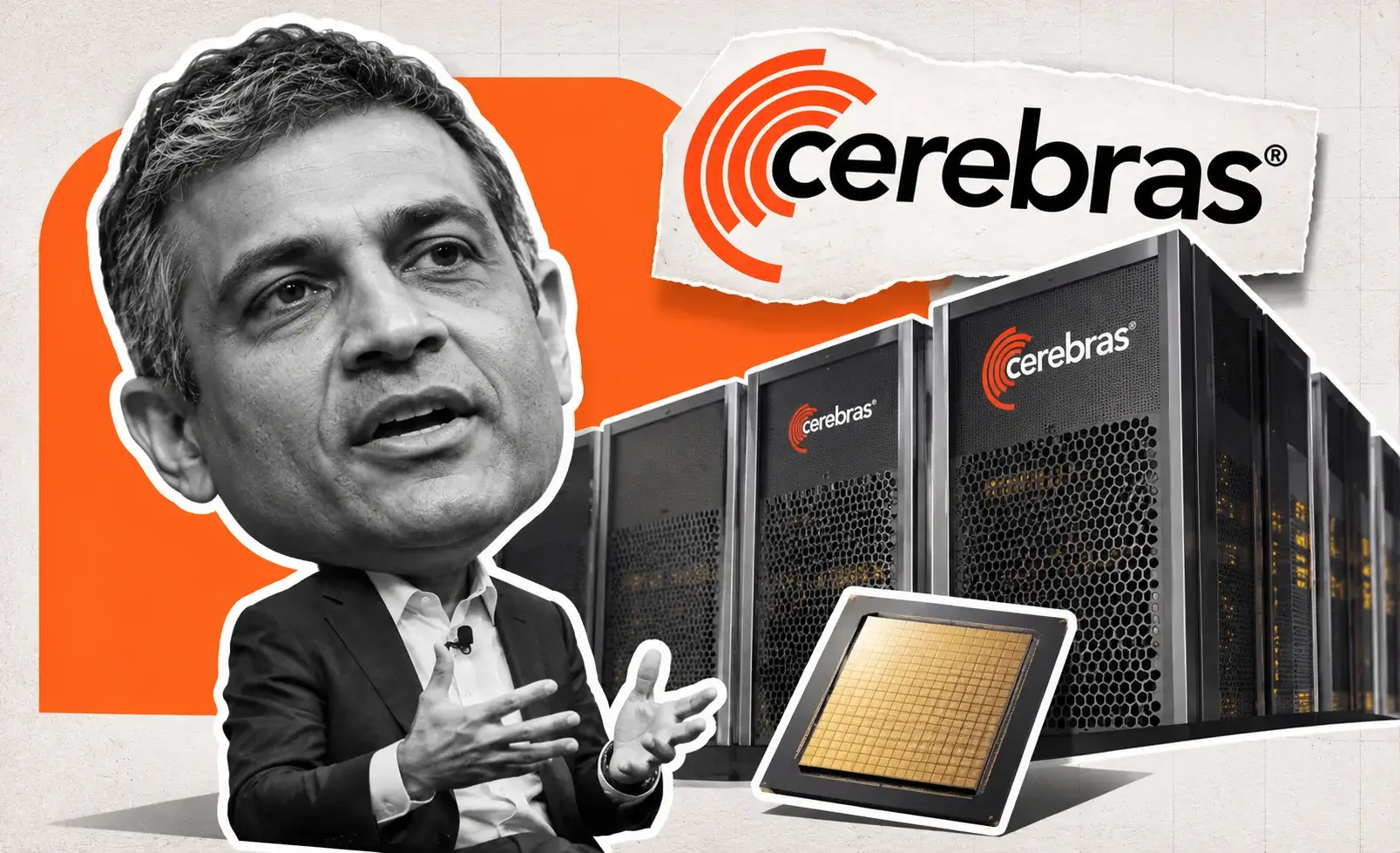
Cerebras Stock (CBRS) Rises to $103.68 on First Core Profit and Microsoft Deal; $143 Target in Sight
A $310M-$330M Q4 guide and a third hyperscaler hold CBRS above $100; a close over $117.11 opens $143 | That’s TradingNEWS
Key Points
- Cerebras core revenue rose 70% to $230.9M, beating the $214.7M consensus and its own guidance for a third quarter.
- Q4 core revenue guidance of $310M-$330M tops the $271M consensus by 18% at the midpoint.
- CBRS faded from a $117.11 high to $103.68 as AMD fell 9.72% and Broadcom 6.77% in the chip rout.
Cerebras Systems (NASDAQ: CBRS) traded at $103.68 on Friday, up $5.93 or 6.07% from Thursday’s close of $97.75, after a session that opened with a post-earnings surge and then gave back most of it as the semiconductor sector sold off. The stock printed $115.51 in after-hours trading Thursday, up 18.17%, and reached $116.70 in Friday’s premarket, a 19.39% gain. It opened the regular session at $108.70, traded at $113 by 9:38 a.m. ET, up 16%, and touched an intraday high of $117.11 before the chip-sector reversal dragged it back toward $104.
The rally erased three weeks of damage in a few hours, then handed most of it back. At the $117.11 high, the stock was 50% above its November 5 all-time low of $77.84. At $103.68 it sits 33% above that low. The fade from $117.11 to $103.68 cost $13.43 per share, or 11.5%, inside a single session.
Thursday set the base for the move. CBRS fell 3.29%, or $3.33, to close at $97.75 from a prior close of $101.08, trading between $93.87 and $104.05 on volume of 14.99 million shares against an average of 9.09 million. The stock had slipped 0.35% to $100.73 earlier in the session before the report. At Thursday’s close, Cerebras carried a market value of $23.22 billion on 237.56 million shares outstanding, with a public float of 98.91 million shares.
The long view frames how far the stock has fallen. Cerebras listed on Nasdaq in May at an IPO price of $185 and hit an all-time high of $386.34 on May 14. Thursday’s $97.75 close was 47.2% below the IPO price and 74.7% below the peak. Over the past month, the stock lost 31.74%, though it gained 11.07% over the past week as it bounced off the November 5 low. Beta of 5.68 makes CBRS one of the most volatile large-cap names in the semiconductor group.
At $103.68, the market value stands at $24.63 billion. The rally added $1.41 billion in market capitalization by late morning, down from the $4 billion gain the stock held at the opening high.
The setup heading into the weekend is a collision between two forces. On one side sits the best quarter in the company’s short public history: a third-straight beat on its own guidance, its first positive adjusted net income, a fourth-quarter revenue guide that cleared consensus by $49 million at the midpoint, a Microsoft cloud deal, and a reiterated plan to triple revenue in 2027. On the other sits a semiconductor sector in liquidation after Nvidia’s chief executive resigned, a 10-year Treasury yield at 5.16%, and a stock that still carries heavy execution risk tied to its OpenAI contract.
Q3 Results: Core Revenue of $230.9 Million and the First Core Profit
Cerebras delivered its third consecutive quarter above guidance, and the margin of the beat widened.
Core revenue reached a record $230.9 million in the third quarter, up 70% from $135.7 million a year earlier and up 10% sequentially. That cleared the company’s own guidance range of $214 million to $216 million by $16 million at the midpoint, or 7%, and topped the $214.7 million consensus by the same amount. GAAP revenue rose 55% to a record $210.8 million.
The $20.1 million gap between core and GAAP revenue comes from accounting for customer warrants. GAAP books $36.4 million of customer-warrant amortization as a reduction of revenue, partly offset by $16.4 million of data-center pass-through revenue that management excludes from core results. Those warrants are tied primarily to OpenAI, which holds warrants to purchase 33.4 million Cerebras shares subject to its purchases of compute capacity.
Profitability crossed a line. Core net income reached $29.82 million, compared with a loss of $10.86 million a year earlier and an expected loss of $38.4 million. That marks the first positive adjusted net income for Cerebras as a public company. Adjusted earnings came in at $0.12 per share against an expected loss of $0.14. On a GAAP basis, the net loss widened to $161.2 million, or $0.67 per share, from $22.2 million, or $0.41 per share, a year earlier, driven by stock-based compensation and warrant accounting.
Core gross margin reached 41.0%, 200 basis points above the guidance midpoint and up 40 basis points sequentially. Management had guided the third quarter as the trough for margins, after core gross margin fell from 46.5% in the first quarter to 40.6% in the second because rented-back systems cost more to operate. The third quarter confirmed the trough and held above it.
The mix inside that margin matters. Hardware core gross margin fell to 31.0% from 38.8% on the final shipments at legacy pricing. Cloud margins carried the quarter, which shows that the higher-value inference business is improving while the hardware line resets.
Operating costs rose. Core operating expenses increased 7% sequentially to $127.7 million, with research and development at $96.8 million. Core operating loss held flat at $33.1 million, a negative 14.3% margin, a sharp improvement from the negative 25% to negative 23% guidance range and from negative 16% in the second quarter.
The quarter answered the question the market was asking after the August report. In the second quarter, Cerebras beat on core revenue but reported a GAAP loss of $2.98 per share against a $0.18 estimate, and the stock fell 15.7% after hours. This time the company beat on every core metric and delivered positive adjusted net income ahead of schedule.
Cloud Revenue Up 272%: The Inference Engine Takes Over
The single most important number in the report is cloud revenue, and it confirms that Cerebras has become a cloud company with a hardware business rather than the reverse.
Core cloud and other services revenue rose 272% year over year to $144.9 million. GAAP cloud revenue grew 265%. Cloud now accounts for 63% of core revenue, up from a minority share a year ago. Core hardware revenue fell to $86.0 million from $96.8 million a year earlier, though it rose 5% sequentially.
That mix shift explains why the margin story is improving. Inference, the process of running trained AI models to generate responses and perform tasks, has become the company’s primary growth driver. Cerebras sells speed: its wafer-scale processors run large language models faster than GPU-based systems, and that speed commands premium pricing for latency-sensitive applications like coding assistants and agentic workflows.
The customer base is broadening. Cerebras signed cloud capacity agreements with AI coding companies including Cognition and Lovable earlier this year, and its inference platform serves customers including Block, Figma, AlphaSense and GSK. It has also opened a security segment with CrowdStrike, which uses Cerebras inference for inline security scanning of enterprise traffic. Management said its pipeline for high-speed AI inference increased by more than 10 times in the quarter.
The company delivered what it described as the first production-scale heterogeneous disaggregated inference offering, a configuration that splits the work of running AI models across different types of hardware. That product broadens the addressable market beyond customers who want Cerebras systems alone.
Capacity is the constraint. Cerebras now has 700 megawatts of data center capacity under contract. Chief Financial Officer Bob Komin said fourth-quarter cloud revenue will be flat sequentially because new capacity arrives too late to materially affect the period. Demand is outrunning the company’s ability to deliver compute, which makes data center construction the gating factor for growth.
That gating factor is also why the company is shifting from rented capacity to owned capacity. Rented-back systems compressed margins in the second and third quarters. As Cerebras-owned systems come online, management expects margins to rise toward a long-term target of 60% or higher. The fourth-quarter margin guide of 47% to 49% is the first evidence of that transition.
The cloud model also changes how investors should value the company. Cloud revenue is recurring and contracted, while hardware revenue is lumpy and depends on purchase cycles. A business that is 63% cloud, growing at 272%, with a backlog measured in tens of billions of dollars, deserves a different multiple than a pure chip vendor. The challenge is proving that the backlog converts to revenue on schedule.
Guidance Raised: Q4 at $310 Million to $330 Million and FY26 at $950 Million
The guidance raise was larger than the beat, and that is what drove the after-hours surge.
Cerebras guided fourth-quarter core revenue to $310 million to $330 million, against a $271 million consensus. At the $320 million midpoint, that is $49 million above expectations, an 18% beat. Sequentially, the guide implies 39% growth from the third quarter’s $230.9 million. Core gross margin is guided to 47% to 49%, against a 42.1% consensus and up from 41% in the third quarter. Core operating margin is guided to negative 1% to positive 1%, effectively breakeven.
The full-year raise is equally sharp. Cerebras lifted 2026 core revenue guidance to $940 million to $960 million from $880 million to $890 million, against an $887.04 million consensus. That marks the second raise of the year: in May the company guided $855 million to $865 million, and in August it raised the range to $880 million to $890 million. The new $950 million midpoint sits 7% above the August midpoint and 10% above the May midpoint.
Full-year core gross margin guidance rose to 42% to 44% from 41% to 43%. Full-year core operating margin guidance improved to negative 10% to negative 8% from negative 19% to negative 17%, a nine-point improvement in a single quarter.
The fourth-quarter guide carries a mix shift. With cloud revenue flat sequentially due to capacity timing, the $79 million to $99 million sequential revenue increase comes from hardware. That means hardware shipments at current pricing, rather than the legacy-priced shipments that weighed on the third quarter, will drive the fourth quarter. Hardware at current pricing carries higher margins, which explains the jump in the gross margin guide.
The 2027 target is the headline. Chief Executive Andrew Feldman said the company expects revenue to triple in 2027 as next-generation hardware enters production and international facilities come online. Tripling the 2026 midpoint implies $2.85 billion in 2027 revenue, slightly below the $2.92 billion consensus. Management expects core gross margin to progress toward its 60% long-term target in 2027 and expects significant progress toward its 40% long-term operating margin target during the year.
That small gap between management’s implied number and consensus is one reason the stock faded. A $2.85 billion target against $2.92 billion consensus gives no upside surprise for 2027. The quarter beat and the fourth-quarter guide were strong, but the long-term framework simply confirmed what the market already modeled.
The guidance pattern supports credibility. Cerebras has beaten its own guidance for three straight quarters and raised its full-year outlook twice. A management team that guides conservatively and then beats earns a premium over time. The fourth-quarter guide sets a high bar, and delivering it would mark the company’s fourth consecutive beat.
Microsoft Becomes the Third Hyperscaler
The Microsoft announcement addressed the biggest structural concern hanging over Cerebras: customer concentration.
Feldman said Cerebras signed an important cloud deal with Microsoft, which along with previously announced agreements with Amazon Web Services and Oracle brings the company to three hyperscalers using its platform as part of their inference strategy. That makes three hyperscaler wins in the past six months. Feldman said Microsoft signed in October and that revenue begins to show up in the first quarter of 2027. Cerebras expects to disclose more details on the agreement in the first half of 2027.
The concentration problem has been the stock’s defining risk. In 2025, Mohamed bin Zayed University of Artificial Intelligence accounted for 62% of revenue and G42 for 24%. In 2026, the OpenAI agreement became the dominant contract, with more than half of the company’s remaining performance obligations tied to it. A single customer delay can reshape the entire revenue trajectory.
Three hyperscalers change that math. AWS, Oracle and Microsoft each operate global cloud platforms with the scale to resell Cerebras inference to thousands of enterprise customers. The AWS partnership will make Cerebras’ disaggregated inference offering generally available through Amazon Bedrock in the first quarter of 2027. Each hyperscaler deal diversifies revenue away from OpenAI and creates a distribution channel that Cerebras could not build alone.
The deal also validates the technology. Microsoft is one of OpenAI’s largest backers and runs Nvidia hardware at enormous scale. Its decision to add Cerebras inference to its platform signals that wafer-scale processors offer something GPU clusters do not, at least for latency-sensitive workloads. Feldman told analysts that competitors are struggling to keep up with customer demand and dealing with growing order backlogs.
The timing matters for the stock. The Microsoft deal lands in the same week Nvidia’s chief executive resigned. Investors debating whether the leadership crisis at the dominant AI chipmaker creates openings for alternatives now have a concrete example of a hyperscaler diversifying its inference stack.
The limits are clear. Cerebras disclosed no financial terms for the Microsoft deal, and analysts on the call could not get deal metrics. Revenue begins only in the first quarter of 2027, so it contributes nothing to the 2026 numbers. Investors are being asked to value a contract they cannot size.
For the forecast, the Microsoft deal shifts the risk profile more than the near-term numbers. It reduces dependence on OpenAI, broadens the customer base and supports the 2027 tripling target. The first quarterly revenue contribution in early 2027 will be the first test of how large the deal is.
OpenAI: The $20 Billion Contract and Its Delays
OpenAI remains the largest single variable in the Cerebras story, and the earnings call revealed both its scale and its friction.
Cerebras’ multi-year agreement with OpenAI is valued at $20 billion and includes a 750-megawatt capacity commitment. More than half of the company’s remaining performance obligations belong to OpenAI. Those obligations totaled $26.1 billion at the end of the third quarter, up from $25.4 billion in the second quarter.
The contract has run into physical constraints. Feldman said delivery delays under the OpenAI agreement stemmed from industry-wide shortages of land and electricity for data centers rather than from chip manufacturing. Construction delays related to land, power and building shells pushed initial capacity deliveries for OpenAI behind schedule. Management factored potential delay credits into its remaining performance obligations and projected a return to the OpenAI delivery schedule in the second half of 2027.
That timeline shift drew caution from analysts. One major brokerage had expected the first tranche of OpenAI capacity to be fully online by the beginning of next year. The call indicated that most of the new capacity will come online from mid-2027 instead. Feldman also said Cerebras is evaluating financing options to meet ramping demand, which raises the prospect of capital raises.
The delays mirror problems across the AI infrastructure sector. Nebius fell 17.72% on Thursday after delays at third-party data center sites pushed capacity into 2027 and forced the company to trim its 2026 revenue guidance. CoreWeave has also cited delays in data center electrical infrastructure. Land and power, not chips, have become the binding constraint on AI deployment.
The delay credits deserve attention. If Cerebras owes OpenAI credits for late delivery, some of the $26.1 billion in obligations will convert to revenue at lower effective prices. Management has accounted for that in its numbers, but the exact size of the credits is not disclosed.
The upside case for OpenAI is the take-or-pay structure. Cerebras’ contract obligates OpenAI to pay for committed capacity, which protects revenue once capacity is delivered. Core cloud and services revenue, which reflects the OpenAI deal, more than tripled in the third quarter, so the contract is already generating material revenue even before the full 750 megawatts come online.
The OpenAI relationship also carries an equity link. OpenAI’s warrants to buy 33.4 million Cerebras shares vest as it purchases compute capacity. That aligns the two companies but also creates dilution as the contract scales.
For the forecast, OpenAI is the swing factor for 2027. Delivery on the second-half 2027 schedule supports the tripling target. Further slippage would push revenue into 2028 and pressure the stock.
The Chip Rout: Why the Gap Faded From $117.11
Cerebras did not trade in isolation on Friday, and the sector backdrop explains why the post-earnings rally faded so sharply.
U.S. semiconductor stocks collapsed during Friday’s session. A gauge of the largest chipmakers fell 4% by mid-morning. Nvidia dropped 4.67% to $158.43 a day after Jensen Huang resigned as chief executive following reports of multiple affairs, including one with a woman U.S. intelligence officials suspect of being a Chinese intelligence asset. Advanced Micro Devices fell 9.72% and Broadcom lost 6.77%, giving back more than their Thursday gains. Applied Materials dropped 6.23% despite a record $10.41 billion quarter. The Nasdaq Composite fell 1.85% and the S&P 500 lost 1.09%.
The rate backdrop compounded the selling. The 10-year Treasury yield rose to 5.16%, its highest since October, and markets priced a December Federal Reserve hike as fully certain. High-beta, long-duration growth stocks take the biggest hit when yields rise, and Cerebras, with a beta of 5.68 and most of its value tied to 2027 and beyond, sits at the far long-duration end of public equities.
That combination turned Cerebras’ gap into a fade. The stock opened at $108.70 and pushed to $117.11 on the strength of its own results, then fell back as fund managers cut semiconductor exposure across the board. At $103.68, the stock held a gain of 6.07%, outperforming every major chip name by a wide margin. Cerebras was one of the few AI-linked stocks trading higher, alongside Modine Manufacturing, which jumped on Samsung acquisition talks.
The relative strength is the signal. On a day when AMD fell 9.72% and Broadcom 6.77%, a 6% gain for Cerebras reflects genuine company-specific buying. The earnings beat and Microsoft deal created demand that held up even as the sector broke down.
The Nvidia crisis cuts both ways for Cerebras. The leadership vacuum at the dominant AI chipmaker raises questions over the entire AI trade, which hurts high-beta names. It also raises the strategic value of alternatives. Customers wary of depending on a single supplier have more reason to diversify, and the Microsoft deal shows that diversification is already happening.
Nvidia reports its third quarter next Tuesday, November 17, with interim chief executive Colette Kress leading the call. That report is the next major catalyst for the entire AI chip group. A clean Nvidia quarter would ease sector pressure and give Cerebras room to retest $117. A weak report would extend the selling.
For the forecast, the sector tape caps Cerebras’ upside in the near term. The company’s fundamentals improved sharply this week, but the stock cannot rally independently while the semiconductor group is in liquidation.
Read More
-
Yen Stalls at 160 Despite a 3% JGB and Tokyo Core CPI at 2.0% — Intervention Sits at 164, Friday's Payrolls Decide
02.09.2026 · TradingNEWS ArchiveEnergy
-
S&P 500 Slides to 7,510, Nasdaq Sheds 468 Points, Dow Holds 52,156 as Chip Rout Delays 7,845 Record Retest
13.11.2026 · TradingNEWS ArchiveStocks
-
Ethereum (ETH-USD) Holds $1,933 After $2,000 Break as Staking Hits Record; $2,270 Target in Play
13.11.2026 · TradingNEWS ArchiveCrypto
-
Gold (XAU/USD) Holds $3,883 Above Yearly Low as Central Banks Buy; $4,150 Target in Sight
13.11.2026 · TradingNEWS ArchiveCommodities
-
EUR/USD Holds 1.1051 at 19-Month Low as Fed Outpaces ECB; 1.1260 Upside Target in Play
13.11.2026 · TradingNEWS ArchiveForex
Valuation: 8.6 Times 2027 Revenue After a 73% Drawdown
The drawdown has reset the valuation to levels that look reasonable against the growth rate, but only if management delivers.
At $103.68, Cerebras carries a market value of $24.63 billion. Against the 2026 core revenue guidance midpoint of $950 million, the stock trades at 25.9 times sales. Against management’s implied 2027 revenue of $2.85 billion, it trades at 8.6 times forward sales. The company held more than $8.6 billion in cash, restricted cash and marketable securities at the end of the second quarter, plus an unused revolving credit facility of up to $850 million, which lowers the enterprise value multiple further. One independent model put the stock at 7.3 times 2027 enterprise value to core revenue at Thursday’s after-hours price.
The comparison to the IPO frames the reset. Cerebras listed in May at $185 per share and peaked at $386.34 within days. At the peak, the company carried a market value above $90 billion against 2026 revenue guidance below $870 million, a sales multiple above 100. The 73% drawdown from that peak has compressed the multiple by more than three-quarters while revenue guidance has risen 10.5%.
Street targets span from $170 to $325, with the average near $240 before Thursday’s report. Several firms cut targets this week despite the beat, citing multiple compression across the AI sector, while others raised them on the fourth-quarter outlook. Even the lowest target, $170, sits 64% above Friday’s $103.68 price. An independent valuation blending 10 times 2027 enterprise value to core revenue with 25 times 2028 core earnings per share of $6.28 produced a $135 target.
The bull case on valuation rests on margins. If Cerebras reaches its long-term targets of 60% gross margin and 40% operating margin on $2.85 billion of 2027 revenue, the business would generate operating income above $1 billion. At that profitability, 8.6 times sales is not expensive for a company growing revenue 200% annually.
The bear case rests on execution and dilution. Feldman said the company is evaluating financing options, which may mean new equity. OpenAI’s 33.4 million warrants add potential dilution. Insiders sold 1.29 million shares at prices from $161.46 to $250.30 after the listing. Short sellers have made allegations against the company, and data center delays have already pushed revenue into later periods.
The relative strength index stood at 37.11 before Friday’s session, near oversold territory. Friday’s rally moved the stock off its lows without pushing momentum into overbought conditions, leaving room for further gains if the sector stabilizes.
For the forecast, valuation supports the upside case if execution holds. At 8.6 times 2027 sales with margins expanding, the stock has room to rerate toward its month-ago levels as the company proves the 2027 plan.
Technical Picture: $97.75 Gap Support, $117.11 High and $143 Target
The chart has shifted from a collapse into a potential base, with Friday’s gap defining the levels.
Cerebras set its all-time low of $77.84 on November 5, during the post-midterm rout that sent the Nasdaq down 5.5% in a day. Since then the stock has rallied 11.07% over a week, closing at $89.68 on November 6 after a 9.75% gain and climbing above $100 before the earnings report. Friday’s session added a gap from $97.75 to an open at $108.70.
The support ladder is defined by that gap. The first level is $100, the round number the stock held through Thursday’s session before the report. The second is Thursday’s close at $97.75, the bottom of Friday’s gap. The third is Thursday’s intraday low at $93.87. The fourth is the November 6 close at $89.68. The all-time low at $77.84 is the final floor. A fill of Friday’s gap back to $97.75 would erase the earnings reaction and signal that sector selling has overwhelmed company-specific buying.
Resistance stacks up above. The first level is Friday’s open at $108.70. The second is $113, where the stock traded in the first minutes of the session. The third is the intraday high at $117.11, which aligns with the after-hours peak at $115.51 and the premarket high at $116.70. A close above $117.11 would confirm that buyers have absorbed the sector pressure.
The upside target sits at $143. That level marks where the stock traded one month ago, before the 31.74% monthly decline, and represents the top of the October breakdown zone. Reclaiming $143 would recover the entire October drawdown and put the stock back on a path toward the $170 bottom of the Street’s target range. A move from $103.68 to $143 is a gain of $39.32, or 37.9%.
Volatility defines the setup. With a beta of 5.68, Cerebras moves several times faster than the broader market. Friday’s 11.5% intraday range from $117.11 to $103.68 shows how quickly the stock can swing. That volatility cuts both ways: a recovery in the semiconductor group could push the stock through $117.11 quickly, while further sector selling could fill the gap to $97.75 just as fast.
Momentum is constructive. The relative strength index at 37.11 before Friday’s session left room to run. The stock has posted a higher low since November 5 and a higher high on Friday, the first signs of a reversal in trend.
The technical verdict: constructive above $100, neutral between $97.75 and $100, bearish below $97.75, with $117.11 as near-term resistance and $143 as the upside target.
Competition: Nvidia, AMD and the AI Cloud Peers
Cerebras competes on a different axis than the GPU makers, and that difference shapes its opportunity.
Nvidia dominates AI training and inference with its GPU platform and software ecosystem. Its scale is unmatched, but its leadership crisis has introduced uncertainty. Nvidia stock fell 4.67% to $158.43 on Friday and trades at 12 to 13 times forward earnings, its lowest multiple since 2012. The company reports Tuesday with an interim chief executive. Customers who depend on Nvidia for compute now face both supply constraints and governance questions.
AMD and Broadcom are the closest challengers in the GPU and custom silicon markets. AMD closed up 5.9% and Broadcom up 5.5% on Thursday as traders bet on diversification away from Nvidia, then fell 9.72% and 6.77% respectively on Friday. Both compete for hyperscaler budgets, but neither offers wafer-scale inference.
Cerebras’ advantage is speed. Its Wafer Scale Engine processors are far larger than conventional chips, which lets them run large language models at speeds GPU clusters struggle to match. Feldman called the technology “the undisputed champion of speed.” The trade-off is cost and physical footprint: each node can cost as much as $3 million and draws 25 kilowatts of power. TSMC is currently the only manufacturer capable of producing Cerebras chips, which creates supply-chain concentration.
The AI cloud peers face the same infrastructure constraints. Nebius reported third-quarter revenue of $980.8 million, up 571%, but fell 17.72% on Thursday after delays at third-party data centers pushed capacity into 2027 and capital spending guidance rose to $27 billion for 2026 and $40 billion to $45 billion for 2027. CoreWeave dropped 6.86% on Thursday after a 25% surge the day before. Super Micro Computer fell 11.30%. The entire group is wrestling with land, power and financing.
Cerebras sits between those categories. Like Nvidia and AMD, it designs chips. Like Nebius and CoreWeave, it operates a cloud. That hybrid model gives it two revenue streams but also exposes it to both chip-sector sentiment and cloud-sector capital intensity.
The sector ETFs capture the mood. Semiconductor funds that hold Nvidia, AMD and Broadcom took heavy losses Friday, and AI infrastructure names tied to data center buildouts have fallen sharply since October. Cerebras’ 6% gain on Friday against that backdrop shows its story is starting to separate from the group.
The competitive verdict favors Cerebras in a narrow but growing niche. Fast inference for latency-sensitive applications is a market where speed commands a premium, and three hyperscalers have now validated it. The risk is that Nvidia and AMD close the speed gap with next-generation GPUs before Cerebras scales its manufacturing and data center footprint.
Bull Case: The Path to $143
The upside case rests on five drivers, and the third quarter strengthened each of them.
The first is execution. Cerebras has beaten its own guidance for three straight quarters, raised full-year revenue guidance twice, and delivered its first positive adjusted net income ahead of schedule. The fourth-quarter guide of $310 million to $330 million cleared consensus by 18% at the midpoint. A management team that consistently under-promises and over-delivers earns a valuation premium as the track record lengthens.
The second is margin expansion. Core gross margin troughed at 41% in the third quarter and is guided to 47% to 49% in the fourth. The long-term target is 60% or higher, with an operating margin target of 40%. Full-year operating margin guidance improved by nine points in a single quarter. As owned capacity replaces rented systems and hardware ships at current pricing, margins have a clear path higher.
The third is customer diversification. Microsoft joins AWS and Oracle as Cerebras’ third hyperscaler customer in six months. Each deal reduces dependence on OpenAI and creates a distribution channel. AWS Bedrock availability in the first quarter of 2027 and Microsoft revenue starting in the same quarter set up a step-change in reach.
The fourth is backlog. Remaining performance obligations of $26.1 billion are more than 27 times the 2026 revenue guidance midpoint. Even with delay credits and OpenAI concentration, that backlog provides years of revenue visibility.
The fifth is valuation. At 8.6 times 2027 revenue after a 73% drawdown from the peak, the stock prices in significant execution risk. Every Street target sits at least 64% above the current price.
The price path is defined. The first target is the intraday high at $117.11, where a close above would confirm that buyers have absorbed the sector pressure. The second is $123, the halfway mark between Friday’s price and the month-ago level. The primary upside target is $143, where the stock traded one month ago. A move from $103.68 to $143 is a gain of 37.9%.
The catalysts are clear. Nvidia’s report on Tuesday could stabilize the chip sector. The fourth-quarter report in February will test the $310 million to $330 million guide and the 47% to 49% margin target. Microsoft deal details in the first half of 2027 could size the contract. Each of those events could drive a rerating.
Beyond $143, the bottom of the Street’s target range at $170 and the May IPO price of $185 represent longer-term objectives. Reaching those levels requires the 2027 tripling plan to stay on schedule and the OpenAI delivery timeline to hold in the second half of the year.
Bear Case: The Gap Fills and $77.84 Is Retested
The downside case is specific, and it centers on execution risk and sector pressure.
The first risk is the OpenAI timeline. More than half of the $26.1 billion backlog is tied to OpenAI, and delivery has already slipped to the second half of 2027 because of land and power shortages. Delay credits reduce the effective value of the contract. Further slippage would push the 2027 tripling target out and undercut the growth story.
The second risk is financing. Feldman said Cerebras is evaluating financing options to meet ramping demand. Building 700 megawatts of data center capacity requires enormous capital. An equity raise at depressed prices would dilute existing shareholders, and debt financing at a 5.16% risk-free rate is expensive. OpenAI’s 33.4 million warrants add further dilution as the contract scales.
The third risk is the sector. Semiconductor stocks are in liquidation after Nvidia’s leadership crisis, and the 10-year yield at 5.16% compresses valuations on long-duration growth stocks. With a beta of 5.68, Cerebras amplifies every move in the group. A weak Nvidia report on Tuesday could drag the stock back below $97.75 regardless of its own fundamentals.
The fourth risk is the 2027 target. Management’s implied $2.85 billion falls slightly below the $2.92 billion consensus, leaving no room for an upside surprise next year. Fourth-quarter cloud revenue will be flat sequentially because of capacity timing, and most new capacity does not come online until mid-2027.
The fifth risk is supply. TSMC is the only manufacturer able to produce Cerebras’ wafer-scale chips, and short sellers have made allegations against the company. Insider selling since the listing, at prices from $161.46 to $250.30, adds pressure on sentiment.
The price path is clear. A close below $100 signals the earnings rally is failing. A fill of the gap to $97.75 erases the reaction entirely. Below that, Thursday’s low at $93.87 and the November 6 close at $89.68 are the next supports. The all-time low at $77.84 is the final floor, a decline of 24.9% from current levels.
The bear case would accelerate if Nvidia disappoints on Tuesday, if Cerebras announces a large equity raise, or if the OpenAI timeline slips further.
Verdict: Constructive Above $100, Upside Target $143 on Execution
Cerebras enters the weekend at $103.68, up 6.07% on the day after an intraday high of $117.11, with a market value of $24.63 billion. The third quarter delivered a third straight beat on the company’s own guidance, the first positive adjusted net income as a public company, core revenue of $230.9 million up 70%, cloud revenue of $144.9 million up 272%, a fourth-quarter guide of $310 million to $330 million that cleared consensus by 18%, and a full-year raise to $940 million to $960 million.
The Microsoft deal brings the company to three hyperscalers in six months and addresses the customer concentration risk that has defined the stock since its May IPO. Core gross margin troughed at 41% and is guided to 47% to 49% in the fourth quarter, with a long-term target of 60% or higher. Management reiterated its plan to triple revenue in 2027.
The fade from $117.11 reflects the sector rather than the company. Nvidia fell 4.67%, AMD 9.72% and Broadcom 6.77% on Friday as the chip group liquidated after Jensen Huang’s resignation and the 10-year yield climbed to 5.16%. Cerebras’ 6% gain on that tape is a sign of genuine company-specific demand.
The risks are real. More than half of the $26.1 billion backlog is tied to OpenAI, whose delivery schedule has slipped to the second half of 2027. Financing needs may bring dilution. The 2027 target implies $2.85 billion against $2.92 billion consensus. Beta of 5.68 means the stock will move with the sector regardless of its own results.
The levels are defined. On the downside, $100 is the line, $97.75 fills the gap, and $77.84 is the all-time low. On the upside, $117.11 is the first resistance, $123 the halfway mark to the month-ago level, and $143 the upside target, a 37.9% gain from current levels.
The verdict for investors: the fundamentals turned decisively better this week, and the valuation at 8.6 times 2027 sales after a 73% drawdown prices in heavy execution risk. Cerebras is constructive above $100, neutral between $97.75 and $100, and targets $143 as the company proves the 2027 plan and the semiconductor sector stabilizes. Nvidia’s report on Tuesday is the next test, and a close above $117.11 would confirm the path toward $143.