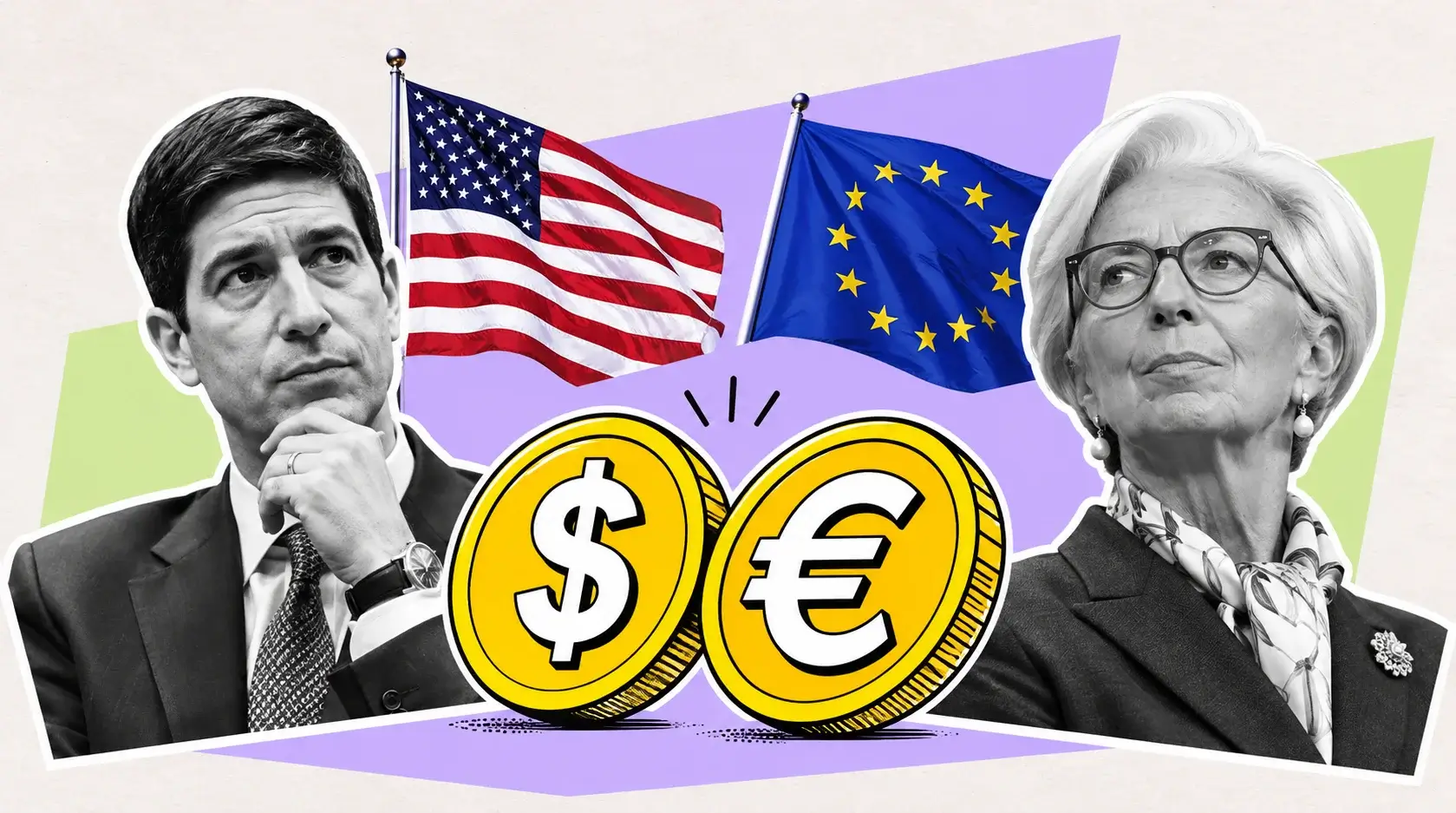
EUR/USD (1.1204) Bounces on Oil Collapse While Fed Hike Odds Hold at 80% — 1.1105 Floor and 1.1273 Ceiling
The euro recovers most of Friday’s payrolls drop as crude slides, but the ECB’s 2.50% deposit rate trails the Fed’s 4.00% upper bound | That's TradingNEWS
Key Points
- EUR/USD rises 61 pips to 1.1204 after a 1.1138 Asian low, testing the 1.1200 level.
- The Fed’s 4.00% upper bound sits 150 basis points above the ECB’s 2.50% deposit rate.
- A daily close above 1.1273 targets 1.1350, while a break of 1.1105 opens 1.1000.
EUR/USD traded at 1.1204 at 4:12 p.m. London time on Monday, November 9, up 61 pips, or 0.55%, from Friday’s 1.1143 close. The pair opened the week at 1.1141, dipped to 1.1138 in Asian trading and then climbed steadily through the European and New York sessions to a high of 1.1206, just above the 1.1200 level. The move recovered nearly all of Friday’s 0.67% drop, when a 165,000-job U.S. payrolls report sent the euro down to 1.1131.
The trigger came from the energy market. Brent crude fell 4.18% to $94.21, after touching $92.96 early, as the White House said renewed strikes on Iran were “highly unlikely” if talks progress. For the euro area, which imports the bulk of its energy, every dollar off a barrel of crude improves the trade balance, eases pressure on household budgets and lowers the inflation rate that has pushed the European Central Bank into two hikes this year. The dollar index slipped 0.36% to 101.93 in the same session.
The thesis of this forecast is that Monday’s rally is a terms-of-trade bounce, not a trend change. Falling crude is the single biggest positive for the euro right now. But the monetary math still favors the dollar. The Federal Reserve’s target range sits at 3.75% to 4.00% after its September hike, against an ECB deposit rate of 2.50%. That 150-basis-point gap at the top of the range is wide, and futures price close to an 80% chance that the Fed hikes again in December. The ECB discussed a hike in October and chose to hold. Until that rate gap narrows, euro rallies will run into selling.
The broader range frames the stakes. EUR/USD’s 52-week band runs from 1.1110 to 1.2024. At 1.1204, the pair sits 6.8% below its high and just 94 pips above its low. The 2026 average through October was 1.1568, so the euro is trading 3.1% below its average for the year. Over the past 90 days, the pair has traded between 1.1127 and 1.1688, with an average of 1.1408.
The October 29 low at 1.1105 was the weakest level since May 2025, set on the day the ECB held rates and Christine Lagarde announced her early departure. Monday’s 1.1204 recovers 99 pips from that low. The pair hit 1.1273 on November 4, the day after the U.S. midterms, but failed to hold above 1.1250, a level that has capped rallies since early October.
The decision band for the week is clear: 1.1105 below and 1.1273 above, a 168-pip range. Tuesday’s U.S. CPI release decides which side breaks first.
Session Structure: From 1.1138 in Asia to 1.1206 in New York
Monday’s session built from the bottom up across three time zones, and the timing of each leg tells the story.
The Asian open was flat. EUR/USD opened at 1.1141, two pips below Friday’s close, as the market digested the strong payrolls data over the weekend. The pair dipped to its session low of 1.1138 in early Asian trade, holding three pips below the open and seven pips above Friday’s 1.1131 low. That held the shaded support zone around 1.1131, the area where Friday’s selloff stopped.
The European morning brought the first push. As Brent slid through the London open, EUR/USD climbed through the 1.1163 pivot level and reached 1.1179 by mid-morning. By 11:01 a.m. UTC, the mid-market rate stood at 1.1192, up 54 pips on the day. The euro area’s own data offered little help: there were no major eurozone releases on Monday, so the move belonged entirely to oil and the dollar.
The New York session added the final leg. U.S. equities opened sharply higher, with the S&P 500 rising 1.91% to 7,517.64 and the Nasdaq up 2.35%, and the risk-on tone weighed further on the dollar. EUR/USD pushed to its session high of 1.1206 and traded at 1.1204 at 4:12 p.m. London time, holding near the top of the day’s 68-pip range.
The intraday pattern is constructive but not decisive. The euro rallied in a straight line through Europe and New York without a meaningful pullback, which signals real demand, not short covering alone. But the high at 1.1206 is barely above the 1.1200 round number, and the pair has not challenged the 1.1250 resistance that capped every October rally. A rally that stops at the first resistance level is a test, not a breakout.
Cross-currency moves confirm the dollar-driven nature of the session. GBP/USD rose 0.43% to 1.3413. AUD/USD gained 0.62% to 0.6910. USD/JPY slipped 0.24% to 158.04. EUR/GBP edged up 0.06% to 0.8352, which shows the euro and the pound moved almost in lockstep against the dollar. When every major currency gains by a similar amount against the dollar, the story is the dollar, not the euro.
For the forecast, the session structure points to one conclusion. The euro is being lifted by falling crude and a softer dollar, not by eurozone fundamentals. That makes the rally vulnerable to any reversal in oil or a hawkish U.S. inflation print.
The Range: 1.1105 Below, 1.2024 Above, 1.1568 Average
The bigger picture shows how much ground the euro has lost in 2026. EUR/USD traded as high as 1.2024 within the past 52 weeks, a level reached when the dollar was under pressure early in the year. The pair has given back 820 pips since then, a 6.8% decline. The euro averaged 1.1568 through October 2026, so the current rate sits 364 pips below the year’s average.
The decline accelerated in the autumn. Over the past 90 days, EUR/USD traded between 1.1688 and 1.1127, a 561-pip range. The pair broke below 1.1250 in early October and has failed to close above it on a sustained basis since. The 100-day moving average has been falling since September, a clear sign of a medium-term downtrend. The 200-day exponential moving average sits at 1.1467, 263 pips above the current rate.
The October 29 low at 1.1105 marks the most important level on the chart. That session saw the ECB hold rates while acknowledging a hike was discussed, and Lagarde announce she would step down after the February 2027 meeting, ahead of her October 2027 term end. EUR/USD fell 0.4% to its weakest level since May 2025, then recovered to 1.116 when Lagarde signaled a December hike remained possible. The 17-month low remains the floor the market will test if the dollar rally resumes.
The November moves show the range narrowing. The pair rose from 1.1160 on October 30 to 1.1273 on November 4, a 113-pip rally driven by the post-midterm dollar weakness. It then fell back to 1.1131 on November 6 after the payrolls report, a 142-pip decline. Monday’s bounce to 1.1204 recovers 73 pips of that loss. The pattern is a market trading a 1.1105-1.1273 box with no clear trend inside it.
Those levels define the week’s forecast. A close below 1.1105 would put the pair at its lowest level since early 2025 and open the 1.1000 level, 204 pips below current levels. A close above 1.1273 would break the November high and target 1.1350, the next resistance level, 146 pips above the current rate. The 200-day EMA at 1.1467 is the level that would confirm a trend reversal.
The positioning point matters too. With the pair 6.8% off its high and near its 52-week low, much of the bearish case is already priced. Further downside needs a new catalyst: a hot U.S. CPI, a December Fed hike or an escalation in the French bond market.
Fed Versus ECB: The 150-Basis-Point Gap
The single biggest weight on the euro is monetary policy, and the gap between the two central banks is wide.
The Federal Reserve raised its federal funds target range by 25 basis points to 3.75%-4.00% on September 16, 2026, its first hike since July 2023. The vote was unanimous at 12-0. Policymakers lifted their 2026 inflation forecasts, and the median official expects the funds rate to end the year at 4.1%, which implies at least one more quarter-point increase. The Fed held in late October, and futures now price between 76.5% and 80% odds of a December hike at the December 8-9 meeting.
The ECB has moved in the same direction but from a lower base. The bank raised rates twice earlier in 2026 and held on October 29, leaving the deposit rate at 2.50%, the main refinancing rate at 2.65% and the marginal lending rate at 2.90%. Policymakers discussed a hike but unanimously agreed to hold. Lagarde said that unless significant developments change the assessment, “the direction of travel is clear,” while declining to commit to a specific path.
The rate gap is the core issue. The Fed’s upper bound of 4.00% sits 150 basis points above the ECB’s 2.50% deposit rate. Using the midpoint of the Fed range, 3.875%, the gap is 137.5 basis points. A December Fed hike without a matching ECB move would widen the gap to 175 basis points at the upper bound. Money tends to flow toward the currency that offers higher returns on short-term deposits, and the dollar offers significantly more.
Read More
-
Yen Stalls at 160 Despite a 3% JGB and Tokyo Core CPI at 2.0% — Intervention Sits at 164, Friday's Payrolls Decide
02.09.2026 · TradingNEWS ArchiveEnergy
-
Oklo Eyes $30 After 38% 2-Day Rally as $3.13B Cash Pile Offsets Aurora’s 2028–2029 Startup Slip
09.11.2026 · TradingNEWS ArchiveStocks
-
XRP Heads for $1 Test After Binance Hacker Dumps 139M Tokens and ETF Inflows Stall for Four Days
09.11.2026 · TradingNEWS ArchiveCrypto
-
Brent ($93) Extends 16% Weekly Collapse as Iran Deal Heads to Trump — Physical Murban at $99 Warns of Snapback
09.11.2026 · TradingNEWS ArchiveCommodities
-
S&P 500 Hits 7,517, Nasdaq Jumps 578 Points, Dow Climbs to 52,139 as NVDA Sheds $175B
09.11.2026 · TradingNEWS ArchiveMarkets
-
Pound Rallies to 1.3423 as Bank of England Matches Fed at 4% and Eyes 4.25% in February
09.11.2026 · TradingNEWS ArchiveForex
The bond market reinforces the point. The 10-year Treasury yield rose 1 basis point to 4.87% on Monday, even as crude fell 4%. The 5-year yield added 2 basis points to 4.67%. U.S. yields are not falling with oil, which keeps the dollar’s yield advantage intact even on a day when the euro rallies.
The policy outlooks diverge in one important way. The Fed is hiking into a strong economy: payrolls rose 165,000 in October and unemployment fell to 4.1%. The ECB is weighing hikes against a fragile growth backdrop, with energy prices driving inflation rather than domestic demand. That makes the Fed’s path more durable and the ECB’s more conditional.
For the forecast, the rate gap acts as a ceiling on EUR/USD. The euro can rally on oil and risk sentiment, but sustained gains above 1.1273 need either a slower Fed or a more aggressive ECB. Neither is priced in this week.
The U.S. Side: 165,000 Jobs and Tuesday’s CPI Test
The dollar’s strength comes from a U.S. economy that keeps beating expectations. The October Employment Situation report from the Bureau of Labor Statistics showed nonfarm payrolls up 165,000, against consensus estimates of 59,000 to 65,000. The unemployment rate fell to 4.1% from 4.2% even as 421,000 people joined the labor force. August and September payrolls were revised up by a combined 84,000. Average hourly earnings rose 0.4% to $38.00, the strongest monthly gain since January.
The report hit EUR/USD directly. The pair fell 0.67% on Friday to 1.1140, with a low of 1.1131, as December Fed hike odds jumped from 67% to as high as 80%. Monday’s rally recovers most of that drop, but the macro case behind it has not changed. A labor market adding 165,000 jobs with wages rising 0.4% a month gives the Fed every reason to keep tightening.
Tuesday’s October consumer price index is now the most important event for the pair this week. Consensus calls for a 0.3% monthly increase. Three outcomes are possible.
A hot reading, with core prices rising more than 0.3%, would push December hike odds toward certainty and raise the probability of further hikes in 2027. The dollar would rally across the board, and EUR/USD would likely retest Friday’s 1.1131 low and the 1.1105 October low. A break below that level would open the 1.1000 handle.
An in-line reading at 0.3% would leave the December hike priced near 80% and keep the pair inside its 1.1105-1.1273 range. The euro could hold above 1.1200 if crude stays below $95.
A soft reading, helped by falling gasoline prices, would cut December hike odds and weaken the dollar. EUR/USD could then retest the 1.1273 November high and attempt a break toward 1.1350.
Producer prices follow on Friday, November 13. The Fed’s December decision lands four weeks later.
The asymmetry favors the dollar. A hot print would confirm a trend the market already believes in, while a soft print would challenge it. Markets tend to react more strongly to data that confirms an existing view. For the euro, the U.S. calendar this week is a source of downside risk more than upside opportunity.
Eurozone Inflation at 4.0%: An Energy Problem, Not a Demand Problem
The euro area’s inflation picture explains why the ECB faces a harder choice than the Fed. Eurostat’s flash estimate for October, released November 4, showed headline inflation at 4.0%, up from 3.8% in September and the highest since September 2023. Prices rose 0.4% on the month. Inflation stands at double the ECB’s 2% target.
The composition is the critical detail. Energy prices surged 20.8% year over year in October, adding about 1.9 percentage points to the headline rate on their own. Core inflation, which excludes energy, food, alcohol and tobacco, held steady at 2.5%, unchanged from September. Services inflation ran at 3.3%, food at 1.6% and non-energy industrial goods at 1.2%. Inflation excluding energy stayed at 2.3%.
The country breakdown shows the energy shock spreading unevenly. Spain’s harmonized inflation reached 4.9% in October, flat from September, with core at 3.1%. Belgium rose to 5.2% from 4.5%. The Netherlands climbed to 3.3% from 3.0%. Germany’s national inflation measure came in at 2.8% for October, with core at 2.1% and energy prices up 12.2% year over year. Inflation in Germany fell 0.2% on the month.
The trajectory over the summer shows how the Iran war fed through. Eurozone inflation stood at 1.9% in February 2026, rose to 2.6% in March, 3.0% in April and 3.2% in May, then eased to 2.8% in June before reaccelerating to 2.9% in July, 3.2% in August, 3.8% in September and 4.0% in October. Energy inflation jumped from 14.3% in August to 18.8% in September and 20.8% in October.
This pattern matters for the euro because it determines how the ECB will respond. A central bank facing a 4.0% headline rate driven by energy, with core stable at 2.5%, has room to wait. Energy shocks tend to fade on their own when oil prices fall, and Monday’s 4% drop in Brent is exactly the relief the ECB needs. That reduces the pressure for a December hike, which limits one of the euro’s potential supports.
The final October inflation figures are due November 18. If crude stays below $95 through November, the November flash estimate on December 1 could show the first decline in headline inflation since July. That would be good news for the eurozone economy but would remove the case for further ECB tightening and keep the rate gap with the Fed wide.
Oil Is the Euro’s Lever
For EUR/USD, crude oil now matters more than almost any eurozone data point. The euro area imports most of its energy, so the price of oil acts directly on the trade balance, corporate margins and household spending. Higher oil prices drain euros out of the region to pay energy exporters; lower prices keep that money at home.
The past five weeks show the relationship clearly. Brent traded above $112 at the start of November and peaked near $110 for WTI on October 19, as the Iran conflict threatened Gulf supply. During that stretch, EUR/USD fell to its October 29 low of 1.1105. Since then, Brent has fallen to $94.21, a decline of 16% in under 10 sessions, while the euro has recovered 99 pips.
Monday’s move followed the same script. Brent dropped 4.18% after the White House said renewed strikes on Iran were “highly unlikely” if negotiations progress. West Texas Intermediate fell 3.56% to $87.60, RBOB gasoline futures fell 3.01% and heating oil fell 1.42%. EUR/USD gained 0.55% over the same hours. Natural gas rose 4.40% to $3.13, but U.S. gas prices have little direct effect on European energy costs.
The diplomatic picture is far from settled. Qatar’s prime minister met with U.S. officials in Washington on Monday. Tehran says progress depends on the U.S. lifting its naval blockade, releasing seized assets and removing sanctions. The Secretary of State said talks are not on the verge of a breakthrough. Any collapse in the negotiations would send crude back above $100 and reverse the euro’s gains.
Lower crude helps the euro through three channels. It improves the trade balance, which supports demand for the currency. It lowers headline inflation, which eases pressure on household real incomes and supports growth. And it reduces the stagflation risk that has weighed on European assets since the summer, when the ECB faced rising prices and weakening growth at the same time.
The flip side is that lower oil also lowers the chance of an ECB hike. That is a real offset. But in a currency pair where the Fed holds a 150-basis-point advantage, the euro gains more from a stronger economy than from a slightly higher policy rate.
For the forecast, Brent below $95 is the condition for the euro to hold above 1.1200. A move toward $90 would support a test of 1.1273. A rebound above $100 would put 1.1105 back in play.
The ECB: A Hike Discussed, a Leadership Change Ahead
The ECB’s October 29 decision set up a two-sided risk for the euro. The Governing Council held all three key rates for a second meeting, after two increases earlier in 2026. The decision was unanimous, but Lagarde confirmed that policymakers discussed a hike before deciding to wait. ECB staff projections keep 2026 headline inflation at 3.0% and raise the forecasts for 2027 and 2028.
The bank kept its guidance deliberately open. Officials warned that eurozone inflation could come in higher than projected, but stressed the importance of avoiding guidance on the rate path given high uncertainty. Lagarde said that unless the assessment is changed by significant developments, “the direction of travel is clear,” while insisting the Council decides meeting by meeting. The ECB left the door open to a December hike without committing to it.
The leadership change adds another layer. Lagarde announced on October 29 that she will step down after the Governing Council’s February 2027 meeting, ahead of the October 2027 end of her term. The early departure comes as France heads toward its 2027 presidential election and as French borrowing costs have surged. The appointment of her successor will shape the ECB’s direction through the next phase of the inflation fight, and the selection process will run through the next three months.
Market pricing has swung with each data point. In early October, futures priced an 80% chance of another ECB hike by year-end. The ECB’s chief economist then said higher borrowing costs could curb demand and reduce the need for further tightening. The October 29 hold and the subsequent energy-led inflation data have left the December decision genuinely open.
For EUR/USD, a December ECB hike would narrow the rate gap with the Fed only if the Fed does not move at the same time. If both central banks hike 25 basis points in December, the gap stays at 150 basis points and the euro gains nothing from relative policy. The euro needs the ECB to hike while the Fed holds, an outcome that looks unlikely given the U.S. jobs and inflation data.
The leadership transition is a moderate negative for the euro in the near term. Markets dislike uncertainty around central bank leadership, and the period between Lagarde’s announcement and her successor’s confirmation creates exactly that. A successor seen as hawkish would support the euro. A successor seen as accommodating, or one tied to French political interests, would weigh on it.
The ECB’s next policy meeting is in December, after the November 18 final inflation print and the December 1 flash estimate.
France and the OAT-Bund Spread: The Fragmentation Risk
The euro faces a risk that has nothing to do with the dollar: stress in French government debt. French borrowing costs surged in the autumn of 2026, with the 10-year OAT yield climbing above 5% in early October for the first time since 2002. The yield eased back to 4.75% on October 6, but the gap between French and German 10-year yields reached its widest level since the 2012 eurozone debt crisis in mid-October.
The OAT-Bund spread is the clearest gauge of French sovereign risk. It measures the extra yield investors demand to hold French debt rather than German debt. Historically, that spread traded between 30 and 50 basis points. It widened sharply in 2024 amid French political and fiscal uncertainty, sat near 75 basis points in May 2026, and blew out further in September and October as investors questioned France’s ability to manage high debt, weak growth and political uncertainty at the same time.
The drivers are structural. France faces a presidential election in 2027, and budget negotiations have dragged on through the autumn. A centre-left prime minister would likely pursue a less ambitious fiscal consolidation path, and rating agency reviews have added pressure. Lagarde’s early departure from the ECB, announced in the middle of this stress, adds a political dimension because France will play a central role in choosing her successor.
For EUR/USD, French bond stress is a fragmentation risk. When spreads between eurozone members widen sharply, investors question whether the single currency can hold together under stress, and they demand a discount on euro assets. The 2012 crisis showed how quickly that risk can drive the euro lower. The current episode is far less severe, but the direction matters.
The ECB has tools to contain fragmentation, including its Transmission Protection Instrument, which allows targeted bond purchases to counter disorderly spread widening. The bank has not activated those tools in 2026. Their existence limits the tail risk of a full-blown crisis, but it does not prevent a slow widening that weighs on the euro over months.
The French situation also complicates the ECB’s rate decision. Higher policy rates raise France’s borrowing costs further, which could aggravate spread widening. That gives the ECB another reason to move cautiously in December, which keeps the rate gap with the Fed wide.
For the forecast, French spreads are a background risk rather than a driver this week. A renewed surge in the 10-year OAT above 5% would weigh on EUR/USD and could push the pair toward 1.1105. A narrowing would remove a source of pressure but would not, on its own, lift the euro through 1.1273.
Equity Flows: The Reallocation Toward Europe
One development in the euro’s favor is the shift in global equity allocation. European stocks rallied hard on Monday. Germany’s DAX gained 431.53 points, or 1.67%, to 26,251.89, within 1.7% of its 52-week high of 26,692.90. The Euro Stoxx 50 rose 1.92% to 6,288.94. France’s CAC 40 climbed 1.22% to 8,238.46, and the broader MSCI Europe index gained 1.69%. London’s FTSE 100 added 0.87%.
The institutional backdrop supports those gains. A major global strategy desk cut U.S. equities and global technology to neutral from overweight on Monday and raised European equities outside the U.K. to overweight. The rationale combined Europe’s lower exposure to AI-related volatility with its greater upside from falling oil prices. That call follows a week in which the S&P 500 posted its biggest weekly loss since April 2025, while the Stoxx 600 rose 0.2%.
Equity flows matter for the currency because foreign investors buying European stocks must buy euros to do it. A sustained reallocation from U.S. to European equities would create a steady source of euro demand that offsets some of the dollar’s rate advantage. That flow tends to build over weeks and months rather than days, but it can shift the balance in a currency pair that is otherwise stuck in a range.
The risk-on tone also helped on Monday. U.S. stocks rallied strongly, the VIX fell 17.58% to 21.14, and gainers outnumbered losers on U.S. movers screens by more than 16 to 1. Risk appetite tends to weaken the dollar’s safe-haven appeal, which supports the euro and other cyclical currencies.
The equity flow story has limits. U.S. stocks still offer deeper liquidity and higher growth exposure, and the Nasdaq’s 2.35% gain on Monday outpaced every major European index. If U.S. tech recovers its leadership, the reallocation call could fade quickly. European equities also carry their own risks, including the French bond stress and an ECB still weighing further tightening.
For EUR/USD, the reallocation is a slow-moving positive. It does not change the near-term rate story, but it raises the floor under the euro by adding a source of structural demand. A sustained run of European outperformance through November would be one of the conditions for the pair to break above 1.1273.
Cross-Currents: Sterling, Yen, Swiss Franc and the Dollar Index
The euro’s move on Monday makes more sense in the context of the broader currency market. The dollar weakened against almost every major currency, which points to a dollar-specific story rather than a euro-specific one.
The dollar index fell 0.36% to 101.93, below its 52-week high of 102.95. The euro makes up about 57.6% of that index, so a 0.55% move in EUR/USD accounts for most of the index decline. The euro and pound currency indexes each rose 0.4%, and the Australian dollar index gained 0.52%.
Sterling matched the euro’s gain. GBP/USD rose 0.43% to 1.3413. The Bank of England raised Bank Rate by 25 basis points to 4.00% on November 5, putting U.K. policy rates in line with the top of the Fed’s range. That makes sterling less exposed to the rate gap than the euro. EUR/GBP edged up just 0.06% to 0.8352, which shows the two European currencies moved together against the dollar.
The Japanese yen strengthened modestly. USD/JPY slipped 0.24% to 158.04, holding near levels that have prompted concern about intervention in the past. The yen benefits from lower oil prices for the same reason as the euro: Japan imports nearly all its energy.
The Swiss franc held steady. USD/CHF traded near 0.8196, below the 0.8300 resistance level and above its 200-day exponential moving average at 0.8098. The franc typically draws safe-haven flows during European stress, and its stability suggests markets are not pricing a crisis in French debt or a broader eurozone shock right now.
The Australian dollar was the strongest major. AUD/USD rose 0.62% to 0.6910, lifted by the risk-on tone and a 1.73% rise in copper futures to $6.35 a pound. Commodity currencies tend to lead when global growth expectations improve.
Bitcoin, which some investors treat as a dollar alternative, fell 0.78% to $75,088, a sign that the dollar weakness on Monday was a traditional macro move rather than a flight from fiat. Gold rose 1.35% to $4,126, consistent with a softer dollar and lower real-rate expectations.
For the euro, the cross-currency picture confirms that Monday’s move was driven by the dollar and oil. The euro did not outperform its peers. That limits how much the rally says about the euro’s own fundamentals.
Technical Map: 1.1105 Floor, 1.1273 Ceiling, 1.1467 Trend Line
The chart frames the week’s forecast in tight levels. EUR/USD at 1.1204 sits inside a 168-pip box between 1.1105 and 1.1273.
Immediate support sits at the 1.1163 pivot, the level the pair cleared in the European morning. Below it, the 1.1131-1.1138 zone holds Friday’s low and Monday’s session low. A break below 1.1131 would put the October 29 low at 1.1105 in play, 99 pips below current levels. That low is the most important level on the chart. A daily close below it would put the pair at its weakest since early 2025 and open the 1.1000 level, a further 105 pips lower. The 52-week low on some feeds sits at 1.1110, five pips above the October low.
Resistance starts at 1.1206, Monday’s session high. The 1.1250 level is the first major hurdle: it has capped every rally since early October and stopped the post-midterm bounce on November 4. Above it, the November high at 1.1273 is the line the bulls need to break. A daily close above 1.1273 would target 1.1350, 146 pips above current levels and the next resistance level. The 200-day exponential moving average at 1.1467 would confirm a trend change, 263 pips above the current rate.
The trend indicators lean bearish. The 100-day moving average has been falling since September. The pair trades well below the 200-day EMA. The 90-day average of 1.1408 sits 204 pips above the current rate, which shows how far the euro has fallen over the past three months.
Short-term momentum has turned positive. Monday’s rally recovered most of Friday’s payrolls-driven drop without a meaningful pullback, and the pair is trading near its session high. That intraday strength supports a test of 1.1250 if Tuesday’s CPI does not surprise to the upside.
The technical setup describes a market in a downtrend that has found a temporary floor. The 1.1105 low has held twice, on October 29 and indirectly on November 6, when the pair stopped at 1.1131. A third test with a hot CPI would be the most dangerous for the euro, because repeated tests of a support level tend to weaken it.
For the forecast, the levels are clear. Holding above 1.1163 keeps the bounce alive. A break above 1.1273 is needed to change the short-term picture. A close below 1.1105 would confirm the next leg of the downtrend.
EUR/USD Price Forecast and Verdict: Neutral-to-Bearish in a 1.1105-1.1273 Box
The near-term forecast for EUR/USD comes down to three scenarios, each defined by Tuesday’s U.S. CPI release and the direction of crude oil.
The base case, which we weight most heavily, is a range between 1.1105 and 1.1273 through the CPI and PPI releases. U.S. inflation comes in near the 0.3% consensus, December Fed hike odds stay near 80%, and Brent holds between $90 and $100. The euro trades a 168-pip box, with resistance at 1.1250 capping rallies and the 1.1131-1.1138 zone absorbing dips. The 150-basis-point Fed-ECB gap keeps a lid on the pair, while lower oil and European equity inflows keep it off the October low.
The bull case needs three conditions: a soft U.S. CPI that cuts December hike odds below 70%, Brent sliding toward $90 on progress in the Iran talks, and continued equity reallocation toward Europe. If all three line up, EUR/USD breaks 1.1273 on a daily close and targets 1.1350, 146 pips or 1.3% above current levels. A move beyond that toward the 200-day EMA at 1.1467 would need a shift in the ECB’s stance or a clear slowdown in U.S. data.
The bear case is a hot U.S. CPI combined with a stall in the Iran talks. Core inflation above 0.3% would push December Fed hike odds toward certainty and lift Treasury yields above 5%. If Brent rebounds above $100 at the same time, the euro loses its main support. EUR/USD would break 1.1131, test 1.1105 and, on a daily close below that level, target 1.1000, 204 pips or 1.8% below current levels. A renewed surge in French borrowing costs would add to the pressure.
The verdict is a neutral-to-bearish bias. Monday’s 61-pip rally to 1.1204 is real, but it is a terms-of-trade bounce driven by a 4.18% drop in Brent and a 0.36% decline in the dollar index, not a change in the euro’s fundamentals. The core problem is unchanged. The Fed sits at 3.75%-4.00% and is priced at 80% to hike again in December. The ECB sits at 2.50% after discussing and rejecting a hike in October. Eurozone inflation at 4.0% is an energy story, with core stable at 2.5%, which gives the ECB room to wait and keeps the rate gap wide. A leadership transition at the ECB and stress in French debt add risks that the dollar does not face.
The euro has supports that cap the downside: lower oil, a reallocation of equity money toward Europe and a market that has already priced much of the bad news, with the pair near its 52-week low. Those supports keep 1.1105 as a solid floor in the near term.
The trigger to watch is a daily close above 1.1273, which would flip the bias to bullish and target 1.1350. Until then, rallies toward 1.1250 run into supply, and the risk of a retest of 1.1105 on a hot CPI outweighs the upside. EUR/USD holds 1.1204 heading into Tuesday’s CPI, with oil, not the ECB, deciding how long the bounce lasts.