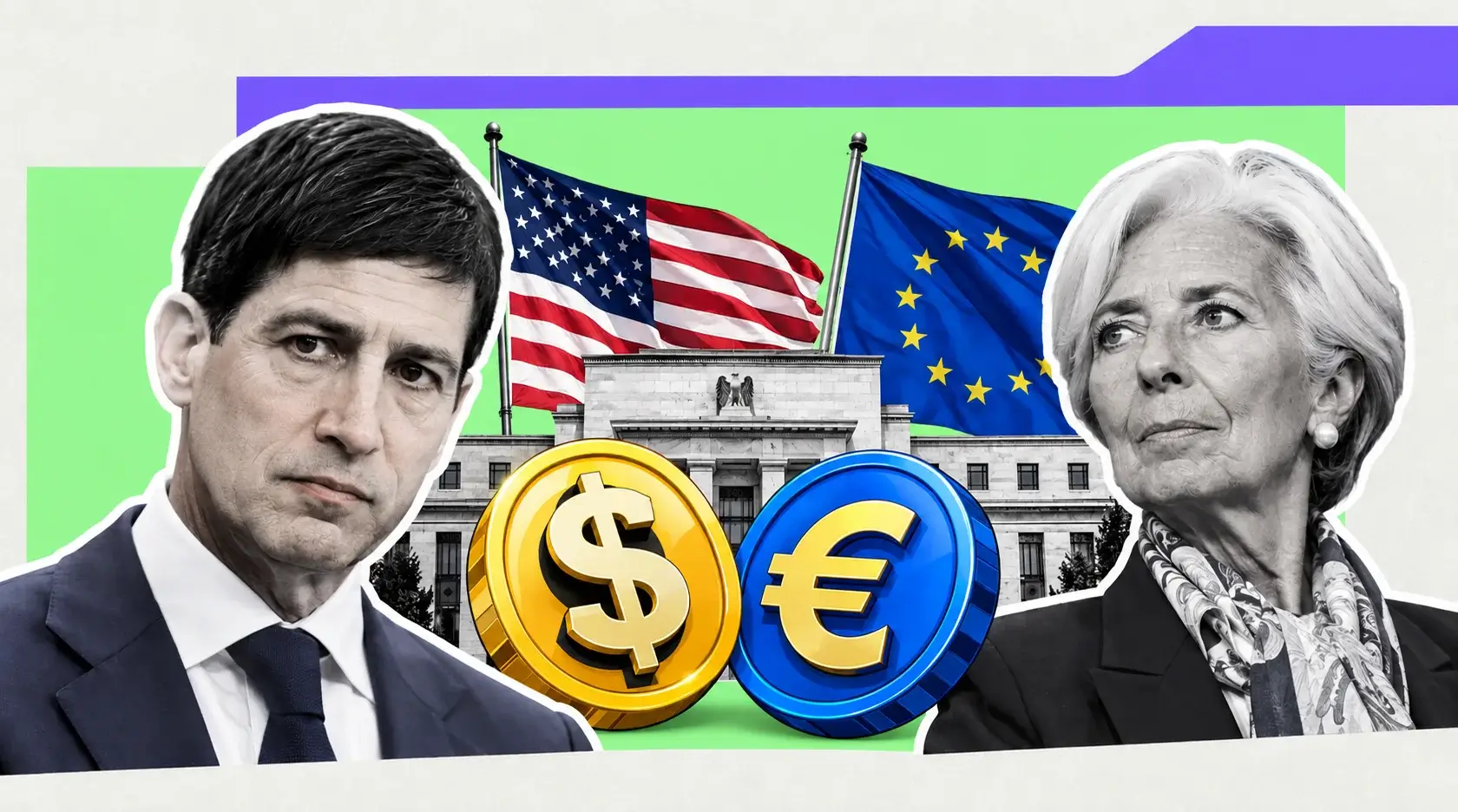

EUR/USD Price Forecast: Euro Reclaims $1.1730 as Hormuz Stays Shut, Fed and ECB Loom
Pair recovers from $1.1633 lows as DXY drops to 98.33 framing Powell's penultimate Fed meeting | That's TradingNEWS
Key Points
- EUR/USD trades at $1.17313 after rebounding from $1.1633 lows as the DXY slipped from 99.35 to 98.33 on stalled Iran talks.
- Brent crude jumped to $108 with Hormuz still shut, creating stagflation risk that complicates ECB and Fed responses this week.
- Fed Wednesday, ECB Thursday, BoE Thursday, BoJ Tuesday all decide rates, with $1.1849 resistance and $1.1633 support framing the range.
The euro (EUR/USD) has clawed back early Asian-session weakness to trade at $1.17313 against the US dollar as of Monday, April 27, 2026, recovering after the pair opened sharply lower when President Trump scrapped the second round of US-Iran peace talks in Islamabad over the weekend. The major currency pair touched intraday lows in the 1.1633-to-1.1660 zone before reversing to $1.1730 as the dollar gave back early gains, with the US Dollar Index (DXY) opening near 99.35 before retreating to 98.33-to-98.45. The 0.06% to 0.19% intraday gain disguises what is actually one of the most catalyst-dense weeks in months for the world's most heavily traded currency pair, with the Federal Reserve announcing Wednesday, the European Central Bank Thursday, the Bank of England Thursday, the Bank of Japan beginning Tuesday, and the Bank of Canada slotted into the same window. Layered on top of that monetary-policy cluster is a stalled Iran ceasefire, Brent crude north of $108 per barrel, and the start of the Magnificent Seven earnings parade on Wall Street—a combination of variables that virtually guarantees the EUR/USD will not stay in its current 1.1633-to-1.1750 range through Friday's close.
The structural setup heading into the week is genuinely unusual. The euro is trading 6.73% higher year-over-year against the dollar, sitting roughly in the middle of its 52-week range of $1.0778 to $1.2079. The ECB has been holding its policy rate at 2.15% while the Fed sits at 3.75%—a 160-basis-point spread that historically would suggest dollar strength, but the dynamics this week are anything but historical. Eurozone inflation prints at 2.5% versus US inflation at 2.41%, an inversion that has not gone unnoticed by ECB hawks who are demanding the central bank refuse to look through the energy-driven price pressure. The setup is exactly the kind of mismatch between rate differentials and inflation differentials that produces sharp directional moves when a central bank surprises in either direction, and traders running EUR/USD exposure right now are effectively short gamma into a binary event cluster.
Where the Euro Stands Right Now: $1.17313 With $1.1633 Floor in View
The pair's intraday range tells the story of a market still trying to find its footing after the weekend headlines. The EUR/USD opened lower with a gap-down move triggered by news that special envoy Steve Witkoff and Jared Kushner would not be traveling to Pakistan for the second round of peace talks. President Trump's Truth Social broadside framing Iran as "offering a lot, but not enough" and characterizing Tehran's leadership as suffering from "tremendous infighting and confusion" instantly evaporated the modest peace-deal premium that had been building in EUR/USD through last week. Yet the recovery to $1.1730 by mid-morning London demonstrates that the dollar's safe-haven bid is not as durable as the headlines might suggest, particularly as the Iran proposal to reopen Hormuz in exchange for a US blockade lift kept the door ajar for a negotiated resolution.
The 52-week range from $1.0778 to $1.2079 frames the broader trading band, and the current $1.17313 print sits roughly 8.7% above the lows and 3.0% below the highs—a position that gives both bulls and bears something to work with depending on which catalyst hits first. The 12-month change of 6.73% confirms the medium-term trend remains upward, but the price action over the past six weeks has been characterized by chop within a defined channel between $1.1407 and $1.1628 that broke higher in mid-April after the Fed's hawkish hold provided clarity on the rate path.
The pair's all-time high sits at $1.6039 from July 15, 2008, while the all-time low at $0.8227 was recorded on October 26, 2000—a historical range that provides important context for any long-term forecast. Current pricing puts EUR/USD roughly 26.8% below its all-time high and 42.5% above its all-time low, sitting closer to the midpoint of that historical band than recent price action would suggest. The 12-month appreciation of 6.73% is meaningful but moderate compared to the 2002-to-2008 period when the euro rallied from approximately 0.85 to 1.60 against the dollar—a 88% advance over six years that defined the post-euro launch era.
The Iran-Hormuz Equation That Refuses to Resolve
The single most important macro variable for EUR/USD over the coming five sessions is whether the Strait of Hormuz reopens. The waterway typically handles approximately 20% of global oil and gas shipments, and traffic remains near zero per Bloomberg's shipping trackers despite the new Iranian proposal delivered to Washington via Pakistani intermediaries. The terms—reopening Hormuz and lifting the US blockade of Iranian sea ports in exchange for deferring nuclear program negotiations—represent the most concrete diplomatic offer since the conflict began at the end of February, but the White House response has been the opposite of constructive. Iranian Foreign Minister Seyed Abbas Araghchi did fly to Pakistan over the weekend in an attempt to revive talks, only to depart for Moscow shortly after as the cancellation of the US envoy trip rendered the mediation effort effectively stillborn.
The energy-price impact is the channel through which the Iran situation reaches EUR/USD most directly and most painfully for the euro. Brent crude jumped as much as 2.8% to $108 per barrel earlier Monday, with the contract now up 44.1% since the conflict began at the end of February. West Texas Intermediate (WTI) is trading at $95.35 to $97.17. Goldman Sachs lifted its Q4 oil price forecasts again, projecting Brent at $90 in the fourth quarter versus $80 prior and WTI at $83 versus $75. The bank's Daan Struyven flagged "net upside risks" and described the Hormuz disruption as an "unusually large shock," signaling that the energy-driven inflation pulse is structural rather than transitory.
For the euro specifically, the energy shock is materially worse than for the dollar because the eurozone is a net energy importer with limited domestic production capacity. Higher oil prices translate into both inflation pressure and growth drag for the European economy in ways that do not apply equally to the United States. The trade-weighted impact on the eurozone current account is meaningfully negative, while the US benefits from being a net energy exporter through its shale production base. That structural asymmetry is why EUR/USD has historically struggled during oil-price spikes despite the broader risk-off impulse that typically weakens the dollar.
Germany's IFO business climate index has fallen to its lowest level since the pandemic, an early signal that the supply-chain transmission is already biting at the heart of the eurozone's industrial base. That deterioration in the German growth outlook is precisely why the EUR/USD pair has struggled to capitalize fully on the dollar's intraday weakness. German manufacturing PMI data due later in the week could compound the negative read-through if the figure comes in below the 50 expansion-contraction threshold.
The Fed Wednesday Decision: Powell's Penultimate Statement
The Federal Open Market Committee announces Wednesday, and the consensus expectation is a hold at the current 3.50% to 3.75% range with futures markets pricing essentially zero probability of a move and only an 8% chance of a hike by year-end 2026. The mechanical decision is not the question; the language Chair Jerome Powell uses around the energy shock, inflation expectations, and the path forward will determine whether EUR/USD breaks above 1.1750 or rolls back toward 1.1633.
The Fed faces a genuinely difficult communication challenge. Brent at $108 is creating sustained inflation pressure that argues for keeping rates higher for longer, but the labor market has been showing modest signs of softening and Q1 GDP—released Thursday morning along with the core PCE deflator—is expected to rebound to roughly 2.2% annualized after a subdued 0.5% in the prior quarter. Powell will need to signal sufficient hawkish conviction to keep inflation expectations anchored without simultaneously triggering a recession scare that would force pricing to flip toward cuts.
This is also Powell's penultimate meeting before the leadership transition to Kevin Warsh, with Warsh's confirmation vote imminent. The market has been pricing policy continuity, but if the statement language hints at any Warsh-era pivot—either more dovish on growth concerns or more hawkish on inflation discipline—the EUR/USD reaction could be sharp and sustained. Independent commentary suggests Warsh may pursue a more dovish track than expected given the political pressure from the White House for rate cuts, but Warsh's historical reputation is genuinely hawkish and his published academic work emphasizes the importance of central bank independence.
The 10-year US Treasury yield at 4.339% with a marginal three-thirty-seconds move into Monday's session reflects market positioning for hawkish continuity. If Powell delivers more hawkish language than the curve expects, the DXY could pop back toward 99.00 and EUR/USD would test the 1.1670 38.2% Fibonacci retracement level. If the statement softens at all on the growth side, the dollar weakness extends and EUR/USD makes a run at 1.1788 and ultimately 1.1850.
The supporting US data calendar is heavy and consequential for EUR/USD. Consumer confidence prints, the core PCE deflator (the Fed's preferred inflation gauge), and the first estimate of Q1 GDP all release in the window around the Fed decision. Any combination of weak confidence and hot core PCE would produce maximum volatility because it would describe a stagflationary economy that ties the Fed's hands and complicates the dollar's safe-haven appeal simultaneously.
ECB Thursday: Lagarde's Stagflation Test
The European Central Bank decision Thursday is the second binary catalyst of the week and arguably the more interesting from a euro-specific standpoint. The ECB sits at a 2.15% policy rate with eurozone inflation at 2.5%, which means the central bank is effectively running a slightly negative real rate at a moment when energy-driven inflation is feeding into the headline number. The classic ECB response would be to maintain a tightening bias to keep medium-term inflation expectations anchored, but the German growth picture argues for caution.
Lagarde's communication challenge is sharper than Powell's. If the ECB signals a willingness to look through energy-driven inflation as transitory, the euro could paradoxically rally because the message would imply the central bank is prioritizing growth preservation over inflation discipline—and the market has already absorbed enough hawkish positioning that any dovish tilt produces a short squeeze in EUR/USD. Conversely, if the ECB tightens its stance and hints at a June hike to defend inflation expectations, the immediate euro reaction may be muted because tightening into stagflation typically damages growth expectations more than it supports the currency.
The single most important paragraph in Thursday's ECB statement will be how Lagarde frames the German IFO collapse and the broader energy-driven supply shock. Any acknowledgment that the central bank is concerned about second-round wage effects from energy inflation would be hawkish; any framing of the shock as temporary and externally driven would tilt dovish. The ECB has been notably more divided internally than the Fed in recent meetings, with peripheral country governors generally more dovish and core country governors (particularly the Bundesbank's representative) more hawkish. A meaningful dissent in the policy decision could signal future direction more clearly than the headline statement itself.
BoE, BoJ, BoC: The Supporting Cast for EUR/USD Volatility
The Bank of England announces Thursday in the same window as the ECB, with similar challenges. UK inflation is running hotter than the eurozone, the 10-year Gilt at 4.93% is approaching the 2008 financial crisis high, and Prime Minister Keir Starmer is reportedly facing investigation over misleading lawmakers regarding the appointment of former US ambassador Peter Mandelson. GBP/USD at 1.3540-to-1.3550 reflects all these crosscurrents and limits the room for sterling rally even as the BoE leans hawkish. The political-risk overlay on sterling has direct implications for EUR/USD via the EUR/GBP cross—euro strength against sterling in the wake of UK political turmoil would mechanically support EUR/USD pricing.
The Bank of Japan begins its two-day meeting Tuesday and is widely expected to hold the policy rate steady, but any signal toward further normalization would strengthen the yen against both the dollar and the euro. The Nikkei 225 closing at a record above 60,000 for the first time provides unique context for the BoJ decision—the equity market is signaling resilience that could support a more hawkish policy stance than the central bank has been willing to telegraph publicly. The Bank of Canada's decision rounds out the central bank cluster and is most directly relevant for USD/CAD positioning, but the cumulative effect of five major central banks all communicating in the same week is to amplify volatility across the entire G10 currency complex.
Technical Analysis: 1.1633-to-1.1849 Defines the Tactical Range
The EUR/USD chart shows a pair caught between defined support at 1.1633-to-1.1611 and resistance at 1.1849, with the 20-day exponential moving average at 1.1696 functioning as the dynamic support that has caught every recent dip. The Relative Strength Index at 54.9 sits moderately above the 50 line, indicating firm but not overstretched bullish momentum as the pair pushes deeper into the upper half of the recent Fibonacci retracement grid.
Immediate resistance emerges at the 50.0% Fibonacci retracement at 1.1749, with a sustained break higher exposing the 61.8% retracement at 1.1828, then the 1.1864-to-1.1842 Target Zone 2, followed by 1.1941 and the cycle high region near 1.2080-to-1.2058 as Target Zone 3. The Hammer candlestick pattern that formed near the $1.1407 key support level signals a potential upward reversal, and the MACD consolidating in negative territory shows muted but improving momentum. The Money Flow Index is moving sideways near its lower boundary, indicating low liquidity that historically precedes sharp directional moves once volume returns to the tape.
On the downside, initial support is provided by the 20-day EMA at 1.1696, with additional protection at the 38.2% Fibonacci level at 1.1670. A deeper pullback would bring the 23.6% retracement at 1.1572 into view ahead of the structural floor around 1.1413. The longer-term technical map shows key support levels at $1.1407, $1.1156, $1.0930, $1.0750, $1.0585, $1.0448, and $1.0254, with key resistance levels at $1.1628, $1.1836, $1.2082, $1.2346, $1.2521, $1.2729, and $1.2937.
The trade idea on the weekly margin-zone framework is straightforward: buy support at 1.1633-to-1.1611 with first take-profit at 1.1730 and second target at 1.1849, stop loss at 1.1555. The risk-reward on that setup is roughly 1:2, which justifies the position given the binary catalyst risk into Wednesday and Thursday. For traders preferring to trade the breakout rather than the support test, a sustained break above 1.1750 with volume expansion would be the trigger to add long exposure with targets at 1.1828, 1.1850, and ultimately 1.2080.
Read More
-
Yen Stalls at 160 Despite a 3% JGB and Tokyo Core CPI at 2.0% — Intervention Sits at 164, Friday's Payrolls Decide
02.09.2026 · TradingNEWS ArchiveEnergy
-
T-Rex 2X Inverse MSTR ($4.39) Rips 10.44% as Strategy Pauses Bitcoin Buys for a 2nd Week — $4.63 Close Opens $5.27
15.09.2026 · TradingNEWS ArchiveStocks
-
XRPR ($10.59) and XRPI ($7.04) Open at Highs and Close at Lows After Senate Kills CLARITY Act
15.09.2026 · TradingNEWS ArchiveCrypto
-
NG ($2.908) Holds Above $2.80 Low as LNG Feedgas Hits 18.8 Bcf and TTF Trades 9.2x Henry Hub
15.09.2026 · TradingNEWS ArchiveCommodities
-
USD/JPY (155.09) Faces 275bp Policy Gap as BOJ Prepares 31-Year-High Rate — Close Below 154 Opens 153.40
15.09.2026 · TradingNEWS ArchiveForex
The DXY Dimension: Dollar Index at 98.33 Frames the Setup
The US Dollar Index (DXY) at 98.33 to 98.45 is rejecting at the 98.80-to-99.00 resistance area, which is precisely where the prior downward trendline used to function as support. That role reversal—old support becoming new resistance—is one of the cleanest technical signals available to the FX trader, and it indicates the dollar remains in a structurally bearish gear despite the safe-haven bid that briefly pushed DXY to 99.35 on the Iran headlines.
If DXY cannot reclaim 98.80, the first downside target is 97.97, followed by 97.60. A break below 98.20 would likely accelerate the bearish move, with the DXY potentially testing the 96.00 to 95.00 zone over the coming weeks. Only a sustained move above 99.00 would suggest the dollar is genuinely returning to a bullish footing, with 100.10 as the next meaningful upside target in that scenario. The mechanical implication for EUR/USD is that DXY weakness toward 97.60 would translate roughly into euro strength toward 1.1850, while DXY recovery to 99.00-plus would compress EUR/USD back toward 1.1670.
The dollar's safe-haven function has been weakening structurally throughout 2025 and into 2026, with foreign central banks—particularly the People's Bank of China—reducing US Treasury holdings and gold accumulating record official-sector demand. The "Sell America" narrative that defined parts of 2025 has given way to a "Hedge America" framework where institutional investors maintain US asset exposure but layer in currency hedges that effectively reduce dollar long positioning. That hedging activity has been one of the underappreciated structural supports for EUR/USD throughout the past 12 months.
Forecast Dispersion: Where Major Models Land for 2026
The professional forecast community is genuinely split on EUR/USD's trajectory through year-end 2026, and the dispersion is itself the signal worth interpreting. WalletInvestor projects moderate gains with the pair trading in a $1.1200 to $1.1790 range through 2026, hitting $1.1750 by December. LongForecast sees the pair declining from $1.1460 in early April to $1.1200 by mid-year and $1.1180 by December within a $1.0930 to $1.1700 range. CoinCodex is the bear of the cohort, projecting a steady decline to $1.0500 by year-end within a $1.0300 to $1.1500 range, with the average price collapsing to $1.0900 by mid-year.
Looking out to 2027, the dispersion widens further. LongForecast projects $1.1180 to $1.2450, with EUR/USD reaching $1.2270 by mid-year before retreating to $1.1840 by December. WalletInvestor sees more modest gains within $1.1710 to $1.2080. CoinCodex projects a brutal decline to $0.9559 by December 2027 within a $0.9410 to $1.0800 range—a bear case that would require a complete reversal of the multi-year euro recovery and would imply the dollar regaining full safe-haven dominance.
For 2028, LongForecast suggests EUR/USD will hover around $1.1840 in early 2028 before settling at $1.1670 by December within an $1.1360 to $1.2220 range. WalletInvestor sees moderate growth to $1.2340 by year-end within $1.2010 to $1.2380. CoinCodex anticipates recovery from a Q1 low at $0.9706 to $1.07 by December.
For 2029, LongForecast projects $1.1390 to $1.2900 with the year-end print at $1.1890. WalletInvestor sees $1.2300 to $1.2680, hitting $1.2640 by December. CoinCodex maintains its bearish stance with $1.0200 to $1.1400 range and the pair settling at $1.0300 by year-end.
The 2030 outlook is the most divergent of all. WalletInvestor projects EUR/USD grinding higher to $1.2940 by year-end within $1.2600 to $1.2970. CoinCodex sees the pair settling at $1.0100 within $0.9937 to $1.0500. Gov Capital projects gradual weakening to $1.0764 by 2030 within an extreme $0.9598 to $1.2624 range.
The consensus view across the bullish forecasts puts EUR/USD between $1.1840 and $1.2050 in 2027, $1.1670 and $1.2340 in 2028, $1.1890 and $1.2640 in 2029, and as high as $1.2940 in 2030. The bearish CoinCodex framework would imply a collapse below $1.00 by 2030—a scenario that has historical precedent but would require sustained dollar safe-haven dominance combined with eurozone economic deterioration well beyond current trajectories.
Social Sentiment: Mixed Positioning Among Independent Traders
The retail and independent-trader cohort is genuinely divided on EUR/USD positioning into the catalyst-heavy week. Independent trader @ewstategy projects the pair will fall to $1.1350 in the short term, betting on dollar strength from hawkish Fed positioning and the Hormuz energy shock continuing to favor the greenback. On the opposing side, @tradewithjamesX anticipates EUR/USD rising to $1.1667 in the near term, arguing the dollar's safe-haven bid has run its course and the ECB's stagflation framework will support the euro. User father_Of_Gold is the most bullish in the visible cohort, projecting EUR/USD climbing to $1.1550 and higher.
The split positioning reflects the genuine uncertainty about which catalyst hits first. If Hormuz reopens before the Fed announces Wednesday, EUR/USD likely rallies toward 1.1850 as both the energy shock and the dollar's safe-haven premium fade simultaneously. If the Fed delivers a hawkish hold while the ECB tilts dovish on Thursday, the pair could compress back toward 1.1633 as policy divergence reasserts itself. The asymmetry favors waiting for clarity on at least one of the two binary catalysts before sizing positions aggressively.
The 12-Month Technical Roadmap: Monthly Levels Through March 2027
The technical projection for EUR/USD through the next 12 months shows the pair likely consolidating within a wide range before resolving directionally. April 2026 is projected at $1.1456 to $1.1794 with an average of $1.1625. May 2026 sees the range tighten to $1.1633 to $1.1859 with an average of $1.1746. June 2026 projects $1.1604 to $1.2054 with an average of $1.1829, and July 2026 extends to $1.1639 to $1.2102 with an average of $1.1870—the highest projected average in the 12-month window.
August 2026 retraces to $1.1592 to $1.1847 with an average of $1.1719. September 2026 sees further pullback to $1.1426 to $1.1876 with an average of $1.1651. October 2026 projects $1.1379 to $1.1823 with an average of $1.1601—the lowest projected average in the second half of 2026. November and December 2026 stabilize within $1.1390 to $1.1876 with averages around $1.1633 to $1.1740.
The Q1 2027 outlook shows continued consolidation: January 2027 at $1.1361 to $1.1776 with an average of $1.1568, February 2027 at $1.1610 to $1.1876 with an average of $1.1743, and March 2027 at $1.1598 to $1.2060 with an average of $1.1829. The projected trading bias remains constructive but capped, with the model anticipating EUR/USD to remain below the $1.21 cycle high through Q1 2027 absent a major catalyst shift.
Historical Context: The Multi-Year Euro Story
Understanding the current EUR/USD setup requires appreciating the multi-year arc that brought the pair to $1.17313 today. Between 2002 and 2008, EUR/USD rallied from approximately 0.85 to 1.60 against a structurally weak dollar and a strengthening EU economy that briefly looked like it might overtake the United States in economic dynamism. The 2008 financial crisis ended that trajectory, and the eurozone debt crisis of 2010-to-2012 took the pair back toward 1.20 to 1.25.
The 2014-to-2020 period was defined by ECB low interest rates and quantitative easing programs that kept the euro structurally weak against the dollar. The 2020-to-2021 pandemic-era recovery briefly pushed EUR/USD to 1.23 as the Fed's accommodative response and post-pandemic recovery trade favored the euro, but 2022 brought the pair below parity amid aggressive US rate hikes and the renewed European energy crisis triggered by the Russia-Ukraine conflict.
Since 2023, EUR/USD has stabilized within a 1.05 to 1.10 range that gradually widened higher through 2024 and 2025. The 2025 trading year was characterized by exceptional volatility driven by ECB and Fed policy divergence, with the euro strengthening to $1.1829 in the first half before consolidating in a $1.1391 to $1.1918 range in the second half and reaching $1.1740 in December. February 2026 brought trading between $1.1530 and $1.1996 amid moderate eurozone inflation prints, and the euro weakened to $1.1410 at the end of March amid the escalation of the Iran conflict and ECB rate-cut speculation.
The Trade Decision: Tactical Buy on $1.1633 Test, Sell Above $1.1850
The honest read on EUR/USD at $1.17313 is a tactical buy on a confirmed test of $1.1633-to-1.1611 support with first target at $1.1730 and second target at $1.1849, stop loss below $1.1555. The structural setup remains constructive: the 20-day EMA at $1.1696 is providing dynamic support, RSI at 54.9 indicates firm momentum without overextension, and the longer-term trajectory from the $1.0778 52-week low favors the upside. The 6.73% year-over-year gain confirms the multi-quarter trend remains higher despite the current consolidation.
The tactical risk is that the Fed delivers a more hawkish hold than expected on Wednesday while the ECB tilts dovish on Thursday, which would compress EUR/USD back toward $1.1633 and potentially trigger a deeper pullback to $1.1572 or even $1.1413. That scenario warrants holding fire on aggressive long entries above $1.1750 and waiting for either a confirmed channel break above $1.1828 or a clean retest of $1.1633 before adding meaningfully to long positions.
For position sizing, the binary catalyst risk into Wednesday and Thursday justifies smaller-than-usual exposure. Defined-risk options strategies—particularly long straddles or strangles around the Fed announcement—offer attractive risk-reward for traders with conviction on the magnitude of the move but uncertainty on direction. The implied volatility on EUR/USD options has been elevated heading into the central bank cluster, which is itself a signal that professional positioning is hedged rather than directional.
The medium-term verdict is bullish on EUR/USD with a 12-month target range of $1.1840 to $1.2050 based on the bullish forecast cohort. The bear case requires CoinCodex-style assumptions about dollar safe-haven dominance and eurozone deterioration that are not currently supported by the data. The single biggest variable is Hormuz—a confirmed reopening would likely send EUR/USD through 1.1850 toward 1.2080 within days, while sustained closure compresses the pair within the current 1.1633-to-1.1750 range.
Hold existing long positions, buy weakness toward $1.1633, take partial profits on strength above $1.1828, and respect the binary catalyst risk into Wednesday and Thursday. The Fed-ECB-BoE cluster will determine whether EUR/USD breaks higher or rolls back, and the right play for serious capital is patience for the confirmed move rather than premature conviction at these specific levels. A break above $1.1849 with volume expansion is the trigger to scale long exposure higher with targets at $1.1941, $1.2058, and $1.2080. A break below $1.1611 is the trigger to flatten tactical longs and wait for the $1.1413 reload zone where the structural floor remains intact.