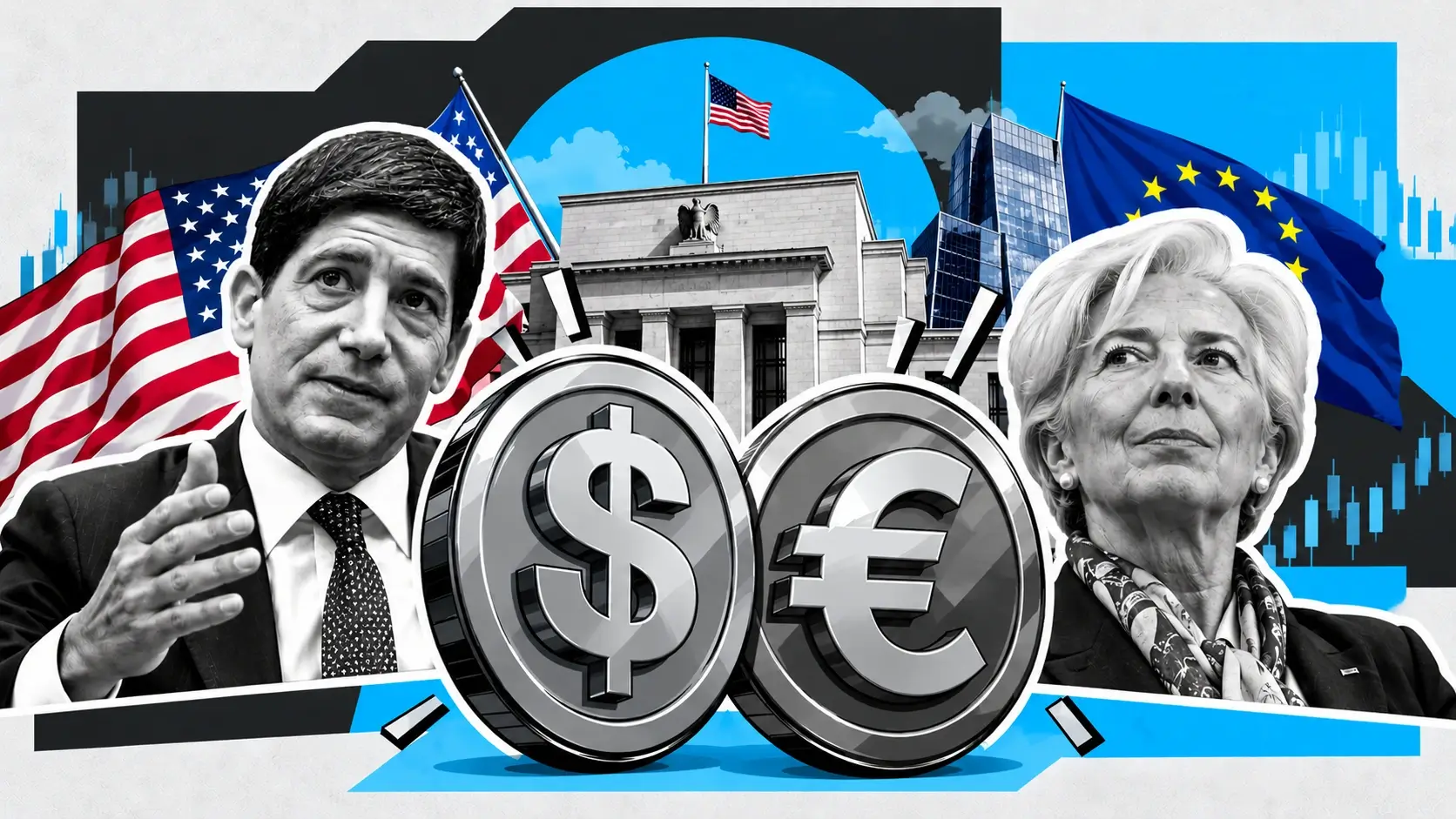
Euro at 1.1316 Holds 200-Week EMA as 5.34% Treasury Yield Meets Friday's 3.6% CPI Test — 1.1425 in Play
The euro sits at its weakest since May 2025 after four straight weekly losses, with the dollar index near 102 | That's TradingNEWS
Key Points
- EUR/USD trades at 1.1316, down 0.12%, four pips above Tuesday's 1.1312 low, the weakest since May 2025.
- The U.S. 10-year yield at 5.28% sits 173 basis points above Germany's 3.56% Bund yield.
- Euro-area flash September CPI is due Friday with a 3.6% consensus, up from August's 3.2%.
EUR/USD is trading at 1.1316 in the European afternoon, down 0.12% on the day and four pips above Tuesday's intraday low of 1.1312, the euro's weakest level since May 2025. The pair has now closed below 1.1350 for two straight sessions. September took the euro from 1.1592 on Sept. 1 to 1.1330 at the Sept. 30 close, a 2.3% monthly decline and the worst month since July 2025. That makes four consecutive weekly losses. On a 12-month basis, EUR/USD is down 3.4%, and it is 6.3% below its January high of 1.2082.
The selloff came during a month when euro-area inflation should have supported the currency. Germany reported September inflation of 3.3%, its highest since December 2023. Spain's rate reached 4.9%. France came in at 3.4%. Italy also beat forecasts. Each of those prints raises the case for another European Central Bank hike, and each should have lifted the euro. Instead, EUR/USD closed lower on the day the national figures landed. The euro is not trading on European inflation. It is trading on the U.S. bond market.
The thesis for this forecast is that EUR/USD is a yield-spread trade, and right now the spread favors the dollar decisively. The U.S. 10-year Treasury yield touched 5.34% this morning, its highest since 2002. Germany's 10-year Bund trades at 3.56%. That 173-basis-point gap in Washington's favor is what has pushed the euro to a 16-month low. Until it narrows, rallies in EUR/USD are selling opportunities rather than trend changes. The 1.1300 level, which coincides with the 200-week exponential moving average and the June and July lows near 1.1335, is the floor the market is testing now.
Friday is the inflection point. At 11:00 CEST, Eurostat publishes the euro-area September flash inflation estimate, with a consensus of 3.6% against August's final 3.2%. Three and a half hours later, the U.S. September payrolls report lands. A hot euro-area print combined with a soft U.S. jobs number is the one combination that can lift EUR/USD back above 1.1425. Strong U.S. payrolls would send the pair through 1.1300 regardless of what European inflation shows.
The dollar index is pushing toward 102.00, its highest since April 2025, after gaining 2% in September. The euro makes up 57.6% of the DXY basket, so a 102 dollar index and a 1.13 euro are essentially the same trade. Thursday's U.S. data reinforced that trade: jobless claims came in at 197,000, below the 200,000 forecast, and continuing claims fell to 1.701 million. A U.S. labor market that strong keeps the Fed hiking and keeps the yield spread wide.
September's 2.3% Slide: Four Weeks, Four Lower Closes
The September decline was steady rather than sudden, and the path matters for the forecast. EUR/USD opened the month at 1.1592 and held between 1.1480 and 1.1600 through the first half. The breakdown began after Sept. 19, when the pair was still at 1.1486. By Sept. 23 it had dropped to 1.1384. It recovered to 1.1391 on Sept. 25 and 26, then fell to 1.1372 on Sept. 28, 1.1341 on Sept. 29 and 1.1330 on Sept. 30. That is a loss of 156 pips in seven trading sessions, with every rally attempt sold.
The trigger for the second-half selloff was the Federal Reserve's Sept. 16 rate hike, its first since 2023, combined with the bond market's reaction. The Fed signaled further tightening, and the market moved to price at least three more increases by mid-2027. The U.S. 10-year yield rose 54 basis points in September, its largest monthly jump since September 2022, and 87.1 basis points over the quarter, the steepest quarterly rise since 1994.
The ECB was not standing still. It raised its key rates by 25 basis points on Sept. 10, taking the deposit facility rate to 2.50%. That followed a June hike to 2.25%, the first since 2023. Both hikes responded to energy-driven inflation linked to the Iran conflict and the closure of the Strait of Hormuz. The ECB's tightening has been real, but it has been slower and smaller than the Fed's, and markets have priced the gap accordingly.
The euro's September performance also reflects Europe's energy exposure. The euro area is a net energy importer, and energy inflation reached 14.3% in August, its highest since January 2023. With crude above $90 for most of September and diesel supplies tight, Europe's terms of trade deteriorated. Higher import costs drain euros from the region and weaken the currency. The White House has urged the European Union to release emergency diesel inventories, most of which are held in Germany and France, a sign of how tight European fuel markets have become.
The September selloff took EUR/USD into oversold territory on several measures. Four straight weekly declines, a 2.3% monthly drop and a close below the June and July lows all signal stretched positioning. Oversold conditions don't reverse trends by themselves, but they make the pair vulnerable to a sharp countertrend bounce on any shift in the data. Friday's inflation and jobs reports are exactly the type of catalyst that can trigger one.
The 173-Basis-Point Gap Between Treasuries and Bunds
EUR/USD is ultimately priced off the difference in yields between U.S. and German government bonds, and that difference is the single clearest explanation for the euro's decline. The U.S. 10-year Treasury yield closed Wednesday at 5.289% and touched 5.34% early Thursday before easing to 5.28%. Germany's 10-year Bund trades at 3.56%, down from a peak of 3.65% on Monday. The spread between them is 173 basis points.
At the two-year maturity, which tracks central bank expectations more closely, the gap is similar. The U.S. 2-year yield closed Wednesday at 4.879%. Germany's 2-year Bund was at 3.29% as of Sept. 29. That puts the 2-year spread at 159 basis points in favor of the dollar. A global investor choosing between two-year U.S. and German government debt earns 1.59 percentage points more per year by holding dollars. That carry advantage is what draws capital into the dollar and keeps EUR/USD under pressure.
The direction of the spread matters as much as its level. Both yields have been rising, but U.S. yields have been rising faster. Bund yields climbed from 3.34% at the start of September to a peak of 3.65%, a rise of 31 basis points. U.S. 10-year yields rose 54 basis points over the same month. The spread widened by 23 basis points in September, and EUR/USD fell 2.3%. That relationship is close to the textbook sensitivity of the pair to rate differentials.
Germany's 30-year Bund yield reached 3.95% on Sept. 29, and its 10-year yield is at the highest level since 2011. European borrowing costs are surging along with U.S. yields, driven by the same global forces: heavy sovereign issuance, persistent inflation and energy-driven price pressures. France faces an additional risk premium tied to its political and fiscal outlook. The global bond selloff is not just a U.S. phenomenon, but it is hitting U.S. yields hardest, and that is the problem for the euro.
For the forecast, the spread is the variable to watch. A narrowing of the 10-year spread to 160 basis points or less would likely lift EUR/USD toward 1.1425 to 1.1500. That would require either U.S. yields falling or Bund yields rising faster. A widening to 185 basis points or more would push EUR/USD toward 1.1200. The spread will be driven almost entirely by Friday's data releases on both sides of the Atlantic.
ECB at 2.50%: Markets Price 24 Basis Points More by Year-End
The ECB has hiked twice in 2026, and markets expect more. The deposit facility rate stands at 2.50% after the Sept. 10 increase. Money markets price 24 basis points of additional tightening by the end of the year, close to one more full quarter-point hike. The implied policy rate is expected to reach 3.27% by July 2027. That is a meaningful tightening cycle, but it still leaves the ECB's rate path well below the Fed's.
The ECB's September staff projections set the framework. Headline inflation is projected to average 3.0% in 2026, 2.5% in 2027 and 2.1% in 2028, according to the ECB's macroeconomic projections. The ECB expects inflation to peak in late 2026 as the Middle East conflict has driven energy prices higher, then ease as energy prices fall, despite pass-through to non-energy inflation. The 2026 headline forecast was unchanged from June, but 2027 was revised higher. Longer-term inflation expectations in both the ECB's professional forecaster survey and its monetary analyst survey remained at 2%.
The September national inflation figures suggest the 3.0% full-year projection is at risk. Germany at 3.3%, Spain at 4.9%, and France at 3.4% all came in above forecasts. The euro-area flash estimate due Friday has a 3.6% consensus. If it prints at or above that level, inflation will be running well ahead of the ECB's staff projections, and the case for an October or December hike will strengthen.
Core inflation tells a more nuanced story. In August, core inflation, excluding energy, food, alcohol and tobacco, eased to 2.4% from 2.5%. Services inflation, which the ECB watches closely as a measure of domestic price pressure, fell to 3.0% from 3.3%. The euro-area inflation problem is concentrated in energy, which hit 14.3% in August. That distinction matters for the ECB: energy-driven inflation reflects an external supply shock, and central banks are reluctant to hike aggressively in response to supply shocks that also hurt growth.
That reluctance is the core of the euro's problem. The ECB is hiking, but cautiously, weighing the cost of tighter policy on indebted households and small businesses already hit by energy costs. The Fed is hiking against a backdrop of 4% third-quarter GDP tracking and 197,000 jobless claims. Markets see the Fed's path as steeper and more durable. Until euro-area core inflation starts accelerating or U.S. data softens, the ECB will remain the slower-moving central bank in the pair.
Friday's Euro-Area Flash CPI: 3.6% Consensus After National Beats
The euro-area flash inflation estimate for September, due Friday at 11:00 CEST from Eurostat, is the most important European data release for EUR/USD this week. The consensus is 3.6%, up from August's final reading of 3.2%. The flash estimate for August was 3.3%, revised down to 3.2% in the final release.
The national figures released earlier this week point to upside risk. Germany's annual inflation rate rose to 3.3% in September, according to Destatis, its highest since December 2023. Spain's national statistics office reported 4.9% on the national measure, with the harmonized figure at 5.0%, the highest since 2023. France reported 3.4%. Italy also came in above forecast. All four of the largest euro-area economies beat expectations. When the four largest members surprise to the upside, the aggregate euro-area figure usually follows.
A print of 3.7% or higher would be the highest euro-area inflation since 2023 and would put significant pressure on the ECB to hike again in October rather than December. That would narrow the expected policy gap with the Fed and offer the euro some support. A print below 3.5% would suggest the national data overstated the aggregate and would reduce pressure on the ECB.
Market reaction to the national data this week offers a warning, though. Germany, France, Italy and Spain all beat forecasts, and EUR/USD still fell. The euro did not rally on hotter European inflation because the market views energy-driven inflation as a growth negative as much as a policy positive. Higher energy costs squeeze household incomes and corporate margins in a region that imports most of its energy. A hot inflation print raises ECB hike odds but also raises recession risk, and the two effects partly cancel out for the currency.
Core inflation in Friday's release is the key detail. A rise in core inflation above 2.5%, or in services inflation above 3.2%, would show that energy costs are spreading into broader prices. That would be a more durable reason for ECB tightening and a more convincing case for euro strength. If core stays near 2.4% while headline jumps, the market will likely treat the print as an energy story and fade any initial euro rally.
U.S. Payrolls Friday: The Dollar Side of the Trade
The U.S. September nonfarm payrolls report lands at 14:30 CEST Friday, three and a half hours after the euro-area inflation flash. For EUR/USD, it is the more important of the two releases. The dollar has been the driver of the pair's decline, and U.S. labor data is the main input into the Fed's rate path.
The leading indicators point to strength. Initial jobless claims came in at 197,000 for the week ending Sept. 26, below the 200,000 forecast, with the prior week revised up to 198,000. The four-week average fell to 200,000. Continuing claims dropped 11,000 to 1.701 million. Announced layoffs totaled 43,281 in September, 20% fewer than a year earlier and the lowest September total since 2022. Private employers added 90,000 jobs in September, above the 68,000 forecast, with base pay up 3.2% year over year.
The broader U.S. economy is running hot. Second-quarter GDP was revised up to 2.2% annualized, and third-quarter tracking estimates are near 4%. Consumer spending in August rose at its fastest pace in more than a year. The August PCE report showed inflation softer than expected, with headline at 3.4% and core at 3.0%, but the Fed has made clear that a single soft inflation print does not change its path. Minneapolis Fed President Neel Kashkari said overnight that inflation is "still too high."
Fed funds futures price a 63% probability of a hold at the October FOMC meeting, with at least three more hikes priced by mid-2027. A strong payrolls report with wage growth of 4% or more would push October hike odds higher and send the U.S. 2-year yield back toward 5%. That would widen the spread with Germany and push EUR/USD below 1.1300 toward 1.1250.
A soft report would change the picture quickly. Hiring below 100,000 and wages cooling below 3.5% would reduce hike expectations, pull U.S. yields lower and narrow the spread. Combined with a hot euro-area inflation print earlier in the day, that would be the most bullish possible setup for EUR/USD, with a move to 1.1425 likely and 1.1500 possible.
Five Fed officials are also speaking Thursday: Thomas Barkin, Christopher Waller, Philip Jefferson, Michelle Bowman and Lorie Logan. A uniformly hawkish message ahead of payrolls would add pressure on the euro.
The Dollar Index Near 102 and the Euro's 57.6% Weight
The Dollar Index is pushing toward 102.00, its highest since April 2025, after a 2% gain in September, its best month since June. Because the euro makes up 57.6% of the DXY, the dollar index and EUR/USD are almost mirror images. A DXY move from 100 to 102 accounts for most of EUR/USD's decline from 1.16 to 1.13. To understand where EUR/USD goes next, it helps to see what is driving the dollar overall.
The other major currencies are also weakening against the dollar. USD/JPY is at 158.33, up 0.6%, after the Bank of Japan's summary from its September meeting showed debate over additional hikes but reduced expectations for back-to-back moves. GBP/USD is under pressure as U.K. borrowing costs hit new highs after oil's rally earlier in the week. The dollar's rally is broad, not euro-specific. That supports the view that EUR/USD's decline is a dollar story first and a euro story second.
Positioning data shows speculative traders are already short the euro. Speculators held a net short of 52,334 contracts in euro futures as of Sept. 25. They are also short the British pound by 82,568 contracts and the Swiss franc by 26,752 contracts. They are net long the Japanese yen by 71,982 contracts. A meaningful euro short means that a hawkish surprise from the ECB or a dovish surprise from the Fed could trigger short covering and a rapid euro rally.
FX options positioning will also influence the pair Thursday. Large EUR/USD option expiries at the 10:00 New York cut include €1.95 billion at 1.1425, €1.78 billion at 1.1375 and €1.03 billion at 1.1400. Expiries of €1 billion or more tend to attract spot prices when the pair trades within its daily range. With EUR/USD at 1.1316, the 1.1375 expiry is the most likely to act as a short-term magnet. A move toward 1.1375 into the New York cut is possible if U.S. yields ease, but those strikes are more likely to cap rallies than to drive a sustained move.
For the forecast, a DXY close above 102.00 would confirm a new leg higher in the dollar and point to EUR/USD at 1.1200. A DXY reversal below 101.00 would bring EUR/USD back to 1.1425.
Energy and the Strait of Hormuz: Europe's Exposure
Energy is the euro's structural weakness in 2026. The euro area imports most of its oil and gas, and the closure of the Strait of Hormuz for the past seven months has raised costs across the region. Energy inflation hit 14.3% in August, up from 10.3% in July. Spain, with inflation at 4.9%, and Germany, at 3.3%, show how energy costs have pushed headline prices higher across the bloc.
Oil is falling this morning, which helps the euro. WTI crude dropped 1.4% to $89.20 a barrel, and Brent slipped below $97. Gulf crude exports excluding Iran returned to pre-war levels of 16.5 million barrels per day in September, as supplies moved through alternate routes. Saudi Arabia resumed tanker loadings at its Red Sea port of Yanbu after restarting its East-West Pipeline. Iran said overnight that it received a U.S. response to its ceasefire proposal. Every $1 drop in Brent improves Europe's terms of trade and reduces the energy drag on the euro.
Diesel is the tighter market. European diesel supplies are constrained, and the White House has pushed the EU to release emergency inventories. EU emergency diesel stocks are mainly held in Germany and France. President Trump played down the impact of a diesel export ban on other fuels. A refined-products shortage hits Europe harder than the U.S., which is a net exporter of fuels. That asymmetry adds to the euro's weakness.
The winter outlook is the bigger risk. If the Strait of Hormuz remains closed into the heating season, Europe faces the possibility of energy supply shortages similar to those after Russia's invasion of Ukraine in 2022. That would weigh on growth, push inflation higher and put the ECB in an even more difficult position. Markets are already partly pricing that risk into the euro, which is one reason European inflation surprises are not translating into currency strength.
A durable ceasefire in the Iran conflict is the clearest upside catalyst for the euro outside the data calendar. Lower energy prices would ease inflation, reduce the drag on European growth and improve the trade balance. In April, a temporary ceasefire triggered sharp moves across risk assets. A similar announcement now would likely push EUR/USD above 1.1425 quickly. Escalation, including the attacks on three ships in the Strait on Tuesday, would push oil higher and the euro lower.
Euro-Area Growth: Manufacturing PMI at 52.9
The euro-area economy is holding up better than the currency suggests. The final HCOB euro-area manufacturing PMI for September came in at 52.9 this morning, up from the preliminary 52.7 and unchanged from August's 52.7. A reading above 50 signals expansion. Manufacturing output remains near multi-year highs, and overall euro-area business activity accelerated in September.
That resilience is a turnaround from the start of the year. The manufacturing PMI was at 48.8 in December 2025 and 49.5 in January 2026, both in contraction. It moved above 50 in February at 50.8, rose to 51.6 in March, and has been above 52 since summer. The recovery has been broad, with most major euro-area economies reporting growth. German industrial production, long the weak point of the euro area, has stabilized.
For the euro, stronger growth gives the ECB more room to keep tightening. A central bank facing an energy shock in a contracting economy has to weigh rate hikes against recession risk. A central bank facing the same shock in an expanding economy can tighten with more confidence. A manufacturing PMI of 52.9 and accelerating business activity support the case for another ECB hike in October or December.
The price components of the PMI survey are the detail the ECB will focus on. Input and output prices have been rising as energy and raw material costs climb. The combination of continued manufacturing expansion and renewed price pressure keeps further tightening on the table. That is supportive for the euro over a medium-term horizon, even if it hasn't helped the currency in recent weeks.
The growth comparison with the U.S. still favors the dollar, though. U.S. third-quarter GDP tracking estimates are near 4%, well above any reasonable estimate for the euro area. U.S. consumer spending is growing at its fastest pace in more than a year. Strong U.S. growth supports both higher Fed rates and inflows into U.S. assets, particularly equities tied to AI investment. Micron's $54.23 billion quarter and Nasdaq 100 futures up 0.54% this morning are reminders of where global capital is flowing. Until euro-area growth closes the gap, the dollar keeps the advantage.
Technical Map: 1.1300 Floor, 1.1425 Pivot, 1.1500 Ceiling
EUR/USD's chart has clearly defined levels after four weeks of decline. The immediate support is Tuesday's low of 1.1312, the weakest level since May 2025. Just below that is 1.1300, the round number that coincides with the 200-week exponential moving average. The 200-week EMA is one of the most important long-term trend indicators on the chart, and EUR/USD has not closed a week below it since early 2025. A weekly close below 1.1300 would signal a break in the long-term trend.
The June and July lows near 1.1335 form the next level above current prices. EUR/USD broke below that level on Wednesday and is now testing it from beneath. A daily close back above 1.1335 would suggest the breakdown was a false move and would set up a recovery toward 1.1375 and 1.1425.
The first meaningful resistance is 1.1370 to 1.1375, the pullback pivot and the location of a €1.78 billion option expiry. Above that, 1.1400 to 1.1425 is the key resistance zone, combining a €1.03 billion expiry at 1.1400, a €1.95 billion expiry at 1.1425, and the level where EUR/USD broke down on Sept. 23. A daily close above 1.1425 would end the September downtrend.
The major ceiling is 1.1500, where EUR/USD traded for most of mid-September before the breakdown. That level is the most important resistance on the chart and the area where the market is likely to remember heavy selling. A move back to 1.1500 would require a substantial shift in the yield spread and is the upper end of a realistic one-month range.
On the downside, if 1.1300 breaks, the next support is 1.1250, followed by 1.1200, where a cluster of 2025 trading sits. A move to 1.1200 would represent a 1% decline from current levels and would likely require strong U.S. payrolls, a U.S. 10-year yield above 5.40%, and a dollar index above 102.50. Some longer-term chart patterns point to a rounded top on the weekly chart that could eventually take the pair to 1.0800, though that would be a multi-month move rather than an October target.
Momentum indicators are deeply oversold after four weekly declines. That doesn't guarantee a bounce, but it means the pair is vulnerable to a sharp short-covering rally on any positive surprise.
Speculative Positioning and the Short-Covering Risk
Positioning is an underappreciated factor in EUR/USD right now. Speculators held a net short of 52,334 contracts in euro futures as of Sept. 25, a position built during the September decline. Since then, the euro has fallen further, so the short has likely grown. Large speculative positions in one direction create the conditions for sharp reversals when the data or the narrative shifts.
The mechanics of a short squeeze are simple. If Friday's euro-area inflation comes in hot and U.S. payrolls come in soft, speculators holding euro shorts will rush to cover. Covering a short requires buying euros. When many traders try to buy at the same time, the price can move sharply higher in a short period. A 1% to 1.5% rally in a single session is possible in that scenario, taking EUR/USD from 1.1316 to 1.1430 to 1.1490.
Positioning is not a forecast on its own. Large shorts can persist for months if the fundamentals support them, and the yield spread does support the dollar. But crowded positioning adds asymmetry to the risk. If the data surprises in favor of the dollar, the euro falls further, but the move is partly priced in. If the data surprises in favor of the euro, the reversal can be faster and larger than the fundamentals alone would suggest.
The positioning picture across the other major currencies points the same way. Speculators are short the pound by 82,568 contracts and the Swiss franc by 26,752 contracts. They are long the yen by 71,982 contracts, which has not helped the yen as USD/JPY climbed to 158.33. The common thread is that the market is positioned long the dollar against most of the G10. A broad shift in the dollar narrative would unwind those positions simultaneously.
Volatility markets are pricing elevated risk around Friday. The VIX rose to 16.33, a two-week high, and FX implied volatility tends to rise ahead of major data releases. Traders should expect wider ranges in EUR/USD on Friday than in recent sessions. A daily range of 80 to 120 pips would be consistent with the event risk, compared with the 50 to 70 pips typical of recent sessions.
Read More
-
Yen Stalls at 160 Despite a 3% JGB and Tokyo Core CPI at 2.0% — Intervention Sits at 164, Friday's Payrolls Decide
02.09.2026 · TradingNEWS ArchiveEnergy
-
Microsoft Consolidates Below $520 With Azure Guided to 45% Growth — $553.72 Record in Reach
01.10.2026 · TradingNEWS ArchiveStocks
-
XRP-USD Holds $1.46 Support After 1B Token Escrow Release as ETF Holdings Reach 1.16B XRP — $1.70 in Sight
01.10.2026 · TradingNEWS ArchiveCrypto
-
Brent Crude Reclaims $100 on China's Fuel Export Halt as Gulf Crude Hits 16.5M Barrels a Day — $107 in Sight
01.10.2026 · TradingNEWS ArchiveCommodities
-
S&P 500 , Nasdaq and Dow Jones Futures Rise as ACN Rips 17% and MU Forecasts $61.5B
01.10.2026 · TradingNEWS ArchiveMarkets
-
Pound at 1.3230 Tests 1.3200 as 6.03% 30-Year Gilts and a 6-3 BoE Hold Meet a 5.34% Treasury Yield — 1.3150 in Sight
01.10.2026 · TradingNEWS ArchiveForex
Scenarios and Targets: 1.1425 Base Case, 1.1200 Downside
The base case, with a 50% probability, is a countertrend bounce to 1.1425 within two weeks. In this scenario, euro-area September inflation prints at or above the 3.6% consensus, lifting ECB hike expectations. U.S. payrolls come in near expectations, without a major upside surprise. The U.S. 10-year yield stabilizes between 5.20% and 5.35% as oil eases. EUR/USD holds 1.1300, short-covering lifts the pair through 1.1375, and it tests the 1.1400 to 1.1425 resistance zone. The target of 1.1425 is a gain of 109 pips, or 1.0%, from 1.1316. The September downtrend would stall but not reverse.
The bull case, with a 15% probability, requires both Friday releases to break in the euro's favor. Euro-area inflation comes in at 3.8% or higher with core rising above 2.5%, raising the odds of an October ECB hike. U.S. payrolls disappoint, with hiring below 100,000 and wage growth cooling. U.S. yields fall below 5.15%, and the 10-year spread narrows to 160 basis points or less. EUR/USD rallies through 1.1425 to 1.1500 by mid-October, a gain of 1.6%, as speculative shorts cover.
The bear case, with a 35% probability, is a break of the 200-week EMA. U.S. payrolls come in strong, with wage growth of 4% or more, and the 10-year yield climbs above 5.40%. The dollar index breaks above 102.00. Euro-area inflation comes in near consensus, with core stable at 2.4%, so the ECB is seen sticking with its cautious path. EUR/USD closes below 1.1300 on a weekly basis and falls to 1.1200 to 1.1250, a decline of 0.6% to 1.0%. A further energy shock or escalation in the Middle East would extend the move toward 1.1100.
The risk-reward is balanced but slightly favors a short-term bounce. From 1.1316, the base-case target of 1.1425 offers 109 pips of upside, while the bear-case target of 1.1200 carries 116 pips of downside. The higher probability of the base case, combined with oversold conditions and crowded speculative shorts, gives a modest edge to the long side in the very short term. The medium-term trend still favors the dollar, so any long position should be tactical, with a stop below 1.1280.
Verdict: Neutral Near Term, Bearish Bias Below 1.1425
EUR/USD enters October at a decision point. The euro is at 1.1316, four pips above its 16-month low, testing the 200-week EMA at 1.1300 after a 2.3% September decline and four straight weekly losses. It is 6.3% below its January high of 1.2082 and down 3.4% over the past year. The driving force is clear: a 173-basis-point gap between U.S. 10-year Treasuries at 5.28% and German Bunds at 3.56%, and a 159-basis-point gap at the two-year maturity.
The fundamentals favor the dollar. The Fed has hiked and markets price three more increases. U.S. jobless claims are at 197,000. U.S. third-quarter growth is tracking near 4%. The dollar index is near 102. Europe faces an energy shock with the Strait of Hormuz closed, energy inflation at 14.3%, and a tight diesel market heading into winter. The ECB has raised its deposit rate to 2.50% and markets price 24 basis points more by year-end, but that path is shallower than the Fed's.
The near-term setup gives the euro a chance at a bounce. The pair is oversold after four weeks of losses. Speculators are short 52,334 contracts. National inflation prints from Germany, Spain, France and Italy all beat forecasts, and the euro-area flash estimate Friday is expected at 3.6%. The manufacturing PMI is expanding at 52.9. Oil is falling, with WTI at $89.20. A hot euro-area CPI and a soft U.S. payrolls report on Friday would trigger a short-covering rally.
The verdict is neutral for the next 48 hours, with a bearish bias over a one-month horizon as long as EUR/USD stays below 1.1425. The base-case target is 1.1425 within two weeks, with a 50% probability. A daily close below 1.1300 would confirm the bearish case and target 1.1200. A daily close above 1.1425 would end the September downtrend and open 1.1500. Tactical longs at 1.1300 to 1.1320 with a stop below 1.1280 offer a defined-risk entry for a bounce, but selling into rallies toward 1.1425 remains the higher-probability trade while the U.S. 10-year yield holds above 5.25%.