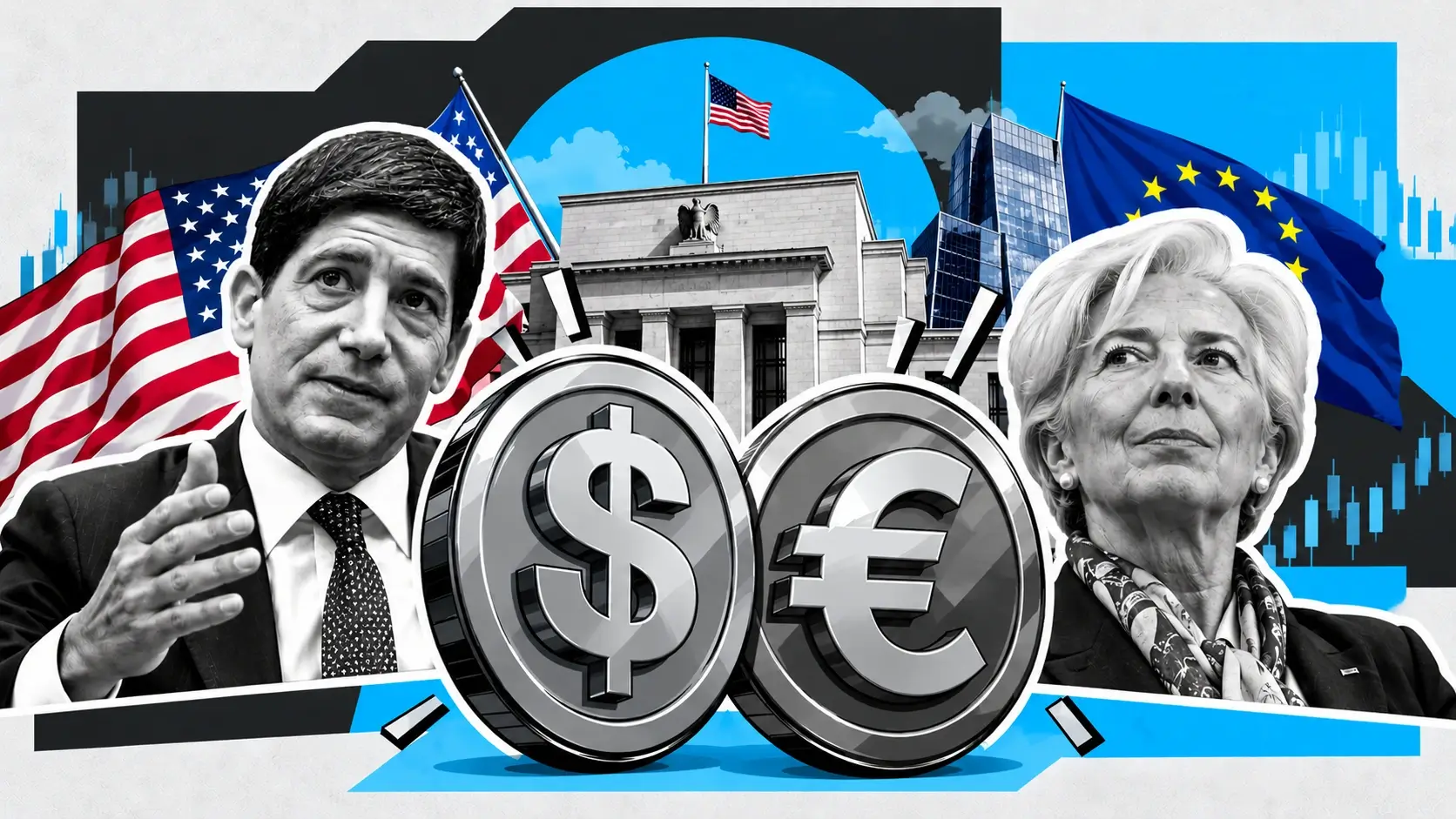
EURUSD (1.1350) Oversold at RSI 24 After 2.5% September Slide — 1.1450 in Reach Above 1.1400
Germany's 3.3% September inflation and a 37% October Fed hike probability narrow the policy gap that drove the euro to 15-month lows | That's TradingNEWS
Key Points
- EUR/USD hit 1.1312 on Tuesday, its lowest since May 2025, after a 2.5% September drop against the dollar.
- U.S. core PCE rose 3.0% annually against a 3.3% forecast, cutting October Fed hike odds to 37% from 47%.
- German inflation climbed to 3.3% in September against a 3.2% forecast, driven by 14.9% energy inflation.
The euro enters the final trading hours of September pinned near its weakest level since May 2025, but Wednesday delivered the first macro data point in weeks that works against the dollar. EUR/USD slid to 1.1312 on Tuesday, the lowest print since May 2025, then traded at 1.1330 to 1.1339 during Wednesday's Asian session before climbing to 1.1350 in the European morning. At 8:30 a.m. ET, the U.S. personal consumption expenditures report showed core PCE rising 0.2% in August for a 3.0% annual rate, against forecasts of 0.3% and 3.3%. Headline PCE came in at 3.4% against a 3.7% estimate. The dollar slipped on the release.
The monthly damage is already done. The dollar gained close to 2.5% against the euro in September, its largest monthly rise against the single currency in 14 months, and is set for a third straight quarterly gain. EUR/USD is down 2.39% over one month, 1.85% over six months, 3.45% year to date and 3.51% over 12 months. The dollar index started September below 99 and pushed to 101.40 by Tuesday.
Two forces drove that slide. The first was policy divergence. The Federal Reserve hiked on September 16 to a 3.75%–4.00% range, and futures priced another move as likely. The European Central Bank hiked its deposit rate to 2.50% the same day the Fed's decision took effect, but ECB President Christine Lagarde signaled on Monday that the eurozone's inflation surge has not yet produced significant second-round effects, pointing to a measured response. The market read that as the ECB lagging the Fed.
The second force was European risk. Energy prices tied to the Iran war hit European households harder than American ones. French government bond spreads over German Bunds blew beyond 115 basis points, the widest since 2012. Benchmark European gas prices hit their highest level since 2022 earlier in the month.
Today's thesis turns on timing. EUR/USD is deeply oversold, with a 14-day RSI of 24, its lowest reading since March 13. The U.S. inflation print just cut October Fed hike odds to 37%. Friday brings a eurozone flash inflation reading expected at 3.6%, which would pressure the ECB to keep hiking. That combination favors a relief bounce toward 1.1400 and 1.1450 in the coming sessions. The broader trend stays bearish until the pair reclaims its 50-day moving average, and a daily close below 1.1300 would open a slide toward 1.1200.
The Session Map: From 1.1312 to 1.1350 Ahead of the U.S. Data
The price action over the past 48 hours shows sellers in control but running low on fuel.
On Monday, EUR/USD opened at 1.1400, traded in a tight range between 1.1358 and 1.1401, and closed near 1.1375 after the previous session's 1.1393 close. The ECB's official reference rate that day, published around 16:00 CET, came in at 1.1378. That was the last session the pair held above 1.1350.
Tuesday broke the floor. Lagarde's comments on Monday evening landed alongside stalled U.S.-Iran talks over reopening the Strait of Hormuz, which pushed oil higher and lifted Fed hike expectations. EUR/USD broke horizontal support at 1.1350 and printed 1.1312, the lowest since May 2025. The break took the pair below its prior 52-week low of 1.1325 and below the 1.1335 level that marked the lowest points in both June and July this year.
Wednesday's Asian session saw a third consecutive day of selling pressure, with the pair trading near 1.1330 and just above Tuesday's low. The euro also tested support near 178 yen, a sign that selling was broad across euro crosses.
The European morning brought a modest recovery to 1.1350. German state inflation data released before the national figure showed acceleration across Bavaria, North Rhine-Westphalia, Lower Saxony, Baden-Württemberg and Hesse, which reminded traders that the ECB faces rising price pressure of its own. The national German print, released at 12:00 GMT, came in hot, covered in detail below.
The U.S. data at 12:30 GMT then hit the dollar. Core PCE at 3.0% sent the 2-year Treasury yield down more than 6 basis points to 4.827% and the 10-year down almost 4 basis points to 5.217%. When U.S. front-end yields fall, the rate gap that has favored the dollar all month narrows.
The levels for the rest of the week are clear. Support sits at 1.1312, then at the 1.1300 round number that traders have flagged as key. Resistance comes in at 1.1350, the broken support now acting as a pivot, then at 1.1375 to 1.1400, where Monday's trading range sat. A move back above 1.1400 would be the first sign that the September downtrend has paused.
Why the U.S. Core PCE Print Matters More for EUR/USD Than Any European Data This Week
EUR/USD in September has been a dollar story first and a euro story second. The pair's 2.39% monthly drop tracks the rise in U.S. rate expectations almost tick for tick, which makes today's inflation data the most important event of the week for the pair.
Rate futures show how much the picture changed. At one point in September, traders priced more than an 80% chance of a quarter-point Fed hike at the October meeting. Before Wednesday's data, the probability still stood at 47%, with a 91% chance of a hike by December. After the core PCE release, October odds fell to 37%, and the next fully priced increase moved out to December.
That shift directly affects the euro. The dollar's appeal this month came from the prospect that the Fed would keep hiking while the ECB moved more slowly. Each point of lower Fed hike probability shrinks that expected rate advantage. A 10-point drop in October odds in a single morning represents the largest one-day move against the dollar's rate story since the September decision.
The composition of the U.S. report also helps the euro's case. Core PCE's 0.2% monthly gain annualizes to 2.4%, the softest run rate in several months. Energy goods and services rose 2.3% in August, which means much of the remaining headline pressure in the United States comes from oil rather than from wages and services. An energy-driven inflation spike is the type central banks tend to look through, which lowers the chance of a prolonged U.S. hiking cycle.
New York Fed President John Williams laid the groundwork on Tuesday, saying there was no urgency to tighten in October and that the Fed may need more data before moving again. Today's report gave that argument evidence.
The U.S. labor data adds a counterweight. ADP reported 90,000 private jobs added in September against a 68,000 consensus, with August revised to 36,000. Base pay for job stayers rose 3.2% year over year and gross pay 4.7%. A strong labor market keeps the Fed alert even when inflation cools, and the dollar still has support from U.S. growth running faster than Europe's.
Friday's September nonfarm payrolls report becomes the swing factor. A figure near ADP's 90,000 with steady wages would lock in lower October hike odds and support a EUR/USD rebound toward 1.1400. A figure well above 150,000 with accelerating wages would push hike odds back up and send the pair back toward 1.1300.
Germany's 3.3% Inflation Print Puts the ECB Back in Play
While the U.S. data eased pressure on the Fed, European data this week pushed in the opposite direction. That split matters for EUR/USD because it narrows the policy divergence from both sides.
Germany's preliminary September inflation figures, released Wednesday, showed consumer prices rising 3.3% from a year earlier, up from 2.9% in August and above the 3.2% forecast. Some estimates had called for 3.1%. Prices rose 0.6% on the month, compared with a 0.2% gain in August. The EU-harmonized index also rose 3.3% year over year and 0.6% month over month. That is Germany's highest inflation rate since December 2023.
Energy drove the acceleration. Energy prices rose 14.9% from a year earlier, up sharply from 10.5% in August and 8.3% in July, the highest energy inflation rate since February 2023. Food inflation edged up to 0.4% from 0.1%. Services inflation eased to 2.7% from 2.8%. Core inflation, excluding food and energy, held at 2.4% for a third straight month.
The state data released earlier in the morning previewed the national number. Inflation rose to 3.2% from 2.9% in Bavaria, to 3.3% from 2.9% in both North Rhine-Westphalia and Lower Saxony, to 2.9% from 2.6% in Baden-Württemberg, and to 3.4% in Hesse. The German government now expects inflation of 2.7% for all of 2026 and 2.8% in 2027.
The composition mirrors the U.S. picture. In both economies, the headline acceleration comes from energy, while core inflation stays contained. The difference is scale. Germany's energy inflation at 14.9% runs far above U.S. energy price growth, which reflects Europe's greater dependence on imported oil and gas.
For EUR/USD, the German data cuts two ways. Higher headline inflation strengthens the case for another ECB hike, which supports the euro through higher expected rates. Energy-driven inflation also squeezes European household incomes and corporate margins more than in the United States, which hurts growth and weighs on the euro through weaker economic prospects.
The market's reaction suggests the first effect dominated on Wednesday. The euro held its European-morning gains to 1.1350 after the German release, rather than extending its decline. Inflation in France and Spain also accelerated more than expected in September, with Spain's rate reaching 4.9%. Three of the eurozone's four largest economies have now reported hotter-than-expected September inflation.
Friday's 3.6% Eurozone Flash Inflation Estimate Sets Up a Double Data Day
The biggest event risk for EUR/USD this week lands on Friday, when two data releases hit within hours of each other. Eurostat publishes the flash estimate of September eurozone inflation, and the U.S. Bureau of Labor Statistics publishes the September jobs report.
The eurozone inflation forecast calls for a 3.6% annual rate in September, up from 3.2% in August. That would mark the highest eurozone inflation rate since 2023 and a sharp acceleration in a single month. The German, French and Spanish data released this week all point toward a hot reading.
The August figures set the baseline. Eurozone inflation came in at 3.2% in the final reading, slightly below the 3.3% flash estimate and matching May's two-and-a-half-year high. Energy inflation jumped to 14.3% in August from 10.3% in July, the highest since January 2023. Services inflation eased to 3.0%, a four-month low, from 3.3%. Non-energy industrial goods rose 1.2%. Food, alcohol and tobacco rose 1.1%. Core inflation, excluding energy and food, edged down to 2.4% from 2.5%.
That services slowdown is important. Services make up 46.8% of the eurozone consumption basket and reflect domestic wage pressure more than any other component. A drop in services inflation to 3.0% supports Lagarde's view that energy costs have not yet fed into wages. If Friday's reading shows services inflation holding near 3.0% while headline jumps to 3.6%, the ECB can argue for a measured pace.
If services inflation rises alongside headline, the calculus changes. A services reading back above 3.3% would signal second-round effects, the exact scenario Lagarde said has not yet happened. That would push markets to price faster ECB hikes and give the euro its strongest support of the quarter.
The market currently prices a third ECB hike this year by December, and roughly 100 basis points of total ECB tightening by the end of 2027. A 3.6% headline with firm services would pull those hikes forward. A reading below 3.5% would push them back.
For traders, Friday is a binary setup. A hot eurozone print paired with soft U.S. payrolls would be the most bullish combination for EUR/USD and could drive the pair toward 1.1450. A soft eurozone print with strong U.S. payrolls would be the most bearish, likely breaking 1.1300. Mixed outcomes would keep the pair range-bound between 1.1300 and 1.1400.
The ECB at 2.50%: Two Hikes, a Neutral Ceiling and a Measured Lagarde
The ECB's policy path is central to any EUR/USD forecast, and the bank's stance has shifted sharply this year.
The ECB raised its three key interest rates by 25 basis points at its September 10 meeting, effective September 16. The deposit facility rate rose to 2.50% from 2.25%. The main refinancing rate rose to 2.65%, and the marginal lending rate to 2.90%. That was the second hike of the year. The first came on June 11, when the ECB raised rates by 25 basis points to take the deposit rate to 2.25%, citing inflation pressure from the war in the Middle East. The bank held rates steady in July before resuming hikes in September.
The September decision carried a hawkish message. The ECB acknowledged that eurozone inflation had climbed above 3%, well beyond its 2% target, and forecast faster inflation ahead. Lagarde warned that inflation risks were tilted to the upside and growth risks to the downside, and said inflation would likely stay elevated longer than the bank had expected. She described the labor market as robust while noting easing core inflation and wage growth.
The deposit rate now sits at the top of the 1.75% to 2.50% range that ECB staff estimate for the neutral rate, the level at which policy neither stimulates nor restrains the economy. Lagarde played down the neutral rate concept as theoretical and designed for a world without shocks, and she did not rule out pushing rates above it. That signals the ECB is willing to move into restrictive territory.
Bond markets responded after the September decision. Germany's 10-year Bund yield reached its highest level since 2011.
Lagarde's comments on Monday took some of that hawkish edge off. She said the inflation surge had not yet generated significant second-round effects and that a moderate policy response remained appropriate. She added that the inflation outlook for 2027 and 2028 is now higher than policymakers expected a few months ago, mainly because of energy prices, but that there is no evidence yet of energy costs feeding into higher wages. The euro fell to its lowest level since May 2025 the next day.
For the forecast, the ECB's gradual approach limits the euro's upside. The bank is hiking, but on a slower schedule than the Fed and with more caution about growth. Eurozone GDP is expected to grow just 0.9% this year, which constrains how aggressively the ECB can tighten.
The Rate Gap: 150 Basis Points at the Front End and a Widening Growth Divide
The core driver of EUR/USD over any horizon longer than a few days is the gap between U.S. and eurozone interest rates. That gap has widened this year and explains most of the euro's decline.
At the policy level, the Fed's upper bound stands at 4.00% against the ECB's deposit rate of 2.50%, a gap of 150 basis points. Both banks hiked in September, so the gap held steady at that meeting cycle. The market's expectation for where the gap goes next is what moves the currency.
Before Wednesday, rate futures priced a 47% chance of another Fed hike in October and a 91% chance by December. The ECB was expected to deliver a third hike by December. That implied the gap would hold near 150 basis points or widen to 175. After today's PCE data, the October Fed odds dropped to 37%. If the Fed skips October while the ECB keeps its December path, the gap stops widening, which removes one of the dollar's main supports.
The long end tells a different story. The U.S. 10-year Treasury yield touched 5.29% on Tuesday, its highest since 2007, before easing to 5.217% after the PCE release and drifting back to 5.25%. The 30-year crossed 5.62%, the highest since 2002. The 10-year yield rose 82 basis points in the third quarter, the largest quarterly jump in four years. Germany's 10-year Bund hit its highest level since 2011 in September, but still trades well below Treasuries.
Growth reinforces the gap. The U.S. economy continues to run hot, with private payrolls rebounding and consumer spending in August rising at the fastest pace in more than a year. The eurozone expects 0.9% growth this year. Euro area economic sentiment slipped in September as inflation expectations rose. Europe has also struggled to compete in AI investment, where U.S. companies continue to pour in capital.
Fiscal politics add pressure on the euro side. French markets face debt concerns and political gridlock ahead of next year's presidential election. Spain and Italy also hold key elections next year. The spread between French and German yields has blown beyond 115 basis points, the widest since 2012.
For the forecast, the rate gap argues against a sustained euro recovery. A short-term rebound driven by lower Fed hike odds can play out, but a durable trend reversal needs the ECB to hike faster than the market expects or U.S. growth to slow sharply. Neither is the base case today.
Oil, Hormuz and Why the Energy Shock Hits the Euro Harder
Energy prices have been the hidden driver of EUR/USD this quarter. The war with Iran, now in its seventh month, has pushed oil prices sharply higher, and Europe bears more of the cost than the United States.
November WTI crude traded at $90.75 a barrel on Wednesday morning, up 1.53%, and touched $91.19 earlier. Brent crude, the benchmark more relevant for Europe, traded at $103.30 in early European hours. Attacks on military targets, shipping and energy infrastructure in the Middle East since late August pushed oil back above $100 a barrel for Brent.
The latest escalation came on Tuesday, when unknown projectiles struck three vessels in the Strait of Hormuz, including a crude tanker and an LNG tanker. Iran's Revolutionary Guard said the war would end only when Washington admits defeat. President Trump denied reports that he would ease sanctions on Iran. Stalled talks over reopening the Strait pushed oil higher on Monday and Tuesday and fed directly into the euro's slide.
The energy shock hits Europe harder for a structural reason. The United States is a net energy exporter. The eurozone imports most of its oil and gas. When prices rise, money flows out of Europe to pay for energy, which weakens the euro through the trade balance. U.S. producers benefit from higher prices, which supports the dollar.
The inflation data shows the gap. German energy inflation reached 14.9% in September and eurozone energy inflation hit 14.3% in August. U.S. energy goods and services prices rose 2.3% on the month in August. European gas prices hit their highest level since 2022 earlier in September.
The energy link also explains why the dollar has acted as a safe haven during the war. Higher oil prices push up U.S. inflation expectations, which raise Fed hike odds and lift the dollar. Every escalation in the Gulf has fed that loop.
Some relief is coming on the supply side. Saudi Arabia resumed tanker loadings from its Red Sea port of Yanbu on Tuesday after restarting its East-West Pipeline. Gulf oil exports recovered to 23.3 million barrels per day last week, in line with the 2025 average. A U.S. Strategic Petroleum Reserve release pushed WTI briefly below $90 on Tuesday. The White House has urged the European Union to draw down emergency diesel inventories to lower global prices.
For EUR/USD, a ceasefire in the Gulf would be the most bullish development available. Lower oil would cut European inflation, ease the trade drain and reduce the dollar's safe-haven bid in one move.
Across the Crosses: Yen Strength, Franc Weakness and Sterling at 1.3270
The euro's weakness this month has not been uniform across currencies, and the cross-currency picture helps separate euro-specific risk from dollar strength.
Against the yen, the dollar has moved the opposite way. The dollar fell 1.5% against the yen in September. USD/JPY traded near 156.70 early Wednesday, down more than 0.3% on the day, after trading near 158.00 recently, and slipped toward 156.40 later. The euro tested support near 178 yen during Wednesday's Asian session. Yen strength against both the dollar and the euro reflects safe-haven demand tied to the Gulf conflict and expectations of tighter Japanese monetary policy.
Against the Swiss franc, the dollar reached a 16.5-month high overnight at 0.8358 francs. Franc weakness against the dollar suggests the dollar's safe-haven appeal has outweighed the franc's traditional role during this conflict.
Sterling has held up better than the euro. GBP/USD rebounded from Tuesday's decline to trade near 1.3270 in the European session on Wednesday. EUR/GBP traded near 0.8579, based on the ECB reference rate. The pound's relative strength reflects a Bank of England that has kept rates higher for longer and a UK economy less exposed to continental gas prices, though UK consumer borrowing jumped to £2.5 billion in August as households leaned on credit.
The commodity currencies have suffered alongside the euro. The rising dollar pushed the Australian dollar below 70 cents for the first time since early August. The Reserve Bank of Australia holds its cash rate at 4.60%, and Australian inflation came in at 4% in August.
The cross-currency data points to a clear conclusion. The euro's decline has two components: broad dollar strength driven by Fed expectations, and euro-specific weakness from energy costs, French politics and a cautious ECB. The dollar's weakness against the yen shows that it is not universally strong, and today's PCE data targets the Fed-expectations component directly.
Options markets show traders still leaning bearish. The skew in euro options has tipped sharply in recent sessions toward protection against further euro declines. When options positioning becomes one-sided, the pair becomes vulnerable to a short-covering rally if data surprises against the consensus. Today's PCE print is that kind of surprise.
Read More
-
Yen Stalls at 160 Despite a 3% JGB and Tokyo Core CPI at 2.0% — Intervention Sits at 164, Friday's Payrolls Decide
02.09.2026 · TradingNEWS ArchiveEnergy
-
NYSE:MP Bounces 5.66% Off $45.43 Low as Magnet Shipments Near — $58 in Reach Above $50
30.09.2026 · TradingNEWS ArchiveStocks
-
Ethereum ($2,686) Coils Below $2,800 With $1B in Shorts Stacked at $2,779 — $3,000 in Reach
30.09.2026 · TradingNEWS ArchiveCrypto
-
Brent ($103.60) Heads for 14% Monthly Gain as Diesel Squeeze Beats the SPR — $110 in Reach Above $105
30.09.2026 · TradingNEWS ArchiveCommodities
-
S&P 500, Nasdaq and Dow Rally as Core PCE Drops to 3.0%, MRNA Slides 6.56% and Micron Looms
30.09.2026 · TradingNEWS ArchiveMarkets
-
GBPUSD (1.3270) Turns Higher as BoE Hike Odds Hit 85% and Fed Bets Fade — 1.3345 in Reach
30.09.2026 · TradingNEWS ArchiveForex
Technical Picture: RSI at 24, Below the 50-Day EMA and Testing 1.1300
The chart sets up a classic tension between a bearish trend and oversold momentum.
The trend is clearly down. EUR/USD trades below its 50-day exponential moving average and below the Ichimoku cloud on the daily chart, both signs that sellers control the medium-term direction. The pair broke horizontal support at 1.1350 on Tuesday, then broke the 1.1335 level that marked the lowest points of June and July this year, and printed 1.1312, the lowest since May 2025. That move took out the prior 52-week low of 1.1325 and set a new floor for the yearly range, which now runs from 1.1312 to 1.2024.
From the 52-week high of 1.2024, the pair has lost 5.9%. Returning to that high requires a 5.9% rally from 1.1350.
Momentum points the other way. The 14-day relative strength index dropped to 24, its lowest reading since March 13. An RSI below 30 signals oversold conditions, and a reading of 24 marks an extreme stretch. Oversold readings do not reverse trends on their own, but they typically produce relief rallies as short sellers take profits.
The support structure sits in tiers. First support is Tuesday's 1.1312 low. The 1.1300 round number sits directly below and has been flagged by traders as the key level. A daily close below 1.1300 would confirm the breakdown and open the path toward 1.1200, a 1.3% decline from current levels.
Resistance also sits in tiers. First resistance is 1.1350, the broken support that now acts as a pivot. Above that, Monday's range between 1.1358 and 1.1401 forms the next barrier, with 1.1400 as the round-number target for any oversold bounce. A move above 1.1400 would put the pair back inside its prior range and target 1.1450. The 50-day EMA sits above those levels, and reclaiming it would be the first signal that the trend has turned.
The five-day performance adds context. EUR/USD is down 0.46% over one week and 0.78% over five sessions, a moderate pace compared with the 2.39% monthly drop. The selling has slowed even as the pair made new lows, a pattern that often precedes a bounce.
For traders, the technical setup supports a short-term long position from the 1.1312 to 1.1350 zone with a stop below 1.1300, targeting 1.1400 and 1.1450. The medium-term trend stays bearish below the 50-day EMA.
Positioning and Seasonality: One-Sided Bets Into Quarter-End
Positioning in the euro has become heavily skewed toward the dollar, and that matters for the forecast because crowded trades tend to unwind when data surprises.
The options market signals the crowding. The skew in euro options has tipped sharply toward protection against further declines in recent sessions. Traders are paying up for euro puts relative to euro calls, which means the market expects further downside and has positioned for it. When most participants hold the same view, a surprise in the opposite direction forces them to cover, which can amplify a rally.
Today's PCE data delivered that surprise. Core inflation came in 30 basis points below forecast, the largest downside miss in months. Traders who positioned for a hot U.S. print and further dollar strength now face a market where October Fed hike odds have fallen 10 points in a morning.
The quarter-end calendar adds a technical factor. Wednesday is the last trading day of the third quarter. Portfolio managers who hold international assets often rebalance currency hedges at quarter-end, and after a quarter in which the dollar rose for a third straight quarter, some of those flows can favor the euro.
The monthly pattern also points to exhaustion. The dollar's 2.5% gain against the euro in September was the largest monthly move in 14 months. Moves of that size tend to be followed by consolidation rather than immediate continuation, particularly when momentum indicators reach extreme oversold readings like the RSI at 24.
The risk to the bounce thesis is that fundamental drivers remain intact. The Fed still has a 150-basis-point policy advantage over the ECB. U.S. growth still outpaces European growth. Oil still sits above $90. French political risk still hangs over euro assets ahead of next year's elections. A positioning-driven bounce can run out of fuel once short covering is complete.
For the forecast, positioning argues for a sharp but limited rebound. Once shorts cover, the pair needs fresh fundamental support to extend gains, and that support can come only from hotter European inflation data forcing faster ECB hikes, a slowdown in U.S. data, or a drop in oil prices. Friday's double data release determines which of those scenarios gains traction.
The Risk Ledger: Payrolls, Oil, French Spreads and a Soft ECB
Four specific risks could push EUR/USD back below 1.1300 and invalidate a rebound forecast.
The first is Friday's September nonfarm payrolls report. The ADP data showed private employers adding 90,000 jobs, above the 68,000 consensus. If official payrolls come in well above that, with wage growth accelerating from ADP's 4.7% gross pay reading, October Fed hike odds could jump back above 47%. That would reverse today's dollar weakness and push EUR/USD back toward 1.1300.
The second is oil. Brent crude above $103 already reflects elevated Gulf risk. Strikes on vessels in the Strait of Hormuz and stalled diplomacy keep supply risk high. A move in Brent toward $110 would widen Europe's energy import bill, push eurozone inflation higher in a way that damages growth, and strengthen the dollar's safe-haven bid. Energy shocks have been the single most reliable trigger for euro weakness this year.
The third is French political and fiscal risk. The spread between French and German government bond yields has blown beyond 115 basis points, the widest since 2012. France faces debt concerns and political gridlock ahead of next year's presidential election. A further widening in that spread would signal rising stress inside the eurozone and would likely hit the euro regardless of what U.S. data shows.
The fourth is a softer ECB. Lagarde's Monday comments that inflation has not yet produced significant second-round effects already cost the euro its footing at 1.1350. If Friday's eurozone inflation data shows services inflation cooling further, the ECB could lean toward pausing after its September hike. Markets currently price a third hike by December. Removing that hike would widen the policy gap with the Fed and remove one of the euro's few supports.
A fifth, smaller risk is the long end of the U.S. Treasury curve. The 10-year yield dipped to 5.217% after the PCE release but drifted back to 5.25%. A move back above 5.29% would revive the rate differential that has favored the dollar.
Each of these risks carries a measurable trigger. Payrolls above 150,000, Brent above $110, a French-German spread above 125 basis points, or eurozone services inflation below 2.8% would each shift the balance toward a retest of 1.1300 and a possible move to 1.1200.
EUR/USD Price Forecast and Verdict: Short-Term Rebound to 1.1400–1.1450, Bearish Below 1.1300
The verdict on EUR/USD splits by time frame. In the short term, the pair is set up for a rebound. Over the medium term, the trend stays bearish until it reclaims the 50-day moving average.
The short-term case rests on three factors. First, U.S. core PCE at 3.0% against a 3.3% forecast cut October Fed hike odds to 37% from 47% before the data and dropped the 2-year Treasury yield more than 6 basis points to 4.827%. That directly weakens the dollar's main support. Second, EUR/USD is deeply oversold, with a 14-day RSI of 24, its lowest since March 13. Third, positioning is crowded, with options skew heavily favoring euro puts after the dollar's 2.5% September gain, the largest monthly move against the euro in 14 months.
Friday's eurozone inflation data adds support. German inflation already came in at 3.3% against a 3.2% forecast, and French and Spanish readings also beat estimates. A eurozone flash reading at or above the 3.6% forecast would reinforce expectations of a third ECB hike by December and narrow the policy divergence.
The near-term target is 1.1400, a 0.4% gain from 1.1350, which aligns with Monday's trading range. A daily close above 1.1400 opens 1.1450, a 0.9% gain. Those levels represent a retracement of the September decline, not a reversal of it.
The medium-term case stays bearish. The Fed's 4.00% upper bound sits 150 basis points above the ECB's 2.50% deposit rate. U.S. growth outpaces the eurozone's 0.9% forecast. Brent crude above $103 drains Europe's trade balance. The French-German spread beyond 115 basis points reflects fiscal stress. EUR/USD trades below its 50-day EMA and the Ichimoku cloud.
The invalidation level is a daily close below 1.1300. A break there would target 1.1200, a 1.3% decline from current levels, and confirm that the September breakdown has further to run.
The balance of evidence favors a relief rally into early October, with the pair likely to test 1.1400 and possibly 1.1450 as short positions unwind after today's soft U.S. inflation print. Friday's double release of eurozone inflation and U.S. payrolls decides whether that bounce extends toward the 50-day EMA or fails and sends the euro back to 1.1300, and as long as 1.1300 holds, the near-term path points higher while the broader dollar trend stays intact.