Euro Falls to 1.1420, Weakest Since March, as Two Hawkish Central Banks Trap EUR/USD in Its Range
The dollar wins the tug-of-war as a risk-off bid and hawkish Fed bets press the pair on the defensive. J.P. Morgan flipped bearish to 1.13–1.15 | That's TradingNEWS
Key Points
- EUR/USD fell to 1.1420, weakest since mid-March, down ~1.9% on the month, as a global risk-off bid and hawkish Fed lifted the dollar above 100 on the DXY.
- The pair is trapped between a hawkish ECB (2.25% deposit rate, first hike since 2023) and a strong dollar; 1.1400 is key support, 1.15 the ceiling.
- PCE Thursday is the swing factor; J.P. Morgan flipped bearish to 1.13–1.15, scrapping the old 1.25 targets built on Fed cuts that aren't coming.
EUR/USD fell to around 1.1420 on Tuesday, off marginally on the session but parked at its softest level since mid-March, as the global flight from risk handed the dollar a fresh safe-haven bid on top of the rate advantage it already enjoys. The pair has been stuck in a tight band just above 1.1400 through European trading, on the defensive, with the dollar holding the upper hand on the combination of a risk-off mood and a hawkish Federal Reserve. The chip rout tearing through equity markets worldwide didn't just hit stocks — it sent money into the deepest, most liquid safe haven on earth, and that's the dollar, not the euro.
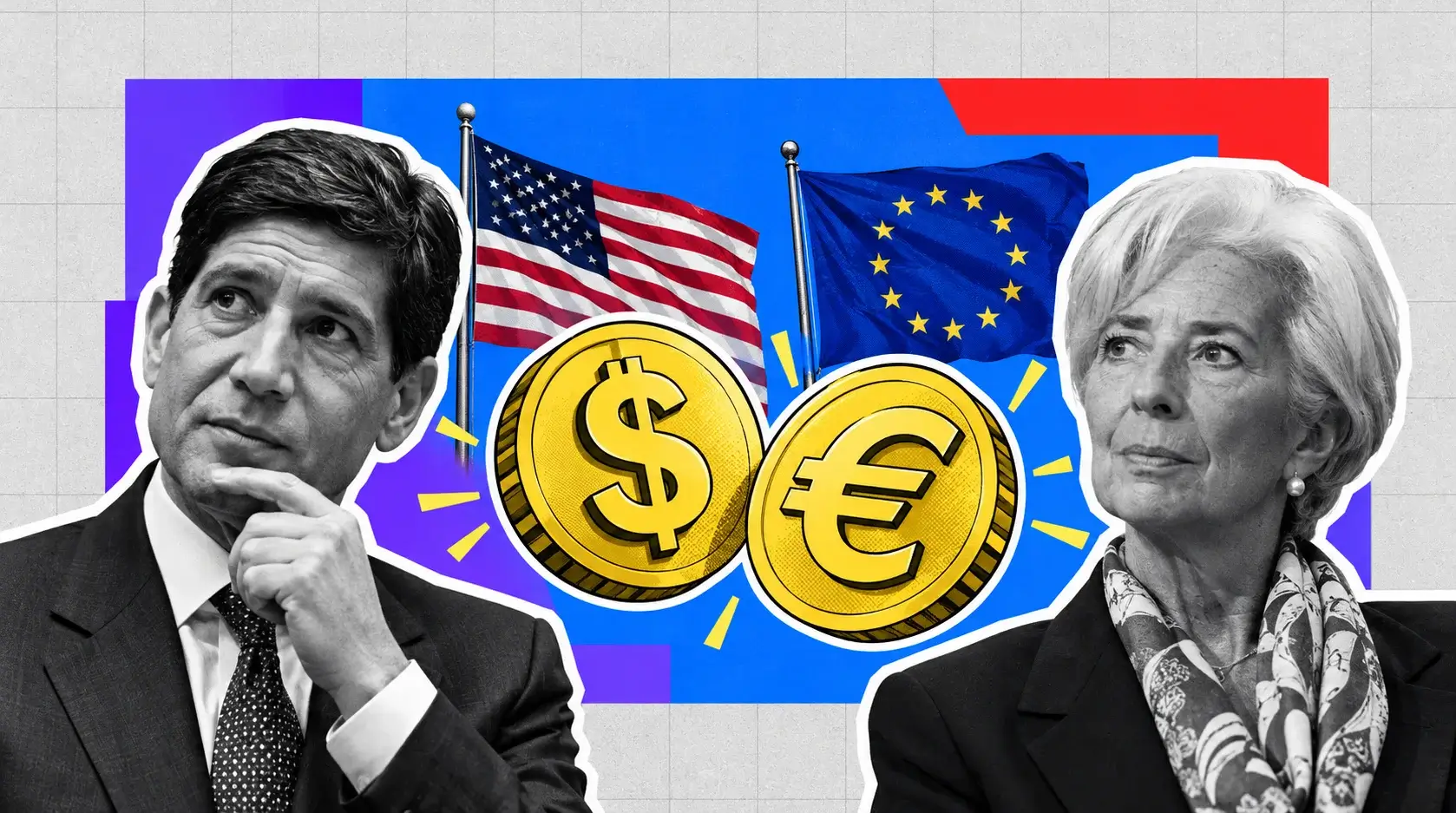
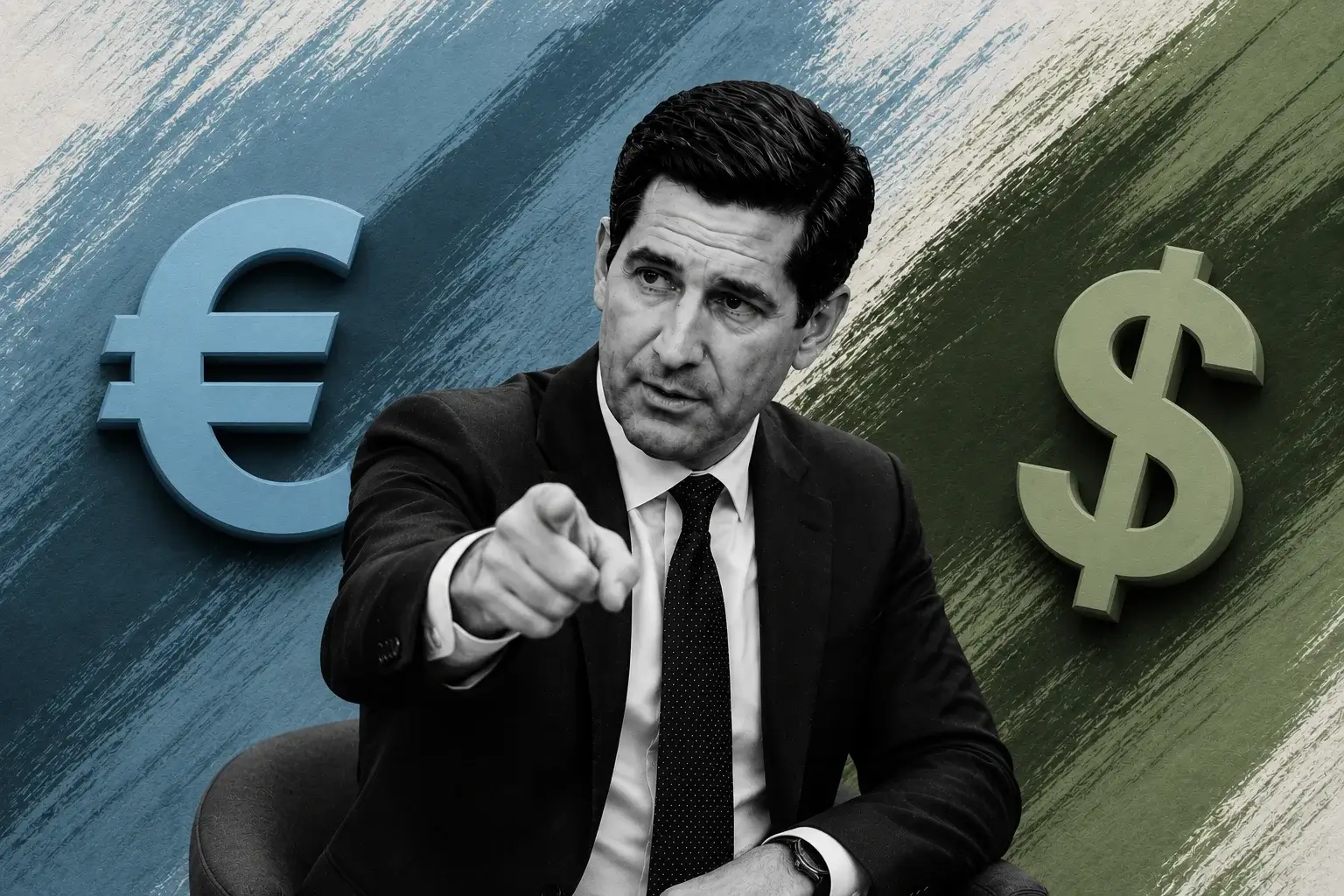
The thesis here is specific and it's the key to the whole pair: EUR/USD is trapped between two hawkish central banks, and that's why it can't break out in either direction. The Fed under new Chair Kevin Warsh has signaled rate hikes and driven the dollar near its highest level since May 2025. The European Central Bank just raised rates for the first time since 2023 and is signaling more. When both sides of a currency pair have a firm central bank behind them, the pair gets pinned — neither the bulls nor the bears can win decisively, and the price grinds in a range. Right now the range is sloping lower because the dollar's hawkish story is the stronger of the two, and the euro is sitting at the soft end as a result.
That's a crucial reframe from the narrative that dominated early 2026. Back then, every major bank had EUR/USD climbing toward 1.22–1.25 by year-end, built on the assumption that the Fed would keep cutting while the ECB held steady. That assumption has been demolished. The Fed isn't cutting — it's threatening to hike. And the moment that repricing took hold, the bullish euro case lost its engine. The euro isn't collapsing; it's range-bound and capped, and the dollar is now firmly in the driving seat. The level that defines the floor sits just below current price, and PCE Thursday is the swing factor that decides whether it holds.
The Scoreboard
Here's where the pair stands. EUR/USD is trading around 1.1420, down roughly 1.9% over the past month and off about 1.65% over the trailing twelve months, sitting at the lower end of the range it's held all year. The 2026 low near 1.1435 was printed on March 15, and the pair is now testing and probing those March levels — the weakest the euro has been against the dollar since the spring. Against that, the January high near 1.20 stands as a distant memory; the pair has surrendered a big chunk of the 2025 rally that carried it up from the low 1.0000s.
The character of the move is a controlled grind, not a crash. EUR/USD opened 2026 around 1.17, surged toward 1.20 in January, pulled back to 1.14 in March, recovered toward 1.17 by late April, and has since rolled back down to the 1.14 area as the Fed-ECB dynamic shifted against the euro. The pair has spent the year in a well-defined band, and right now it's pressing the bottom of that band rather than breaking cleanly out of it. The dollar index broke above 100 in June and has held firm, which is the mirror image of the euro's softness.
What the scoreboard captures is a currency that's not in trouble so much as it's boxed in. The euro has its own hawkish central bank, which keeps it from collapsing. But it faces a dollar with an even more hawkish central bank and a safe-haven bid, which keeps it from rallying. The result is the lower end of a range, with the pair searching for a catalyst — PCE Thursday and the July ECB meeting being the two on the calendar — to break it one way or the other.
The Two-Hawk Trap
The single most important fact about EUR/USD right now is that both central banks pivoted hawkish within days of each other, and that's what's pinning the pair. The ECB raised its deposit rate to 2.25% from 2.00% on June 11, its first hike since 2023, and money markets are pricing at least one more increase before year-end. The Fed held at 3.50–3.75% on June 17 but signaled possible hikes, with nine of its 19 policymakers now projecting at least one increase in 2026. Two hawks, one pair, and the result is a tug-of-war where neither side can land a knockout.
This is a genuine regime change from the setup that drove the euro's 2025 rally. For most of the past year, the trade was simple: the Fed was cutting, the ECB was holding or easing more slowly, the rate differential was narrowing in the euro's favor, and EUR/USD climbed. That narrowing differential was the core bull case, and it worked — the pair ran from the low 1.0000s to nearly 1.20. The two-hawk trap broke that mechanism. With both central banks now leaning toward tighter policy, the differential isn't compressing in the euro's favor anymore; if anything, the hawkish Fed repricing has moved it back toward the dollar.
The practical consequence is a pair stuck mid-to-lower range with no clear path to a breakout. As one currency strategist framed it, the ECB pivoted to tightening just as the Fed turned hawkish too, so both sides of EUR/USD are firm, which is why the pair is range-bound rather than trending. The hawkish ECB puts a floor under the euro — it's hard to sell the currency aggressively when its central bank is raising rates. The hawkish Fed and strong dollar put a ceiling over it. The euro sits in between, and the slope of that range is determined by which hawk the market believes more, which right now is the Fed.
The Fed Side: Warsh, the Dollar Above 100
Take the dollar side first, because it's the heavier weight. Warsh, who took office as Fed Chair in May 2026, used the June meeting to cement a hawkish posture — holding the rate steady but stripping the statement of any dovish bias and making clear his determination to drive inflation, running at 4.2%, back toward the 2% target. The projections did the talking: nine of 19 policymakers now expect at least one hike by year-end, and both Deutsche Bank and BofA revised their forecasts to include a September increase. The market has moved with them, pricing roughly 70% odds of a hike by September.
The dollar's response has been decisive. The US Dollar Index broke above 100 in June after the Fed's hawkish hold and has held firm near its highest level since May 2025. A strong dollar is a direct, mechanical drag on EUR/USD — the pair is, after all, the dollar's value against the euro, so dollar strength is euro weakness almost by definition. The hawkish Fed and the firm dollar are two expressions of the same force, and that force is pressing EUR/USD lower even though the euro's own monetary story turned more hawkish at the same time.
The dollar's safe-haven character compounds the effect on a day like today. With a global tech rout driving money out of risk assets worldwide, capital flows into the deepest, safest market available, which is U.S. Treasuries and the dollar that buys them. So the risk-off event that might in another era have lifted the euro as a dollar alternative instead lifts the dollar itself, pressing EUR/USD toward the bottom of its range. The greenback is benefiting from both the rate story and the fear story at once, and the euro is on the wrong side of both.
The ECB Side: First Hike Since 2023
The euro isn't defenseless, though, and that's what keeps the pair from simply collapsing. The ECB delivered a genuinely hawkish surprise with its June 11 hike to a 2.25% deposit rate — the first increase since 2023, a clear signal that the central bank is more worried about inflation broadening out than about choking off a fragile recovery. And the messaging since has reinforced the hawkish lean. Governing Council member Pierre Wunsch said another increase could come as soon as next month if inflation pressures broaden beyond energy, while Philip Lane suggested the euro-area economy may be able to absorb higher borrowing costs without losing momentum.
Money markets have taken the signal and now price at least one additional ECB hike this year, with roughly even odds attached to a September move. That repricing is what gives the euro its floor. It's difficult to mount a sustained attack on a currency when its central bank is actively raising rates and openly discussing more — the carry math and the policy direction both argue against aggressive selling. The ECB hike is the reason EUR/USD is holding above 1.1400 rather than breaking toward 1.12, even with the dollar this firm.
The catch is that the ECB hike is now largely in the price. With the move delivered and further tightening partly discounted, the bigger swing factor from here is what the dollar does, not what the ECB does. Some good news for the euro is already baked into the rate, which limits how much further the ECB story can lift the pair without fresh hawkish surprises. That's why the dollar is in the driving seat — the euro's hawkish leg is mostly priced, while the dollar's hawkish leg, tied to a live PCE print and an active hike debate, still has room to move expectations. The next real test for the euro's side comes at the July 23 ECB meeting.
Today's Risk-Off Adds a Dollar Bid
Layered on top of the structural rate dynamics is the immediate risk-off shock, and it's pushing the same direction. The chip rout that crashed South Korea's market 10% and dragged the Nasdaq down nearly 2% sent a wave of risk aversion through global markets, and the dollar capitalized on the mood. EUR/USD held the upper hand to the dollar precisely because the safe-haven flows and the hawkish Fed bets reinforced each other — when money flees risk and the Fed is the hawkish anchor, the dollar gets bid on both counts, and the euro gives ground.
The data flow today added a layer of its own. Preliminary June Purchasing Managers' Index readings landed for Germany, the eurozone, and the United States, with eurozone manufacturing expected to edge down toward 50.9 from May's 51.6 and services seen improving modestly toward 48.8 from 47.7 — a services sector still in contraction below the 50 line that separates expansion from decline. Soft eurozone activity data does the euro no favors when the dollar is already firm, reinforcing the growth-divergence story that's been weighing on the pair.
The combination is what's pinning EUR/USD at the low end of its range today. The structural setup — two hawks, dollar stronger — provides the baseline pressure, and the risk-off shock provides the acute push. Neither is enough on its own to break 1.1400, but together they've kept the pair on the defensive all session, unable to mount any meaningful recovery while the equity tape bleeds and the dollar holds its bid. The euro is absorbing the risk-off blow rather than benefiting from it, which tells you everything about where the safe-haven flows are actually going.
The Technical Picture: 1.1400 Is the Floor
The chart confirms the defensive posture. EUR/USD is holding well below the 200-period Simple Moving Average on the four-hour timeframe, keeping a bearish near-term tone, with the MACD in negative territory and the Relative Strength Index hovering around 38 — subdued but not yet deeply oversold. The momentum indicators together suggest downside pressure persists even as the pair attempts to stabilize above its recent swing lows. This is a market grinding lower with the technical wind at the dollar's back.
The support map is what matters most here, and it converges on a critical zone. The immediate floor is the March swing-low area around 1.1435–1.1476, which the pair is testing now. Below that sits the pivotal 1.1400 level — a round number that also marks the approximate 23.6% Fibonacci retracement of the entire 2022–2026 rally from 0.9536 to the 2026 high. That 1.1400 line was tested as support earlier in the cycle and held, which makes it the key battleground. A decisive break below it would shift sentiment firmly bearish and open the path toward the next major support at 1.1200, where the August 2025 pullback low and the longer-term moving-average zone sit.
The structure tells a clear story: the path of least resistance is lower, but the 1.1400 floor is well-defended and won't give way without a catalyst. The pair is compressing against that level, with the bearish momentum arguing for an eventual test but the hawkish ECB floor and the not-yet-oversold RSI arguing the break isn't automatic. This is the kind of coiled setup that resolves violently on a data surprise, and the data surprise on the calendar is PCE. Hold 1.1400 and the range survives; lose it and 1.1200 comes into view.
The 1.15 Ceiling
If 1.1400 is the floor, the ceiling is just as well-defined and just as hard to break. EUR/USD has repeatedly struggled to hold above 1.15, and that level has become the line separating the lower third of the range from the middle. Above it, the technical hurdles stack up quickly: a horizontal resistance breakpoint near 1.1575–1.1580 sits ahead of the 1.1600 round figure, and any recovery attempt has to clear that cluster before it can even think about the higher resistance at 1.1837 and the January high near 1.20.
The reason 1.15 is so sticky is the same reason the whole pair is range-bound: the dollar's firmness caps every euro rally. A strong dollar on high U.S. inflation is the main thing keeping EUR/USD from holding above 1.15 — every time the euro tries to push higher, the dollar's rate advantage and safe-haven bid pull it back. The ECB hike provided the fuel for the euro to test toward 1.15, but with that hike now priced, the pair lacks a fresh catalyst to sustain a break above it.
What it would take to clear the ceiling is specific and currently absent: the ECB continuing to tighten with hawkish guidance, combined with clear signs that U.S. inflation is cooling enough for the Fed to ease later in the year. If both lined up, a move back toward 1.20 would become the path of least resistance. But that's two conditions, and right now neither is in place — the ECB hike is priced, and U.S. inflation at 4.2% is keeping the Fed hawkish, not dovish. Until that changes, 1.15 caps the upside and the pair stays in the lower half of its range.
PCE Thursday Is the Swing Factor
Everything compresses into one number this week. The May reading on Personal Consumption Expenditures — the Fed's preferred inflation gauge — lands Thursday alongside the third estimate of first-quarter GDP, and it's the catalyst that resolves the coiled setup around 1.1400. The whole pair is positioned around it, because PCE directly informs whether the September hike the market is pricing actually materializes, and that hike is the dollar's primary fuel.
The setup is binary. A hot PCE print confirms the hawkish Fed path, pushes the dollar higher, widens the rate differential in the greenback's favor, and gives EUR/USD the shove it needs to break 1.1400 and target 1.1200. A soft print does the reverse — it revives hopes that the Fed can ease later in the year, takes the wind out of the dollar, and hands the euro the relief it needs to bounce back toward and potentially through the 1.15 ceiling. The pair's direction for the next several weeks likely hinges on which way the number breaks, because it's the difference between the Fed hawk getting louder and the Fed hawk getting quieter.
The mid-tier data ahead of the print — today's flash PMIs, the GDP revision, the University of Michigan inflation expectations on Friday — can nudge the pair at the margin, but they're warm-ups. PCE is the main event because it speaks directly to the rate differential that drives the whole trade. EUR/USD has been coiling against 1.1400 into the release, unable to recover while the hawkish Fed bets dominate, and that defensive posture reflects a market bracing for a print that confirms the dollar's advantage rather than one that relieves it. Until Thursday's number lands, the bias is to sell euro rallies rather than buy the dips.
The July 23 ECB Decision Looms
The euro's own next catalyst sits a month out, and it matters as much for the guidance as for the rate. The next ECB monetary policy decision is Thursday, July 23, 2026, with President Lagarde's press conference to follow, and with fresh staff projections only published in June, the July meeting is where the central bank either confirms or walks back the hawkish lean that lifted the euro. The deposit rate currently stands at 2.25% after the June 11 hike, and the question is whether the ECB signals another move is coming or signals that it's done.
The stakes for EUR/USD are real. If the ECB delivers another hike or guides clearly toward one, with Wunsch's warning about broadening inflation pressures materializing, the euro gets a fresh hawkish boost that could help it challenge the 1.15 ceiling. If the ECB instead signals patience — that the June hike was a calibrated adjustment rather than the start of a cycle — the euro's floor weakens and the pair becomes more vulnerable to the dollar's pull toward 1.1200. The July meeting is the euro's chance to reassert its side of the two-hawk standoff.
The complication is that the ECB is hiking into a soft growth backdrop, which limits how far it can push. Raising rates when eurozone services are still in contraction and growth has been trimmed is a delicate act, and the market knows it. The central bank can talk hawkish, but the economic data constrains how aggressive it can actually be. That tension — a central bank that wants to fight inflation but faces a weak economy — is why the euro's floor is firm but not rising fast, and why the July meeting carries so much weight for the pair's medium-term direction.
Read More
-
Yen Stalls at 160 Despite a 3% JGB and Tokyo Core CPI at 2.0% — Intervention Sits at 164, Friday's Payrolls Decide
02.09.2026 · TradingNEWS ArchiveEnergy
-
QQQ Tests Its $715 Floor as a $4.18B Exodus Meets Burry’s Nasdaq-100 Puts — Upside to $746
16.10.2026 · TradingNEWS ArchiveStocks
-
Spot Bitcoin ETFs Post a $5.06M Trickle After a $261M Exit as IBIT ETF Carries the Category — October Redemptions Near $535M
16.10.2026 · TradingNEWS ArchiveCrypto
-
Henry Hub ($3.19) Caught Between a Shrinking Storage Surplus and Mild Late-October Weather — $3.10 to $3.35 Range
16.10.2026 · TradingNEWS ArchiveCommodities
-
USD/JPY Price Forecast — Dollar-Yen (157.79) Caught Between a 216-Basis-Point Yield Gap and Tokyo’s 160 Intervention Line
16.10.2026 · TradingNEWS ArchiveForex
The Eurozone Growth Problem
Underneath the currency dynamics sits a structural weight on the euro: the eurozone economy isn't growing fast enough to support a strong currency. The ECB's June staff projections, the first since the Iran shock, trimmed eurozone growth to around 0.8% for 2026 — a sluggish pace that reflects an economy struggling to gain traction. Today's flash PMIs reinforced the picture, with services still below the 50 expansion line and manufacturing barely above it, neither sector signaling the kind of momentum that would underpin sustained euro strength.
The growth divergence between the eurozone and the U.S. is one of the two bearish euro forces that strategists have flagged as intensifying in recent weeks. The relative growth gap between the two economies has widened, and that divergence feeds directly into the currency — capital flows toward the economy with stronger growth and higher returns, which has been the U.S. The euro area's relative equity returns have collapsed against U.S. stocks, and that performance gap pulls investment flows toward dollar assets, weighing on the euro independent of the rate story.
There's a structural offset that the euro bulls point to — the eurozone's plans for higher infrastructure and defense spending, particularly a large German fiscal program, are expected to support domestic demand and growth in coming years. That fiscal expansion is a genuine medium-term positive for the euro. But it's a multi-quarter story, not a near-term catalyst, and right now the weak current growth data dominates. The growth problem caps the euro's upside even when its central bank turns hawkish, because a hawkish central bank fighting a sluggish economy is a recipe for a range-bound currency, not a strong one.
The Iran Angle Cuts Both Ways
The geopolitical backdrop has shifted in a way that's more complicated for the euro than it first appears. The U.S.–Iran framework — the 60-day roadmap toward a final deal, the reopening of the Strait of Hormuz, and the temporary license for Iranian oil sales — drove oil prices to three-month lows and eased the inflation pressures that had been weighing on both sides of the Atlantic. Lower oil should, in theory, help the eurozone more than the U.S., since Europe is a larger net energy importer, and cheaper energy eases the cost pressures on European households and industry.
But the picture is murkier than that. The euro area's terms of trade — the ratio of its export prices to its import prices — deteriorated sharply following the Iran conflict, and that deterioration is one of the forces that has weighed on the euro. The energy shock that accompanied the conflict hit Europe's trade position hard, and even as oil prices fall on the peace framework, the damage to the terms of trade has lingered as a drag on the currency. The geopolitical de-escalation that's draining the war premium from oil isn't translating cleanly into euro strength.
There's also the durability question. The framework remains fragile — earlier planned talks were abruptly canceled at one point, renewing doubts about the deal's staying power, and President Trump has warned of renewed action if the terms aren't upheld. That uncertainty keeps a risk premium in the market that tends to favor the dollar over the euro, since the dollar is the safe haven and the euro is the higher-beta currency in a risk-off scenario. The Iran angle, on balance, has been neutral-to-negative for the euro rather than the clear positive that lower oil might suggest.
The Forecasts Flipped: Why 1.25 Is Dead
The most telling development in the EUR/USD story isn't the price — it's how violently the forecasts have changed. Through early 2026, the major banks were uniformly bullish: Goldman Sachs targeted roughly 1.25 by year-end, J.P. Morgan and ING called for 1.22, Scotiabank saw 1.24, and the median clustered around 1.23–1.24, roughly 5–6% above current spot. Those targets shared a single foundation — they assumed the Fed would deliver one to two more rate cuts in 2026 while the ECB held, narrowing the rate differential in the euro's favor and driving the pair higher.
That foundation has been demolished. The Fed isn't cutting; it's threatening to hike. And the moment that repricing took hold, the bullish euro case lost its engine. The clearest signal came from J.P. Morgan, which pivoted to a bearish EUR/USD forecast for the first time in a year, now seeing the pair hover between 1.13 and 1.15 over the next three quarters — down sharply from its previous 1.20 target. The bank cited two intensifying bearish forces: the widening growth divergence between the EU and the U.S., and the hawkish Fed repricing that moved rate differentials in the dollar's favor in both real and nominal terms. Its updated path sees EUR/USD at 1.15 in September, 1.14 in December, and 1.13 by March 2027.
The current, fresh forecasts reflect the new reality. The most recent independent reads put EUR/USD in a 1.13–1.21 range across the rest of 2026, with a modest upward bias but capped near-term by a firm dollar, and the explicit acknowledgment that the dollar — not the ECB — is now in the driving seat. The lesson is that the old 1.25 targets were artifacts of a Fed-cutting world that no longer exists. A sustained move back toward 1.20 would now require the ECB to keep tightening with hawkish guidance and clear evidence that U.S. inflation is cooling enough for the Fed to ease — a tall order with inflation at 4.2%. The bull case isn't dead, but it's been pushed out and scaled back, and the near-term bias has flipped toward the dollar.
The Verdict: The Levels That Decide the Next Move
Strip it down and EUR/USD is a pair pinned by two hawks, with the dollar's hawk currently the stronger of the two. The euro has a firm floor from a tightening ECB and a firm ceiling from a hawkish Fed and a safe-haven dollar, and it's grinding at the lower end of its range near 1.14 because the dollar story is winning. Today's global risk-off only reinforced the dynamic, sending money into the dollar and pressing the euro to its weakest since March. This isn't euro weakness so much as dollar strength meeting a euro that can't break free of its range.
The levels are clear on both sides. The floor is 1.1400 — the round number, the Fibonacci retracement, and the well-defended support that's holding the pair up. A decisive break below it opens the path toward 1.1200. The ceiling is 1.15, with the 1.1575–1.1600 cluster above it; the pair has repeatedly failed to hold above 1.15, and clearing it requires a catalyst that isn't currently present. The band between 1.1400 and 1.15 is the cage the euro is trapped in, and the next move depends on which wall breaks first.
The catalyst is PCE on Thursday, with the July 23 ECB meeting as the follow-on. A hot PCE print confirms the hawkish Fed, strengthens the dollar, and pressures 1.1400 toward a break and a test of 1.1200. A soft print revives Fed-easing hopes, softens the dollar, and gives the euro room to challenge 1.15. The structural backdrop — two hawkish central banks, a sluggish eurozone economy, a dollar with both a rate and a safe-haven bid — favors the lower end of the range until the Fed's posture shifts, which is why the bullish 1.25 targets gave way to bearish 1.13–1.15 calls. The euro doesn't get its breakout until either the ECB out-hawks the Fed or U.S. inflation cools enough to let the Fed ease. Until then, EUR/USD stays caged, and the bias is to fade the rallies toward 1.15 rather than chase them.