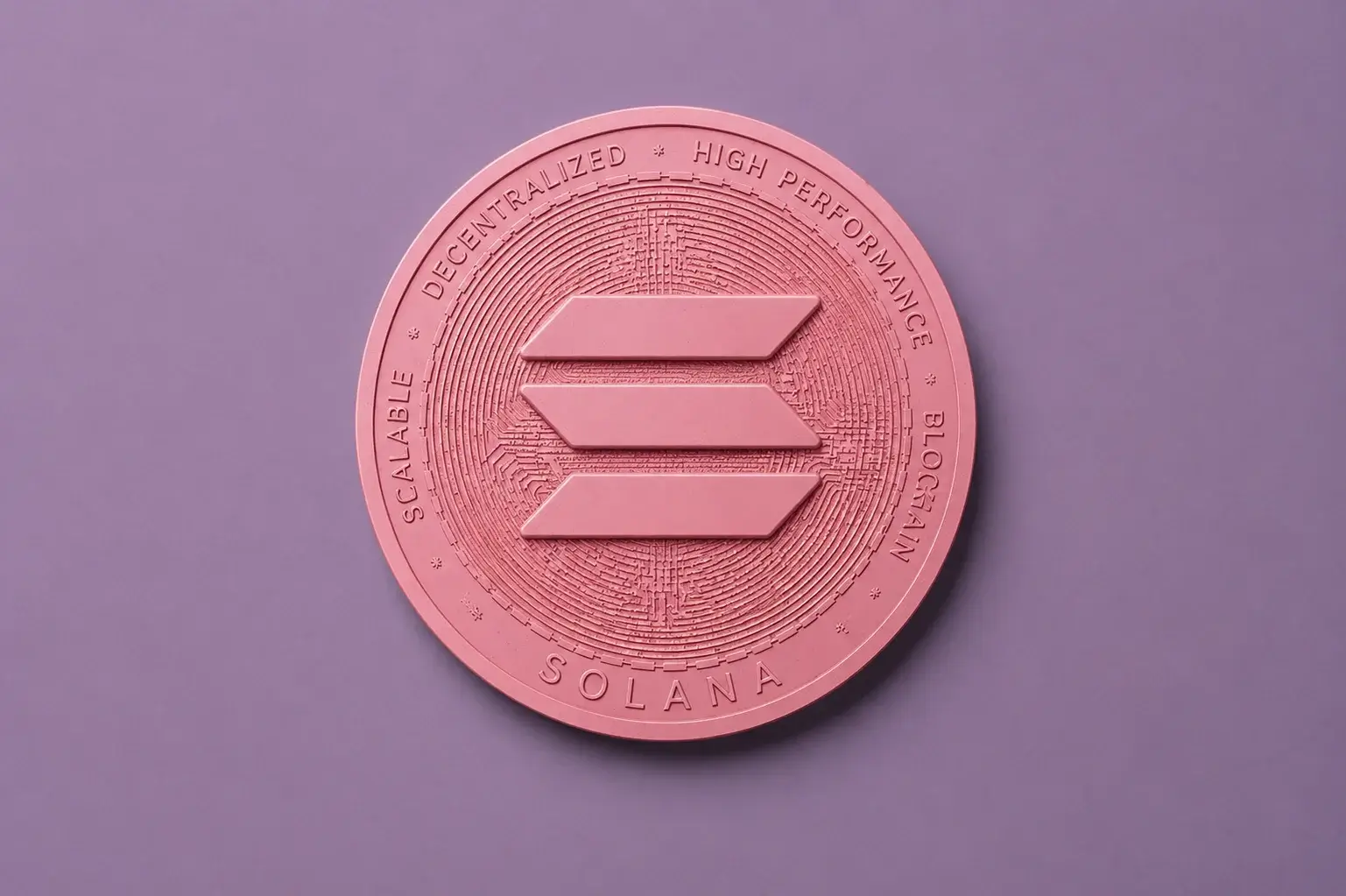
Solana Reclaims $70 After Iran Truce as Meta Adds USDC Payouts — But Solana Stalls Below Its Moving-Average Wall
Solana bounced off $66.99 on risk-on flows and a Meta USDC integration spanning 160+ countries | That's TradingNEWS
Key Points
- Solana reclaimed $70 to trade ~$71, up ~4% on the Iran deal, as Meta added USDC payouts on the network.
- SOL is pinned at its 20-day EMA ($71.96), below the 50-day ($78.20); a break above $72.50 opens $76.
- The token sits 76% below its $294 peak with Extreme Fear at 12; $97 is confirmation, $60 the downside risk.
Solana reclaimed the $70 level Monday, trading around $71.00 to $71.13 and gaining roughly 3.2% to 4.4% over 24 hours, riding the crypto-wide risk-on wave the U.S.-Iran peace deal ignited. SOL's bounce came in tandem with Bitcoin reclaiming $65,000, as rejuvenated inflows hit the digital-asset complex on the prospect that a reopened Strait of Hormuz, cheaper oil, and cooling inflation could pull interest rates lower and reward high-risk assets. The token carved a 24-hour range of $66.99 to $71.50 on a $41.18 billion market cap, holding its position as the seventh-largest cryptocurrency.
The thesis is the same conditional setup running through the majors: SOL is staging an oversold recovery attempt inside a broken downtrend, and it's pinned right at its 20-day EMA. The token is trading at $71 against a 20-day exponential moving average of $71.96 — the immediate resistance it has to clear — with the 50-day at $78.20 and the 100-day at $85.29 stacked overhead, an RSI at 44.26 that hasn't flipped bullish, and Extreme Fear gripping the market. SOL sits roughly 76% below its early-2025 peak near $294, deep in a correction that has run for hundreds of days. The recovery is real and the utility is building, but the price is capped at a wall of moving averages. A break above $72.50 opens the door to $76; reclaiming $97 is what would confirm a genuine trend turn. Until then, this is a relief bounce that hasn't earned the word reversal.
The Tape: $71 Off the Lows, Down 76% From the Peak
The price action frames a token clawing back from a brutal correction. SOL trades at $71 after bouncing off a 24-hour low of $66.99, with a $1.92 billion trading volume confirming the recovery has real participation behind it. The bounce reclaimed the psychologically important $70 level that the token had lost during the war-driven crypto selloff, when SOL broke below both the $80 and $70 support shelves that analysts had flagged as key thresholds.
Stretch the lens and the magnitude of the damage comes into focus. Solana traded as high as roughly $294 in early 2025 before entering a correction that has run for hundreds of days — one read called it a 500-day correction from its last peak. The current $71 puts SOL about 76% below that high, a decline that has reset the token from a top-five name to the seventh slot by market value. Monday's 3-to-4% pop fits the pattern of a high-beta asset bouncing off the lows rather than breaking out from strength. A token that lost three-quarters of its value doesn't reverse the structure on a single green session — it builds a base, tests the resistance overhead, and waits for confirmation. SOL is in that testing phase, pressed directly against its 20-day EMA, with the broader downtrend still technically intact.
$72.50 Is the Trigger, $97 the Confirmation
The chart frames the upside in clear levels, and the first is right overhead. The 20-day EMA at $71.96 is acting as immediate resistance, with SOL trading just below it — the line the token has to reclaim to keep the recovery alive. The next near-term trigger sits at $72.50: SOL is approaching a major descending-wedge reversal point, and a break above $72.50 with buying volume behind it would open a rebound toward $76 and above, supporting a medium-term recovery.
The real confirmation lives higher. The critical near-term resistance that a sustained recovery would need to clear is $97 — clear that, and the path opens toward $116. That's the level that separates a relief bounce from a genuine trend turn, because it would mean SOL has reclaimed the territory it lost in the downtrend and flipped the broader structure. The hierarchy of resistance is layered: $72.50 as the immediate trigger for $76, then the 50-day EMA at $78.20 and the 100-day at $85.29 as the moving-average wall, and finally $97 as the confirmation level. Each level cleared adds conviction, but the token has a lot of overhead to work through. The descending wedge is the constructive technical pattern — a break above it would mark a reversal — but the price has to prove it by clearing $72.50 first.
The Moving-Average Wall
The structure that defines the downtrend is the stack of moving averages overhead. SOL trades below its 50-day EMA at $78.20, its 100-day EMA at $85.29, and its 200-day moving average — a configuration that confirms the token is in a recovery attempt within a broader downtrend rather than a fresh uptrend. Price below all the key averages at once is the technical signature of an asset bouncing in a bear structure, and it's why the recovery needs confirmation before it can be trusted.
The momentum gauges back up the caution. The RSI sits at 44.26, below the neutral 50 mark, which says the bounce hasn't yet generated the thrust that would flip momentum bullish. The 20-day EMA at $71.96 acting as immediate resistance is the first hurdle, and until SOL closes above it convincingly, the moving-average wall keeps the rallies capped. The path higher is a sequence of reclaims — the 20-day, then the 50-day at $78.20, then the 100-day at $85.29 — each of which would mark a step toward repairing the downtrend. The bounce is improving the picture at the margin, lifting the RSI off its lows and pressing against the 20-day, but a single session doesn't undo a downtrend that the moving averages confirm is intact. The wall is real, and SOL has to climb it level by level.
Support: $66.99, Then $60
Underneath, the levels that define the downside are sharp. The first cushion is the 24-hour low at $66.99 — the level buyers stepped in to defend on Monday's dip before the reclaim of $70. That zone is the immediate support the bounce is built on, and holding it keeps the recovery attempt alive.
Below that, the risk turns to $60. The analysis is explicit that a failure to reclaim the $97 resistance could leave SOL exposed to further downside toward $60 — meaning the token's medium-term fate hinges on whether it can clear the overhead levels or rolls back toward the lower support. The asymmetry into the Fed is the thing to respect: the upside to the $72.50 trigger is small, the path to $76 and the moving averages is incremental, and the downside to $60 on a failed recovery is a meaningful drop. A token bouncing in a downtrend, pinned at its 20-day EMA, with $60 as the downside risk and $97 as the confirmation level, is one catalyst away from resolving in either direction. The Fed decision Wednesday is exactly that catalyst.
The Risk-On Bid From the Peace Deal
Monday's bounce is fundamentally a macro-driven, risk-on story. The crypto market is experiencing rejuvenated inflows after the U.S.-Iran peace deal, which is set to be signed Friday, June 19. The transmission to SOL runs through the rate channel: Trump's reopening of the Strait of Hormuz without tolls has already caused a dip in oil prices, and if crude stays low, inflation could cool, which may lead to lower interest rates — and high-risk assets like Solana benefit from lower rates.
That chain is the bull thesis in macro form. Solana is one of the highest-beta major cryptocurrencies, so when the macro backdrop turns risk-on and rate fear eases, SOL tends to move harder than Bitcoin in percentage terms. The peace deal removed the war premium that had money huddled in safety, the oil crash is disinflationary, and the prospect of a softer Fed is the kind of environment that rewards risk appetite. The catch is that the disinflation hasn't shown up in hard data yet, so SOL is front-running a narrative the Fed hasn't confirmed. The risk-on bid powered the reclaim of $70, but whether it extends depends on the macro cooperating — and the first test of that is Wednesday's Fed decision. The peace deal lit the fuse; the Fed decides whether it burns.
Meta Brings USDC Payouts to Solana
The token-specific catalyst landed Monday, and it's a meaningful one for the utility case. Meta is expanding USDC stablecoin payouts on Solana — creators in Colombia and the Philippines can now receive USDC via Solana and Polygon, with plans to expand to over 160 countries by the end of 2026. A payments giant routing real creator payouts through the Solana network is exactly the kind of real-world adoption that underpins the long-term value thesis rather than pure speculation.
The significance is in the use case. Stablecoin payments are one of crypto's clearest product-market fits, and Solana's high throughput and low transaction costs make it well-suited for high-volume, small-value payouts — the kind of micropayments that would clog and overprice slower networks. Meta choosing Solana as a rail for its creator-payout expansion validates the network's technical positioning and brings genuine transaction demand, which generates fees and reinforces the ecosystem. The expansion to 160-plus countries by year-end signals scale, not just a pilot. For a token trading on whether its network becomes critical payments and DeFi infrastructure, a Meta integration is a concrete proof point that the adoption is real. It's the kind of fundamental catalyst that, layered on the macro risk-on, gives SOL a reason to bounce beyond just tracking Bitcoin.
ETF Inflows and the Institutional Bid
The institutional channel adds a layer of demand beneath the price. Spot Solana ETF products have accumulated around $1.45 billion in total cumulative inflows since launch — regulated exposure that lets traditional money access SOL without managing wallets and private keys. The ETF wrapper is a structural demand source, and crucially for Solana, the spot products pass staking yield through to shareholders, which makes the regulated vehicle more attractive than a non-yielding spot ETF would be.
The read on the flows is mixed but improving. The cumulative inflows haven't been enough to fully offset the broader market downturn that dragged SOL through its support levels — institutional demand alone hasn't stabilized the price near current levels. But the steady accumulation provides a floor and a demand anchor that didn't exist in prior cycles, and sustained inflows would confirm the bounce is drawing real capital rather than just short-covering. The staking-yield pass-through is the differentiator that could pull more income-focused money into the wrapper over time. The ETF bid is a slow-burning structural support rather than an explosive catalyst — it builds a base under the price even as it hasn't yet been enough to drive a breakout. Whether it accelerates is one of the variables that determines if SOL can clear the moving-average wall.
On-Chain: Pump.fun, Jupiter, and Developer Activity
Beneath the price, the network fundamentals are the strongest part of the long-term case. Solana generates substantial on-chain fees from protocols including Pump.fun and Jupiter, the kind of real economic activity that anchors demand for the token beyond speculation. Those fee-generating applications are the proof that Solana hosts genuine usage — a high-throughput chain processing real transaction volume rather than sitting idle. The fee generation ties network activity directly to SOL's utility, since transactions require the token.
The developer story reinforces it. Solana's developer activity ranked second globally in 2025, a signal that the ecosystem keeps attracting builders even through the price correction — and developer engagement is one of the most durable indicators of a blockchain's long-term health, because it's the pipeline for the applications that drive future usage. The institutional infrastructure around SOL has also matured: SOL Strategies, a Nasdaq-listed firm, reported first-quarter 2026 results that showed a $99.8 million net loss but growing staking revenue to $3.4 million, an example of the public-market vehicles building businesses around Solana staking. The network is busy, the developers are building, and the on-chain economy is generating real fees. That fundamental foundation is why money keeps accumulating SOL at the lows despite the brutal price action — the bet is on the network, not the next bounce.
Extreme Fear Meets the Bounce
The sentiment backdrop is the same paradox haunting the whole complex. Even with SOL bouncing off the lows and reclaiming $70, the Fear & Greed Index sits at 12 — deep in Extreme Fear, even lower than the broader crypto reading. That gap between a recovering price and a terrified market cuts both ways, and it's the kind of divergence that defines a potential bottom.
The bull reading is that Extreme Fear at the lows is fuel — a market this scared has a wall of skeptics and sidelined capital that has to chase if the recovery sticks, and contrarian signals tend to flash brightest when sentiment is most negative. The bear reading is that the fear is justified, the bounce lacks conviction, and SOL remains in a downtrend that the moving averages confirm. The technical picture is mixed enough to support either: a recovery attempt pressing the 20-day EMA against an RSI that hasn't cleared 50, with Extreme Fear in the background. A market with a fear reading of 12, an oversold bounce, and a price capped at resistance is one that doesn't trust its own recovery — and that distrust is exactly what a clean break above $72.50, and then $97, would be designed to break. Sentiment this negative is a setup for a sharp move if the catalyst aligns.
Read More
-
Yen Stalls at 160 Despite a 3% JGB and Tokyo Core CPI at 2.0% — Intervention Sits at 164, Friday's Payrolls Decide
02.09.2026 · TradingNEWS ArchiveEnergy
-
LLY Reclaims $1,200 as Mounjaro and Zepbound Deliver $14.9B a Quarter — Buy Rating, $1,292 High in Sight
07.10.2026 · TradingNEWS ArchiveStocks
-
XRP-USD ($1.42) Underperforms Bitcoin as Weekly ETF Inflows Fade to $4.74M — Hold, Buy Zone at $1.37 to $1.40
07.10.2026 · TradingNEWS ArchiveCrypto
-
Brent $101 and WTI $89 Split on War Risk and Recovering Supply — EIA Sees $105, Support at $88
07.10.2026 · TradingNEWS ArchiveCommodities
-
Dow Sheds 539 Points, S&P 500 Back Under 7,800, Nasdaq Off 0.75% as Yields Reach 2002 Highs; PENG +17%
07.10.2026 · TradingNEWS ArchiveMarkets
-
Pound Retreats From 1.3284 Trendline as U.S. Yields Hit 2002 Highs — Sell Rallies to 1.3303, Downside to 1.3139
07.10.2026 · TradingNEWS ArchiveForex
SOL Tracks Bitcoin
The relative performance frames SOL's behavior. Solana's latest upswing came in tandem with Bitcoin reclaiming the $65,000 mark — the two moved together on the peace-deal risk-on, which tells you SOL's bounce is partly its own story and partly just the token tracking a recovering Bitcoin. As one of the highest-beta majors, SOL tends to amplify Bitcoin's moves: when BTC rallies, SOL rallies harder; when BTC rolls over, SOL falls faster.
That correlation is a double-edged sword. On the upside, if Bitcoin's recovery extends and the broader market enters an expansion phase, SOL is positioned to outperform as capital rotates down the risk curve into the higher-beta names — the historical pattern of altcoin rotation following a Bitcoin move. On the downside, SOL's dependence on Bitcoin's direction means it can't fully decouple on its own fundamentals; a BTC reversal would drag SOL lower regardless of the Meta integration or the ETF inflows. Monday's reclaim of $70 was as much about Bitcoin reclaiming $65,000 as about anything specific to Solana. The token-specific catalysts — Meta USDC, on-chain fees, developer activity — give SOL reasons to outperform, but the correlation means a sustained BTC move above its own resistance is what would give Solana the macro tailwind to clear $72.50 and challenge the moving averages above.
The Forecasts: $76 Near-Term to $150 and Beyond
The forecasts span a wide range, reflecting the uncertainty in a downtrend with improving fundamentals. The near-term technical path is clear: a break above $72.50 opens $76, and reclaiming $97 targets $116. Model-driven projections put SOL in a full-year 2026 trading channel of roughly $65 to $116, with a year-end target near $99 — implying meaningful upside from $71 if the recovery holds. More bullish ecosystem-driven forecasts see a $75-to-$150 range for 2026, with a break above $100 potentially pushing toward $150 on continued network growth and ETF inflows.
The long-term targets stretch much higher and depend on the cycle. Forecasts point to $500 as a 2031 milestone driven by DeFi and NFT adoption, developer activity, and institutional ETF inflows, with $1,000 framed as a 2028-2031 story tied to the next halving cycle. VanEck's most bullish scenario explicitly targets $3,211 by 2030 — one of the only major institutional forecasts to contemplate that level. Those far-out numbers are speculative and assume the network captures a dominant share of on-chain activity, but they capture why money accumulates SOL at $71 despite the correction: the bet isn't on the next bounce, it's on Solana's role in a tokenized financial future. The near-term reality is a $72.50 trigger and a $97 confirmation level. The long-term case rests on the network the current price action obscures.
The Macro: Fed Wednesday
Everything funnels into Wednesday. The Federal Reserve decision lands at Kevin Warsh's first meeting as chair, and while a hold is fully priced, the tone and projections are the trigger that resolves the range. The same disinflationary force helping the whole risk complex applies to Solana: the oil crash following the peace deal eases the inflation pressure that kept the Fed hawkish, and lower-for-longer rate fear is the backdrop that lets high-beta assets like SOL breathe.
The fork mirrors the rest of crypto. A dovish Warsh — acknowledging the oil-driven disinflation and signaling a stable-to-easier path — gives Solana the macro cover to clear $72.50 and challenge the moving averages above. A hawkish surprise on forward guidance pressures the entire risk complex and likely rejects SOL at its 20-day EMA, sending it back toward $66.99 support and the $60 risk level. As one of the highest-beta majors, SOL is the leveraged bet on the Fed outcome — a dovish tone helps it more than Bitcoin, a hawkish one hurts it more. The decision is 48 hours away, and SOL is pinned at resistance waiting on it. The Meta catalyst and the on-chain fundamentals are the token-specific support, but the macro is what governs whether the bounce extends or fails.
Forecast: An Oversold Bounce, Capped at the EMAs
The verdict is mixed, with a fundamental tilt toward the bulls held in check by the chart. The constructive case is genuine: SOL reclaimed $70 on the peace-deal risk-on, bounced off $66.99 support on real volume, landed a Meta USDC integration that brings real-world payment utility, sits on ~$1.45 billion in cumulative ETF inflows with staking yield passed through, and ranks second globally in developer activity. The descending-wedge pattern is constructive, and the macro tailwind from the oil crash is real.
The structure keeps the optimism capped. SOL is pinned at its 20-day EMA at $71.96, below the 50-day at $78.20 and the 100-day at $85.29, with an RSI at 44.26 that hasn't flipped bullish, Extreme Fear at 12, and the token down 76% from its early-2025 peak. The base case is consolidation between $66.99 support and the moving-average wall into the FOMC, with Wednesday's decision the trigger. The bull path: a dovish Warsh, a break above $72.50, momentum toward $76 and then the $97 confirmation level that opens $116. The bear path: a hawkish tone, rejection at the 20-day EMA, and a slide back toward $60. Until SOL clears $72.50 and then reclaims $97, this is an oversold relief bounce reclaiming $70 with real utility building beneath it — tradable, fundamentally supported, and still capped at the EMAs in a downtrend.