Stock Market Today: S&P 500 Slides to 7,393, Nasdaq Off 0.7%, Dow Drops 1.1% Ahead of Warsh Fed Verdict — Micron at $820 After 8.9% Rout
Stocks opened lower Wednesday as Iranian strikes on US positions sent Brent to $89.61 | That's TradingNEWS
Key Points
- S&P 500 at 7,393.34 (-0.48%) after Tuesday's 7,428.78 close; Dow leads losses at -1.15% as Brent spikes 6.6% to $89.61 on renewed Iranian strikes.
- Fed decision at 2:00 p.m. ET with the range at 3.50%-3.75%, hike odds near 35% and September priced at roughly 80% — no dot plot released.
- KOSPI hit a second straight circuit breaker after SK Hynix posted ₩60.54T operating profit (+557%) but missed a ₩64T consensus; ADR at $130.17, a record low.
Stocks opened soft on Wednesday with three separate pressure points landing inside the same six-hour window: a fresh Iranian strike on US positions that put crude back on the tape, a Federal Reserve decision at 2:00 p.m. ET that carries live hike risk for the first time in three years, and after-the-bell results from the two largest remaining AI spenders on the calendar.
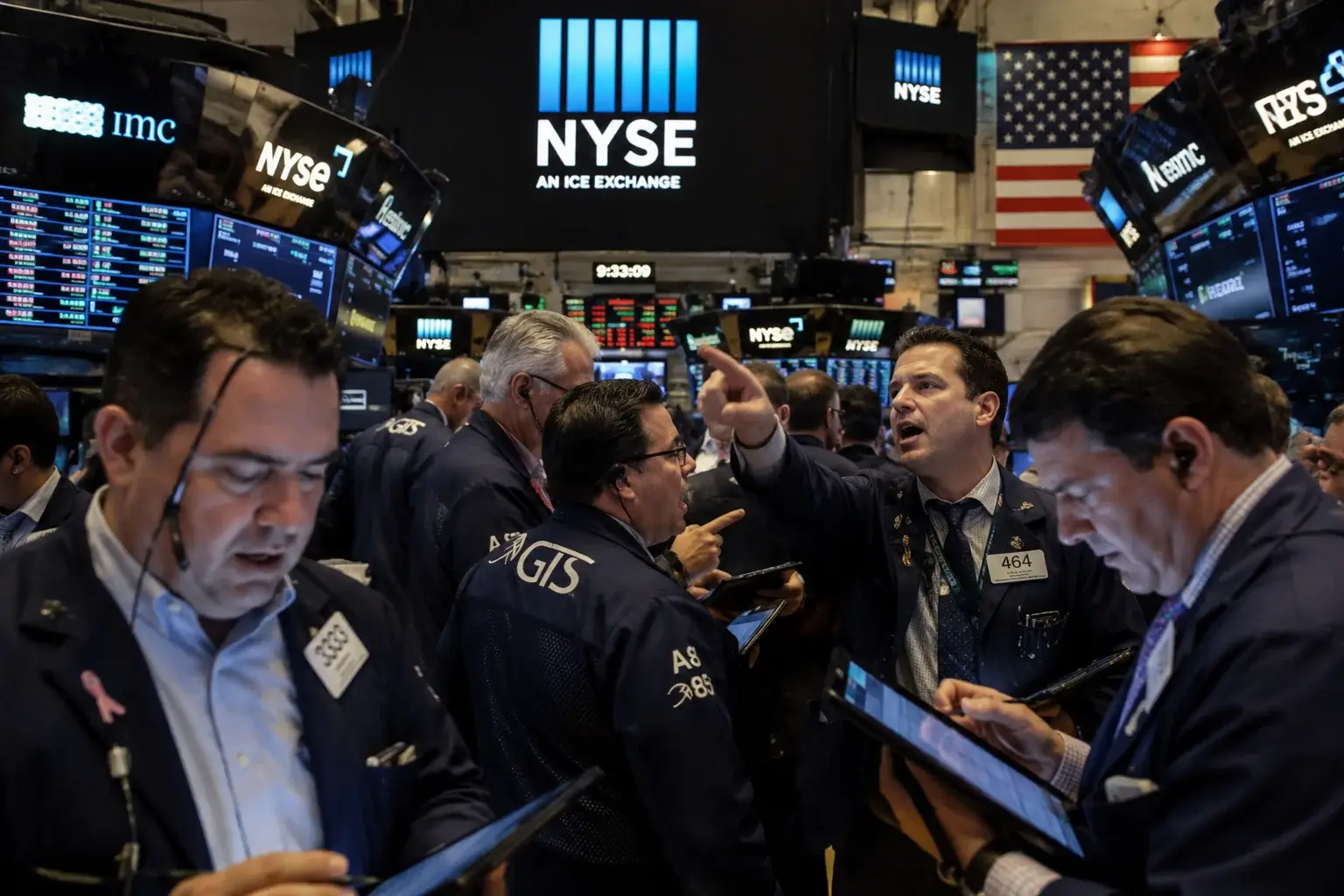
The S&P 500 was trading at 7,393.34, down 35.44 points or 0.48%, roughly twenty-five minutes into the session. The Nasdaq Composite was off 0.69% and the Dow Jones Industrial Average was carrying the heaviest drag at 1.15%, an inversion of the rotation that has defined the last three sessions. The Dow's underperformance is worth sitting with — this is the index that closed higher on Tuesday by 537.24 points, or 1.03%, to 52,747.32, its third straight winning day, and it is now the one giving back the most.
Tuesday's closing marks are the anchors for everything that follows. The S&P 500 finished at 7,428.78, up 0.21%. The Nasdaq Composite ended at 24,876.91, down 0.22% — a fifth session where the broad tape and the tech tape refused to agree. The split has been mechanical: money leaving semiconductors, money arriving in staples, industrials and healthcare.
Futures gave a preview of the disagreement. In the pre-open, S&P 500 contracts traded at 7,453.75, off 0.15%, while Dow futures sat at 52,497, down 447 points or 0.84%. Nasdaq-100 futures held at 27,869.75, off 0.19%, and Russell 2000 futures were at 2,956.00, down 0.29%. Earlier in the overnight session those same contracts had been green — S&P futures at 7,482.00 and Nasdaq futures at 27,927.75 — before the Middle East headlines flipped the sign.
Volatility repriced accordingly. The VIX closed Tuesday at 18.21, down 2.46% on the session, then pushed to 18.89 in the pre-open, a 3.73% move higher. That is not a panic reading. It is the reading of a market that has three binary events queued up before Thursday's open and has decided to pay a modest premium for the privilege of holding through them. The bid for protection is real but disciplined, which tells you positioning going into 2:00 p.m. is lighter than it was going into Alphabet's report last Thursday.
The 2:00 P.M. Decision Is About the Vote Count, Not the Rate
The Federal Open Market Committee has held the target range at 3.50%–3.75% since December 2025, when it delivered the last cut. The effective federal funds rate sits at 3.63%. Consensus expects a fifth consecutive hold, and consensus is probably right. But the interesting number is not the rate — it is the distribution around it, which has moved violently in nine days.
Hike odds on the July meeting sat at 10.7% on July 15. By July 24 they had run to roughly 38%. By Tuesday they had settled near 35%. A one-in-three probability priced into a Fed meeting forty-eight hours before the announcement is an unusually wide band by the standards of the last decade, and it is not the product of a data surprise. It is the product of an oil market that added roughly 20% in July and a chair who has deliberately stopped telling anyone what he is going to do.
September is where the actual fight lives. Fed funds futures put a quarter-point hike at that meeting at roughly 80%. That means today's decision functions as a signalling device for a move that markets have already largely accepted. A hold with a unanimous vote reads dovish and takes some steam out of September pricing. A hold with two or three dissents in favour of a hike reads hawkish and cements it. A hike today is the tail, and it is fat enough that at least one major market-making desk went on the record expecting exactly that, arguing a surprise move would buy the chair credibility he has not yet spent.
Two structural features amplify the ambiguity. There is no Summary of Economic Projections at this meeting, so there is no dot plot to parse and no median path to anchor to. And at the June meeting — a 12-0 decision — the chair declined to submit individual projections at all, while nearly half of policymakers indicated they would support a hike at some point in 2026.
That leaves the vote tally and the 2:30 p.m. press conference carrying the full informational load. Traders will be counting dissents in the first thirty seconds of the statement, then listening for whether energy-driven inflation gets characterised as a level shift or a persistent problem. Those two framings imply completely different September outcomes, and the equity tape between 2:00 and 4:00 p.m. will be trading that distinction rather than the rate itself.
Warsh's Second Meeting Is a Communications Test Disguised as a Policy Test
Kevin Warsh has chaired exactly one FOMC meeting before this one, on June 17. He served as a Fed governor from 2006 to 2011, built a public reputation as a critic of quantitative easing, and has framed his chairmanship around a single organising commitment: returning inflation to 2% without apologising for the cost. He told Congress on July 14 that the central bank has no tolerance for persistently elevated inflation.
He has paired that hawkish rhetoric with a deliberate reduction in forward guidance — fewer signals, fewer projections, less choreography. The stated theory is that a central bank that pre-commits to a path surrenders optionality and trains markets to trade the guidance rather than the economy. The practical consequence is that the distribution of outcomes around every meeting is now wider, which is precisely why hike odds could travel from 10.7% to 38% on no new inflation print.
There is a case that he holds today regardless of how hawkish he sounds. He has stood up a series of task forces due to report from late 2026 onward, examining whether AI is raising productivity without raising prices, whether the inflation framework itself needs rebuilding, and how often the Fed should even hold press conferences. Voting to hike at his second meeting would pre-empt the answers those task forces were created to produce, and would spend political capital he assembled specifically to reshape the institution. He has also suggested that one-time price shocks from energy or AI-driven demand are not automatically inflationary — which is the intellectual permission structure for looking through a $90 Brent print.
The political layer sits underneath all of it. The chair was appointed by a president who spent the prior administration publicly attacking his predecessor for keeping rates too high, and that predecessor still sits on the Board of Governors as a voting member of this committee. A hike today would be the first increase in three years, delivered by a chair two meetings into the job, into a war-driven energy shock, against the express preference of the White House.
The honest read: the institutional and political incentives point to a hold, the inflation data and the oil tape point to a hike, and the chair has removed every mechanism that would normally let markets tell which force is winning. That is the setup, and it is why a decision nobody expects to change the rate is still capable of moving the S&P 500 more than a percent.
Brent at $89.61 Rewrites the Inflation Math the Committee Just Finished Debating
Crude did the single most consequential thing on the tape overnight. Brent futures gained 6.6% to $89.61 a barrel and West Texas Intermediate advanced 6.4% to $84.31, reversing a three-session collapse that had taken Brent down roughly 16% — its steepest such decline since 2020.
The trigger was military. US Central Command described an attempted surprise Iranian attack on American forces across the region, including ballistic missiles aimed at a US base in Jordan, all of which were reported intercepted. US and Saudi forces struck what were characterised as logistics and weapons sites in eastern Iraq in response to more than thirty drone attacks over three days. Iran-aligned militias in Iraq launched drones at oil facilities in Saudi Arabia's Eastern Region for a second consecutive day. The president told a television interviewer that Iran "is going to get a beating" and that US forces would be "hitting them hard."
The diplomatic channel that had capped prices earlier in the week is also degrading. Iran rejected an Omani proposal for shared 50-50 control of the Strait of Hormuz, insisting on full control of the inbound lane and part of the outbound route. That proposal had gained traction among Gulf states and was the mechanism markets were pricing as the off-ramp. Its rejection removes the ceiling.
Supply data is not helping. API figures showed US crude inventories fell by 3.3 million barrels last week. Brent has traded in a range of nearly $32 since July 1 — a market that has stopped functioning as a price discovery mechanism and started functioning as a headline transmission device.
For the equity market the arithmetic is direct. A 20% monthly move in crude flows into headline CPI with a lag of roughly one to two months, which puts the damage inside the window the committee will be assessing at the September meeting. It also compresses margins across transport, chemicals, packaging and any consumer business without pricing power — which is a large share of the Dow, and part of why the blue-chip index is the worst performer this morning despite having led for three sessions.
Energy equities are the offset, and the ones that were sold hardest on Monday when Brent broke below $85 are the ones with the most room to recover if $90 holds through the close.
Korea's Second Circuit Breaker in Two Days Turns a Chip Trade Into a Solvency Question
The KOSPI triggered a market-wide circuit breaker for the second consecutive session on Wednesday — the first back-to-back suspension in the exchange's history. The index ended down roughly 6% after falling as much as 12.6% intraday, following an almost 11% decline on Tuesday. It broke below 6,000 for the first time since early April.
The cumulative damage is the part that matters for US portfolios. The index has now lost roughly 40% from a peak set little more than a month ago and is tracking a monthly decline of about 35%, which would be the worst calendar month in its recorded history. Volumes were light on the way down, which is the signature of buyers stepping away rather than sellers being forced out — a distinction that matters for whether Thursday stabilises.
The concentration risk was always the flaw in the trade. SK Hynix and Samsung Electronics together account for more than half of the KOSPI's market value. A rally that made Korea the best-performing major equity market on earth this year — still up 41.5% year-to-date in dollar terms even after the rout — depended almost entirely on two memory manufacturers. When both fell together there was no diversification left to absorb it.
The contagion mapped exactly as you would expect. Samsung Electronics fell 13.4% Tuesday in its worst session in roughly two decades, then another 6% to 8% Wednesday. TSMC dropped 3.5% in Taipei. SK Hynix's US-listed ADR closed Tuesday at $130.17, down 8.98%, an all-time low since its Nasdaq listing earlier this month and 23.4% below its debut price.
South Korean officials convened an emergency meeting Wednesday to assess the market. That is a specific signal — regulators do not gather for a correction in a cyclical sector. They gather when leverage inside the retail base is unwinding faster than it can be margined, and one Asia-Pacific strategist flagged exactly that, warning that leverage within Korean equities remains high and that further unwind should be expected.
For US traders the read-through is that the marginal seller of global semiconductor exposure is currently a leveraged Korean retail account, and that seller is not price-sensitive. Samsung reports Thursday, which is the next scheduled opportunity for the selling to either exhaust or accelerate.
Record Earnings, Record Low: The Print That Broke the Memory Bid
The SK Hynix numbers deserve to be read carefully, because the headline figures and the market reaction point in opposite directions and the gap is the entire story.
Second-quarter operating profit came in at ₩60.54 trillion, roughly $42 billion, a 557% increase year over year. Revenue reached ₩79.32 trillion, about $54.5 billion, up 257% from a year earlier and 51% sequentially. Operating margin hit an all-time high of 76%. First-half revenue crossed ₩100 trillion for the first time in company history. By any historical standard these are extraordinary results from a memory manufacturer.
The stock hit a record low on them. Consensus had modelled roughly ₩64 trillion in operating profit. The miss was about 5%, which in a normal cycle produces a 3% down day. Instead the Seoul listing fell 14.7% Tuesday and as much as 19% Wednesday before closing down more than 9.6%.
What broke was not the quarter. It was the call. Management raised capital spending guidance to the high ₩40 trillion range — roughly $31 billion for the year — while saying almost nothing about shareholder returns and declining to detail the pricing structure inside its long-term customer contracts. An analyst covering the region put it plainly: lifting capex while staying silent on returns and contract pricing left investors uneasy, and given the weight of the two chipmakers on the index, there was nowhere to hide.
That combination is the specific thing memory investors have been trained by four decades of cycles to fear. Record margins plus accelerating capex plus opaque contract pricing is the profile of a company at a cyclical peak building capacity into it. Executives pushed back directly, telling investors there is no end in sight to demand. The market did not buy it.
Three structural concerns arrived in the same forty-eight-hour window and gave the miss more weight than it deserved on its own: China's CXMT completed an $8.6 billion Shanghai listing, Asia's largest IPO of 2026, with proceeds earmarked for DRAM expansion; China began domestic production of DUV lithography equipment that export controls were designed to keep out of reach; and questions resurfaced about whether Nvidia's $250 billion financing arrangement with OpenAI reflects genuine demand or circular funding.
The competitive threat is narrower than the reaction implies — CXMT competes in commodity DDR5 and LPDDR5 at a 5% to 10% discount, not in high-bandwidth memory. But narrow threats get repriced as broad ones when leverage is unwinding.
The US Semiconductor Tape Already Absorbed Most of the Damage on Tuesday
American chip names took the hit a session early, and the losers list from Tuesday's close reads like a supply-chain autopsy rather than a sector selloff.
Micron Technology closed at $819.88, down $80.32 or 8.92%, on 50.77 million shares. Intel finished at $86.28, off 5.88%, on 135.98 million shares — the heaviest volume on the tape. AMD fell 8.1%. Sandisk dropped 14.25% to $1,096.10. Seagate lost 8.53% to $747.30. The VanEck Semiconductor ETF shed more than 3%.
The equipment and packaging layer was worse, which is where the capex-cut fear actually expresses itself. Amkor Technology was the single worst performer in the market, down 24.74% to $45.69 on 18.65 million shares against a 5.59 million average. Sanmina fell 17.46% to $172.43. Ichor Holdings dropped 13.03%, Cohu 11.17%, Ultra Clean Holdings 10.89%, FormFactor 10.70%, ACM Research 9.94%, AXT 10.69%. Vishay Intertechnology lost 12.00%, TTM Technologies 12.14%, Materion 13.28%.
Corning was the large-cap casualty, down 12.10% to $126.01 on 44.13 million shares versus a 15.29 million average — roughly triple normal turnover. Coherent fell 10.31% to $243.33 on 7.15 million shares.
Read the 52-week columns and the mechanics become obvious. Amkor is still up 142% over twelve months. Ichor is up 273%. AXT is up 1,991%. TTM is up 155%. Ultra Clean is up 254%. These are not broken businesses being marked down on fundamentals. These are the most crowded, most levered expressions of the AI infrastructure trade being unwound by holders who are sitting on enormous gains and have decided the risk-reward has inverted.
Micron traded higher in Wednesday's pre-open, with the bull case resting on long-term AI supply agreements that improve earnings visibility and HBM margins that remain structurally above commodity DRAM. Nvidia closed Tuesday at $197.01, up 0.25% — essentially unchanged while the complex around it was cut apart. That divergence is the tell. The market is not selling AI compute demand. It is selling the capital intensity required to serve it, and it is selling the names furthest down the supply chain from the customer.
Whether that distinction survives contact with tonight's hyperscaler capex guidance is the question the next six hours answer.
Microsoft Reports After the Bell With Azure and Capex on Opposite Sides of the Ledger
Microsoft delivers fiscal fourth-quarter results covering April through June after the close, with the call at 5:30 p.m. ET — three and a half hours after the Fed statement. Consensus sits at $4.24 in earnings per share, up 16% year over year, on revenue of roughly $87.62 billion, up about 15%.
Nobody is trading the print. Beat probability is priced near 95%. The stock moves on two numbers that appear nowhere in the headline release: the Azure growth rate and the fiscal 2027 capital spending framework.
Azure has been running in the high-30% range. Holding that line is the bar. A deceleration into the low 30s, even with a revenue and earnings beat, reopens the argument that AI workloads are being pulled forward rather than compounding. Copilot monetisation detail matters for the same reason — usage figures without revenue attached have stopped being persuasive.
Capex is the live wire. Consensus has Microsoft's spending nearly tripling from $65 billion in fiscal 2025 to roughly $190 billion in fiscal 2027, an estimate that has climbed $60 billion since January. Estimates approaching $230 billion without a corresponding Azure reacceleration trigger genuine free-cash-flow repricing. The counterweight is a $627 billion commercial backlog, which is management's strongest argument that the spending is demand-led rather than speculative.
The precedent is fresh and ugly. Alphabet guided full-year 2026 capital spending to $195–205 billion last Thursday and the stock fell 7% on the day, dragging the Nasdaq down more than 2% in the session that followed. That reaction is why a softer fiscal 2027 capex outlook would now be received as relief rather than as a demand warning — an inversion of how this market treated the same disclosure twelve months ago.
Valuation has already done some of the work. Microsoft is down roughly 21% year-to-date and trades near 23 times trailing earnings against a five-year average closer to 32.5. The consensus 2027 multiple has compressed from 31 times last July to about 20 times now. The stock has traded down 4% since the last earnings release despite that release being a beat.
Amazon follows Thursday. Azure holding its bar with capex framed as demand tonight, then AWS confirming acceleration tomorrow, is the combination that converts last week into an Alphabet-specific event. Anything short of it keeps the burden of proof on the spenders.
Read More
-
Yen Stalls at 160 Despite a 3% JGB and Tokyo Core CPI at 2.0% — Intervention Sits at 164, Friday's Payrolls Decide
02.09.2026 · TradingNEWS ArchiveEnergy
-
QQQI ETF Pays 13.96% While The Nasdaq-100 Rolls Over — Why Section 1256 Is Worth More Than The Yield
14.09.2026 · TradingNEWS ArchiveStocks
-
XRP ETFs Took $19M In A Week After A $110M Record — Why The Filings Tell A Different Story Than The Flows
14.09.2026 · TradingNEWS ArchiveCrypto
-
US Gas Holds $2.88 While Europe Pays $28 — Why Only A Tenth Of The War Premium Reaches Henry Hub
14.09.2026 · TradingNEWS ArchiveCommodities
-
Yen Holds Near February Highs As Tokyo Prepares Its Highest Rate Since 1995 — Why The Yield Gap Will Not Move
14.09.2026 · TradingNEWS ArchiveForex
Meta Faces a Market That Punished Its Last Two Beats
Meta Platforms reports alongside Microsoft, and its setup is stranger. Consensus expects earnings of roughly $7.18 to $7.23 per share on revenue of about $60.22 billion, up close to 27% year over year. Operating profit is modelled near $21.5 billion, with Family of Apps contributing roughly $26 billion and Reality Labs losing around $5.0 billion.
The revenue growth rate is exceptional. The earnings growth rate is approximately 1%. That gap — 27% top line, flat bottom line — is the entire investment debate compressed into two numbers, and it is the direct arithmetic consequence of AI infrastructure spending running ahead of AI revenue.
Full-year 2026 capex consensus sits at $136.7 billion, raised more than $10 billion since last quarter and up roughly $67 billion from fiscal 2025. But the first quarter told a different story: Meta spent $19.84 billion against a Street estimate near $27.6 billion. An underspend of nearly $8 billion in a single quarter either means the full-year number gets cut, or it means the back half is enormous. Both readings will find advocates on the call.
The behavioural history is what should worry longs. Meta beat on revenue and earnings last quarter and fell 6% to 7% after hours purely on the capex line. A beat alone has not moved this stock higher in either of its last two reports. The market has stopped grading the quarter and started grading the spending plan.
Valuation offers some cushion. The stock is down about 10% and trades near 18 to 22 times forward earnings depending on the estimate used, below its own three-year average of roughly 23 times, on gross margins around 82%. Ad pricing power has not cracked.
The strategic gap is that Meta is the only major hyperscaler without a cloud business to point to as proof its AI spending earns money outside advertising. Reported discussions about supplying compute to a large AI lab would be the first concrete answer to that, and any directional commentary on the call would be the most meaningful new information in the release.
There is a quieter signal already visible: bond investors are demanding materially higher yields to fund Meta's data centre buildout than they were nine months ago. The credit market has begun pricing AI infrastructure risk independently of the equity, and it is pricing it wider.
Hyperscaler Capex Is Now a $682 Billion Line Item and the Market Wants the Payback Schedule
Step back from the individual prints and the aggregate is what the tape is actually trading. Consensus 2026 capital spending across the hyperscalers is projected at $682 billion, up from $384 billion in 2025 — an increase of nearly $300 billion in a single year. The 2027 estimate sits at $878 billion. That is more than $1.5 trillion committed across two years.
Spending is projected to grow faster than the revenue it is supposed to generate. That is the sentence the equity market has spent five sessions repricing, and it is why an earnings season with S&P 500 profit growth projected at 24.7% — the second consecutive quarter above 20% — has produced a Nasdaq that closed lower on Monday, Tuesday and is lower again Wednesday morning.
The circularity concern is the accelerant. Nvidia's $250 billion financing commitment to OpenAI, part of a broader deal package reported near $750 billion, raises a structural question that no individual company's earnings can answer: how much of the demand signal flowing into semiconductor order books originates from capital the semiconductor complex itself supplied. That question has no clean answer, which is precisely why it repriced the equipment and packaging names hardest on Tuesday.
The competitive dimension arrived at the same moment. CXMT's $8.6 billion Shanghai listing funds DRAM capacity expansion at a 5% to 10% price discount to the incumbents in commodity segments. China's move into domestic DUV lithography production undercuts the assumption that export controls preserve a permanent technology gap. Neither development threatens high-bandwidth memory economics today. Both compress the terminal value assumptions that justify current capacity commitments.
What the market wants tonight is unglamorous: a capex number framed against a contracted backlog, with a timeline. The bull case does not require spending to fall. It requires spending to be visibly attached to signed demand. Alphabet's guidance failed that test last Thursday because the number arrived without the framing, and the stock lost 7% in a session.
Two of the largest spenders get their turn in roughly six hours, with a Fed decision in between. Qualcomm and Arm Holdings also report after the bell, which adds a semiconductor-specific data point to a night already overloaded with them.
Procter & Gamble and Ford Split the Consumer Verdict Before the Open
The morning's earnings tape delivered a clean divergence on the health of the American consumer, and both halves are informative.
Procter & Gamble fell more than 3% in the pre-open after missing revenue expectations. Net sales rose 2% year over year against a $21.38 billion consensus, with organic sales — stripping out currency, acquisitions and divestitures — coming in soft. The segment detail is where the read lives. Beauty led with volume up 3% and organic sales up 4%. Fabric and home care was the only other division to post volume growth, at 1%. Health care posted the steepest volume decline at 3%, with oral care softening in North America and Greater China. Baby, feminine and family care fell 1%, as did grooming.
For the full fiscal year the company reported net sales of $87.0 billion, up 3%, with organic growth of just 1%, and returned more than $15 billion to shareholders. Volume grew in only one quarter of the entire fiscal year. That is a company with premium-tier pricing meeting a consumer who has started making shampoo and detergent last longer, or switching to store brands outright. Management had already flagged a challenging geopolitical and economic environment and guided full-year earnings toward the low end of its range.
Ford went the other way, jumping 5% after beating expectations and raising its 2026 forecast. The stock closed Tuesday at $14.96, up 1.91%, on 64.41 million shares. A financed-purchase business raising guidance into a rate environment where a hike is 35% priced is a genuinely constructive data point, and it complicates the tidy narrative that high borrowing costs have broken big-ticket demand.
Elsewhere in the results flow: Visa reported revenue of $11.63 billion against a $11.39 billion estimate, up 14.4% year over year, with adjusted earnings of $3.32 per share beating by 2.8% — cross-border volumes holding up. Boeing posted a core loss of $0.76 per share against Street estimates in the $0.28 to $0.34 loss range, though volume lifted results across all three segments against a $695 billion backlog. Wingstop beat on earnings at $1.18 adjusted but missed on revenue with same-store sales down 7.5%. Fiverr fell 15.3% pre-market to $9.82 and Clarivate dropped 15.0% to $2.04, both on results.
Starbucks and Chipotle also report today, adding two more consumer readings before the week is out.
Bloom Energy and the Power Trade Refuse to Follow the Chips Lower
The most instructive divergence on the tape is inside the AI infrastructure complex itself, where the power and electrification names are trading on their own fundamentals rather than on semiconductor sentiment.
Bloom Energy surged 11% in the pre-open after posting second-quarter revenue of $1.065 billion against an $822.77 million consensus — a 30% beat, up 166% year over year and 42% sequentially, with product revenue up 215%. Operating income climbed 737% to $240 million. Adjusted earnings came in at $0.78 per share against a $0.40 estimate, nearly double.
The context makes it sharper. Bloom closed Tuesday at $167.12, down 11.19% on 23.45 million shares against a 12.63 million average, having been dragged lower with everything else attached to the data centre theme. The stock is still up 442% over twelve months. It fell on sentiment and recovered on numbers inside eighteen hours.
The rest of the power and infrastructure complex was sold hard Tuesday and is worth watching for the same snapback. Sterling Infrastructure lost 15.21% to $538.09 despite being up 140% over twelve months. IES Holdings fell 9.90% to $543.49, still up 77% on the year. Solaris Energy Infrastructure dropped 10.04% to $47.31. Fervo Energy fell 11.93% to $21.12. Legence lost 12.45%. Vertiv fell 6.27% to $269.56. Amphenol dropped 3.64% to $143.85.
These businesses build and power the buildings that house the chips. Their revenue is contracted and backlogged, with recognition schedules that extend well past any single quarter's capex guidance. Selling them on a memory manufacturer's margin miss in Seoul is a correlation trade, not a fundamental one — and Bloom's print is the first evidence this week that the two can be separated when the numbers are unambiguous.
If tonight's hyperscaler guidance frames capex as contracted rather than speculative, this is the group with the most direct upward re-rating path, because it is the group that was sold for the wrong reason.
Rates, Gold, Bitcoin and the Cross-Asset Frame Into 2:00 P.M.
The bond market is the cleanest expression of what today actually is. The 10-year Treasury yield rose to 4.63%, up 2 basis points from Tuesday's 4.59% close, which itself capped a three-session decline driven by falling oil. The yield is up 16 basis points over the past month and 25 basis points higher than a year ago.
That is a market pricing higher-for-longer without pricing crisis. A yield holding in the low 4.60s into a meeting with 35% hike odds attached tells you the bond market believes the September hike is more likely than the July one and has largely already discounted it. The equity risk today is therefore asymmetric in a specific way: a hold with unanimous support is a modest positive that has partially been paid for, while a hike or a heavily dissenting hold is a repricing event that has not been.
Gold futures traded at $4,075.60, down 0.56%, after swinging between $4,013.20 and $4,096.90 through the overnight session — an $84 range in a single night, which is its own commentary on how little conviction exists in either direction ahead of the statement. A geopolitical escalation that lifts Brent 6.6% and fails to lift gold is a market weighing the inflation-hedge case against the higher-real-rates case and finding them roughly balanced.
Bitcoin opened the session at $63,853.49 and traded at $64,244.18 through the morning, up about 0.2%, with sentiment readings sitting deep in fear territory. Ethereum opened at $1,919.73, up 1.5%, before easing to $1,904.82. Crypto is trading as a pure liquidity asset here — a hike tightens the screw directly, and positioning reflects that.
The dollar has firmed through the week, shrugging off both the earlier crude collapse and the subsequent spike, which is unusual and points to rate expectations dominating the currency's price action rather than terms of trade.
Into the close, three sequential markers matter. The 2:00 p.m. statement and the dissent count. The 2:30 p.m. press conference and whether energy inflation is characterised as transitory or persistent. Then 4:00 p.m., when Microsoft and Meta hand the market the capex numbers that have driven every session since Alphabet's guidance last Thursday. Qualcomm and Arm land in the same window. Amazon follows Thursday, Samsung reports in Seoul overnight.
Nothing gets resolved before 6:00 p.m. ET, and the S&P 500 at 7,393 is holding a level that assumes at least two of the three go the market's way.