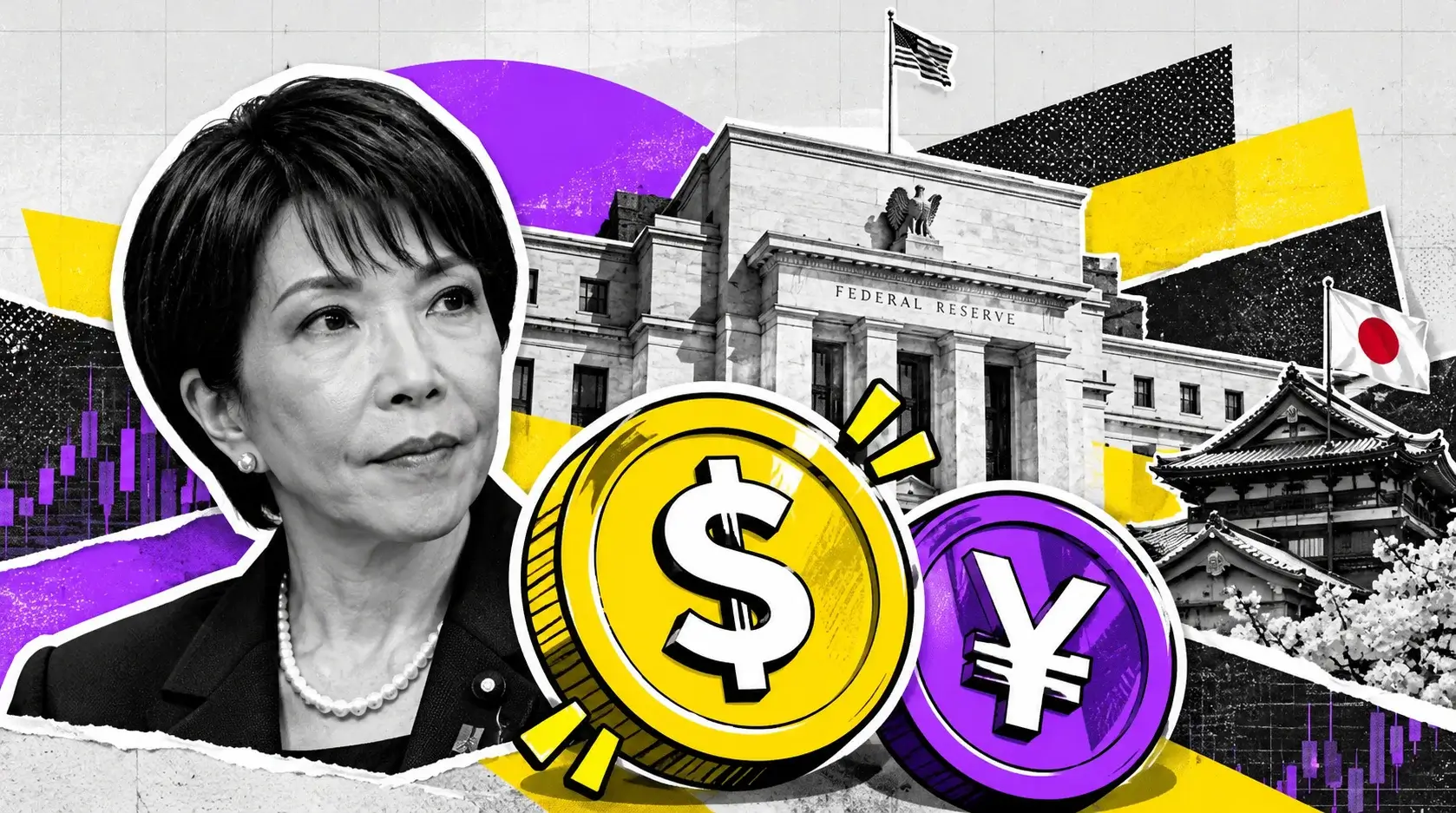
USD/JPY Price Forecast - USD/JPY at 159.40 — Trump's Iran Escalation Crushes the Yen, 160.40 Resistance From 1990 Looms
Japan's 90% Middle East oil import dependency is the yen's structural weakness — every Iran escalation worsens Japan's trade balance while simultaneously strengthening | That's TradingNEWS
Key Points
- USD/JPY surged to 159.50 before settling at 159.40 — 90 pips below the critical 160.40 resistance from 1990 that, if broken, signals major yen destruction.
- Fed at 3.75% vs BoJ near zero = 375bps rate differential; 10-year Treasury yield holds 4.30%, making the carry trade overwhelmingly dollar-positive.
- BoJ April meeting prices 70% hike odds, but even a 25bps move leaves a 300bps gap — insufficient to reverse the structural yen weakness driving USD/JPY higher.
USD/JPY is trading near 159.40 on Thursday, April 2, 2026, having surged sharply earlier in the Asian and European sessions before trimming intraday gains during the American session as the Iran-Oman Hormuz protocol headline briefly reversed risk sentiment across every asset class simultaneously. The pair's Thursday trajectory tells the complete story of the competing forces driving it: a strong risk-off open driven by Trump's Wednesday night escalation address pushed USD/JPY from its prior session close toward 159.50 and beyond, the Iran-Oman Hormuz protocol headline then triggered a brief pullback as the dollar's safe-haven premium compressed marginally, and the pair settled back into the 159.37 to 159.50 zone as the market concluded — correctly — that the Hormuz headline represented potential diplomatic signaling rather than actual Hormuz reopening.
The 159.40 level sits within an extraordinarily consequential technical zone. The pair recovered strongly after a two-day corrective move that had pulled it back toward the 20-day Exponential Moving Average near 158.70 — a level that held precisely and from which the pair bounced sharply on Trump's Wednesday address, confirming that the 20-day EMA is functioning as a reliable dynamic support for the current uptrend. The session range on Thursday extended from approximately 158.30 at the prior week's pullback low to 159.70 at Thursday's intraday high, with the pair settling near the middle of that range and holding above both the 20-period and 100-period Simple Moving Averages on the 4-hour chart. The US Dollar Index (DXY) was up 0.5% to near 100.00 on the day — a broad dollar strengthening event that was providing tailwind for USD/JPY independently of Japan-specific factors.
What Trump's Wednesday Address Did to USD/JPY — and Why the Pair Responded With a Sharp Rally Rather Than a Hedge
The conventional wisdom about USD/JPY during periods of geopolitical stress is that the Japanese yen strengthens as a safe-haven currency — a historical pattern established during the 2008 financial crisis, the 2011 Fukushima disaster, and various other risk-off episodes over the past two decades. Thursday's price action is a direct refutation of that pattern, and understanding why it is breaking down is essential for positioning in USD/JPY through the remainder of the Iran war.
Trump's Wednesday night address vowed to hit Iran "extremely hard" over the next two to three weeks, threatened strikes on Iranian energy infrastructure, and provided zero timeline for withdrawal or diplomatic resolution. The reaction in USD/JPY was a sharp rally rather than a yen-strengthening safe-haven move — the opposite of what the historical playbook would predict. The reason is structural and specific to Japan's economic position in the current conflict: Japan is a massive net importer of energy from the Middle East. Approximately 90% of Japan's crude oil imports come from Middle Eastern sources, and the Strait of Hormuz handles a critical proportion of those flows. When Trump escalates the Iran war and extends the timeline for Hormuz disruption, Japan faces an energy cost shock that is proportionally more severe than virtually any other major economy — including Europe. Higher oil prices directly worsen Japan's trade balance, increase input costs throughout the Japanese manufacturing sector, and create inflationary pressure that is imported rather than domestically generated.
This dynamic inverts the traditional safe-haven yen relationship in the specific context of the Iran war: rather than strengthening as a risk-off destination, the yen weakens when the war escalates because escalation is uniquely negative for Japan's fundamental economic position. The dollar simultaneously strengthens because the United States, as a net energy exporter, benefits from higher oil prices rather than suffering from them — and because the Fed's frozen rate stance at 3.75% maintains the interest rate differential that makes dollar-denominated assets more attractive than yen-denominated alternatives. The confluence of these two factors — Japan's energy import vulnerability and the US interest rate advantage — creates a USD/JPY environment where traditional safe-haven currency flows are reversed and the pair rises rather than falls on geopolitical escalation.
The 10-Year Treasury Yield at 4.30% — The Single Most Important Number for USD/JPY
Christopher Lewis, who has more than 20 years of experience trading forex and commodities, was explicit about what he is watching above all else in the USD/JPY trade: "The 10-year yield is the first thing I'm watching, and I know I've been putting this at the front of every video for the last couple of weeks, but quite frankly, it's the one thing that seems to matter." The 10-year Treasury yield is currently hovering near the 4.30% level — a critical technical and psychological threshold that the market has been testing repeatedly on both sides without achieving a decisive directional break.
The relationship between US 10-year Treasury yields and USD/JPY is one of the most mechanically reliable correlations in global forex markets. Japan's overnight policy rate remains near zero following the Bank of Japan's cautious tightening cycle that has been slower and more tentative than any market participant anticipated when it began. The interest rate differential between the Fed's 3.75% target rate and the BoJ's near-zero policy rate is approximately 375 basis points at the short end of the curve — one of the largest rate differentials between two major economy central banks in modern history. At the longer end of the curve, the 4.30% US 10-year yield compared to Japanese Government Bond yields that remain significantly lower despite BoJ yield curve control relaxation creates a carry trade dynamic that has been the primary structural driver of USD/JPY's upward trajectory throughout 2024, 2025, and into 2026.
Lewis noted that following Trump's Wednesday address, the 10-year yield shot straight up before pulling back to the 4.30% level — a move he described as somewhat surprising given that "he didn't really say anything that should have been much of a surprise during that speech." The explanation for the yield jump is that fixed income markets were pricing in increased near-term inflation risk from extended Iran war energy disruption, which reduces the probability of Fed rate cuts and increases the probability that yields remain elevated or move higher. A Fed that cannot cut rates because energy-driven inflation is running at 3.6% per BofA's forecast — while simultaneously being unable to hike because growth is slowing toward 2.3% — creates a frozen rate environment that maintains the 375 basis point short-end differential in the dollar's favor indefinitely rather than gradually eroding it through rate cuts as had been widely anticipated entering 2026.
For USD/JPY specifically, every 10 basis point increase in the US 10-year yield tends to generate meaningful upward pressure on the pair through the carry trade channel. Institutional money that borrows cheap yen and invests in higher-yielding dollar assets — the classic yen carry trade — becomes more attractive as the yield differential widens. Conversely, any significant decline in US 10-year yields — triggered by a ceasefire announcement, a sharp deterioration in US economic data, or a sudden Fed dovish pivot — would compress the carry trade differential and create the conditions for a rapid USD/JPY unwinding that could take the pair back toward 157 or below in a short period.
The 160.40 Resistance Wall From 1990 — The Most Important Technical Barrier in Decades
The technical analysis of USD/JPY cannot proceed without confronting the 160.40 resistance level — a price that represents the highest point the yen has traded against the dollar since 1990, the year Japan's economic bubble was still inflating before its catastrophic three-decade deflation. Lewis described this level with appropriate gravitas: "We are pressing or at least had been until a couple of days ago, a major resistance barrier in the form of the 160.40 yen level or so, which was a swing high going all back to 1990. We have a lot of questions to ask here and if we do breakout to the upside, it will absolutely destroy the Japanese yen."
The significance of a 36-year resistance level cannot be overstated in technical analysis. When a price level has held as resistance for over three decades, it represents the accumulated memory of an entire generation of market participants — every institutional trader who has bought yen weakness near 160 and been rewarded for it, every Japanese Ministry of Finance intervention that has occurred near that level, and every technical analyst who has maintained sell positions against the yen at that price. Breaking above 160.40 on a sustained daily close basis would not just be a technical breakout — it would be the demolition of a 36-year structural resistance barrier that has contained every prior dollar rally against the yen.
Thursday's price action at 159.37 to 159.50 sits approximately 90 to 100 pips below that 160.40 resistance ceiling — within striking distance if the current momentum is maintained, but not yet at the level where the critical test occurs. The pair has been consolidating near this zone after approaching 160.40 in prior sessions before pulling back during the two-day corrective move that brought USD/JPY back toward the 20-day EMA at 158.70. The recovery from that corrective pullback to the current 159.40 level is the first indication that buyers are reestablishing control after the brief consolidation. Whether the next attempt at 160.40 succeeds or fails will be one of the most consequential technical events in forex markets this year.
On the 4-hour chart, the immediate resistance progression is clearly mapped: 159.39 as the first minor resistance, 159.70 as the more significant barrier where recent consolidation highs converge, and 160.00 as the round-number psychological level that precedes the 160.40 all-time resistance. A daily close above 159.70 would shift the short-term momentum picture from neutral to constructively bullish and increase the probability of testing 160.00 within days. A daily close above 160.40 on sustained volume would be the signal to add aggressively to long USD/JPY positions with targets at 161.50 and potentially 163.00 in the medium term.
Support Structure: 159.00, 158.70 EMA, 158.20 Channel Floor, 158.00 Critical Level — Where the Buyers Are
The support structure beneath Thursday's 159.40 trading level is dense and well-defined, providing multiple layers of protection against a sustained bearish reversal. Immediate support emerges at 159.32, with additional protection at 159.24 — both sitting close to the 20-period SMA on the 4-hour chart and reinforcing this area as the key floor for the current upswing. The 20-day Exponential Moving Average near 158.70 represents the first major dynamic support and is the level that held precisely during the two-day corrective move earlier this week — its defense at that level was the signal that the medium-term uptrend remains intact.
Below the 20-day EMA, the ascending parallel channel floor near 158.20 is the next significant support — a level that coincides with prior consolidation support and the channel structure that has been guiding USD/JPY higher since mid-March. Lewis identified the 158 yen level as "a significant support level that I think is backed up by the 50-day EMA, so I'll be watching that very closely." The confluence of the channel floor, the 50-day EMA, and the round number at 158.00 creates a support zone of exceptional technical significance. Lewis was explicit about his positioning logic: "As long as we can stay above the 158 yen level, I'm looking for short-term bounces that I can buy into. I have no interest in shorting this pair."
A break below 158.00 on a sustained daily close basis would represent a material deterioration in the technical structure and would expose the 157.40 level where prior consolidation base aligns with the channel projection below. Below 157.40, the analysis from RoboForex points toward 157.70 as an initial target in a more aggressive corrective move, with a potential extension toward 156.00 in the most bearish scenario. However, Lewis's explicit statement that he has "no interest in trying to short this market" reflects the broader analytical consensus that the interest rate differential, Japan's energy import vulnerability, and the geopolitical environment create structural headwinds for yen strength that make sustained USD/JPY declines difficult to maintain regardless of short-term catalysts.
Bank of Japan April Meeting: 70% Rate Hike Probability and What It Actually Means for the Yen
Markets are currently pricing approximately a 70% probability of a Bank of Japan rate hike at the April 27-28 meeting — a figure that sounds dramatically hawkish but requires careful interpretation before drawing conclusions about its USD/JPY implications. New BoJ board member Toichiro Asada, who joined the policy council ahead of the April meeting, has explicitly signaled a preference for a cautious, data-driven approach — language that is essentially the same language every BoJ official has used for the past three years to describe their framework while repeatedly disappointing markets with more gradual tightening than expected.
The 70% hike probability reflects the market's acknowledgment that Japan's inflationary environment — driven heavily by imported energy costs from the Iran war's oil price surge — is making it increasingly difficult for the BoJ to justify holding rates near zero. Japan's fuel prices reached record levels in March, and the war's impact on Japan's energy import costs is directly worsening the trade balance and creating inflationary pressure that is visible in consumer price data. The government has provided partial relief through subsidies that have "slightly eased" the burden according to RoboForex — but subsidies address price perception rather than underlying cost reality, and the fiscal cost of maintaining those subsidies in a high-oil-price environment is itself becoming a constraint on government finances.
However, the 70% hike probability must be contextualized against the BoJ's historical pattern of underdelivering relative to market pricing. In March, markets expected the Bank to cut its policy rate and no move was delivered. In early April, futures markets were pricing in expectations of a 75-basis-point hike by year-end — a forecast that Morningstar's Forex analysts described as "overly dramatic" and that BoJ Governor Ueda has taken care to avoid endorsing. The concern for BoJ policymakers is that hiking rates into an energy-shock environment where Japan's growth is already under pressure from import cost increases could further compress economic activity without meaningfully reducing the imported inflation that is driving CPI higher. Hiking interest rates does not reduce oil import costs — it only increases the domestic cost of capital on top of already elevated energy costs.
Even if the BoJ does deliver a 25 basis point hike at the April meeting — taking its overnight rate from approximately 0.50% toward 0.75% — the interest rate differential with the US dollar at 3.75% would narrow from approximately 325 basis points to approximately 300 basis points. That 25 basis point narrowing is insufficient to meaningfully reduce the carry trade incentive that has been driving institutional money into dollar-denominated assets and out of yen-denominated assets. The yen would need to see the BoJ hiking to at least 1.50% to 2.00% — a level that would begin to materially compress the carry differential — before the structural case for USD/JPY weakness becomes compelling on fundamental grounds. At 0.50% to 0.75%, the BoJ's rate is still delivering real negative returns to yen holders when compared to US Treasury yields at 4.30%.
Japanese Intervention Risk: The Ministry of Finance Warning That Has Limited Lasting Impact
Japanese authorities have repeatedly reiterated warnings about excessive yen weakness — a pattern of verbal intervention that has become a familiar feature of USD/JPY price action every time the pair approaches the 160 level. These warnings have historically produced short-term yen strengthening of 2 to 5 percentage points followed by a resumption of the underlying trend as the interest rate differential reasserts itself as the dominant pricing driver. The most recent episodes of actual Bank of Japan market intervention — when the Ministry of Finance authorized the BoJ to sell dollars and buy yen in the open market — occurred when USD/JPY was trading well above 160 at levels that attracted significant political attention within Japan.
Thursday's analysis from FXStreet noted that "Japanese authorities have reiterated warnings about excessive Yen weakness, suggesting that intervention risks remain elevated if volatility intensifies. However, without a decisive policy shift from the BoJ, these warnings have had limited lasting impact." That assessment is accurate and precisely captures the structural problem with verbal intervention in the current environment: the market understands that the conditions driving yen weakness — the interest rate differential, Japan's energy import vulnerability, and the Fed's frozen rate stance — are not going to be resolved by verbal warnings or even moderate actual intervention. Real intervention has only temporary effect when the structural drivers remain intact.
The intervention calculus for the Ministry of Finance is also complicated by the current geopolitical environment. If the Bank of Japan were to intervene aggressively — selling dollars and buying yen in size — it would effectively be taking the opposite side of a trade that reflects genuine underlying yen weakness driven by Japan's structural energy import vulnerability. That intervention would be defending an exchange rate that the fundamentals do not support, consuming Japan's foreign exchange reserves in the process. Japan holds approximately $1.2 trillion in foreign exchange reserves, which represents substantial intervention capacity — but market experience has shown that fighting a fundamental trend with reserve depletion is a losing strategy over time, regardless of the size of reserves. The Ministry of Finance is aware of this, which is why verbal warnings are deployed far more frequently than actual intervention.
USD/JPY Carry Trade Dynamics: The $6.6 Trillion Daily Forex Market and Japan's Role as the World's Funding Currency
The US dollar is the most heavily traded currency in the world, accounting for over 88% of all global foreign exchange turnover — approximately $6.6 trillion in transactions per day. Within that enormous flow, the USD/JPY pair represents one of the most actively traded currency pairs globally because it sits at the center of the global carry trade — the mechanism by which institutional money borrows in low-interest-rate currencies (primarily the yen) and invests in higher-yielding currencies and assets (primarily dollar-denominated securities).
The carry trade dynamic in USD/JPY is currently being supported by the most extreme interest rate differential the pair has experienced since Japan's long era of near-zero rates began in the 1990s. At 375 basis points between the Fed's 3.75% and the BoJ's approximately zero to 0.50% rates, the annualized carry income from being long USD/JPY represents extraordinary income for institutional money deployed in this trade. A fund that borrows yen at 0.50%, converts to dollars, and invests in US Treasuries at 4.30% captures approximately 380 basis points of annualized carry — effectively 3.8% per year before any currency appreciation benefit. When USD/JPY is also moving higher — as it has been — the total return for carry traders is carry income plus currency appreciation, creating a compounding return that drives institutional positioning heavily toward long USD/JPY.
The risk to carry trade positions — and the mechanism by which USD/JPY can see rapid, violent declines — is the carry trade unwinding. When risk appetite deteriorates sharply in a manner that is not offset by dollar safe-haven strength, carry traders simultaneously exit their yen-funded positions to reduce leverage, creating a surge of yen buying and dollar selling that can move USD/JPY 5 to 10 percentage points in hours. The most famous example was August 2024, when an unexpected BoJ rate hike combined with disappointing US economic data triggered a massive carry trade unwinding that sent USD/JPY from approximately 155 to below 142 in a matter of days. The current environment — where the BoJ is signaling potential hikes and the US economic data is showing some softening from the energy shock — contains the ingredients for another such episode, though the magnitude of any unwinding would depend on how extreme current positioning is and how quickly the triggering catalyst develops.
Read More
-
Yen Stalls at 160 Despite a 3% JGB and Tokyo Core CPI at 2.0% — Intervention Sits at 164, Friday's Payrolls Decide
02.09.2026 · TradingNEWS ArchiveEnergy
-
QQQ ETF ($706.22) Slides 7.4% Below Its High as the Market Reprices the AI Capex Bill — $686.57 Target if $700 Breaks
22.10.2026 · TradingNEWS ArchiveStocks
-
XRPI ($7.00) and XRPR ($10.74) Slide Toward 52-Week Lows as Spot XRP ETF Flows Stall at $708,510
22.10.2026 · TradingNEWS ArchiveCrypto
-
NG ($2.775) Decoupled From Europe’s €88 Gas Crisis as LNG Feedgas Hits 18.9 Bcf/d — $3.30 Upside on Cold Weather
22.10.2026 · TradingNEWS ArchiveCommodities
-
Dollar-Yen (157.35) Loses 157.65 as the Yen Rallies on Haven Demand — 155 Target if 156 Breaks
22.10.2026 · TradingNEWS ArchiveForex
ADP and ISM Manufacturing Data: The US Economic Signals Strengthening the Dollar Case
Thursday's USD/JPY rally was supported not just by geopolitical safe-haven flows but by a genuine positive surprise in US domestic economic data. Upbeat US ADP Employment Change and ISM Manufacturing PMI data for March were cited as providing additional support for the dollar — data that confirmed the US labor market and manufacturing sector are holding up better than feared under the energy shock conditions that would typically be expected to produce deterioration. The ADP private sector employment reading came in above expectations, and the ISM Manufacturing PMI data reinforced the picture of an economy that is absorbing the Iran war's energy price shock without experiencing the rapid deterioration that would force a Fed pivot toward rate cuts.
This data context matters for USD/JPY positioning because it reduces the probability of the specific scenario that would most damage the dollar's case — a sharp US economic deterioration that forces the Fed to cut rates even while inflation is elevated, narrowing the interest rate differential that is the pair's structural foundation. If US employment and manufacturing data continue to surprise on the upside despite $100-plus oil prices, the Fed's frozen rate stance is more easily maintained, the 375 basis point differential is preserved, and the carry trade incentive remains intact. Conversely, if the data deteriorates sharply — as the March NFP report releasing Friday morning could potentially indicate, given February's -92,000 print — the calculus changes rapidly in ways that could compress USD/JPY back toward 158 and potentially lower.
The initial jobless claims data released Thursday morning at 202,000 — well below the 212,000 consensus — added another constructive US labor market data point to the week's picture. The four-week moving average on continuing claims dropped to its lowest level since September 28, 2024, confirming that the labor market disruption from the energy shock has not yet materialized in actual layoff data despite the macro anxiety that the Iran war has generated. A labor market that remains tight at 202,000 weekly claims is a labor market where the Fed has limited justification for rate cuts regardless of energy-driven inflationary pressure — and a Fed that cannot cut is a dollar that maintains its yield advantage against the yen.
USD/JPY Technical Outlook: Four Specific Scenarios With Price Targets
The technical picture for USD/JPY at 159.40 presents four distinct scenario pathways that can be mapped with specific price targets based on the analysis available across multiple technical frameworks.
Scenario one — bullish continuation — requires a sustained daily close above 159.70, which would confirm that the consolidation below 160.40 resistance is resolving to the upside. Above 159.70, the next target is 160.00 as the round-number psychological level, followed by 160.40 as the 36-year resistance barrier. A daily close above 160.40 — Lewis's trigger for what he described as a move that "will absolutely destroy the Japanese yen" — would open targets at 161.50 and potentially 163.00 in the medium term. This scenario requires the BoJ to remain cautious at the April meeting, US yields to hold above 4.20%, and the Iran war to continue without the kind of rapid de-escalation that would collapse the oil price and reduce Japan's import cost pressure.
Scenario two — range-bound consolidation — reflects the current market structure where USD/JPY oscillates between 158.70 EMA support and 159.70 to 160.40 resistance. This scenario is consistent with the current RSI reading of approximately 52 — neutral rather than trending — and with the MACD signal line that Lewis's analysis identified as pointing downward on the H4 chart. Range-bound conditions between 158.70 and 160.40 would persist as long as the interest rate differential remains stable, the BoJ maintains its cautious approach, and geopolitical developments produce neither a dramatic escalation nor a credible ceasefire.
Scenario three — corrective pullback — would develop if USD/JPY breaks below the 158.70 EMA support on a sustained daily close basis. This would expose the 158.20 channel floor first, then the 158.00 critical support zone, and potentially the 157.70 level that RoboForex identified as the target for the corrective wave anticipated in its H1 and H4 analysis. Below 157.70, the 157.40 prior consolidation base and 156.00 come into focus. This scenario requires either a BoJ surprise hike above market pricing, a rapid Iran ceasefire that collapses oil prices and improves Japan's trade balance outlook, or a sharp deterioration in US economic data that forces dollar selling.
Scenario four — violent carry trade unwinding — is the tail risk scenario that replicates the August 2024 episode. This would require a combination of BoJ hawkish surprise at the April 27-28 meeting simultaneously with sharply disappointing US data, producing a rapid USD/JPY decline of 5 to 10 percentage points toward the 150 to 155 zone in a compressed timeframe. This scenario has low probability given current positioning and data trends but cannot be dismissed given the BoJ's 70% April hike probability and the Friday NFP data creating a specific near-term catalyst risk.
The NFP Friday Gap Risk — Markets Closed for Good Friday, Monday Opens With the Data Already Known
USD/JPY faces the same good Friday gap risk that every other major currency pair does — the March NFP report releases Friday morning into closed markets in both Japan and the US, with the first opportunity for the pair to reprice coming at Sunday evening's Asian market open and Monday's full session. The consensus NFP expectation of approximately 60,000 jobs — recovery from February's shocking -92,000 — is the number that will determine which direction USD/JPY gaps at Monday's open.
A strong NFP above 150,000 would validate the dollar's current strength, reduce Fed cut probability, maintain the interest rate differential, and likely push USD/JPY through 159.70 toward 160.00 on Monday's open — potentially setting up the test of the critical 160.40 resistance within the first week of April. A weak NFP below 50,000 or a negative print would raise recession fears, increase the probability of eventual Fed rate cuts, weaken the dollar, and could push USD/JPY back toward the 158.70 EMA support with further downside risk toward 158.20 if the miss is severe enough to trigger carry trade partial unwinding. The holiday weekend between the data release and the market reaction creates asymmetric gap risk that long USD/JPY positions need to account for through appropriate position sizing and stop-loss placement.
The Dollar's Reclaimed Safe-Haven Status in This Specific War Context — Why USD/JPY Rises on Escalation
The final analytical piece that brings the USD/JPY picture together is the dollar's reclamation of safe-haven status during the Iran war — a status that had been questioned during the 2025 tariff war period when the dollar weakened on geopolitical uncertainty. The Evelyn Partners chief investment strategist Daniel Casali noted in a Thursday note that maintaining dollar exposure has become "increasingly valuable" as the currency "tends to strengthen during periods of geopolitical stress and in response to higher US interest rates." That dual safe-haven characteristic — responding positively to both geopolitical risk and the interest rate differential — makes the dollar particularly advantaged against the yen in the current environment where both forces are simultaneously operating in the dollar's favor.
The dollar's safe-haven demand was explicitly confirmed in Thursday's US Dollar Index movement — the DXY was up 0.5% to near 100.00 even as gold (GC=F) fell more than 2% and traditional safe-haven assets diverged in their responses to Trump's address. The dollar's strength against the yen while gold fell simultaneously reflects the specific nature of the Iran war's safe-haven flows: the dollar is winning the competition for geopolitical safe-haven capital not because it is the traditional haven but because the US is a net energy exporter that benefits from the same oil price surge that is devastating energy-importing economies like Japan.
USD/JPY Is a Buy on Dips to 158.70-159.00 — The Interest Rate Differential Makes Shorting This Pair Unjustifiable
USD/JPY at 159.40 is a buy on dips to the 158.70 to 159.00 support zone with a stop loss below 157.70 and primary targets at 160.00 and 160.40. The fundamental case is as straightforward as the numbers: a 375 basis point interest rate differential between the Fed at 3.75% and the BoJ near zero, Japan's catastrophic energy import vulnerability to the Iran war's oil price shock, the 36-year resistance at 160.40 that — if broken — opens significant additional upside, and a BoJ that even at its most hawkish is pricing only 25 basis points of hikes that would barely dent the structural carry differential.
Lewis's conclusion captures the positioning logic precisely and correctly: "I am still bullish because the interest rate differential does favor the dollar." The carry trade, the geopolitical energy shock asymmetry between the US and Japan, and the technical structure all align in the same direction. Shorting USD/JPY at 159.40 means betting against the interest rate differential, betting against Japan's energy import vulnerability, and betting against a 36-year technical resistance breakout that would represent the most significant JPY weakening event since 1990. The risk-reward for that short is unfavorable. The risk-reward for buying dips to 158.70 to 159.00 with the target at 160.40 and beyond is compelling. The trade is clear.