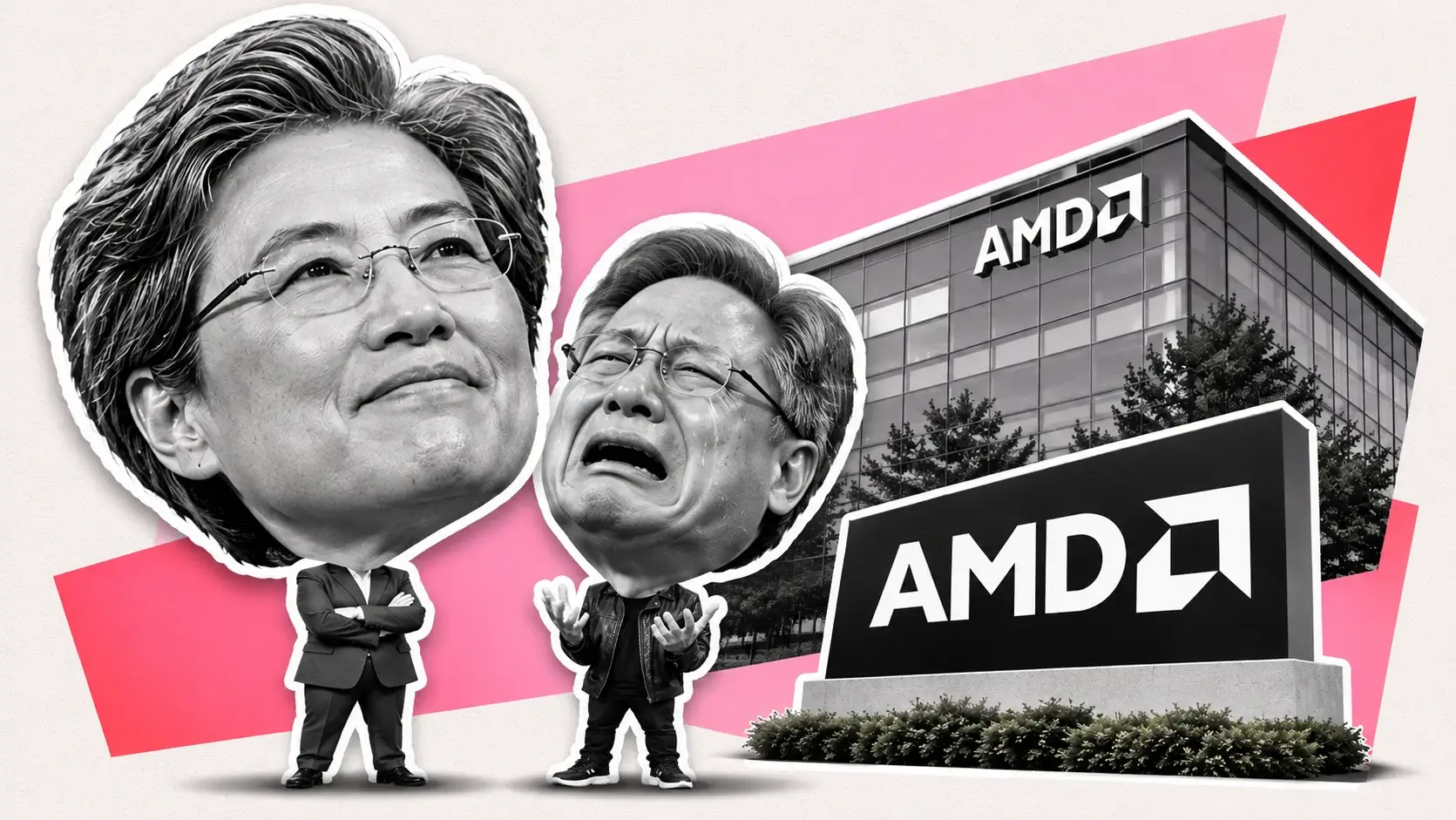
AMD ($500.16) Erases Midterm Crash While Nvidia Falls 4% — $600 Target After Record $13.38B Quarter
AMD adds $83.8B in value as data center revenue nearly doubles to $8.55B and the Q4 guide hits $17B | That's TradingNEWS
Key Points
- AMD rises 11.38% to $500.16, recovering 23.7% in two sessions from its $404.40 Nov. 5 close.
- Data center revenue rose 97% to $8.55 billion, making up 64% of AMD’s Q3 sales.
- An upgrade sets a $600 target, 20% above current levels and 8.9% below the $658.52 high.
Advanced Micro Devices traded at $500.16 at 11:22 a.m. Eastern on Monday, November 9, up $51.11, or 11.38%, from Friday’s $449.04 close. The stock opened at $473.39, dipped to $468.21 in the first minutes, then climbed steadily to a session high of $504.80. By late morning, 22.76 million shares had traded, already above AMD’s average full-day volume of 22.34 million. The move added $83.8 billion to the company’s value, which now stands at $820.3 billion.
The setting makes the rally striking. Nvidia, AMD’s main rival in AI accelerators, fell 4% on Monday after its board opened an investigation into chief executive Jensen Huang. The two largest merchant GPU suppliers moved more than 15 percentage points apart in one session. Investors are not selling the AI trade. They are moving money from the company with a leadership cloud to the company with a fresh upgrade, a new Google design win and a record quarter behind it.
The thesis of this forecast is that AMD has become the market’s preferred way to own AI compute while Nvidia carries key-person risk, and the fundamentals support that shift. AMD’s data center revenue nearly doubled to $8.55 billion in the third quarter. Management guided fourth-quarter revenue to $17 billion, 66% above a year earlier, and projected total revenue growth of more than 80% in 2027. The stock trades at 106.89 times trailing earnings, but on Q4’s annualized revenue run-rate of $68 billion it trades at 12.1 times sales.
The past week shows how violent the ride has been. AMD closed at $504.80 on October 30 after an 10.88% drop triggered by Intel’s weak outlook. It rose to $483.90 on November 3 ahead of earnings, briefly touched $523 in premarket trading on November 4 after the report, then crashed 17.3% on November 5 as Democratic midterm wins raised fears of data center construction limits. Friday’s 11.04% bounce and Monday’s 11.38% rally have lifted the stock 23.7% in two sessions, from $404.40 to $500.16.
The broader context frames the upside. AMD’s 52-week range runs from $188.22 to $658.52. At $500.16, the stock sits 24.0% below its high and 165.7% above its low. It is up 133.58% so far in 2026 and 114.20% over 12 months, against 9.88% and 11.79% for the S&P 500.
The price target that matters this week is $600, the level set in Monday’s upgrade, 20% above current levels. The line to hold is $483.90, the pre-earnings close.
Session Structure: From $468.21 to a $504.80 High
Monday’s session showed AMD building on Friday’s rebound without hesitation. The upgrade arrived at 7:29 a.m. Eastern, and AMD’s own Google announcement followed at 8:00 a.m. The stock traded up 3.2% before the bell on the upgrade alone, then extended its gains as the Google news spread and U.S. index futures climbed on falling oil prices.
The opening print at $473.39 put AMD 5.4% above Friday’s close. The first minutes brought the session low of $468.21, as early buyers took profits on Friday’s 11% gain. That dip held 4.3% above Friday’s close and never threatened the gap. From there, the stock climbed in a near-straight line. By 10:20 a.m., AMD was up 9.9%, at roughly the level of its November 4 close. By 11:22 a.m., it reached $500.16 after touching $504.80.
The session high carries a specific meaning. $504.80 is exactly where AMD closed on October 30, before the Intel-driven selloff, the earnings report and the midterm crash. Monday’s rally recovered the entire round trip of the past six sessions in one morning. The stock now sits above its November 4 post-earnings close and back above $500 for the first time since the earnings week.
Volume confirmed the move. AMD traded 22.76 million shares by 11:22 a.m., 2% above its full-day average of 22.34 million. A breakout on above-average volume in the first two hours points to institutional demand rather than retail momentum or thin short covering. On the day the stock crashed, November 5, sellers dominated on heavy volume; Monday reversed that flow.
The broader tape helped. The S&P 500 rose 1.91% to 7,517.64 and the Nasdaq Composite gained 2.35% to 25,157.80. The semiconductor complex rallied hard outside Nvidia: Micron rose 6.67% to $735.99, Taiwan Semiconductor gained 3.90% to $390.10, Intel climbed 3.84% to $58.44 and Broadcom added 5%. The VIX fell 17.58% to 21.14 as volatility from last week unwound.
AMD’s beta of 2.54 explains the size of the move. A stock that historically moves two and a half times the market will rip on a day when the Nasdaq gains more than 2% and chip stocks recover from a 12% one-day collapse. That same beta cuts both ways, as last Thursday’s 17.3% decline showed.
For the forecast, the session structure is bullish. The stock opened strong, held its early low, closed the gap to its pre-crash levels and made new highs on rising volume. The test now is whether AMD can hold above $500 into the close and through Tuesday’s U.S. inflation report.
The Round Trip: $566 to $404 to $500 in Eight Sessions
AMD’s path over the past two weeks explains why Monday’s rally matters. The stock entered the end of October near its autumn highs. It closed at $566.42 on October 29, already 14% below its 52-week high of $658.52 after a two-week pullback in AI chip names.
October 30 brought the first shock. Intel forecast lower fourth-quarter revenue and warned of a PC slowdown lasting into next year, and its stock collapsed 28.58%. AMD fell 10.88% to $504.80 on 39.7 million shares, nearly double its 30-day average. The selloff hit every major chip name: Marvell fell 10.05%, Broadcom 5.48%, Micron 5.30% and Nvidia 4.22%. AMD’s exposure to the PC market through its client business made it a direct read-through from Intel’s warning.
The earnings week started constructively. AMD rose 3.65% to $483.90 on November 3 ahead of its report. After the close, the company delivered a record quarter, and the stock jumped to $523 in premarket trading on November 4. The pop faded through the morning as the market weighed a 55% gross margin guide, one point below the third quarter. AMD traded near $493 by 10:30 a.m. and finished the session near $489.
November 5 brought the real damage. The day after the midterm elections, investors dumped chip and data center stocks on fears that Democratic victories in key states would slow AI infrastructure construction. The Nasdaq fell 5.52%, the S&P 500 lost 4.36%, and the semiconductor index dropped more than 12%. AMD fell 17.3% to $404.40, its worst session of the year. The decline wiped out roughly $145 billion of market value in a day.
The recovery started on Friday without a company-specific catalyst. AMD jumped 11.04% to $449.04 as chip stocks bounced 4.6%. Monday’s 11.38% gain added the upgrade and the Google announcement on top of that momentum.
The arithmetic of the round trip is clear. From $566.42 on October 29 to the $404.40 low on November 5, AMD lost 28.6% in five sessions. From $404.40 to $500.16, it has recovered 23.7% in two sessions, regaining 59% of the decline. The stock still needs a 13.2% gain to return to its October 29 close and a 31.7% gain to reach its 52-week high.
For the forecast, the round trip shows that the November 5 collapse was a positioning event, not a change in AMD’s fundamentals. The stock has already recovered its pre-earnings level. The remaining question is whether it can rebuild toward $566 and then $600.
The $600 Upgrade: A Durable Supplier of AI Compute
The catalyst at the open was an upgrade of AMD to outperform from perform, with a $600 price target. The target implies 34% upside from Friday’s $449.04 close and 20% from Monday’s $500.16. The analyst’s case rests on three points: AMD’s emergence as what the note called “a durable supplier of AI compute,” multi-generation customer wins and the company’s move into rack-scale AI systems.
The upgrade followed AMD’s earnings call and a private session the firm hosted with management. The note raised revenue and earnings estimates, and projected AMD’s data center revenue would grow 135% in 2027. That figure goes well beyond AMD’s own guidance for total revenue growth above 80% next year, and it reflects how fast the Helios rack platform and MI450 GPUs are expected to scale.
The timing matters. The upgrade arrived on a day when Nvidia, AMD’s main competitor in AI accelerators, faces a board investigation into its CEO and has no named successor. AMD’s leadership under chief executive Lisa Su has delivered record results for consecutive quarters. Institutional investors looking to keep AI exposure while reducing Nvidia’s concentration risk now have a fresh, positive data point pointing them to AMD.
The $600 target sits below the wider range of expectations. The average one-year analyst target across coverage stands at $658.53, which is almost exactly AMD’s 52-week high and implies 31.7% upside. The lowest target is $540, 8.0% above current levels. The highest is $1,250, which would value the company at roughly $2.05 trillion. Every published target sits above the current price.
Earlier in 2026, price targets moved up repeatedly as AMD’s AI story developed. In July, one firm raised its target from $450 to $600; others moved to $620, $640, $685 and $730. A target of $800 was published as the top of the range at that point, tied to estimates of $38 billion in GPU revenue next year. Those targets were set when AMD traded near $495, close to where it trades now. The difference is that AMD has since delivered a record third quarter and a $17 billion fourth-quarter guide.
The upgrade does not change AMD’s fundamentals on its own. Analyst moves follow results; they do not create them. But it signals that the sell side sees the November 5 collapse as a buying opportunity rather than the start of a broader de-rating. For a stock with a 2.54 beta, sentiment shifts of that kind can drive large short-term moves.
For the forecast, $600 is the first upside target. It sits 20% above current levels and 8.9% below the 52-week high.
Google’s TPU 8tx: EPYC Wins Inside a Rival’s Accelerator
The second catalyst came from AMD itself. At 8:00 a.m. Eastern, the company announced that its 5th Gen EPYC server processors power the host infrastructure for Google Cloud’s TPU 8tx, the first cloud tensor processing unit system to deliver hardware-enforced confidential computing. Alphabet unveiled the TPU 8tx and a second chip, the 8i Max, on the same day as part of its push to compete with Nvidia in AI accelerators.
The technical role is specific. In the TPU 8tx, AMD’s EPYC processors handle workload orchestration, data preparation and communication with Google’s TPU accelerators. AMD’s Secure Encrypted Virtualization technology extends confidential computing protection beyond the CPU to the connected accelerators. That keeps customer prompts, model weights and data encrypted in CPU memory and during transit between host and accelerators, with hardware isolation while the accelerator runs. The system targets inference, fine-tuning and reinforcement learning workloads.
The commercial significance is strategic rather than immediate. AMD’s release gave no revenue figure, and the company plays a supporting role inside Google’s own accelerator system rather than selling its own GPUs into the deal. But the win places EPYC at the foundation of the main custom-silicon alternative to Nvidia. Every TPU 8tx system Google deploys pulls AMD server CPUs with it.
The deal also reinforces a trend that has driven AMD’s server business. As AI workloads shift from training to inference and agentic applications, CPU demand inside AI clusters rises. Accelerators need host processors to manage data movement, scheduling and security. AMD management has said server CPU revenue will double year over year in 2027, and wins like the TPU 8tx are part of how that happens.
The confidential-computing angle carries extra weight. Enterprises with sensitive data, including banks, healthcare providers and governments, have hesitated to run their most valuable models in shared cloud infrastructure. Hardware-enforced isolation on a TPU system gives those customers a path to the cloud, and AMD’s SEV technology is the mechanism that enables it. AMD and Google have worked on confidential computing together since 2020, and the TPU 8tx extends that partnership to AI accelerators for the first time.
The competitive read is favorable for AMD. Google’s TPUs are positioned as an alternative to Nvidia’s GPUs. If Google’s custom silicon gains share, AMD benefits through EPYC host processors. If Nvidia keeps its lead, AMD still competes directly with its own Instinct GPUs. AMD wins under both outcomes.
The Q3 Print: $13.38 Billion and a 97% Data Center Surge
AMD’s third-quarter results, reported November 3, set the fundamental foundation for Monday’s rally. Revenue reached a record $13.377 billion, up 45% from $9.246 billion a year earlier and up 16% from $11.536 billion in the second quarter. The result beat consensus estimates near $13.08 billion and cleared the top of AMD’s own $12.7 billion to $13.3 billion guidance range.
Profitability rose faster than revenue. Non-GAAP earnings per share came in at $2.09, against consensus estimates between $1.95 and $1.97 and up 74% from $1.20 a year earlier. Non-GAAP gross margin reached 56%, non-GAAP operating income $3.9 billion and non-GAAP net income $3.5 billion. The non-GAAP operating margin rose to 29%. On a GAAP basis, gross margin was 54%, operating income $2.8 billion, net income $2.4 billion and diluted earnings $1.46 per share.
The data center segment is now the whole story. Data center revenue reached $8.546 billion, up 97% year over year and 27% sequentially. The segment generated $2.882 billion of operating income, up 168% from a year earlier. Data center accounted for 64% of total revenue, up from 47% a year earlier, and its growth has accelerated sequentially in every quarter of 2026. The drivers were record sales of Instinct GPUs, including the launch of the MI450 series, and EPYC server processors.
The rest of the business was mixed. Client and gaming revenue fell 8% to $3.7 billion. Client processors rose 7% to $2.9 billion, but gaming collapsed 40% to $773 million on lower semi-custom and graphics revenue. The gaming decline is the main reason total growth of 45% trails data center growth of 97%. The client business faces fresh pressure after Intel’s warning of a PC slowdown into next year.
The trailing figures show AMD’s scale. Trailing 12-month revenue stands at $45.44 billion and net income at $7.73 billion, a 16.77% profit margin. Levered free cash flow over the past year totaled $7.36 billion. Operating cash flow in the third quarter was $1.202 billion. AMD holds $15.78 billion in cash, and its debt-to-equity ratio stands at a modest 13.47%.
The weak spot in the report was the gross margin guide. AMD expects fourth-quarter non-GAAP gross margin near 55%, down one point from the third quarter, as lower-margin rack-scale Helios systems ramp. That margin step-down helped push the stock off its $523 premarket high on November 4. The market wants to see whether rack-scale revenue dilutes margins permanently or only during the ramp.
For the forecast, the Q3 print removes any doubt about demand. The question for AMD is no longer whether AI revenue will arrive. It is how fast margins expand as it does.
The Q4 Guide and 2027: $17 Billion and 80% Growth
AMD’s outlook carries more weight than its third-quarter beat. The company guided fourth-quarter revenue to approximately $17 billion, plus or minus 3%, a range of $16.49 billion to $17.51 billion. The midpoint sits $600 million to $800 million above consensus estimates of $16.2 billion to $16.4 billion. It implies 66% year-over-year growth and 27% sequential growth.
The fourth-quarter mix shows where AMD is heading. Management expects data center revenue to grow about 50% sequentially in the fourth quarter, which implies roughly $12.8 billion for the segment from $8.546 billion. For the first time, AMD’s AI GPU business is expected to exceed its server CPU business in a single quarter. Full-year 2026 data center revenue is now expected to more than double from 2025. Client CPU sales are expected to decline sequentially, offset by data center and embedded growth.
The 2027 outlook is the larger catalyst. On the earnings call, Lisa Su said she expects total company revenue to grow more than 80% in 2027. She projected server revenue to double year over year and said data center AI growth is accelerating faster than AMD had expected 90 days ago. Management now expects data center to make up more than 80% of total revenue by 2027. Su has also said AMD will “significantly exceed” its $20 annual earnings-per-share target within its strategic timeframe.
The scale of that growth is unusual for a company of AMD’s size. Applying 80% growth to a 2026 base that will land near $48 billion, based on nine months of $35.166 billion plus a $17 billion fourth quarter, implies 2027 revenue above $86 billion. That would put AMD’s revenue at roughly twice Intel’s 2026 run rate.
The products behind that forecast are Helios and Venice. Helios is AMD’s rack-scale AI system, pairing EPYC processors with MI450-series GPUs, designed to compete directly with Nvidia’s integrated rack systems. Venice is the next generation of EPYC server CPUs. AMD said on the call that it expects growth to accelerate further in the fourth quarter “as we scale Helios and ‘Venice’ production.”
The execution risk is real. A ramp of this size depends on supply chain capacity at Taiwan Semiconductor and memory suppliers, on customers deploying racks on schedule, and on power and construction approvals for the data centers that will house them. Last Thursday’s midterm selloff showed how quickly the market can price in a slowdown in that last factor.
For the forecast, the $17 billion guide and 80% growth outlook are the reason AMD’s stock can sustain a premium multiple. If the company delivers those numbers, the current valuation compresses quickly.
Read More
-
Yen Stalls at 160 Despite a 3% JGB and Tokyo Core CPI at 2.0% — Intervention Sits at 164, Friday's Payrolls Decide
02.09.2026 · TradingNEWS ArchiveEnergy
-
Oklo Eyes $30 After 38% 2-Day Rally as $3.13B Cash Pile Offsets Aurora’s 2028–2029 Startup Slip
09.11.2026 · TradingNEWS ArchiveStocks
-
XRP Heads for $1 Test After Binance Hacker Dumps 139M Tokens and ETF Inflows Stall for Four Days
09.11.2026 · TradingNEWS ArchiveCrypto
-
Brent ($93) Extends 16% Weekly Collapse as Iran Deal Heads to Trump — Physical Murban at $99 Warns of Snapback
09.11.2026 · TradingNEWS ArchiveCommodities
-
S&P 500 Hits 7,517, Nasdaq Jumps 578 Points, Dow Climbs to 52,139 as NVDA Sheds $175B
09.11.2026 · TradingNEWS ArchiveMarkets
-
Pound Rallies to 1.3423 as Bank of England Matches Fed at 4% and Eyes 4.25% in February
09.11.2026 · TradingNEWS ArchiveForex
Helios and the Gigawatt Customers
The customer list behind AMD’s 2027 outlook is the strongest it has ever been. OpenAI has committed to deploy up to 6 gigawatts of AMD Instinct GPUs, and Meta has made a separate 6-gigawatt commitment. Anthropic plans to deploy up to 2 gigawatts of MI450 GPUs in Helios racks beginning in the first half of 2027. Microsoft is installing Helios racks in its Azure cloud, and Oracle is building a 50,000-GPU Helios supercluster. Anthropic, Meta, Microsoft, OpenAI and Oracle are already running models on early Helios racks.
Gigawatt-scale commitments of this kind translate into tens of billions of dollars of potential revenue over several years. A single gigawatt of AI compute capacity typically requires hundreds of thousands of accelerators plus the CPUs, networking and memory around them. The combined 14 gigawatts of commitments from OpenAI, Meta and Anthropic alone represent a multi-year revenue pipeline that dwarfs AMD’s entire current data center business.
The MI450 ramp is running ahead of schedule. AMD’s chief financial officer said earlier this year that the MI450 ramp was progressing “better than expected” at the start of the third quarter. The product launched during the quarter and contributed to record Instinct sales. Initial Helios rack shipments began in the second half of 2026 and scale through 2027.
The customer concentration creates both opportunity and risk. Five companies account for most of AMD’s committed AI GPU demand. If any of them slows its data center build-out, whether because of capital spending discipline, political constraints on construction or a shift to custom silicon, AMD’s growth curve flattens. The midterm results added a new dimension to that risk, as several newly elected state officials campaigned on pausing data center approvals.
The commitments also tie AMD’s fate to the broader AI investment cycle. Hyperscaler capital spending is the fuel for AMD’s data center growth. Earnings this week from Cisco and Applied Materials on Thursday, November 12, and from CoreWeave during the week, will show whether that spending is holding up after the midterms. CoreWeave rose 7.07% on Monday after falling 15.4% last week, a sign that the market is regaining confidence in the build-out.
The diversity of AMD’s customer base is a relative strength. Nvidia’s largest customers overlap heavily with AMD’s, but AMD has secured commitments from AI labs, hyperscalers and enterprise cloud providers across the board. Losing one customer would hurt; losing the AI build-out would hurt everyone.
For the forecast, Helios is the single product that decides whether AMD reaches $600 and beyond. Every confirmed shipment narrows the gap between AMD’s valuation and its earnings.
Valuation: 106.9 Times Trailing, 60 Times Run-Rate, 12 Times Forward Sales
AMD’s valuation looks expensive on trailing numbers and reasonable on forward ones, which is exactly the debate behind the stock’s volatility.
On trailing earnings, AMD trades at 106.89 times its $4.68 of GAAP earnings per share over the past 12 months. That multiple is high for any company and higher than most of AMD’s semiconductor peers. Bears point to that figure as evidence that the stock prices in years of perfect execution. In October, when AMD traded above $600, its trailing multiple reached 155 times.
On the third quarter’s non-GAAP earnings, the picture improves. Annualizing Q3’s $2.09 of non-GAAP earnings per share gives a run-rate of $8.36, which puts AMD at 59.8 times run-rate earnings. That still prices in substantial growth, but it reflects the business as it stands today rather than the smaller business of a year ago.
On revenue, the shift is more dramatic. AMD trades at 18.1 times trailing 12-month revenue of $45.44 billion. Annualizing the fourth-quarter guidance midpoint of $17 billion gives a revenue run-rate of $68 billion, which puts AMD at 12.1 times forward sales. If 2027 revenue grows more than 80% to above $86 billion, the multiple drops below 10 times sales.
The earnings outlook does the heavy lifting. Analyst estimates for 2027 earnings per share have ranged from $14 to more than $20, and Lisa Su has said AMD will significantly exceed its $20 earnings target over time. At $500.16, AMD trades at 25 times a $20 earnings figure and 36 times a $14 figure. A company growing revenue 80% a year at those multiples would look cheap by historical standards for high-growth technology.
The balance sheet supports the valuation. With $15.78 billion of cash, a 13.47% debt-to-equity ratio and $7.36 billion of trailing free cash flow, AMD can fund its growth internally. It does not need to issue equity or take on significant debt to build the Helios ramp.
The risk sits in the gap between trailing and forward numbers. If AMD misses its growth targets, the stock’s trailing multiple offers no support. The 17.3% drop on November 5 showed how quickly sentiment can reverse when the AI build-out looks uncertain. A 2.54 beta guarantees that the next disappointment will also be sharp.
For the forecast, AMD is priced for its 2027 outlook. At $500.16, the stock does not need multiple expansion to reach $600; it needs earnings to arrive on schedule.
Competition: Nvidia’s Governance Cloud, Intel’s Collapse, Broadcom’s Custom Silicon
AMD’s competitive position looks stronger on Monday than it has at any point in 2026, largely because of what is happening to its rivals.
Nvidia faces its first governance crisis. Huang acknowledged in a weekend memo a relationship with a businesswoman whom U.S. intelligence reportedly believes was gathering information for China, and Nvidia’s board opened an independent investigation. The board said it has “no reason to believe” company secrets were compromised. Nvidia fell 8% at the open to $171.62 and traded near $179 by late morning, down roughly 4%. The company was worth $4.5 trillion before the news, and Huang has run it for 33 years without a named successor. Nvidia still dominates AI accelerators, but key-person risk has entered its valuation.
Nvidia reports earnings on November 17, eight days from now. Its results will set the tone for the entire AI chip sector. A strong report would lift AMD alongside it; a weak one, or any leadership change, would hit both stocks but likely hit Nvidia harder given the governance overhang.
Intel is in retreat. The company’s October 30 outlook, which forecast lower fourth-quarter revenue and a PC slowdown lasting into next year, sent its stock down 28.58% in one session. Intel traded at $58.44 on Monday, up 3.84%. Intel’s weakness is a mixed signal for AMD. It confirms AMD’s share gains in server CPUs, where Intel has lost ground for years. But it also warns that AMD’s own client business faces a softer PC market in 2027.
Broadcom represents the custom-silicon threat. Hyperscalers increasingly design their own AI chips with Broadcom’s help, as Google has done with its TPUs. Broadcom rose 5% on Monday alongside AMD. Custom silicon competes with both Nvidia and AMD for AI accelerator spending, but the Google TPU 8tx deal shows AMD can win even inside a custom-silicon design through its EPYC CPUs.
Taiwan Semiconductor is AMD’s manufacturing partner and a bottleneck. TSMC rose 3.90% to $390.10 on Monday. AMD’s ability to deliver its $17 billion fourth-quarter guide and its 2027 outlook depends on TSMC’s advanced packaging capacity. The same capacity serves Nvidia, Broadcom and Apple, and competition for it is intense.
For the forecast, AMD’s competitive moment is favorable. The company has the clearest leadership, the broadest product line across CPUs and GPUs, and a record of execution. Nvidia’s governance issue is the single biggest reason AMD can outperform the AI trade in the near term.
Sector and Macro: A 12% Chip Crash, Midterm Risk and 80% Fed Hike Odds
AMD’s stock does not trade in isolation, and the sector and macro backdrop carry real risks.
The semiconductor sector is recovering from a historic shock. On November 5, the Philadelphia Semiconductor Index fell more than 12% as investors priced in the risk that Democratic victories in Congress and in key state races would slow AI data center construction. The index rebounded 4.6% on Friday and rallied again on Monday, but it still posted its largest weekly decline since March 2025. Data center operators IREN, Applied Digital and Nebius each fell more than 14% on November 5.
The political risk is specific. Several newly elected Democratic officials campaigned on pausing data center approvals, citing rising electricity bills. A senator has called for a national moratorium on new data centers. The Texas governor-elect campaigned on a data center pause. Any slowdown in construction would delay the Helios ramp and push AMD’s revenue growth into later years.
The macro backdrop adds pressure. The Federal Reserve raised its target range to 3.75%-4.00% in September, its first hike since 2023, and futures price close to an 80% chance of another hike in December after the October payrolls report showed 165,000 new jobs. The 10-year Treasury yield stands at 4.87%. Higher rates raise the discount rate applied to future earnings, which hits high-multiple growth stocks like AMD hardest.
Tuesday’s October consumer price index is the next macro test. A hot reading would push December hike odds toward certainty and could weigh on AMD alongside other growth stocks. A soft reading, helped by Monday’s 4% drop in Brent crude to $94.21, would ease rate pressure and support the rally.
The equity backdrop is supportive for now. The S&P 500 rose 1.91% and the Nasdaq 2.35% on Monday. Gainers outnumbered losers more than 16 to 1 on U.S. movers screens. Risk appetite has returned after last week’s selloff, and AMD is one of its main beneficiaries.
One institutional headwind remains. A major global strategy desk cut U.S. equities and global technology to neutral from overweight on Monday, favoring European stocks. That kind of reallocation can weigh on large U.S. tech names for weeks, even on up days.
For the forecast, the sector and macro backdrop supports a short-term rebound but leaves AMD exposed to political and rate risk. A beta of 2.54 means the stock will feel every shift in that backdrop.
Technical Map: $504.80 Ceiling, $483.90 Floor, $600 Target
The chart frames AMD’s next move in clear levels.
Immediate resistance sits at $504.80, Monday’s session high and the October 30 close. AMD needs a daily close above that level to confirm it has fully recovered from the late-October Intel selloff. Above it, $523 marks the November 4 premarket high after earnings, the level where the post-earnings pop faded. The $538 to $566.42 zone holds the October 20 close at $538.05 and the October 29 close at $566.42. A move through $566.42 would mean AMD has recovered its entire pre-Intel position. The $600 level, the upgrade target, sits 20% above current levels. The 52-week high at $658.52 is the ultimate target, 31.7% above $500.16 and almost exactly the average analyst target of $658.53.
Support starts at $483.90, the November 3 pre-earnings close and the level the stock must hold to keep its earnings gains intact. Below that, Monday’s session low at $468.21 marks the first intraday support. Friday’s close at $449.04 represents the gap Monday opened above; a fill of that gap would signal a failed rally. The November 5 close at $404.40 is the post-crash low and the line that, if broken, would point to a deeper decline toward $400.
The pattern after the crash is constructive. AMD fell 28.6% in five sessions from October 29 to November 5, then recovered 23.7% in two. A V-shaped rebound on rising volume, backed by a fundamental catalyst, usually signals that the low is in. The stock reclaimed $500 on above-average volume within two sessions of its worst day of the year.
The volatility profile requires caution. AMD’s beta of 2.54 and its history of large moves mean intraday swings of 5% to 10% are normal. The stock has moved more than 10% in either direction on five separate days in the past two weeks: October 30, November 5, November 6, November 9 and the premarket of November 4. Any forecast built on tight levels needs room for that volatility.
The relationship with Nvidia is a new technical factor. For most of 2026, AMD and Nvidia moved together. Monday’s 15-point divergence suggests the market is starting to price them separately. If that divergence continues, AMD’s chart becomes less dependent on Nvidia’s and more dependent on its own results.
For the forecast, the levels are clear. A daily close above $504.80 opens $523 and then $566.42. A close below $483.90 would neutralize the rebound and put $449.04 back in play.
AMD Stock Price Forecast and Verdict: Bullish Above $483.90, $600 Next
The near-term forecast for AMD comes down to three scenarios, each tied to a key level and a catalyst.
The base case, which we weight most heavily, is a continuation toward $566.42 over the coming weeks, with the stock holding above $483.90 through Tuesday’s U.S. CPI report and Thursday’s Cisco and Applied Materials earnings. In this scenario, the AI capex picture holds up after the midterms, Nvidia’s governance issue keeps institutional money rotating toward AMD, and the stock rebuilds its pre-Intel position. Volatility stays high, with daily swings of 3% to 6%, but the trend points up.
The bull case adds three conditions: a soft CPI that cuts December Fed hike odds, strong capex commentary from Cisco, Applied Materials and CoreWeave this week, and a solid Nvidia report on November 17 that confirms AI demand without resolving its governance overhang. If those line up, AMD breaks $566.42 and reaches the $600 upgrade target, 20% above current levels, by the end of the year. A confirmed acceleration in Helios shipments in the fourth-quarter report, due around February 2, 2027, would put the 52-week high of $658.52 and the $658.53 average analyst target in reach, 31.7% above current levels.
The bear case is a renewed selloff in AI infrastructure stocks. A hot CPI, weak capex signals or concrete political action against data center construction would push AMD back below $483.90. A fill of Monday’s gap to $449.04 would follow, and a retest of the $404.40 post-crash low would be possible, 19.1% below current levels. A broader leadership shake-up at Nvidia that hits AI sentiment across the board would also hurt AMD in the short term.
The verdict is bullish. AMD reclaimed $500 on Monday on an 11.38% gain that erased the entire post-midterm crash, backed by an upgrade with a $600 target and a strategic win inside Google’s new TPU 8tx. The fundamentals justify the move: third-quarter revenue rose 45% to a record $13.38 billion, data center revenue nearly doubled to $8.55 billion, the fourth-quarter guide of $17 billion beat consensus by up to $800 million, and management projects more than 80% revenue growth in 2027 backed by gigawatt-scale commitments from OpenAI, Meta, Anthropic, Microsoft and Oracle. The stock trades at 12.1 times its forward revenue run-rate, a reasonable multiple for that growth. Nvidia’s governance cloud gives AMD a rare window to win institutional share in the AI trade.
The risks are concrete. A 2.54 beta, a 106.89 trailing multiple, a one-point gross margin step-down in the fourth quarter, customer concentration in five companies, and political pressure on data center construction all mean the next shock will be sharp. The 17.3% loss on November 5 is the template for what can go wrong.
The trigger to watch is a daily close above $504.80, which targets $523 and then $566.42 on the way to $600. The floor is $483.90; a close below it neutralizes the bullish bias, and a break of $449.04 would turn it bearish. AMD enters Tuesday’s CPI report as the strongest name in the AI chip complex, with the fundamentals and the timing on its side.