Stock market and Vix index with interest rates
Understanding the Impact of Interest Rates
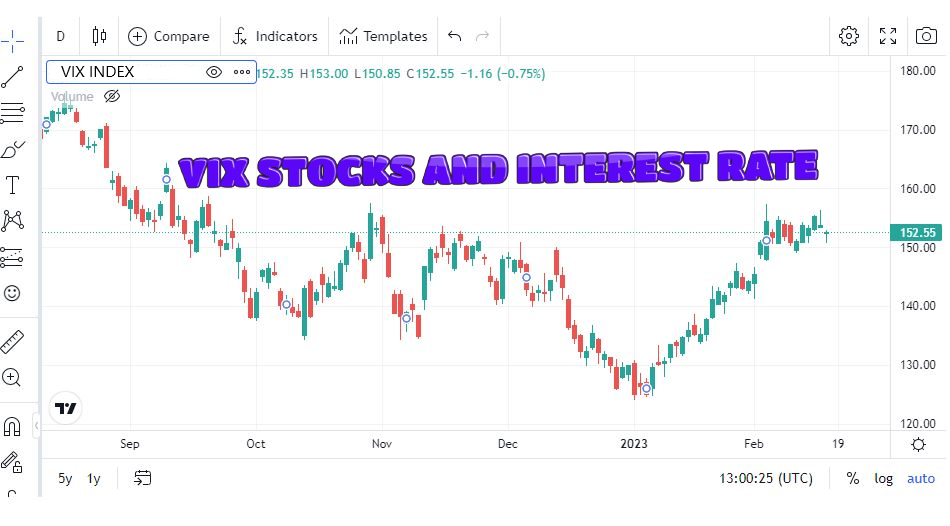
The relationship between stocks and the VIX (CBOE Volatility Index) is often inverse, meaning that when stock prices go up, the VIX tends to go down, and when stock prices go down, the VIX tends to go up. This inverse relationship is because the VIX is often used as a measure of market uncertainty or fear, and higher uncertainty or fear can cause stock prices to decline.
The VIX measures the expected volatility of the S&P 500 index over the next 30 days, and is calculated based on the prices of options contracts on the index. Options are financial derivatives that give the holder the right, but not the obligation, to buy or sell an underlying asset at a predetermined price and time.
When investors are uncertain or fearful about the future direction of the stock market, they may buy options contracts as a way to hedge their portfolios or to speculate on market movements. This can increase the demand for options contracts and drive up their prices, which in turn increases the value of the VIX.
Conversely, when investors are more confident in the market's direction, they may be less likely to buy options contracts, which can decrease the demand for these contracts and drive down their prices, thereby reducing the value of the VIX.
How today's interest rate can impact the Vix index
Impact on borrowing costs: When interest rates rise, it can increase borrowing costs for companies, which can lead to a decrease in their profits and growth potential. This can increase market uncertainty, which can in turn lead to an increase in the VIX index as investors may be more likely to buy options contracts as a way to hedge against potential market volatility.
Impact on inflation expectations: Interest rates are often increased by central banks to combat inflation. Higher inflation expectations can lead to increased uncertainty in the market and a corresponding increase in the VIX index.
Impact on economic growth: Higher interest rates can sometimes slow economic growth, which can increase market uncertainty and lead to an increase in the VIX index.
Impact on investor sentiment: Changes in interest rates can also impact investor sentiment, which can in turn impact the VIX index. For example, if investors believe that higher interest rates may slow economic growth, this may lead to increased uncertainty and a corresponding increase in the VIX index.
How Today's interest rate can impact the Stock market
Cost of capital: Interest rates impact the cost of capital for companies, which can affect their profits and growth potential. When interest rates are low, it's cheaper for companies to borrow money to invest in their business, which can help spur economic growth and boost stock prices. However, when interest rates rise, the cost of borrowing goes up, which can reduce profits and growth potential and put downward pressure on stock prices.
Inflation expectations: Interest rates are often raised to combat inflation. When interest rates are increased, it can slow economic growth and reduce inflation expectations, which can lead to a decrease in stock prices. Conversely, when interest rates are decreased, it can increase economic growth and inflation expectations, which can lead to a corresponding increase in stock prices.
Attractiveness of other investments: When interest rates are low, investors may be more likely to invest in the stock market as an alternative to lower-yielding investments like bonds or savings accounts. When interest rates rise, however, these other investments become more attractive, which can lead to a decrease in stock prices as investors shift their money to other investments.
Consumer spending: Interest rates can also impact consumer spending. When interest rates are low, it's cheaper for consumers to borrow money to finance big-ticket purchases like cars or homes, which can stimulate consumer spending and economic growth. Conversely, when interest rates rise, it can make these purchases more expensive and reduce consumer spending, which can negatively impact the stock market.
Read More
-
Yen Stalls at 160 Despite a 3% JGB and Tokyo Core CPI at 2.0% — Intervention Sits at 164, Friday's Payrolls Decide
02.09.2026 · TradingNEWS ArchiveEnergy
-
Microsoft Rebounds From $491 Low as $678B Backlog and Positive Free Cash Flow Shield It From 5.15% Yields
24.09.2026 · TradingNEWS ArchiveStocks
-
XRP Slides to $1.50 After $1.66 Peak as Escrow Supply Meets $20M Daily ETF Bid, With $1.70 in Reach
24.09.2026 · TradingNEWS ArchiveCrypto
-
Brent Retakes $105 From $98 Low as Houthis Hold Bab al-Mandab and Hormuz Runs at Half Capacity, WTI at $93.96
24.09.2026 · TradingNEWS ArchiveCommodities
-
Nasdaq Falls to 26,804, S&P 500 Drops to 7,688, Dow Sheds 191 Points as Oracle Tumbles 7% on Project Jupiter Notice
24.09.2026 · TradingNEWS ArchiveMarkets
-
Euro Sinks to 1.1380 on 125–150bp ECB-Fed Rate Gap as RSI Hits Oversold 25.47
24.09.2026 · TradingNEWS ArchiveForex