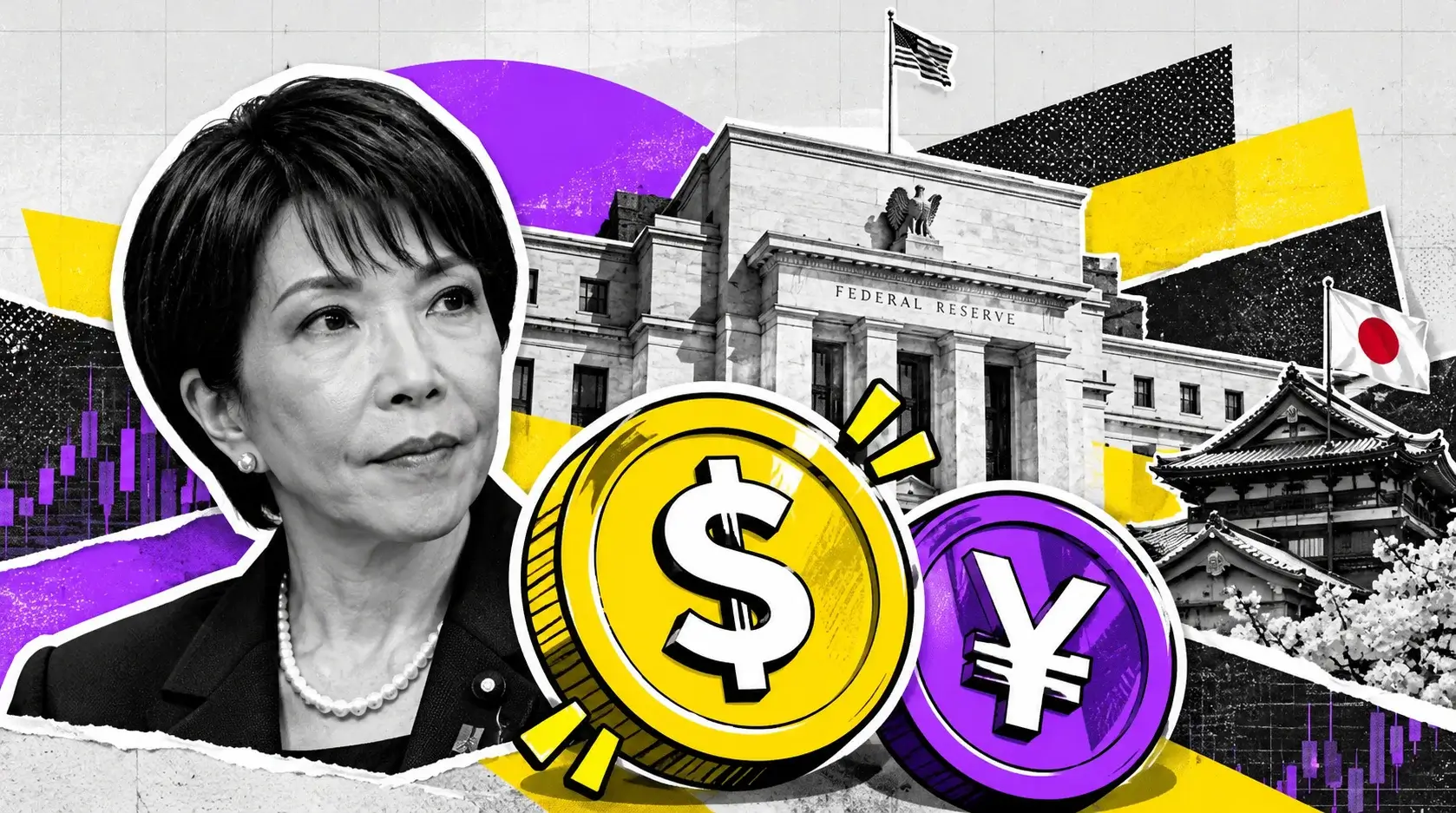
USD/JPY Price Forecast: Bearish Reversal at 160.45 After Triple Intervention Warning From Mimura
10-Year JGB Yields Rise to 2.35%, Tokyo CPI Slides to 1.7%, and Fiscal Year-End Capital Flows Muddy the Signal — Key Support at 158.40, Intervention Risk Above 160.00 Key Point 1: USD/JPY printed a bearish key reversal at 160.45 after Japan's top three officials simultaneously warned of intervention — April BoJ hike probability jumped to 82% from 68% in a single session. Key Point 2: Tokyo CPI slid to 1.7% — its lowest since April 2024 — while JGB 10-year yields rose to 2.35%, narrowing the rate differential with the U.S. and providing structural yen support. Key Point 3: Short rallies toward 160.00-160.30 targeting 158.40 — a break below 157.75 confirms a trend reversal, while a break above 160.50 invalidates the bearish setup | That's TradingNEWS
Key Points
- USD/JPY reversed at 160.45 after Japan's top three officials warned of intervention simultaneously, pushing April BoJ hike probability to 82%.
- Tokyo CPI fell to 1.7% while JGB 10-year yields rose to 2.35%, narrowing the U.S.-Japan rate differential and supporting the yen.
- Short toward 160.00-160.30, target 158.40 — break below 157.75 confirms trend reversal, break above 160.50 invalidates the short.
USD/JPY printed a clean bearish key reversal on Monday — opening above Friday's close, setting a new high at 160.45, then closing beneath Friday's open after trading below Friday's low — one of the most unambiguous single-session reversal signals available on a daily chart. By Tuesday the pair was trading near 158.94-159.70, down approximately 0.7%-0.8% from Monday's peak, as the yen absorbed a simultaneous triple dose of hawkish commentary from Japan's three most powerful financial policymakers in a single trading session. The broader uptrend established from the February low of 152.25 remains technically intact — the pair sits well above its 200-day EMA, and the RSI at approximately 59 stays in positive territory without generating overbought readings. But the reversal candle combined with the policy rhetoric has introduced the first credible near-term downside scenario since the current uptrend began.
The timing creates a specific analytical challenge: the reversal arrived on March 30, one trading day before Japan's fiscal year-end on March 31. Fiscal year-end flows distort directional signals in yen pairs every year — Japanese corporations and institutional managers repatriate overseas profits, insurers rebalance currency-hedged portfolios, and pension funds execute year-end asset allocation adjustments. Whether Monday's reversal reflects genuine directional change or fiscal year-end technical noise is the central question that only follow-through price action in April can answer definitively.
The Triple Intervention Warning: Mimura, Katayama, and Ueda All Speak in One Session
Japan deployed all three of its top financial voices within a single trading session — a coordination that markets do not miss and should not dismiss. Atsushi Mimura, Japan's Vice Finance Minister for International Affairs and the official who actually executes FX intervention, fired first. He warned authorities may need to take "decisive measures" if speculative moves persist, specifically calling out increased activity in both FX and crude oil markets. The phrase "decisive measures" is the specific terminology that Mimura's predecessors used as the final step before pulling the trigger on intervention. This was the first time Mimura has used the phrase in his current role — and that distinction matters because it signals the escalation ladder has moved to its penultimate rung.
Finance Minister Satsuki Katayama reinforced Mimura's message by telling G7 counterparts that Japan is watching markets with a "very high sense of urgency." She did not confirm that Japan has received a green light from partners to intervene, but the public framing of "very high sense of urgency" at a G7 forum is a deliberate political signal — she is establishing the diplomatic record that Japan communicated its concerns to allies before acting unilaterally.
BoJ Governor Kazuo Ueda added the third dimension. He explicitly linked yen weakness to monetary policy — stating the bank will "closely monitor FX moves given their impact on growth and inflation" — and kept the door open to rate hikes. The BoJ paper released alongside his remarks flagged that yen weakness and higher oil prices may now feed more persistently into underlying inflation than historically, specifically because firms are more willing to pass on costs to customers. That observation is structurally significant: it transforms yen weakness from a policy-neutral variable into an active inflation driver that the BoJ cannot continue to ignore.
Markets reacted with precision. April BoJ rate hike pricing jumped from approximately 68% before Ueda's remarks to 82% immediately after. That 14 percentage point repricing in a single session represents a significant shift in the interest rate differential calculus that has been the primary structural driver of yen weakness since late 2025.
Tokyo CPI at 1.7% — The Complication That Cuts Both Ways
The soft Tokyo CPI reading for March — coming in at 1.7%, the lowest since April 2024 — creates a genuine analytical tension with the intervention narrative. Tokyo CPI is the leading indicator for national inflation trends in Japan. A 1.7% reading is below the BoJ's 2% target, below where the central bank wants to be before committing to sustained rate normalization, and below what the hawkish narrative of three rate hikes priced by markets implies.
If Tokyo CPI is softening to 1.7% while oil prices are surging and the yen is depreciating — two factors that should be pushing import prices sharply higher — it suggests domestic demand remains weak enough to absorb the cost-push inflation without generating the wage-price spiral that justifies aggressive tightening. BoJ Governor Ueda acknowledged this directly: the central bank must ensure that "rising inflation expectations do not lead to an uncontrollable acceleration in core inflation." That framing reveals the BoJ's primary concern is not current inflation — it is the risk that current conditions create a future inflation acceleration that becomes self-reinforcing.
For USD/JPY traders, the Tokyo CPI at 1.7% provides the BoJ with argumentative cover to remain patient while simultaneously maintaining the verbal intervention toolkit. The central bank can warn about currency weakness and rate hike optionality without committing to a specific tightening timeline — a posture that keeps speculative yen shorts uncomfortable without definitively resolving the rate differential that caused them to build those positions in the first place.
The 10-year Japanese Government Bond yield at 2.35% is the most concrete expression of the market's reassessment of BoJ policy. JGB yields have moved in a "consistent upward trend" according to the technical analysis of the yield curve — and a 10-year yield at 2.35% meaningfully narrows the interest rate differential between Japan and the United States (where the 10-year Treasury sits near 4.33%) compared to what it was when the yen was trading near 145-150. The differential has compressed from approximately 290 basis points at the yen's weakest points to roughly 198 basis points at current yield levels. That compression is real and is a fundamental support for yen recovery, even if it has not yet been sufficient to definitively reverse the trend.
The Stagflation Trap: 90% Energy Import Dependency and the BoJ's Impossible Position
Japan imports approximately 90% of its energy from the Middle East. That single statistic explains why the Iran war has been simultaneously bullish and bearish for the yen — bullish because higher oil prices eventually force the BoJ's hand on rates, bearish because the immediate impact is to worsen Japan's terms of trade, widen the current account, and amplify the inflationary cost of yen weakness. The yen cannot easily function as a safe haven in a crisis driven by Middle East energy supply disruption when Japan is the world's most exposed major economy to that same disruption.
Eurizon Capital has flagged that declining global equity markets will prompt Japanese institutional investors to repatriate capital to Japan — a potential tailwind for the yen that operates independently of BoJ policy. Japanese insurance companies and pension funds hold enormous overseas equity and bond portfolios, and as those portfolios decline in value during the current risk-off environment, the rebalancing mechanics create natural yen buying. That capital repatriation dynamic is part of what makes fiscal year-end flows relevant — Q1 end and Japanese fiscal year-end combine to create a specific window where yen buying from repatriation is elevated.
However, repatriation flows are not guaranteed, and the capital does not only return to Japan — it can flow to alternative safe havens like gold or Bitcoin. Gold (XAU/USD) has rallied back toward $4,650 on Tuesday as Iran peace hopes emerged. Bitcoin sits near $67,000-$68,000. Both attract some of the capital that would otherwise support the yen, and the competition among safe-haven assets limits how much the repatriation argument can move USD/JPY directionally.
The 160.00 Level: Historical Intervention Threshold Meets Technical Resistance
The 160.00 level is not merely a round number — it is an actively managed policy threshold with documented historical precedent. When USD/JPY approached and crossed 152.00 in 2022, Japanese authorities intervened for the first time in 24 years. When it surpassed 160 in July 2024, the Ministry of Finance executed a second intervention round. The pair is now testing that same zone for the third time, and the verbal intervention campaign being waged by Mimura, Katayama, and Ueda simultaneously is the clearest possible signal that 160.00 remains within the active management zone.
The technical picture at 160.00 is equally significant. Monday's high of 160.45 was a clean break of the 2026 high before the reversal printed. The price action — open above Friday's close, new high, close below Friday's open after trading through Friday's low — is the textbook definition of a bearish key reversal or engulfing pattern that signals the prior uptrend's momentum has been exhausted at least temporarily. The MACD is flattening around the zero line after losing upside traction, and RSI divergence from price is visible with the oscillator setting lower highs while price set higher highs — a bearish divergence signal that complements the reversal candle.
The critical test is whether the reversal produces follow-through. In July 2024, when actual intervention occurred at the 160 level, USD/JPY fell from 162 to below 142 within two months — a move of nearly 20 big figures. That precedent is what creates the asymmetric risk profile near 160: potential downside of 10-20 big figures if intervention materializes, with limited additional upside of perhaps 2-3 big figures before policymakers reach their absolute tolerance limit.
Key Technical Levels: The Complete Map From 157.75 to 162.00
The technical map for USD/JPY is precise and well-defined by the recent price action. On the downside: 159.50 is the immediate battleground — a level the pair has tested repeatedly over the past week and only crossed sustainably once. Below 159.50, the 159.00 round number provides the next psychological support. At 158.40-158.50, the pair finds a deeper floor that has "guarded prior pullbacks" — this is the zone where dip buyers have repeatedly entered. Below 158.40, the next support sits at 157.75-157.80, a level aligned with significant recent price history and one whose breach would create the "lower low" that structurally confirms the trend has shifted. Further below, 157.70 is the next downside level after 158.40 fails.
On the upside: 160.00 is the immediate psychological ceiling. Above it, 160.30 is the most recent swing high that needs to be cleared for bulls to regain momentum. A move above 160.45 — Monday's session high — would require dismissing both the reversal signal and the intervention threat simultaneously, which demands either genuine peace progress that reduces safe-haven yen demand or a hard U.S. economic data beat that forces dollar bulls back into the market. Above 160.45, the 161.00 level provides a target, and above that the 2024 high of 161.95-162.00 represents the zone where a sustained break would genuinely challenge the intervention ceiling. Most analysts expect Japanese authorities would act decisively before the pair reaches 162.00 in the current environment.
The Dollar's Specific Position: JOLTS, NFP, and the Fed's Dual Mandate
The U.S. side of USD/JPY is not static. The dollar's strength has been one of the pair's primary drivers throughout the Iran war period — DXY climbed to ten-month highs near 100.63 as safe-haven demand and rate-differential advantages combined. But Tuesday's modest dollar softness — triggered by Trump's Iran ceasefire signal — demonstrates the dollar's sensitivity to any de-escalation narrative. ING's characterization remains accurate: "Barring any clear, conciliatory messages from the Iranian side, it is hard to see the dollar handing back this month's gains anytime soon." Iran's president later signaled willingness to end the war — which prompted a sharper dollar pullback and a corresponding yen recovery.
The JOLTS data released Tuesday came in at 6.882 million job openings for February, below the 6.920 million consensus and significantly below the prior 7.240 million. Hiring fell to 4.85 million — a collapse of nearly half a million from January and the lowest hiring rate since April 2020. Fed Chair Powell characterized policy as "in a good place to wait and see," while New York Fed President John Williams described the labor market as "sending mixed signals." Those characterizations — cautious but not alarmed — are consistent with a Fed that is frozen rather than pivoting, which keeps the rate differential advantage with Japan intact in the near term but removes the catalyst of additional U.S. rate hikes that would strengthen the dollar further.
Friday's nonfarm payrolls report — with consensus projecting approximately 55,000 jobs added and unemployment holding at 4.4% — will be the week's most important U.S. data point for USD/JPY. The February payrolls surprised to the downside at -92,000. A second consecutive negative or near-zero print would force a genuine reconsideration of the dollar's rate advantage and could generate the sustained follow-through on the reversal signal that currently carries an asterisk due to fiscal year-end distortion.
Read More
-
Yen Stalls at 160 Despite a 3% JGB and Tokyo Core CPI at 2.0% — Intervention Sits at 164, Friday's Payrolls Decide
02.09.2026 · TradingNEWS ArchiveEnergy
-
QQQ ETF ($706.22) Slides 7.4% Below Its High as the Market Reprices the AI Capex Bill — $686.57 Target if $700 Breaks
22.10.2026 · TradingNEWS ArchiveStocks
-
XRPI ($7.00) and XRPR ($10.74) Slide Toward 52-Week Lows as Spot XRP ETF Flows Stall at $708,510
22.10.2026 · TradingNEWS ArchiveCrypto
-
NG ($2.775) Decoupled From Europe’s €88 Gas Crisis as LNG Feedgas Hits 18.9 Bcf/d — $3.30 Upside on Cold Weather
22.10.2026 · TradingNEWS ArchiveCommodities
-
Dollar-Yen (157.35) Loses 157.65 as the Yen Rallies on Haven Demand — 155 Target if 156 Breaks
22.10.2026 · TradingNEWS ArchiveForex
GBP/JPY and EUR/JPY: The Cross Rates Confirming the Yen Trend Shift
The yen's Tuesday recovery was not isolated to USD/JPY — it was visible across all yen crosses, confirming that the driver is yen-specific rather than a reflection of dollar weakness alone. GBP/JPY fell through its 50-day moving average and is now testing the long-term ascending trendline that has been established since the Liberation Day tariff lows in April 2025. Having failed to break above resistance at 213.34 earlier in March, the pair has now seen a "sizeable bearish unwind" that took it through the 50dma with RSI flipping below 50 and MACD crossing the signal line from above. If the Liberation Day trendline breaks cleanly, 209.50 and 207.35 are the downside targets.
EUR/JPY printed a bearish engulfing candle on the daily chart after struggling to even test the late February high of 184.80 — a sequence of lower highs that signals the spectacular bull run over the past year is losing momentum. The 100-day moving average held as support on Monday after being tested. Below the 100dma, minor uptrend support from the February lows and horizontal support at 182.00 are the next levels. If those three support zones fail, 180.82 and 180.00 become targets for shorts. The RSI and MACD on EUR/JPY are sitting "around neutral levels without delivering a definitive momentum signal" — which means the trend is cooling rather than reversing decisively, and the 50dma and 184.80 overhead remain the levels to reclaim for bulls to reassert control.
The convergent weakness across USD/JPY, GBP/JPY, and EUR/JPY on the same session is the strongest confirmation available that the intervention rhetoric is being taken seriously across the market rather than dismissed as routine verbal posturing.
Capital Repatriation and the Structural Yen Support That Persists Through Q2
Beyond the immediate intervention narrative, the structural argument for yen appreciation into Q2 2026 rests on capital repatriation mechanics. Japanese institutional investors — the world's largest pool of overseas bond and equity holdings — reallocate at fiscal year-end and the beginning of the new financial year. The total overseas assets held by Japanese life insurers and pension funds represent trillions of dollars in currency-exposed positions that require periodic rebalancing. When global equity markets are declining — as they were through March, with the S&P 500 down 7.8% for the month — the natural rebalancing trade reduces overseas equity exposure and repatriates capital to Japan, which is mechanically yen-bullish.
Additionally, Japanese corporations with overseas profits need to convert foreign currency earnings into yen for fiscal year-end financial reporting. The yen buying from corporate repatriation is concentrated in the weeks surrounding March 31 — precisely when the current yen strengthening episode is occurring. Whether the move persists into April depends on whether the underlying fundamentals — primarily the BoJ's rate path and the dollar's inflation-driven strength — shift meaningfully.
The LiteFinance analysis explicitly names the $159-$158.50 zone as "pullback support levels" suitable for long positioning — meaning even the analysts noting yen strength are treating this as a buy-the-dip scenario in a broader uptrend rather than a trend reversal. That framing matters: the bears are not yet convinced the trend has definitively shifted, and they are right to be cautious given the broader structural dollarpositive environment.
The Verdict: Near-Term Neutral Leaning Bearish for USD/JPY, Medium-Term Still Dollar-Favorable
USD/JPY is a neutral-to-short position in the near term, with the primary short entry on any failed recovery toward 160.00-160.30. The intervention risk at 160.45 and above creates an asymmetric downside scenario that makes buying the pair above 159.50 extremely poor risk-reward — you are buying against active government opposition with a documented precedent for 15-20 big figure interventions in this exact price zone.
The near-term tactical framework: short on any rally toward 159.70-160.00 that shows signs of rejection, with a stop above 160.50 (above Monday's high and the intervention trigger zone), targeting 158.40 as the first objective and 157.75-157.80 as the secondary target. A confirmed daily close below 158.40 creates the lower low that shifts the structural bias from neutral to bearish and opens 157.00 and below.
The medium-term picture through Q2 2026 remains dollar-favorable on fundamentals. The Fed is frozen at 3.5%-3.75% with no cuts before H2 2026 at the earliest. Japan's BoJ, despite hawkish rhetoric, has Tokyo CPI at 1.7% and economic growth concerns from the energy shock that counsel against aggressive tightening. The rate differential at approximately 198 basis points (10-year basis) and approximately 275 basis points (overnight rate basis) structurally favors dollar holdings. Without a credible BoJ rate hike timeline extending beyond one or two quarter-point moves, the medium-term gravity for USD/JPY remains toward the upper range.
The catalyst that would change the medium-term outlook decisively: a BoJ rate hike at the April 30 meeting (currently 82% priced) combined with a materially soft U.S. NFP on Friday, combined with continued Iran ceasefire progress that reduces dollar safe-haven demand. That triple-catalyst scenario could take USD/JPY toward 155-157 in April. The more likely single-catalyst scenario — BoJ hikes without NFP deterioration — produces a move to 157.75-158.50 that gets bought again by carry traders and dollar bulls. Watch 157.75 as the line between a normal correction and a genuine trend reversal.